Paper 2 Measurement Answers
Question 1: Units, prefixes and homogeneity [10]
(a) : [1]; : [1].
(b)
Correct substitution of units [1]; correct simplification [1].
(c) has unit [1]; is dimensionless, so the right-hand side has unit , matching [1].
(d) Dimensional analysis cannot detect a wrong dimensionless numerical factor [1] or whether the physical model/assumptions are appropriate [1].
(e)
Correct conversion [1]; correct standard form with sensible significant figures [1].
Question 2: Uncertainty in a derived quantity [12]
(a)
Method [1]; value/unit [1].
(b)
Method [1]; value/unit [1].
(c)
Product-rule use [1]; all three percentage terms [1]; correct result [1].
(d) For , percentage uncertainties add:
Mass uncertainty included [1]; correct total percentage [1]; absolute uncertainty [1].
(e)
or with consistent rounding. Value and uncertainty consistent [1]; unit included [1].
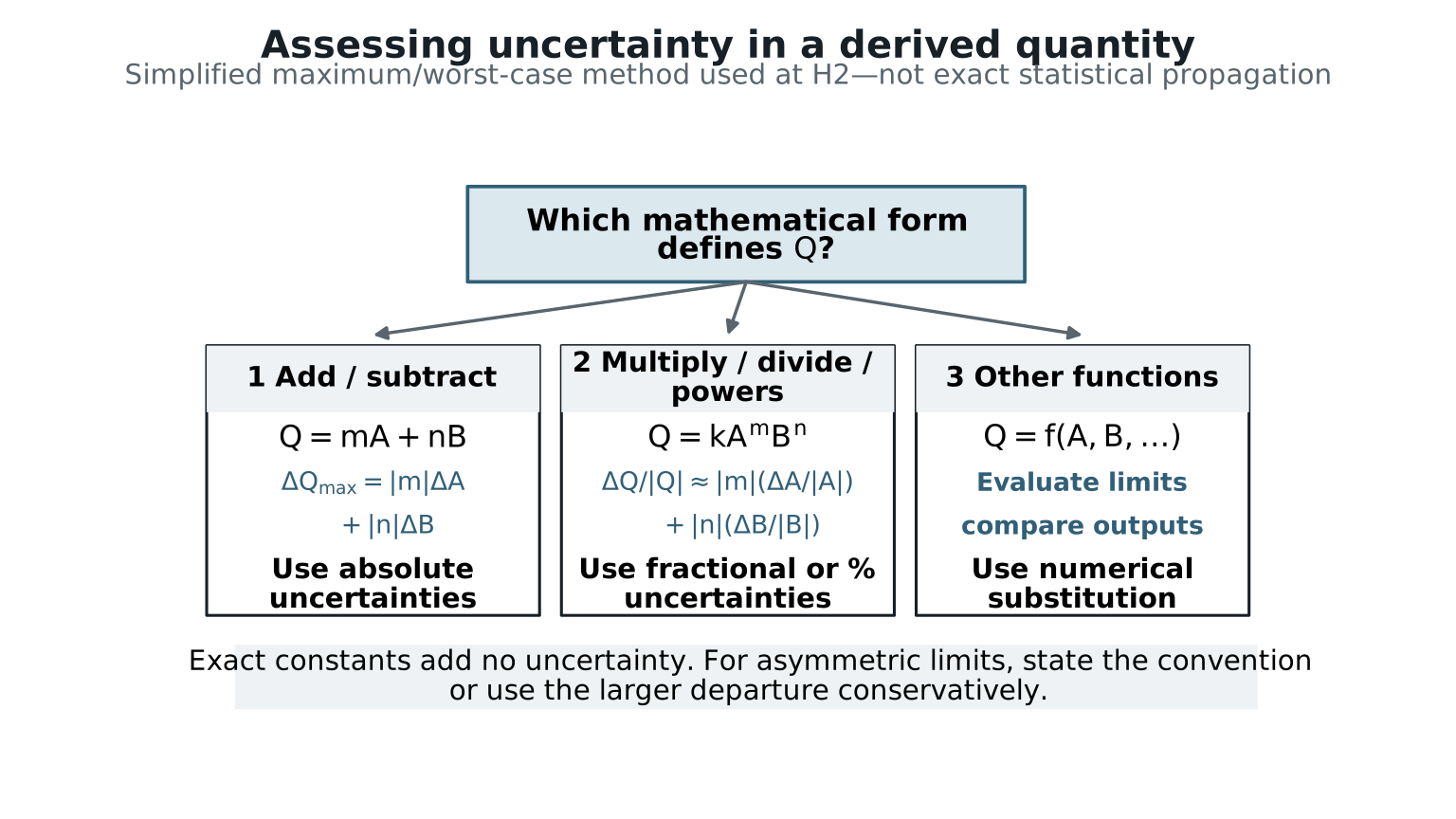
Figure: The density calculation uses multiplication/division, so fractional or percentage uncertainties are added. The exact constants in the rectangular-volume expression do not contribute additional uncertainty.
Question 3: Vector addition and data presentation [11]
(a) Displacement has magnitude and direction [1].
(b)
Pythagoras [1]; value/unit [1].
(c)
Correct ratio [1]; direction north of east [1].
(d) Components after the westward motion:
East component [1]; north component [1].
(e) Distance is the scalar path length travelled [1], while displacement is the vector change from start to finish and depends only on final position relative to start [1].
(f) Any two: arrows drawn head-to-tail; clear scale or stated not-to-scale; directions labelled; resultant drawn from start to final position; components/axes labelled [2].
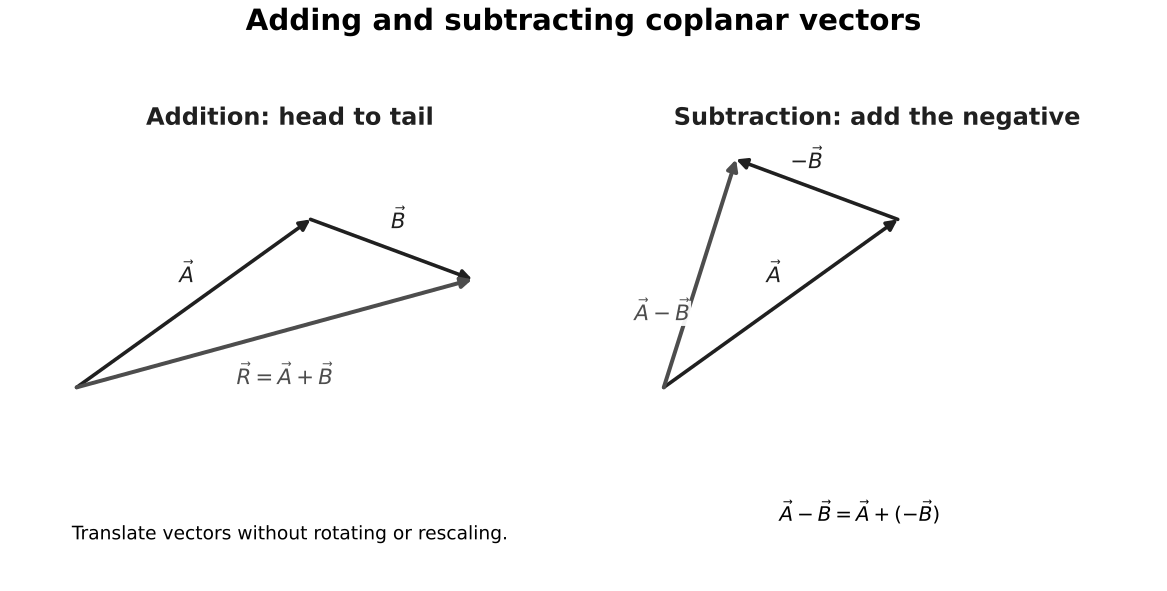
Figure: A clear vector diagram places displacement vectors head-to-tail and draws the resultant from the first tail to the final head. This is why the final displacement is not obtained by simply adding path lengths.