Paper 3 Measurement Drills
Topic-local longer structured practice calibrated to recurring Paper 3 chains of modelling, calculation and interpretation. This is a topic practice set, not a complete Paper 3.
Question 1: Measurement model, transformation and graph analysis [15]
A student measures the period of a simple oscillator for different values of a length . Theory suggests that
where is a constant.
The student obtains the following results.
| 0.250 | 0.350 | 0.450 | 0.550 | 0.650 | |
|---|---|---|---|---|---|
| 1.00 | 1.19 | 1.34 | 1.48 | 1.61 |
(a) Explain why a graph of against provides a direct test of the proposed model. [2]
(b) Complete a derived row for , quoting values to a sensible number of significant figures. [3]
(c) Plot against on the grid below and draw a straight line of best fit. [4]
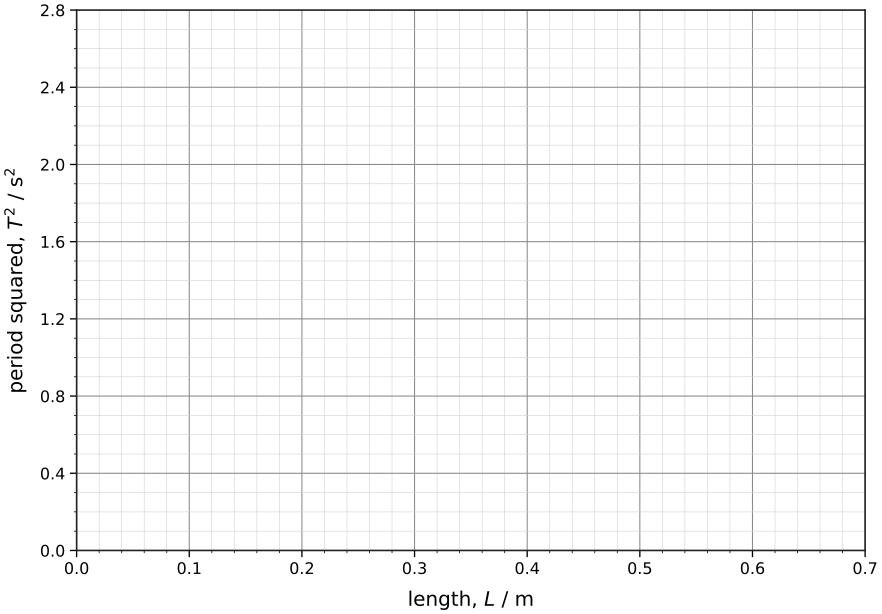
Use a scale that spreads the data across most of the grid. Plot crosses clearly; do not join adjacent points dot-to-dot.
(d) Use a large triangle on your best-fit line to determine . State its unit. [3]
(e) The time for 10 oscillations was measured and divided by 10 to obtain each . Explain why this method reduces the percentage uncertainty in . [2]
(f) State one experimental feature, other than random scatter, that could cause the best-fit line not to pass through the origin. [1]
Question 2: Longer structured vector investigation [20]
A drone is displaced by two horizontal control pulses. The first pulse gives a displacement of due east. The second gives a displacement of at north of east.
The magnitude of the second displacement is measured with uncertainty and the angle is measured with uncertainty .
(a) Resolve the second displacement into east and north components. [3]
(b) Determine the resultant displacement components after the two pulses. [2]
(c) Calculate the magnitude and direction of the resultant displacement. [4]
(d) Explain why vector addition cannot be replaced by adding the two displacement magnitudes in this situation. [2]
(e) Estimate the percentage uncertainty in the magnitude of the second displacement. [2]
(f) Suggest why angle uncertainty can affect both the east and north components even though the displacement magnitude is unchanged. [3]
(g) Describe how a clear scale drawing could be used to check the calculated resultant. [3]
(h) State one limitation of using a scale drawing as the final method instead of calculation. [1]
This 20-mark topic-local question reproduces the length of a Paper 3 optional question, but it is not intended to reproduce the breadth of a complete official Section B problem.