Paper 4 Measurement Practical-Style Drills
Topic-local practical/data-analysis practice. These questions are original and should be checked against the answer file.
Question 1: Spring data, graph and gradient [22]
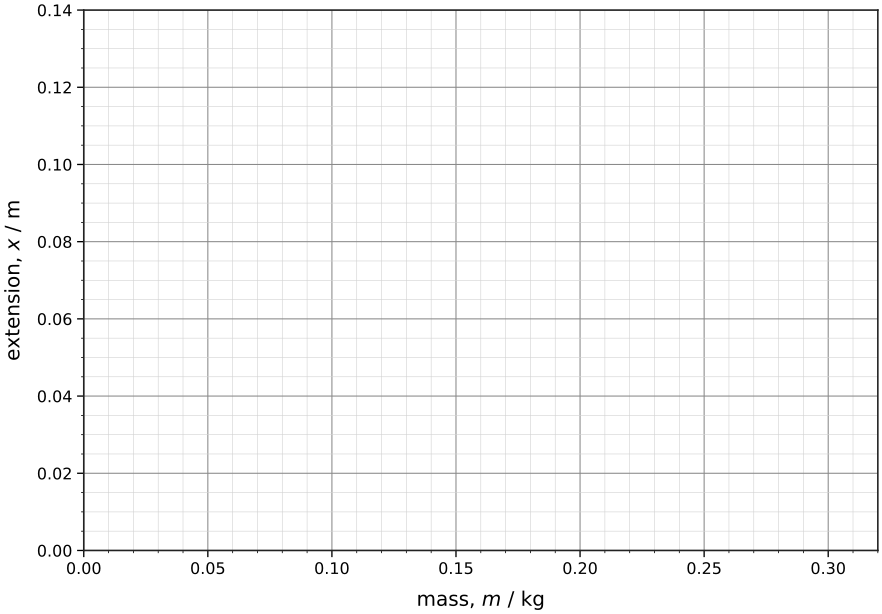
A student investigates a light spring. Different masses are suspended from the spring and the extension is measured after the load has come to rest. The spring is not stretched beyond its elastic limit. The results are shown below.
| 0.050 | 0.100 | 0.150 | 0.200 | 0.250 | 0.300 | |
|---|---|---|---|---|---|---|
| 0.020 | 0.039 | 0.061 | 0.080 | 0.100 | 0.121 |
For loads within the elastic limit, the model is
where is the spring constant and .
(a) State the independent variable and dependent variable in this investigation. [2]
(b) State two features of the table headings that make the data presentation clear. [2]
(c) Plot against on the grid below and draw a straight line of best fit. [5]
(d) Use a large triangle on your best-fit line to determine the gradient. State its unit. [3]
(e) Use your gradient to determine . [2]
(f) State what a significant non-zero intercept could suggest in this experiment. [2]
(g) Identify one source of random uncertainty and one possible systematic error in measuring . For each, explain its effect. [4]
(h) Suggest one improvement that would reduce uncertainty in the gradient. [2]
Question 2: Planning a diameter and density measurement [20]
A student is asked to determine the density of a long thin metal wire. The wire is approximately cylindrical. The available apparatus includes a metre rule, micrometer screw gauge, balance, retort stand, adhesive tape and scissors.
(a) State the quantities that must be measured to determine the density. [3]
(b) Write an equation for the density in terms of the measured quantities. [3]
(c) Describe how the diameter should be measured to reduce random uncertainty. [4]
(d) Explain why a micrometer screw gauge is more suitable than a metre rule for measuring the diameter. [2]
(e) State how a zero error in the micrometer would affect the result if it is not corrected. [2]
(f) Describe how to record the raw measurements in a clear table. [3]
(g) State one safety precaution for this experiment. [1]
(h) State two checks on the final answer that would help identify a calculation or unit error. [2]