Paper 4 Kinematics Answers
Q1 Timing a trolley on a runway
- Since , is proportional to if is constant. The gradient of against is , so the ideal graph passes through the origin. [2]
- Suitable processed values:
| 0.120 | 0.200 | 0.300 | 0.420 | 0.560 | 0.720 | |
|---|---|---|---|---|---|---|
| 0.240 | 0.399 | 0.601 | 0.839 | 1.119 | 1.435 |
Award marks for correct squaring, sensible significant figures and units in the heading. [3] 3. Award axes/units [1], sensible scales using at least half the grid [1], accurate plots [2], and one straight best-fit line [1].
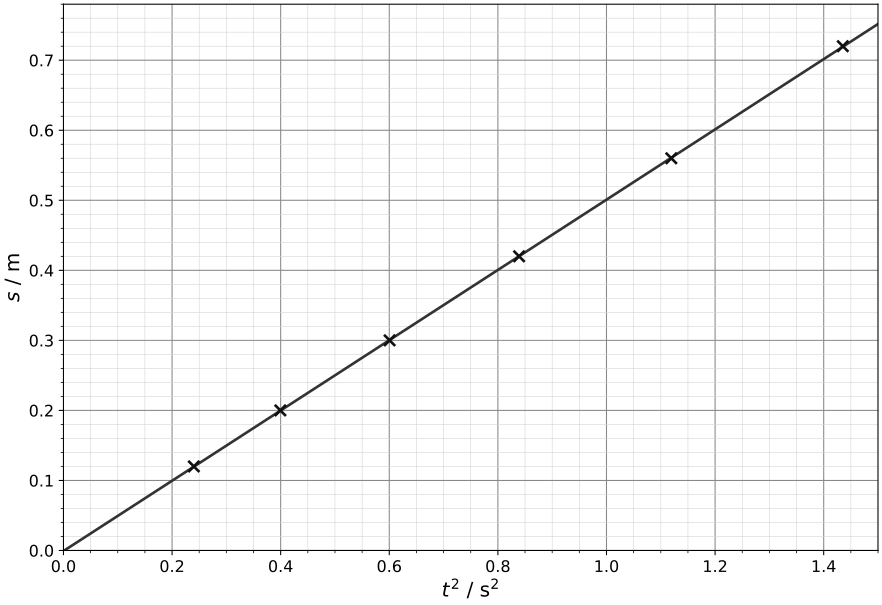
- Use a large triangle on the candidate’s best-fit line [1]. A suitable gradient is about [1], so [1]. Apply follow-through from the candidate’s line.
- Possible precautions: keep the runway angle fixed; use a repeatable electronic release without a push; align the light gate perpendicular to the track; repeat each timing and average; measure from consistent reference marks. [2]
- Possible reasons: release/timer trigger delay; distance zero offset; the trolley not starting exactly from rest; friction causing acceleration to vary. Award a specific cause and its connection to the intercept/model. [2]
Q2 Estimating acceleration from video data
- Award axes/units [1], sensible scales [1], accurate plots [2], and one straight best-fit line [1].
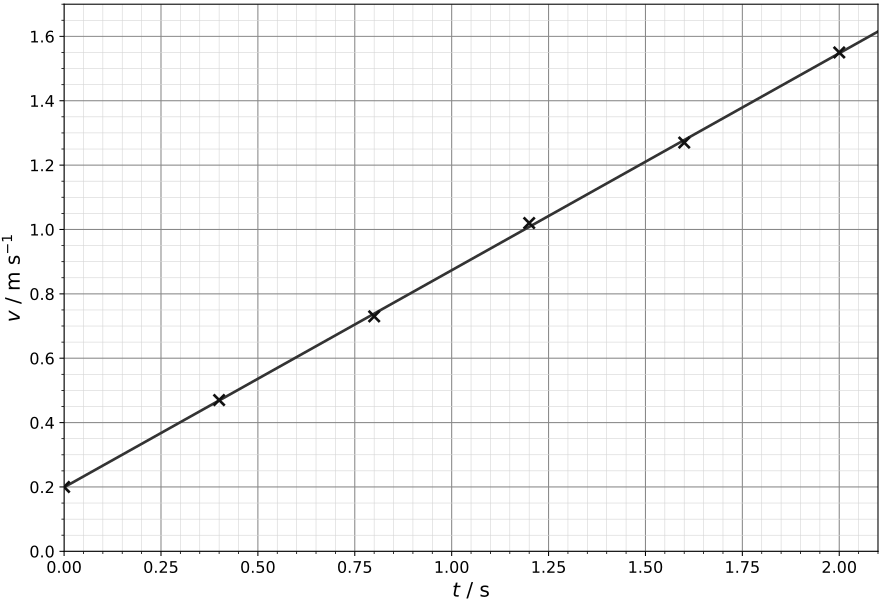
- Use a large triangle on the candidate’s line [1]. The gradient, and hence acceleration, is approximately [1] with the correct unit [1]. Apply follow-through.
- A best-fit line uses the overall trend, reduces sensitivity to random scatter and prevents two endpoint readings from dominating the result. [2]
- . Absolute uncertainty in the difference is . Percentage uncertainty . [3]
- It reduces reaction-time error, permits frame-by-frame checks, or supplies many readings from one run. [1]