Paper 4 Forces Answers
Q1 Force-extension experiment
- Measure the original length with no load, then the new length with each load, using a ruler fixed beside the spring and reading at eye level to avoid parallax. Extension is new length minus original length. [2]
- The load has weight [1]. Once it is at rest, its acceleration is zero, so the spring tension equals its weight; hence the stretching force is [1].
- Award axes/units [1], sensible scales [1], accurate plots [2], and a straight fit through the proportional region followed by a suitable curve/segment through the final point [1].
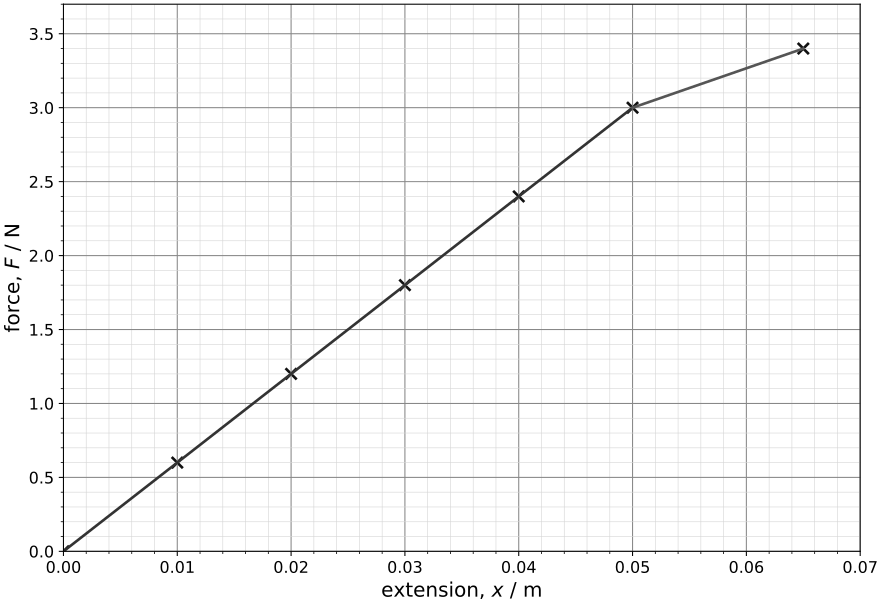
- Use a large triangle on the initial straight-line fit [1]:
Value [1] and unit [1]. 5. The graph remains proportional to about [1]; accept a reasonable estimate justified from the point where the trend departs from the initial straight line [1]. 6. Do not exceed the chosen maximum load/elastic range; add and remove masses gently; wait for oscillations to stop; keep the spring vertical and read at eye level. Any two relevant precautions [2].
Q2 Upthrust measurement
- Upthrust is loss of apparent weight:
[2] 2. If the object touches the beaker, the beaker exerts an additional contact force, so the newton-meter reading no longer represents only weight minus upthrust. [2] 3. , so
[3] 4. Take repeated readings after the object is fully submerged and stationary; remove air bubbles; read the scale at eye level; use a more sensitive force sensor. [1]