Paper 4 Forces Drills
Q1 Force-extension experiment
A student investigates a spring by hanging different masses from it. The force and extension are recorded.
| 0.000 | 0.010 | 0.020 | 0.030 | 0.040 | 0.050 | 0.065 | |
|---|---|---|---|---|---|---|---|
| 0.00 | 0.60 | 1.20 | 1.80 | 2.40 | 3.00 | 3.40 |
- Describe how the extension should be measured accurately. [2]
- Explain why the force may be calculated as after each load has come to rest. [2]
- Plot against on the grid below and draw an appropriate best-fit trend. [5]
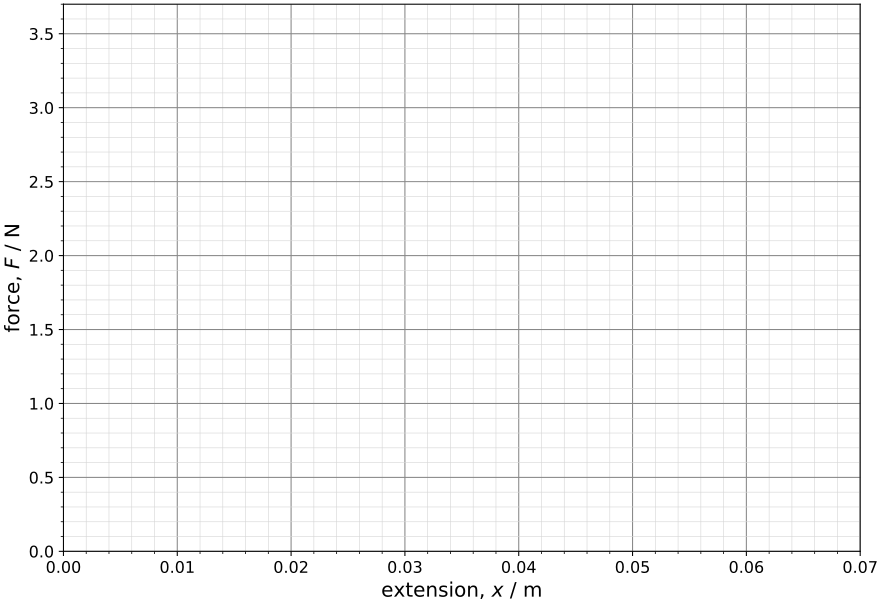
- Use the initial straight-line region to determine the force constant . [3]
- Estimate the extension at the limit of proportionality. [2]
- State two precautions to avoid damaging the spring or invalidating the investigation. [2]
Q2 Upthrust measurement
A solid object is hung from a newton meter. Its weight in air is . When fully immersed in water without touching the beaker, the newton-meter reading is .
- Calculate the upthrust on the object. [2]
- Explain why the object must not touch the beaker. [2]
- The density of water is . Calculate the volume of the object. [3]
- State one method for reducing uncertainty in the immersed reading. [1]