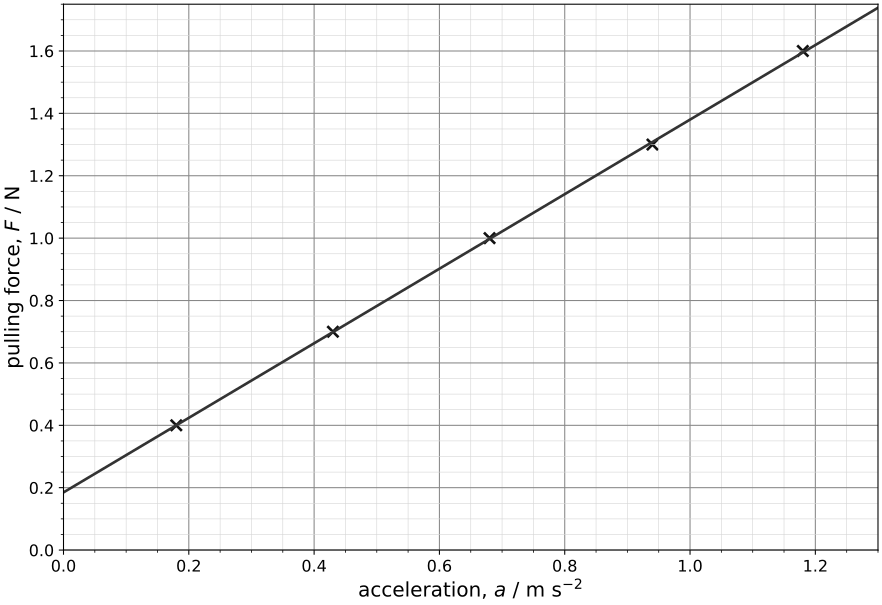
Award axes/units [1], sensible scales [1], accurate plots [2], and one straight best-fit line [1].
2. Comparing $F=ma+F_0$ with $y=mx+c$, the gradient gives the trolley mass and the vertical intercept gives $F_0$. [3]
3. Use a large triangle on the candidate's best-fit line [1]. A linear fit gives $m\approx1.20\ \mathrm{kg}$ [1]. The vertical intercept gives $F_0\approx0.18\ \mathrm N$ [1]. Award units and follow-through from a reasonable graph [1].
4. A non-zero physical intercept may be caused by rolling friction, axle friction or air resistance. A force-sensor zero error could also produce an intercept but is an instrumental bias rather than the intended resistive force. [1]
5. Zero/tare the force sensor before use; pull horizontally; avoid jerky pulling; keep the string taut and aligned with the track. [1]
Q2 Momentum investigation
Masses of both trolleys and velocities of both trolleys before and after collision, with directions/signs. [2]
If the track is not level, a component of weight acts along the track. This gives an external force and external impulse, so total trolley momentum may change during the collision interval. [2]
Repeating reduces the effect of random measurement errors and allows anomalous trials to be identified. Consistent agreement between initial and final total momentum supports the conclusion. [2]
Examples: total momentum after collision differs systematically from total momentum before collision; trolleys speed up/down before collision without contact; visible interaction with a stop, cable or rough patch during collision. [1]
 2. Comparing $F=ma+F_0$ with $y=mx+c$, the gradient gives the trolley mass and the vertical intercept gives $F_0$. [3]
3. Use a large triangle on the candidate's best-fit line [1]. A linear fit gives $m\approx1.20\ \mathrm{kg}$ [1]. The vertical intercept gives $F_0\approx0.18\ \mathrm N$ [1]. Award units and follow-through from a reasonable graph [1].
4. A non-zero physical intercept may be caused by rolling friction, axle friction or air resistance. A force-sensor zero error could also produce an intercept but is an instrumental bias rather than the intended resistive force. [1]
5. Zero/tare the force sensor before use; pull horizontally; avoid jerky pulling; keep the string taut and aligned with the track. [1]
2. Comparing $F=ma+F_0$ with $y=mx+c$, the gradient gives the trolley mass and the vertical intercept gives $F_0$. [3]
3. Use a large triangle on the candidate's best-fit line [1]. A linear fit gives $m\approx1.20\ \mathrm{kg}$ [1]. The vertical intercept gives $F_0\approx0.18\ \mathrm N$ [1]. Award units and follow-through from a reasonable graph [1].
4. A non-zero physical intercept may be caused by rolling friction, axle friction or air resistance. A force-sensor zero error could also produce an intercept but is an instrumental bias rather than the intended resistive force. [1]
5. Zero/tare the force sensor before use; pull horizontally; avoid jerky pulling; keep the string taut and aligned with the track. [1]