Paper 4 Circular Motion Drills
Q1 Whirling bung experiment
A student whirls a rubber bung in a horizontal circle of radius . The time for revolutions is measured.
- Explain why timing many revolutions is better than timing one revolution. [2]
- State how the period is found from the measured time. [1]
- State how the speed of the bung is calculated from and . [1]
- Suggest two precautions for keeping the radius constant. [2]
- State one safety precaution. [1]
Q2 Testing
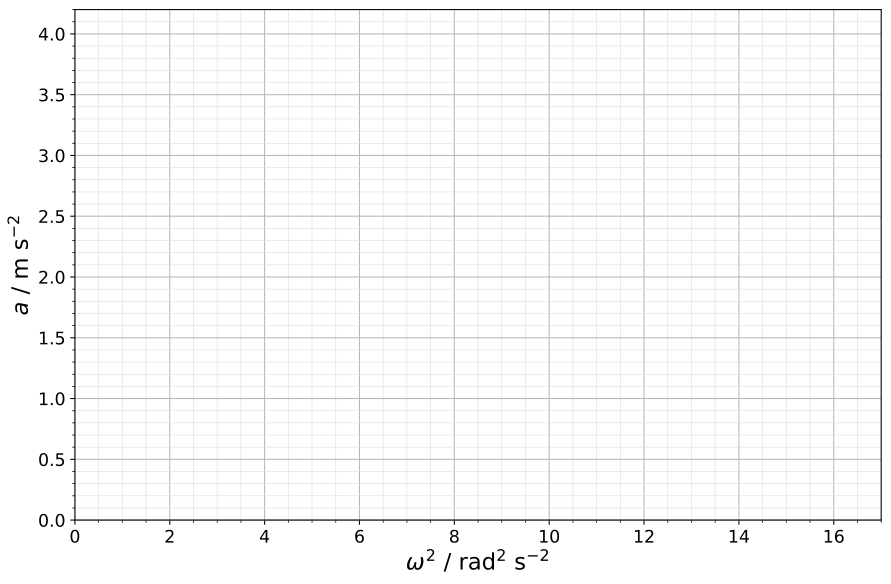
A small acceleration sensor is fixed to a rotating turntable. Its distance from the rotation axis is constant. The measured centripetal acceleration is shown below.
| 1.50 | 0.56 |
| 2.00 | 0.96 |
| 2.50 | 1.52 |
| 3.00 | 2.19 |
| 3.50 | 2.91 |
| 4.00 | 3.86 |
- Calculate for each reading. [1]
- Plot against and draw a best-fit straight line. [5]
- Use the gradient to determine . [3]
- Comment on whether the intercept supports the model . [2]
- Suggest one reason for a small non-zero intercept. [1]
- State one reason why the sensor must be securely attached to the turntable. [1]