Paper 4 Oscillations and SHM Answers
Q1 Measuring spring oscillator period
- For a spring-mass oscillator,
so
Thus against is linear. [2] 2. Correct values, from to . [1] 3. Axes and units [1]; suitable scale [1]; accurate plots [2]; best-fit straight line [1]. [5]
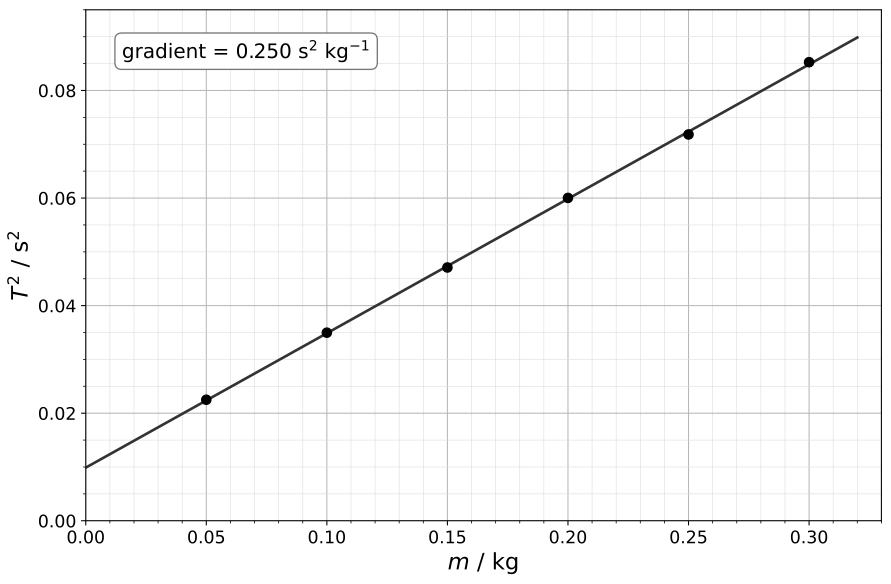
- The fitted gradient is approximately . Since ,
Accept follow-through from the candidate’s line. [3] 5. Writing , the intercept is . With an intercept of about ,
[2] 6. Time many oscillations and divide by the number; keep amplitude small; use the same reference point and direction; repeat and average; avoid parallax if using video or a fiducial marker. Any two. [2]
Q2 Resonance experiment
- It is the driving frequency at which the steady-state amplitude is maximum. [1]
- Immediately after changing frequency, transient motion may still be present. Waiting for steady state ensures the measured amplitude corresponds to that driving frequency. [2]
- The peak becomes lower and broader, and may shift slightly to lower frequency. [1]
- Keep amplitudes within safe limits, secure the oscillator, avoid resonance amplitudes that damage the apparatus, or keep fingers clear of moving parts. [1]