Paper 4 Superposition of Waves Answers
Q1 Microwave stationary-wave measurement
- Incident and reflected microwaves of the same frequency and similar amplitude travel in opposite directions and superpose. Fixed nodes and antinodes form. [2]
- Axes and units [1]; suitable scale [1]; accurate plots [2]; best-fit straight line [1]. [5]
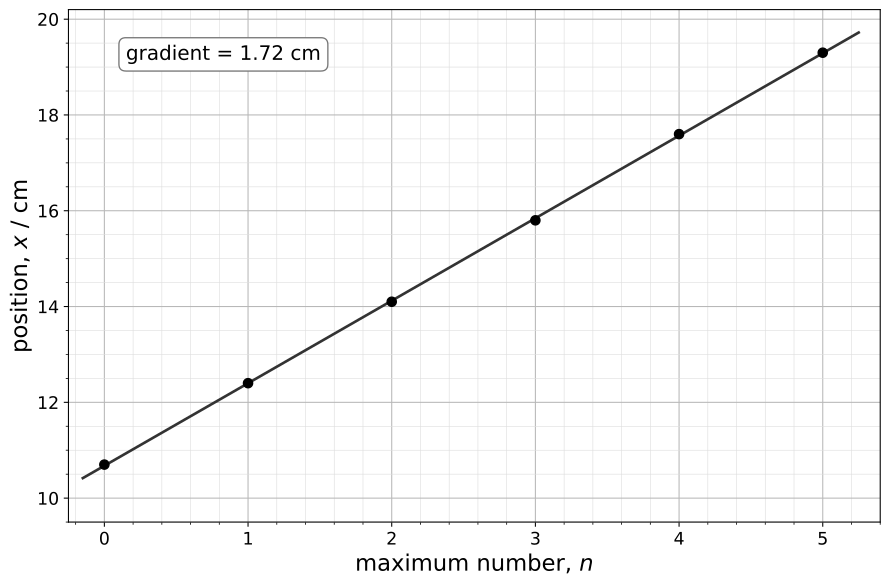
- The best-fit gradient is approximately per maximum. Adjacent maxima are separated by , so
Accept follow-through from the candidate’s line. [3] 4.
[2] 5. A best-fit gradient over several intervals reduces the percentage effect of position-reading uncertainty and random variation in locating each broad maximum. [2] 6. Move the detector slowly; minimise reflections from nearby objects; align transmitter, detector and reflector; keep detector orientation fixed; identify each maximum from approaches on both sides. Any two. [2]
Q2 Diffraction grating measurement
- Measure grating spacing or line density, diffraction order , and angle from central maximum to the chosen order. [2]
- Averaging symmetric left and right angles reduces zero-offset and alignment errors. [2]
- Grating not normal to beam, spectrometer zero error, misidentified order, or inaccurate line spacing. [1]