Paper 4 Superposition of Waves Drills
Q1 Microwave stationary-wave measurement
A microwave transmitter is directed normally at a metal reflector. A detector is moved along the line between them. The positions of consecutive signal maxima are recorded.
| Maximum number | 0 | 1 | 2 | 3 | 4 | 5 |
|---|---|---|---|---|---|---|
| Position | 10.7 | 12.4 | 14.1 | 15.8 | 17.6 | 19.3 |
- Explain how a stationary wave is formed. [2]
- Plot against and draw a best-fit straight line. [5]
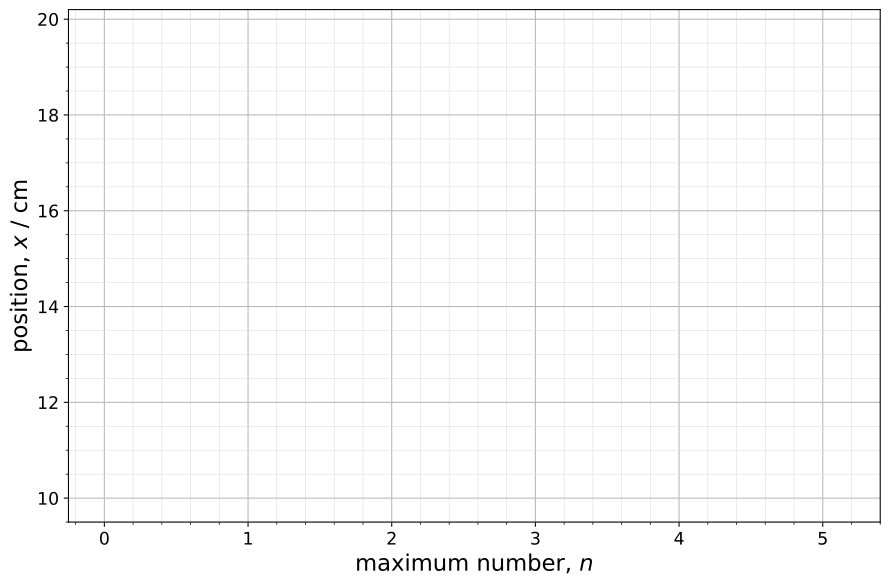
- Use the gradient to determine the microwave wavelength. [3]
- Determine the microwave frequency, taking wave speed as . [2]
- Explain why using all maxima is preferable to using one adjacent pair. [2]
- State two precautions for improving the measurement. [2]
Q2 Diffraction grating measurement
A student uses a grating and a spectrometer to measure wavelength.
- State the measurements needed to use . [2]
- Explain why readings should be taken on both sides of the central maximum. [2]
- State one source of systematic error. [1]