Paper 4 Electric Fields Answers
Q1 Potential Gradient Between Parallel Plates
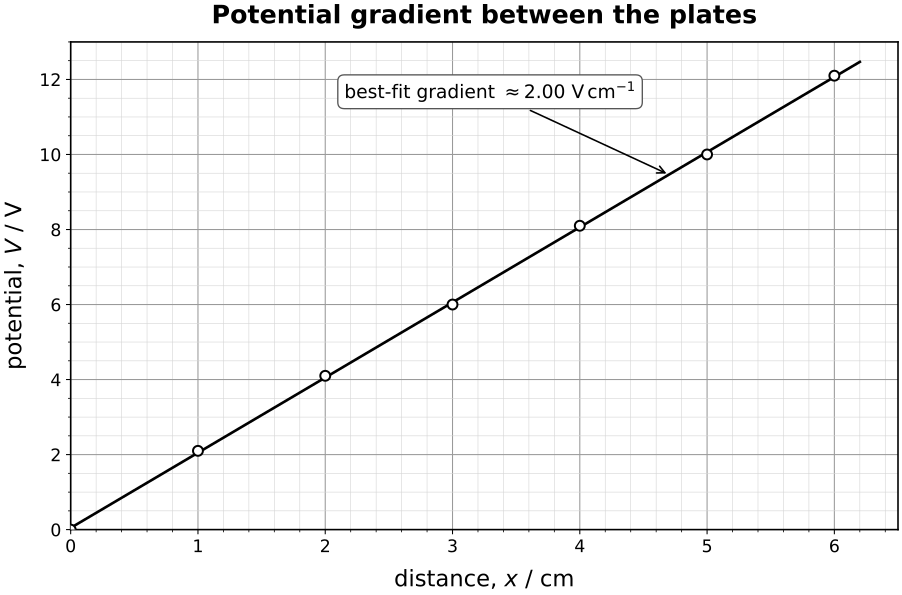
-
Axes correctly oriented and labelled with units [1]; sensible linear scales using most of the grid [1]; all seven points plotted accurately [2]; single best-fit straight line drawn [1].
-
A large triangle on the best-fit line gives, for example,
Since , the magnitude is
Accept values consistent with the candidate’s best-fit line, with correct conversion from centimetres to metres. [3]
-
The points lie close to a straight line, so the potential gradient—and hence —is approximately constant. [2]
-
Near a finite plate’s edge, field lines spread out (fringing), so the field is not uniform and locally. [2]
Q2 Measuring Plate Field
- Measure p.d. across the plates and separation , then use for the central uniform region. [2]
- Switch off before changing connections, use insulated leads, or avoid touching exposed conductors. [1]
- The plates are finite, so field lines spread and curve near their edges (fringing); consequently the potential gradient is not constant there. [2]