Paper 4 Semiconductors and Diodes Answers
Q1 Measuring Diode I-V Characteristics
- Connect diode in series with variable supply/rheostat and protective resistor; measure current with ammeter in series and p.d. across diode with voltmeter; vary p.d. and record readings. [3]
- It limits current and prevents diode damage after the threshold region. [1]
- Take repeated readings, use small voltage steps near threshold, avoid heating, or plot enough points. [1]
Q2 Thermistor Calibration
-
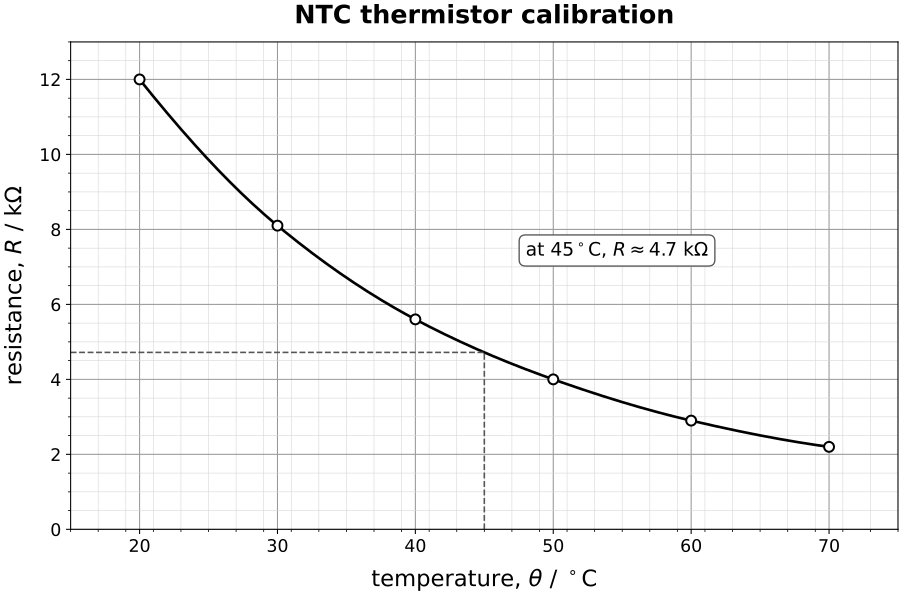
Axes correctly oriented and labelled [1]; sensible scales [1]; six points plotted accurately [2]; smooth decreasing best-fit curve [1].
-
Interpolation gives approximately ; accept a value consistent with the candidate’s curve. [1]
-
With the output measured across the lower thermistor,
Accept a value consistent with part 2. [2]
-
The thermometer measures the bath temperature, whereas depends on the thermistor’s own temperature. Equilibrium is needed so these temperatures are the same and no longer changing appreciably. [2]
-
Any two: stir the bath; use small temperature intervals; repeat and average readings; keep measuring current low to reduce self-heating; use calibrated digital meters; wait for stable readings; place thermometer close to the thermistor without contact. [2]