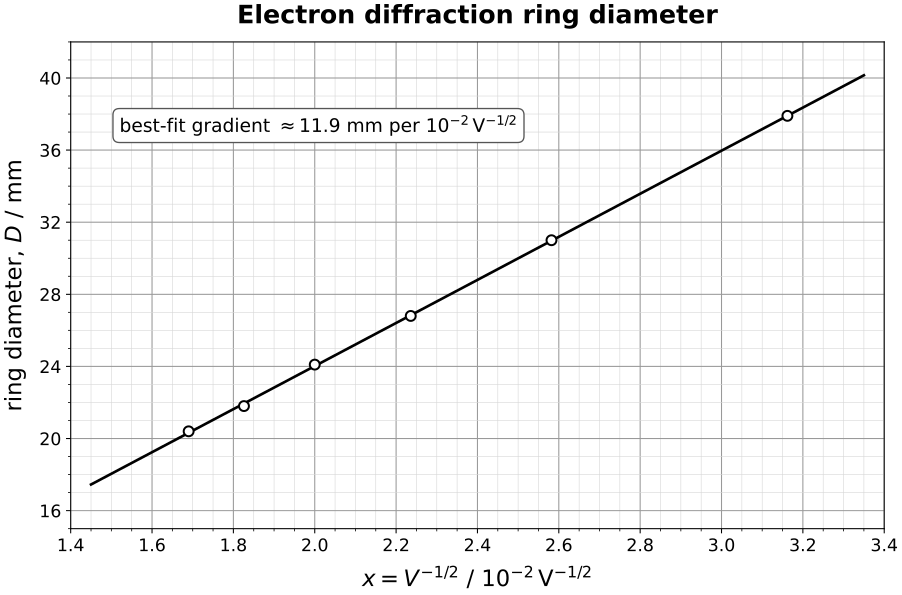
Axes correctly oriented and labelled [1]; sensible scales [1]; six points accurately plotted [2]; best-fit straight line [1].
Gradient ≈12.0mm per 10−2V−1/2, equivalently 1.20×10³mmV1/2. Accept graph-consistent values. [2]
Yes: the points lie close to a straight line whose intercept is consistent with zero within the scatter. [2]
p=2meeV, so λ=h/2meeV∝V−1/2. For fixed apparatus geometry and crystal spacing, diffraction ring diameter is proportional to diffraction angle and hence to λ for small angles. [3]
Example: the ring edge is broad, producing uncertainty in diameter [1]; measure diameters in several directions and average, or measure across opposite edges and use the midpoint/fit the ring [1]. Accept equivalent matched pairs.
Q2 Model Choice
It correctly links different evidence to wave-like and particle-like behaviour. [1]
It suggests a classical object changes identity, whereas quantum theory uses one framework with different observed behaviours. [2]
Light and matter have quantum behaviour; experiments reveal wave-like interference/diffraction or particle-like localized energy transfer depending on what is measured. [2]