Paper 4 Wave-Particle Duality Drills
Q1 Electron Diffraction Data Analysis
A student records the diameter of one diffraction ring for electrons accelerated through different p.d.s . A derived column is included to test the prediction .
| /V | 1000 | 1500 | 2000 | 2500 | 3000 | 3500 | |---:|---:|---:|---:|---:|---:|---:|---:| | / | 3.162 | 2.582 | 2.236 | 2.000 | 1.826 | 1.690 | | /mm | 37.9 | 31.0 | 26.8 | 24.1 | 21.8 | 20.4 |
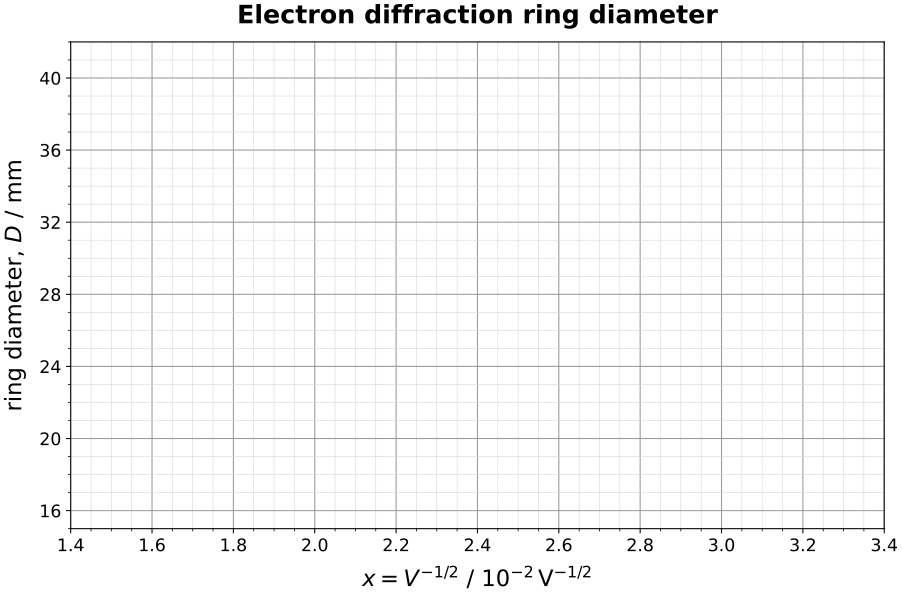
- Plot a graph of against and draw a best-fit straight line. [5]
- Determine the gradient, including its unit. [2]
- State whether the data support and justify your conclusion. [2]
- Explain the predicted relationship using and . [3]
- State one measurement difficulty and a matched improvement. [2]
Q2 Model Choice
A student writes: “Light is a wave in diffraction, but a particle in the photoelectric effect. Therefore it switches identity depending on the experiment.”
- Identify what is useful in the statement. [1]
- Explain what is misleading about it. [2]
- Rewrite the idea more carefully. [2]