Circular Motion Enrichment
Enrichment — beyond H2 Physics 9749 syllabus scope
The material in this note is not required by the stated 9749 Circular Motion learning outcomes. It is retained because it deepens the physical model and may support challenging school-based problems. Learn the examinable core in Circular Motion first.
Overview
This branch extends the uniform-circular-motion model to situations in which speed changes and to idealised vertical-circle constraints. It also derives the standard uniform-circular-motion formulas using coordinates and calculus.
Core Ideas
- Non-uniform circular motion has radial and tangential acceleration components.
- A radial force equation describes one position; an energy equation compares different positions.
- Strings can pull but not push, and surfaces can push but not pull.
- Limiting contact conditions must be derived from the relevant non-negative constraint.
1. Non-uniform circular motion
In uniform circular motion, speed is constant and acceleration is purely radial. In non-uniform circular motion, the direction and the magnitude of velocity may both change.
It is useful to resolve acceleration into two perpendicular components:
- a radial component, which changes the direction of velocity;
- a tangential component, which changes the speed.
Let point radially outward and point along the instantaneous direction of motion. Then
with
and
Therefore,
The magnitude is
The corresponding resultant-force components are
towards the centre and
along the tangent, with signs determined by the chosen positive directions.
Important distinction
The radial expression still applies instantaneously when the speed changes. What is no longer true is that the total acceleration equals only .
2. Why vertical circular motion is usually non-uniform
In a vertical circle, the object’s height changes. If gravity does work and no external agent maintains a constant speed, gravitational potential energy and kinetic energy interchange. The speed therefore generally varies around the circle.
Two different equations then answer different questions:
- The radial force equation at one position relates the forces at that instant to .
- The energy equation between two positions relates their speeds and heights.
Do not combine these into one equation or use as though it were a force additional to tension, weight, or normal contact force.
3. A mass on a string in a vertical circle
Assume:
- the mass is treated as a particle;
- the string is light and inextensible;
- air resistance is negligible;
- the string remains taut unless a limiting condition is being tested.
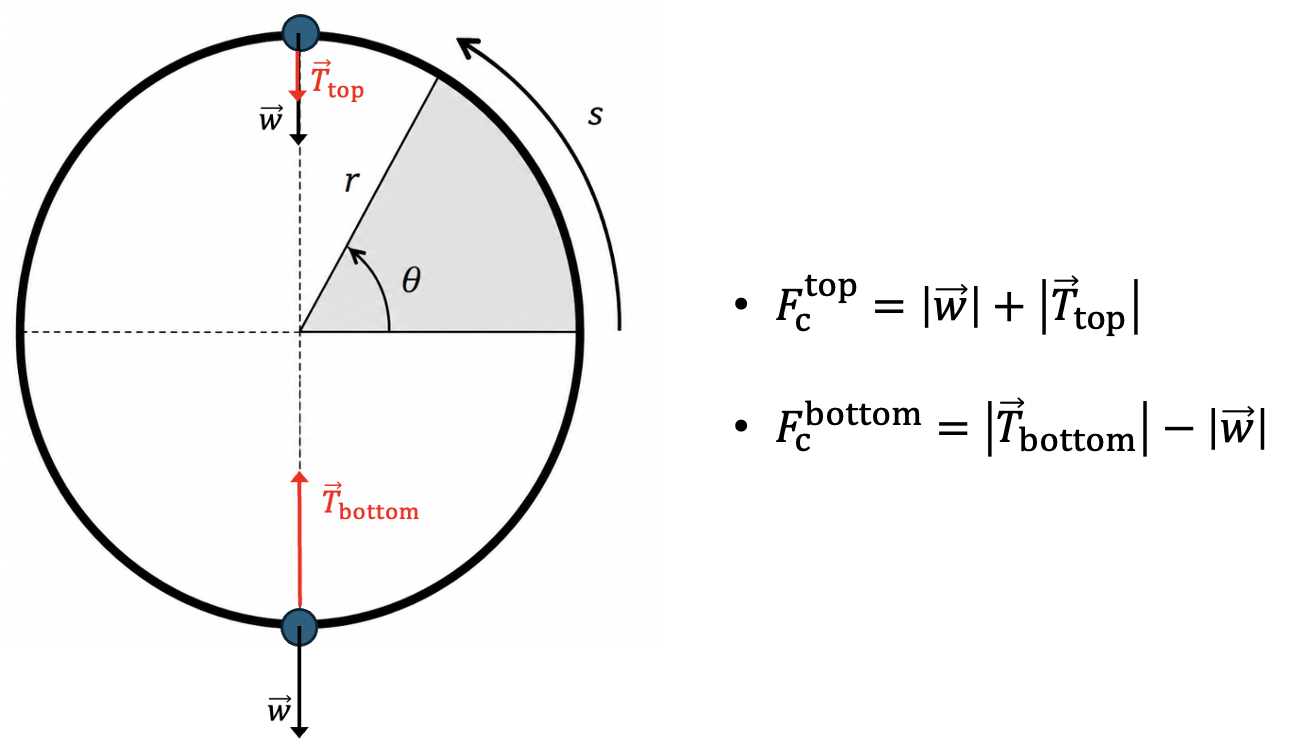
Figure E1. Free-body diagrams for a mass attached to a string. At the top, both tension and weight point towards the centre. At the bottom, tension points inward while weight points outward. The equations shown are radial resultant equations, not additional-force equations. They apply while the string is taut.
At the top
Choose inward, which is downward at the top, as positive. Both tension and weight act inward:
Hence
A string can pull but cannot push, so a taut string requires
At the limiting condition where the string is just taut,
so
and
This is a condition at the top. It is not the speed at every point of the circle.
At the bottom
Choose inward, which is upward at the bottom, as positive. Tension is inward and weight is outward:
Thus
This explains why the tension is commonly greater at the bottom than at the top: the bottom speed is usually greater, and weight opposes rather than assists the inward resultant there.
4. Energy between the bottom and top
For a mass moving under gravity with negligible dissipative forces, choose the bottom as the zero of gravitational potential energy. The top is higher.
Conservation of mechanical energy gives
Therefore,
For a string that is just taut at the top, . Hence
and
The result assumes the object is given its speed at the bottom and then moves without energy loss.
5. Smooth loop-the-loop contact
For a particle moving on the inside of a smooth circular track, the normal contact force at the top points towards the centre. The top radial equation is
Contact requires
At the limiting condition for just maintaining contact,
which again gives
If the particle starts from rest at height above the bottom and slides without energy loss,
At the limiting condition :
This result depends on the idealised model: a point particle, a smooth track, no rolling kinetic energy, no air resistance, and release from rest.
6. Contact and string constraints are not interchangeable
Always identify the interaction:
- a string tension satisfies because a string can pull but not push;
- a normal contact force satisfies because a surface can push but not pull;
- when the calculated or would be negative, the assumed circular constraint has failed.
After the string becomes slack or contact is lost, the object no longer follows the assumed circular path solely because the original geometry was drawn as a circle.
7. Coordinate derivation of the uniform-circular-motion formulas
This derivation uses calculus and is included for conceptual depth.
For a particle moving anticlockwise at constant angular speed in a circle of radius centred at the origin,
Differentiate once:
Its magnitude is
Differentiate again:
Factor out the position vector:
The negative sign shows that acceleration points opposite to the outward position vector, hence towards the centre. Its magnitude is
Using gives
Exam Relevance
This note is not required for the 9749 examination under the stated Circular Motion outcomes. Do not treat the vertical-loop results or the coordinate-calculus derivation as required recall. They are included only as explicitly labelled enrichment.
Enrichment checks and common errors
- Do not assume vertical-circle speed is constant unless an external mechanism explicitly enforces it.
- Use an energy equation between positions and a radial force equation at a position.
- Define inward separately at the top, bottom, and side.
- Do not replace tension or normal force by without first writing the resultant equation.
- Do not allow a string tension or normal contact force to become negative.
- State the model assumptions behind and .