Circular Motion
Overview
Circular motion connects geometry, motion, and force. An object moving at constant speed around a circle is still accelerating because its velocity direction changes continuously.
The examinable H2 Physics 9749 core is:
- angular displacement in radians;
- angular velocity;
- the relation ;
- curved motion caused by a perpendicular resultant force;
- centripetal acceleration in uniform circular motion;
- centripetal force as the inward resultant force.
Substantial material on non-uniform and vertical circular motion has been preserved separately in Circular Motion Enrichment. It is useful physics, but it is explicitly beyond the stated 9749 Circular Motion learning outcomes.
Core Ideas
- Radians connect angular displacement to arc displacement through .
- Tangential speed and angular speed are linked by .
- Constant speed does not mean constant velocity when direction changes.
- Uniform circular motion requires acceleration and resultant force towards the centre.
- “Centripetal force” names the inward resultant of real forces, not an additional interaction.
1. Describing position around a circle
Consider a particle moving along a circular path of radius .
Angular displacement
The angular displacement is the angle through which the radius from the centre to the particle turns.
For the magnitude of an angle subtending an arc of length :
and hence
This equation requires to be measured in radians. If a signed angular displacement is used, is interpreted as signed displacement along the arc rather than unsigned arc length.
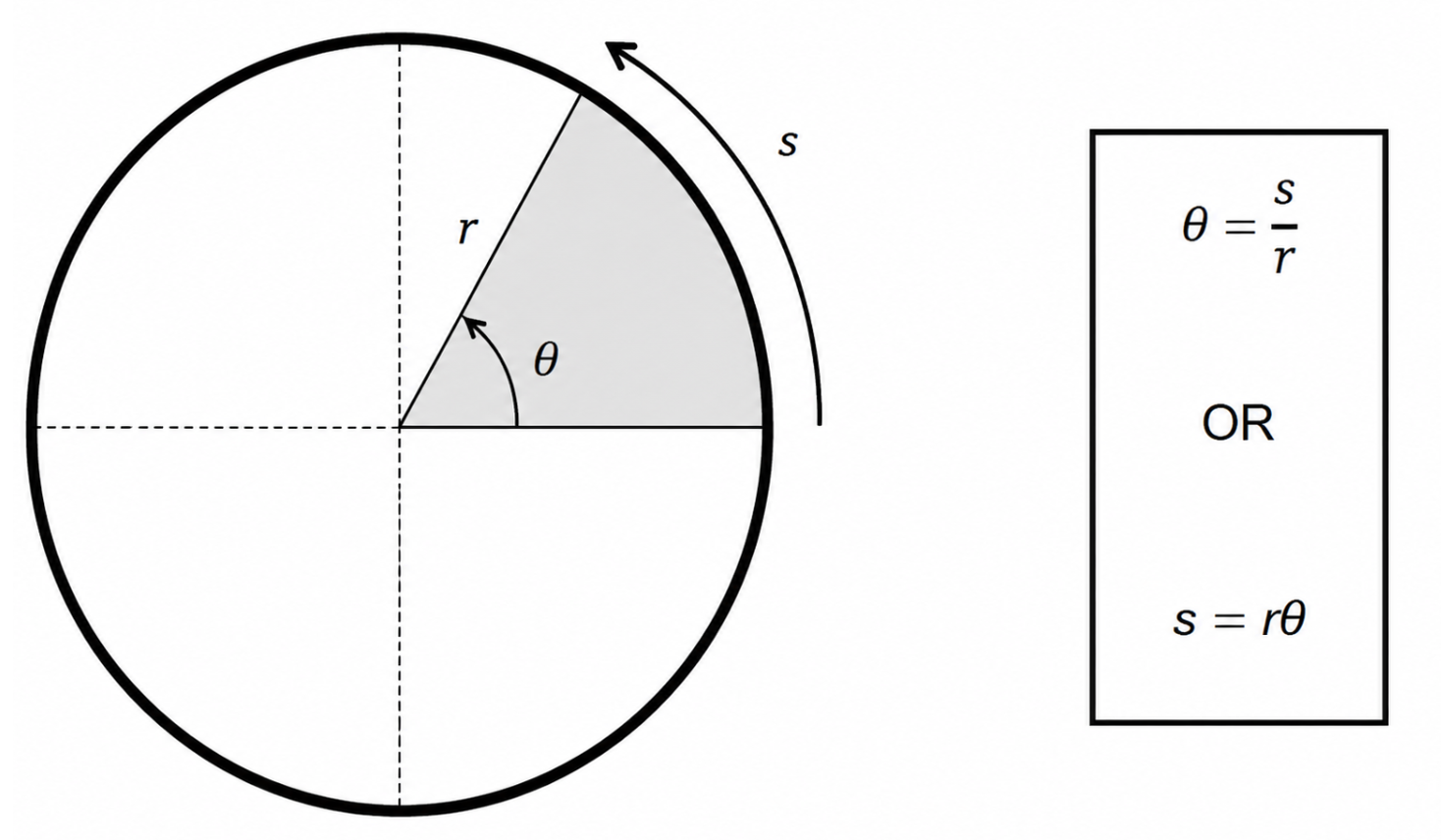
Figure 1. Radian measure links the selected arc length to the radius . The angle is ; when , . The arrow shows the chosen positive sense of angular displacement.
What is one radian?
One radian is the angle subtended at the centre by an arc whose length equals the radius:
A complete revolution has arc length , so
Therefore,
The ratio is dimensionless, but the unit radian is retained because it tells us that the number represents an angle.
Direction convention
For motion in a plane, a question may choose either sense as positive. A common convention is:
- anticlockwise: positive;
- clockwise: negative.
State the convention if signs matter. In many calculation questions, only the magnitude of the angular displacement is required.
2. Angular velocity, period, and frequency
Angular velocity
Angular velocity is the rate of change of angular displacement:
Its SI unit is .
In a two-dimensional problem, the sign of records the direction of rotation according to the chosen convention. The angular speed is the magnitude .
For uniform circular motion, is constant. If the angular displacement is measured from at ,
More generally, if the initial angular position is ,
Period and frequency
The period is the time taken for one complete revolution.
The frequency is the number of complete revolutions per unit time:
Since one revolution is radians,
Useful units are:
- in seconds, ;
- in hertz, ;
- in .
Worked example 1: rpm to angular speed
A washing-machine drum rotates at . Find its angular speed.
First convert revolutions per minute to revolutions per second:
Then
Check: is revolutions each second, so an angular speed much greater than is reasonable.
3. Tangential velocity and the relation
The instantaneous velocity of a particle in circular motion is tangent to the path. It is therefore perpendicular to the radius at that instant.
From the arc relation
differentiate with respect to time while remains constant:
Since and ,
Here and denote magnitudes. The equation says that points on the same rigidly rotating object have the same angular speed, but a point farther from the axis has a greater tangential speed.
Limiting checks
For fixed :
- if doubles, doubles;
- at the axis, and hence .
For fixed :
- if doubles, doubles.
Worked example 2: speed at the rim
A disc of radius rotates at revolutions per second. Find the speed of a point on its rim.
4. Why constant speed still requires acceleration
Velocity is a vector. It changes when either:
- its magnitude changes; or
- its direction changes.
In uniform circular motion, the speed is constant but the direction of changes continuously. Therefore , so the particle has an acceleration.
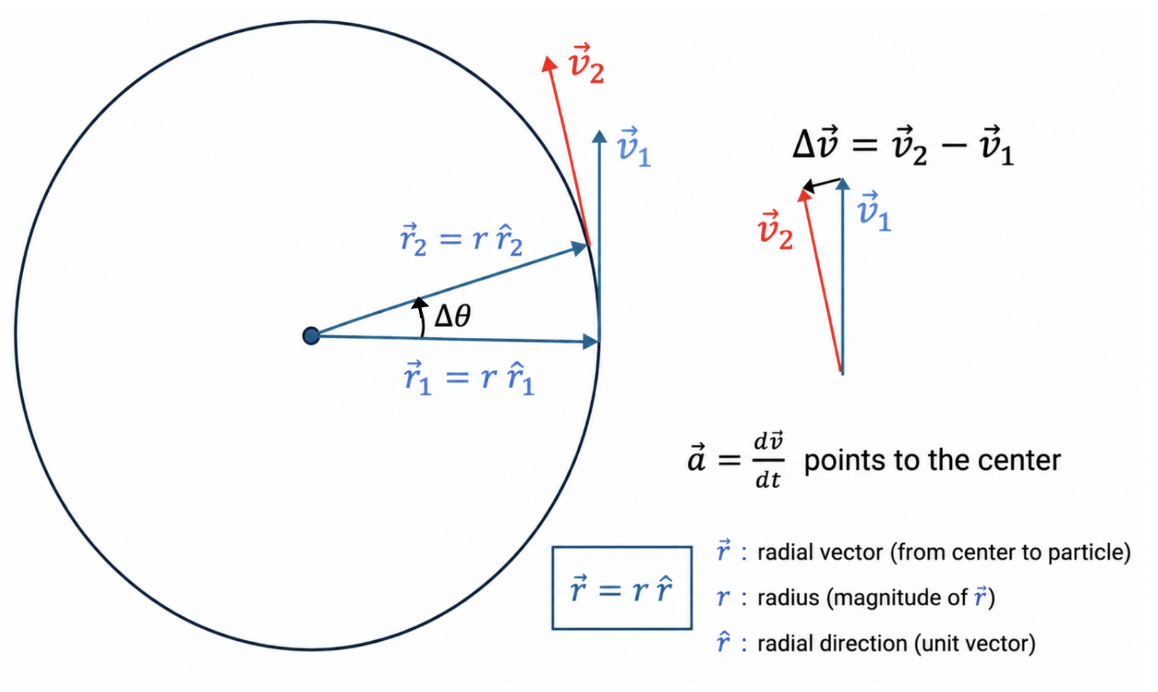
Figure 2. The two tangential velocity vectors have equal magnitude but different directions. To construct , translate the vectors without rotating them. For a finite interval in uniform circular motion, points towards the centre at the midpoint of the swept arc, not at either endpoint. As the interval shrinks, that midpoint approaches the particle and approaches the instantaneous inward direction.
The limiting idea
For a short time interval ,
As , the two positions approach one another and the direction of approaches the direction towards the centre. Thus the instantaneous acceleration is radially inward.
This inward acceleration is called centripetal acceleration. The word centripetal means centre-seeking.
5. Centripetal acceleration
For uniform circular motion, the magnitude of the centripetal acceleration is
Its direction is always towards the centre of the circular path.
If is the unit vector pointing radially outward, the vector equation is
The minus sign means inward; it does not mean that the magnitude is negative.
What the formula predicts
At fixed radius,
Doubling the speed requires four times the centripetal acceleration.
At fixed speed,
A tighter turn requires a greater inward acceleration.
At fixed angular speed,
A point farther from the rotation axis moves faster and requires a greater centripetal acceleration.
Unit check
which is the correct unit for acceleration.
Worked example 3: acceleration around a bend
A car moves at around a circular bend of radius . Find its centripetal acceleration.
The acceleration is directed horizontally towards the centre of the bend.
6. The perpendicular-force idea
Newton’s second law gives
If the resultant force is perpendicular to the velocity, it changes the direction of the velocity but not its magnitude. For a circular path of radius , an inward resultant of magnitude therefore sustains uniform circular motion. A perpendicular force does not by itself guarantee a circle: its direction and magnitude must provide the required curvature.
This is different from a tangential resultant force:
- radial resultant changes velocity direction;
- tangential resultant changes speed.
In uniform circular motion, the inward resultant is perpendicular to the instantaneous displacement. It therefore does no work and does not change the kinetic energy.
7. Centripetal force means inward resultant force
The required inward resultant has magnitude
The symbol does not name a new interaction. It is a convenient name for the radial resultant of real forces.
Depending on the situation, the inward resultant may be provided by:
- tension;
- friction;
- a normal contact force or one of its components;
- gravitational attraction;
- electric or magnetic force;
- a component of lift.
Free-body diagram rule
Draw only real forces acting on the chosen object. Do not draw an additional arrow labelled “centripetal force”. After drawing the real forces, take their inward radial resultant:
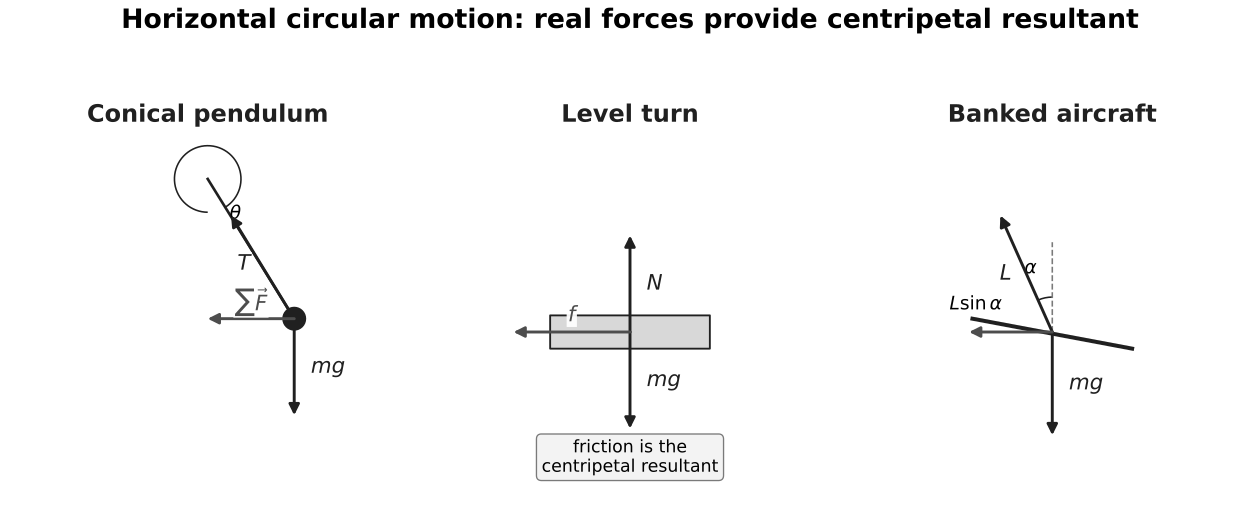
Figure 3. Two standard uniform-circular-motion examples. On a level bend, static friction supplies the horizontal inward resultant while the normal force balances weight. For a conical pendulum, the horizontal component of tension supplies the inward resultant while its vertical component balances weight. No extra “centripetal-force” arrow is added.
A reliable force-analysis procedure
- Choose the object. State which object your free-body diagram represents.
- Locate the centre. Mark the instantaneous inward radial direction.
- Draw real forces only. Include weight, contact forces, tension, and other interactions as appropriate.
- Resolve components. Resolve forces parallel and perpendicular to the radial direction when needed.
- Write the radial equation. Use .
- Use other directions separately. For example, vertical acceleration may be zero even while horizontal radial acceleration is non-zero.
- Check the answer. Include direction, unit, and whether the required force is physically possible.
Example: car on a level circular road
For a car turning on a level road:
- weight acts downward;
- normal contact force acts upward;
- static friction acts horizontally towards the centre.
There is no vertical acceleration, so
The horizontal radial equation is
Friction is not always opposite to the direction of motion. Static friction opposes the tendency to slip; here it acts sideways, towards the centre.
Worked example 4: required inward force
A car travels at around a level bend of radius . Find the required inward resultant force.
The resultant is directed towards the centre and is supplied by static friction from the road.
Example: conical pendulum
For a bob moving in a horizontal circle while its string makes an angle to the vertical:
because there is no vertical acceleration, while
because the horizontal component of tension provides the inward resultant.
Here is the radius of the horizontal circular path. The symbol in these two equations denotes tension, not period. Always define symbols from the context.
8. Choosing the correct equation
| Information given | Useful route |
|---|---|
| revolutions per second | |
| period | |
| angular speed and radius | |
| speed and radius | |
| angular speed and radius | |
| mass and motion | |
| real forces | resolve them and use |
Do not select a formula only by matching symbols. First identify the physical quantity requested and the direction of the radial resultant.
Exam Relevance
Common Misconceptions and Exam Traps
“Constant speed means zero acceleration”
False. Acceleration is the rate of change of velocity, and velocity direction changes in circular motion.
“Centripetal force is an extra force”
False. It is the inward resultant of real forces. Adding an extra centripetal-force arrow double-counts the dynamics.
“Velocity points towards the centre”
False. Instantaneous velocity is tangent to the path. Centripetal acceleration points towards the centre.
“Every force belongs in the radial equation”
False. Include only the inward-minus-outward components in the radial equation. Deal with perpendicular directions separately.
“Friction must act opposite to the velocity”
False. Static friction acts against the tendency of surfaces to slip. In a level turn it may act perpendicular to the car’s instantaneous velocity.
Confusing radius with diameter
The circular-motion equations use the radius. If a diameter is given, divide it by two first.
Confusing frequency and angular velocity
counts revolutions per second. measures radians swept per second:
9. Formula summary
Angular geometry and timing
Tangential speed
Uniform-circular-motion acceleration
Inward resultant force
or, as the radial equation,
10. Final reasoning checklist
Before finishing a circular-motion solution, ask:
- Did I convert angles to radians where required?
- Did I distinguish angular speed from frequency?
- Did I identify the centre and the inward direction?
- Is velocity tangent to the path in my diagram?
- Did I draw real forces only?
- Did I use inward force components, rather than all force magnitudes?
- Did I give the final direction and unit?
- Does the dependence on and make physical sense?
Optional enrichment
The following branch preserves useful content that goes beyond the stated 9749 Circular Motion learning outcomes:
For examinable gravitational circular orbits, continue to Orbital Motion in Gravity.