Photoelectric Effect
Branch note: This page deepens one part of Quantum Physics.
Core outcomes 19(a–h)
Learn the observations and the one-photon–one-electron explanation together. A complete answer connects photon energy , work function , maximum kinetic energy and stopping potential rather than quoting equations alone.
Overview
The photoelectric effect is the emission of electrons from a metal surface when electromagnetic radiation of sufficiently high frequency is incident on it.
It provided strong evidence that light can behave as particles called photons.
This topic is a key part of Quantum Physics.
Core Ideas
- light energy is transferred in photon packets of energy
- an electron is emitted only if one photon supplies at least the work function energy
- threshold frequency determines whether emission is possible
- increasing intensity above threshold increases the number of emitted electrons, not their maximum kinetic energy
- increasing frequency increases the maximum kinetic energy of the emitted electrons
Exam Relevance
Photoelectric-effect questions often test whether students can separate frequency effects from intensity effects. The central equation is:
Graph questions commonly use the gradient, threshold frequency, work function, and stopping potential.
Definition
The photoelectric effect is the emission of photoelectrons from a metal when incident photons transfer sufficient energy to electrons at the surface.
Why It Matters
This phenomenon is important because it:
- showed the limits of classical wave theory
- supported the photon model of light
- introduced threshold frequency and work function ideas
- provides one of the clearest links between light and quantised energy
Key Representations
Experimental Setup
A typical photoelectric tube contains:
- clean metal emitter surface
- collector electrode
- evacuated glass tube
- adjustable potential difference whose polarity can be reversed
- microammeter to measure current
- monochromatic light source
Process:
- light shines on the emitter
- electrons are emitted from the metal surface
- the applied collector–emitter p.d. accelerates or retards the emitted electrons according to its polarity
- electrons that reach the collector produce a photocurrent measured by the microammeter
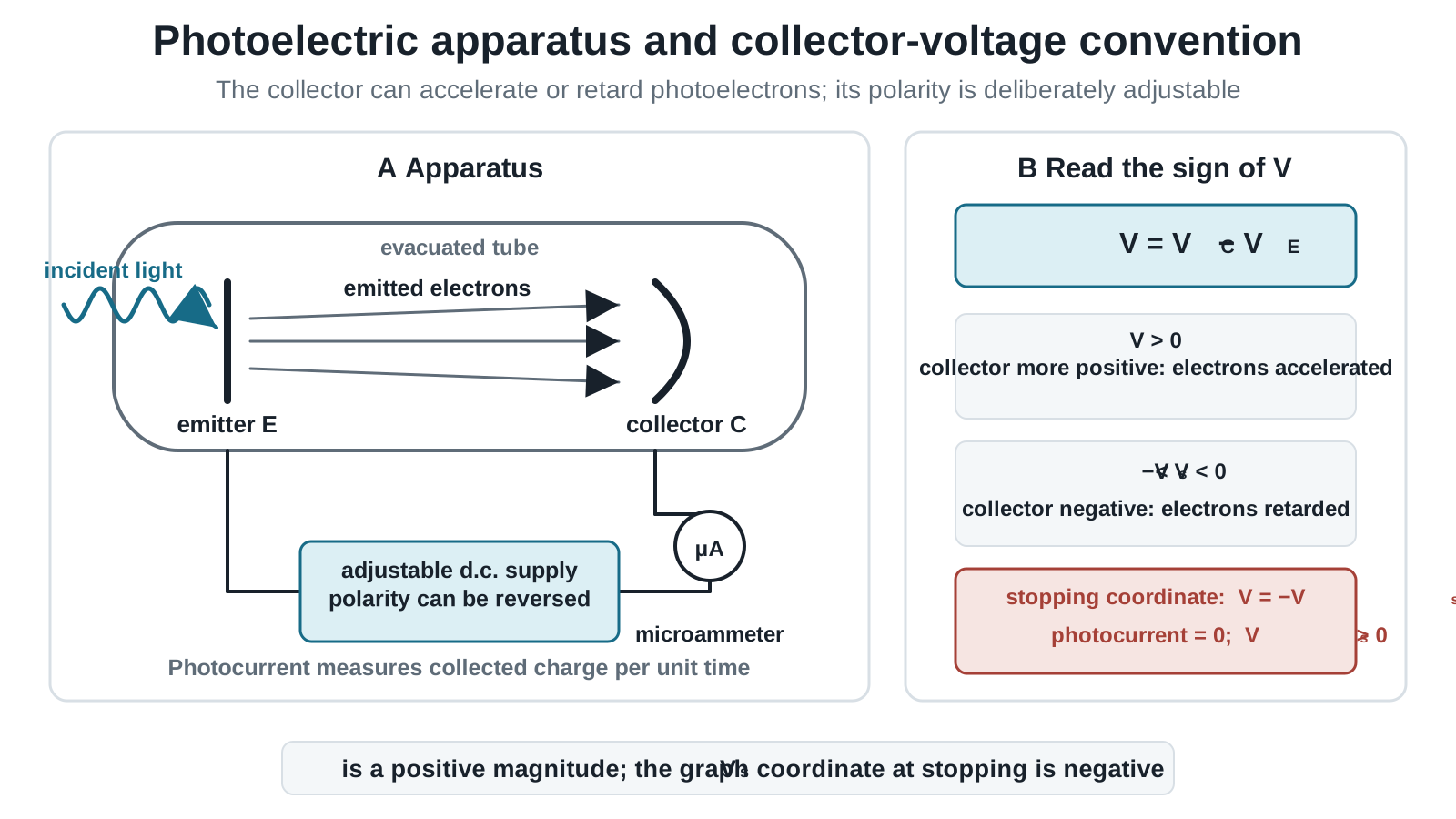
Figure: Monochromatic light illuminates the emitter in an evacuated photoelectric tube, and the microammeter measures photocurrent—the charge collected per unit time. The plotted p.d. is defined as . Positive attracts emitted electrons towards the collector; negative retards them. The current falls to zero at the coordinate , where is the stopping-potential magnitude.
Key Observations
1. Threshold Frequency Exists
Below a certain frequency:
- no electrons are emitted
- regardless of intensity
2. Immediate Emission
When frequency is above threshold:
- electrons may be emitted almost instantly
3. Maximum Kinetic Energy Depends on Frequency
For a fixed metal and frequency above threshold, higher incident frequency gives higher maximum electron kinetic energy.
4. Photocurrent Depends on Intensity
At fixed frequency above threshold:
- increasing intensity increases the emitted-electron rate
- photocurrent increases
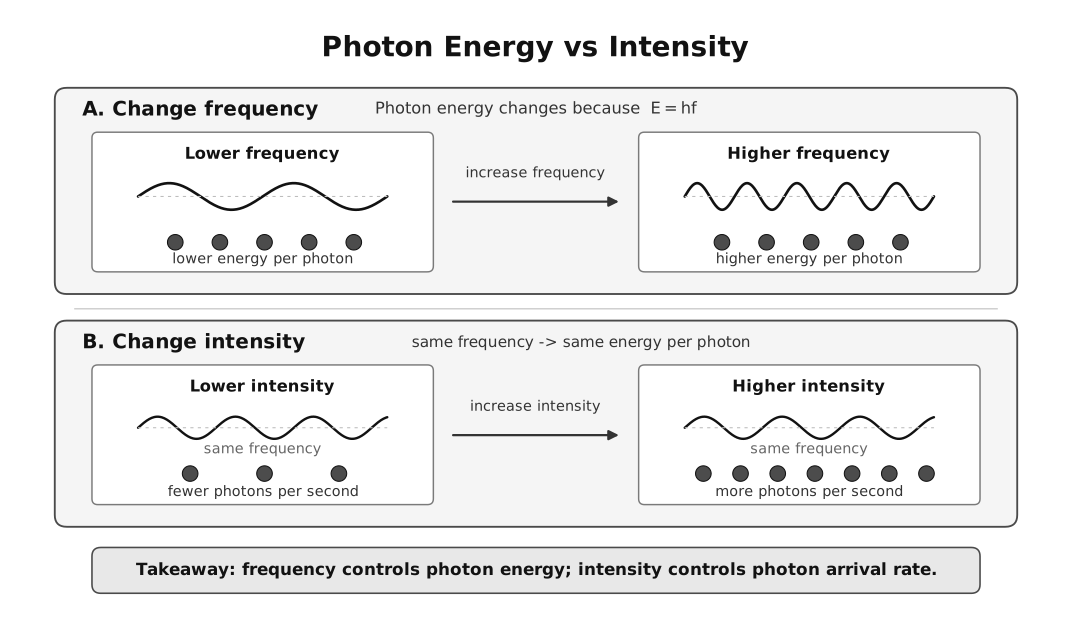
Figure: At fixed frequency, increasing intensity means more photons arrive per second and can increase saturation current. Increasing frequency increases the energy of each photon, which changes the maximum kinetic energy but not necessarily the photon arrival rate.
Why Classical Wave Theory Failed
Classical wave theory predicted:
- energy delivered continuously
- brighter light should eventually eject electrons at any frequency
- delay before emission possible
But experiments showed:
- threshold frequency
- no delay
- kinetic energy depends on frequency
Hence a new model was needed.
Photon Model of Light
Light consists of photons.
Each photon carries energy:
where:
- = Planck constant
- = frequency
One photon transfers energy to one electron.
Threshold Frequency
Minimum frequency required for emission:
If:
then no emission occurs.
If:
electrons can be emitted.
Work Function
The minimum energy needed to remove an electron from the metal surface is called the work function.
Symbol:
Relation with threshold frequency:
Different metals have different work functions.
Photoelectric Equation
Einstein’s photoelectric equation:
where:
- = photon energy
- = work function
- = maximum kinetic energy of emitted electrons
Meaning of the Equation
Photon energy is used for:
- overcoming attraction within the metal
- the remaining energy becomes electron kinetic energy
Hence:
- for a fixed metal, higher frequency gives larger
- higher intensity alone does not increase
Stopping Potential
A sufficiently large retarding collector p.d. can stop emitted electrons from reaching the collector.
Define the plotted electrode p.d. as
With this convention, a retarding collector has . The photocurrent reaches zero at the graph coordinate
where denotes the magnitude of the stopping potential.
When current just becomes zero:
where:
- = elementary charge
- = stopping potential
Thus:
Graph Interpretation
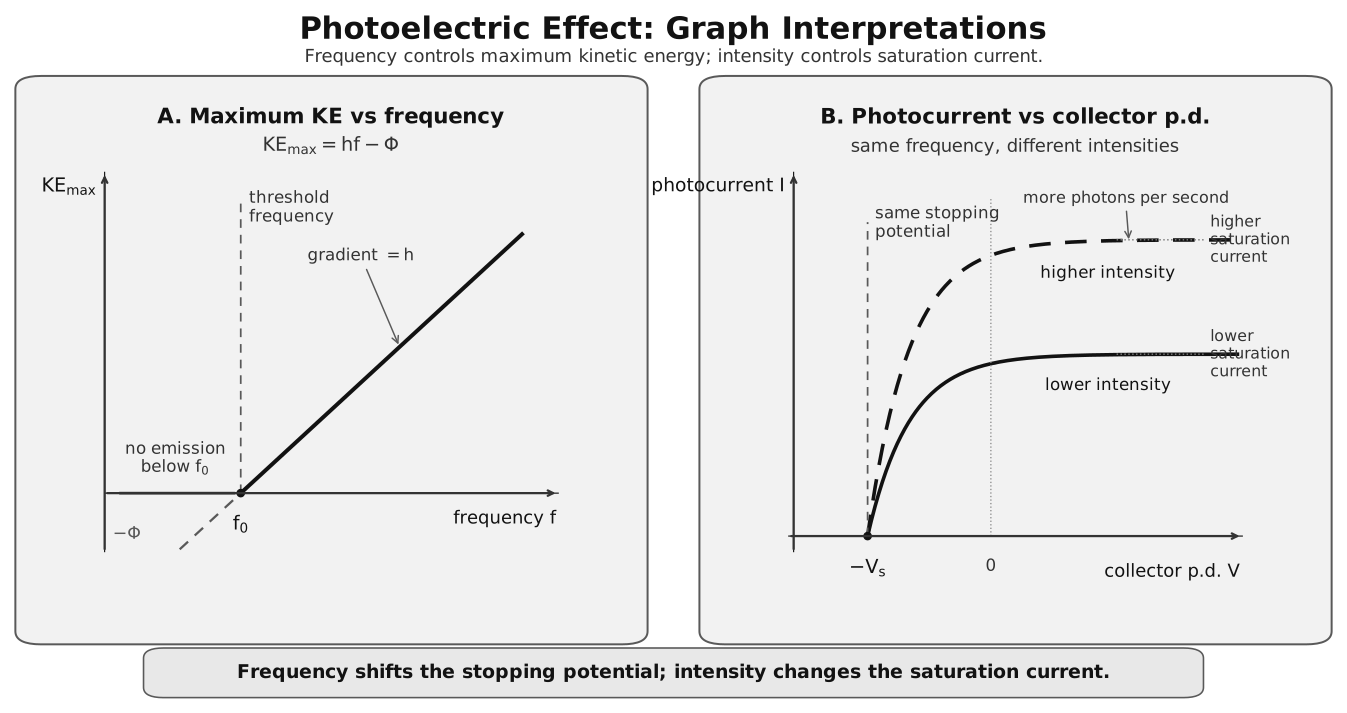
Figure: The – graph carries energy information: gradient , threshold-frequency intercept , and extrapolated energy-axis intercept . For the convention , the current–p.d. graph reaches zero at , while its plateau gives saturation current. These are different graphs and different measurements.
1. vs Frequency
Using:
The graph is a straight line:
- gradient =
- x-intercept = threshold frequency
- extrapolated y-intercept = ; this lies outside the physical emission region because is not negative below threshold
2. Photocurrent vs Voltage
As the collector p.d. relative to the emitter,
becomes more positive:
- more electrons are collected
- current rises
- the current reaches saturation
With reverse voltage under the convention above:
- current decreases
- becomes zero at the coordinate
3. Photocurrent vs Intensity
At fixed frequency above threshold:
- greater intensity gives more emitted electrons per second
- larger photocurrent
Intensity vs Frequency Distinction
Frequency determines:
- photon energy
- whether emission occurs
- maximum kinetic energy for a fixed metal
Intensity determines:
- number of photons arriving each second
- number of electrons emitted
- photocurrent
Worked reasoning: frequency or intensity?
Light above threshold is incident on one metal. Its frequency is increased while intensity is kept constant.
-
Each photon has more energy because .
-
The maximum photoelectron kinetic energy increases:
-
Hence the magnitude of the stopping potential increases because .
-
Constant intensity means constant energy arriving per unit area per unit time, not necessarily a constant photon arrival rate. Because each photon is now more energetic, the photon arrival rate may decrease. Do not infer a larger saturation current unless the photon flux is specified.
By contrast, increasing intensity at fixed frequency above threshold increases photon arrival rate and saturation current, but leaves and unchanged.
This distinction is heavily tested.
Summary
The photoelectric effect shows that light behaves as photons.
Core equations:
Key conclusions:
- threshold frequency exists
- emission can be immediate
- intensity affects photocurrent
- frequency affects electron energy