Quantum Physics
Topic hub: This is the main overview page for Topic 23. Use it as the starting point, then follow the branch and support notes for deeper treatment of specific subtopics.
9749 core and enrichment
The assessed Topic 19 core is photons and the photoelectric effect, wave–particle evidence, de Broglie wavelength, discrete atomic energy levels and line spectra, X-ray spectra, and the position–momentum relation . Wavefunctions, probability-density formalism, the infinite potential well, tunnelling, STM, photon momentum and time–energy uncertainty are retained as Enrichment.
Syllabus outcome map
| Outcomes | Required idea |
|---|---|
| 19(a–c) | particulate electromagnetic radiation and wave/particle evidence |
| 19(d–h) | threshold frequency, work function, stopping potential, intensity effects and |
| 19(i–j) | electron diffraction and |
| 19(k–m) | discrete atomic energy levels, emission/absorption spectra and |
| 19(n) | continuous and characteristic X-ray-spectrum features |
| 19(o) | apply |
Overview
Quantum physics begins with a problem: classical physics works extremely well for many everyday systems, but it fails for several microscopic phenomena involving light, electrons, and atoms.
Classically, energy and motion are often treated as continuous. A wave can carry any amount of energy, a particle can have a definite position and momentum, and an atom might be imagined as a miniature classical system. Quantum physics shows that this picture is incomplete.
For the assessed Topic 19 core, the central shift is that microscopic systems require:
- quantised energy transfers
- photons as packets of electromagnetic energy
- wave-particle duality for light and matter
- discrete atomic energy levels
- uncertainty limits on simultaneous precision
Enrichment beyond the assessed core
Fuller quantum mechanics adds wavefunctions and probability-density descriptions, confinement models such as the one-dimensional infinite well, tunnelling and related applications.
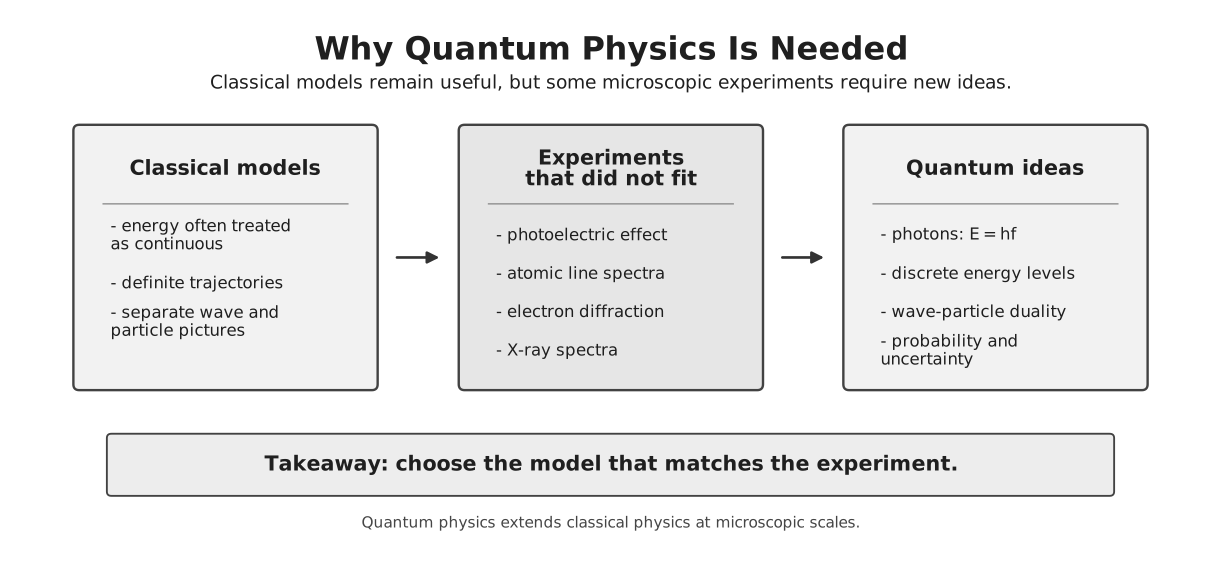
Figure: Classical physics treats many quantities as continuous and definite, while the assessed quantum topic introduces quantised exchanges, wave-particle evidence and a fundamental position–momentum uncertainty limit. Probability-density formalism is retained separately as enrichment.
This topic serves as the master overview hub linking:
- Photoelectric Effect
- X-Ray Production and Spectra
- Uncertainty Principle
- Enrichment: 1D Infinite Potential Well
- Wave-Particle Duality
- Atomic Structure
Core Ideas
- quantum physics is needed when classical wave or particle models fail
- energy transfer by light is often described using photons with energy
- not everything is quantised, but many microscopic exchanges and allowed states are discrete
- the photoelectric effect is strong evidence that light transfers energy in photon packets
- light and electrons both show wave-like and particle-like behaviour in different experiments
- atomic spectra arise because electrons occupy discrete energy levels
- line spectra are evidence that atoms emit and absorb photons with discrete energies
- X-ray spectra combine electron deceleration with atomic energy-level transitions
- Enrichment: wavefunctions describe quantum states, and gives probability density
- Enrichment: confinement in a one-dimensional infinite potential well produces discrete standing-wave states
- uncertainty is a fundamental feature of quantum systems, not merely poor measurement
Why Classical Physics Failed
Classical physics gives powerful models for mechanics, waves, fields, and circuits. The difficulty is that several experiments did not fit the classical expectations.
| Phenomenon | Classical expectation or difficulty | Quantum idea needed |
|---|---|---|
| Photoelectric effect | A sufficiently intense wave should eventually eject electrons even at low frequency. | One photon transfers energy to one electron. |
| Atomic line spectra | Accelerating charges and classical orbits do not naturally give sharp element-specific lines. | Electrons occupy discrete energy levels. |
| Electron diffraction | Electrons are particles, so wave diffraction seems unexpected. | Matter has wave properties with . |
| X-ray spectra | A simple continuous radiation picture cannot explain both a cutoff and sharp characteristic peaks. | Photon energy and atomic transitions are quantised. |
| Microscopic localisation | A particle should be describable by exact position and exact momentum. | Quantum states have uncertainty limits. |
The important exam habit is to identify which classical assumption failed before choosing the quantum explanation.
Quantisation Idea
Quantisation means that a quantity or exchange can occur only in allowed discrete amounts, not every possible value.
This does not mean every quantity in every situation is automatically quantised in the same way. The idea is context-dependent.
Examples:
- light energy is transferred in photons of energy
- electrons in atoms occupy allowed energy levels
- atomic transitions emit or absorb photons with energy equal to the level difference
Continuous and discrete models can both appear in the same chapter. For example, X-ray spectra have a continuous background plus sharp characteristic lines.
Concept Checkpoint
- If a question asks about photon energy, look first at frequency.
- If a question asks about atomic spectra, look first at energy-level differences.
- If a question asks whether emission occurs in the photoelectric effect, look first at threshold frequency.
Photons Overview
Light behaves as a wave in interference and diffraction experiments, but it transfers energy in discrete packets called photons in many quantum interactions.
Each photon has energy:
where:
- = photon energy
- = Planck constant
- = frequency
Since for electromagnetic waves in vacuum,
So:
- higher-frequency light has higher-energy photons
- shorter-wavelength light has higher-energy photons
- intensity is not the same thing as photon energy
For monochromatic light, intensity is related to how much energy arrives per unit area per unit time. If the frequency is fixed, greater intensity usually means a greater photon number rate, not more energy per photon.
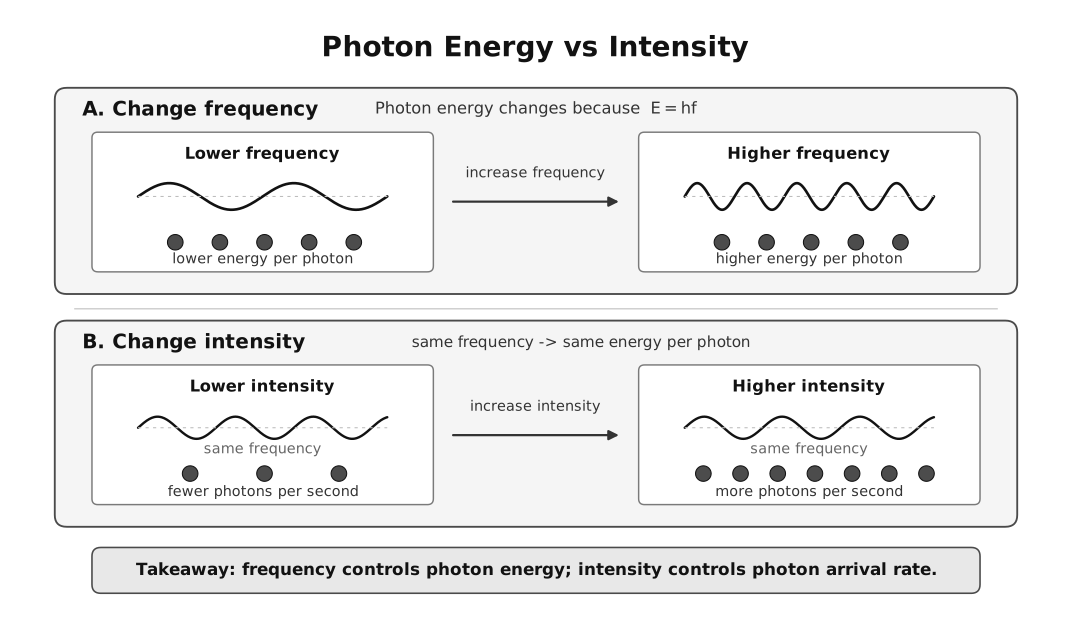
Figure: At fixed frequency, increasing intensity increases the photon arrival rate and therefore the possible photocurrent. Increasing frequency increases the energy of each photon and therefore can change the maximum kinetic energy of emitted electrons.
One Photon to One Electron
In the photoelectric effect, the useful simple model is:
- one photon interacts with one electron
- the photon energy is
- some energy is used to overcome the work function
- any remainder becomes the electron’s maximum kinetic energy
This is why low-frequency light cannot eject electrons, even if the beam is very intense.
Photoelectric Effect Overview
When light shines on certain metal surfaces, electrons may be emitted.
Key observations:
- emission requires threshold frequency
- emission can be immediate
- increasing intensity increases emitted electron number
- for a fixed metal, maximum electron kinetic energy depends on frequency
Classical wave theory struggles because it suggests that energy is spread through the wave and that a sufficiently intense beam should eventually supply enough energy. Experimentally, below the threshold frequency there is no emission, however intense the light is.
The photon model explains this directly. For each emitted electron:
where:
- is the work function of the metal
- is the maximum kinetic energy of emitted photoelectrons
The stopping potential is found by applying a reverse p.d. just large enough to stop even the fastest electrons:
Stopping potential measures maximum kinetic energy, not photocurrent. Photocurrent is more closely linked to how many electrons are collected per second.
See Photoelectric Effect.
Concept Checkpoint
- Frequency controls whether emission is possible.
- Above threshold, frequency controls and .
- Above threshold, intensity controls the rate of emission and photocurrent.
Wave-Particle Duality Overview
Quantum physics does not say that light is sometimes “really” a wave and sometimes “really” a particle in the everyday sense. It says that the model needed depends on the experiment.
Light shows:
- wave behaviour, such as interference and diffraction
- particle behaviour, such as the photoelectric effect
Electrons show:
- particle behaviour, such as charge, tracks, and collisions
- wave behaviour, such as electron diffraction
de Broglie proposed:
where is momentum.
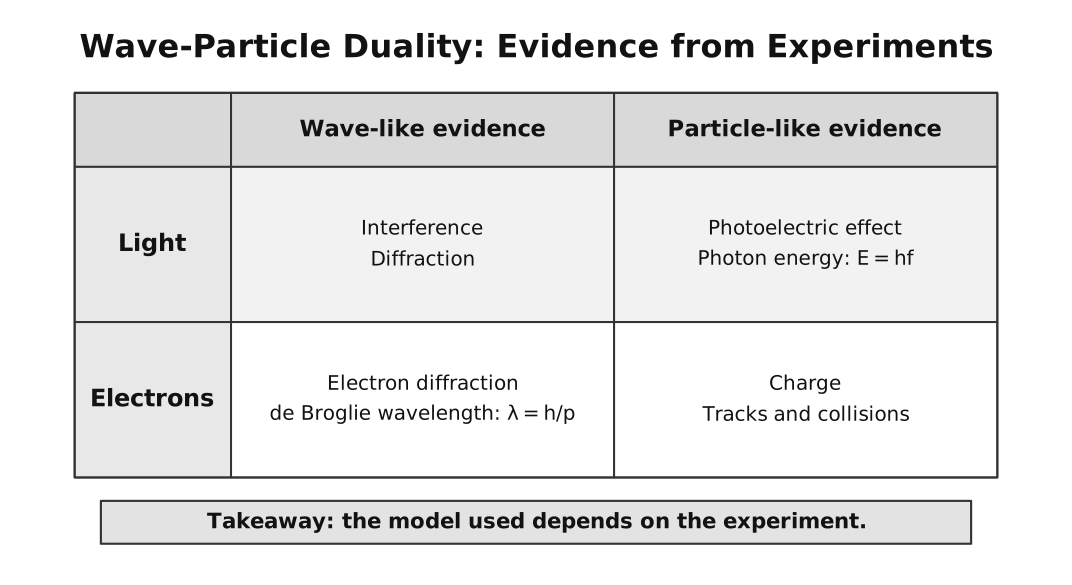
Figure: Different experiments reveal different aspects of light and matter. Wave-particle duality is an evidence-based summary: use wave or particle models according to the observation being explained, not by mixing formulas blindly.
This topic is developed fully in Wave-Particle Duality.
Atomic Energy Levels Overview
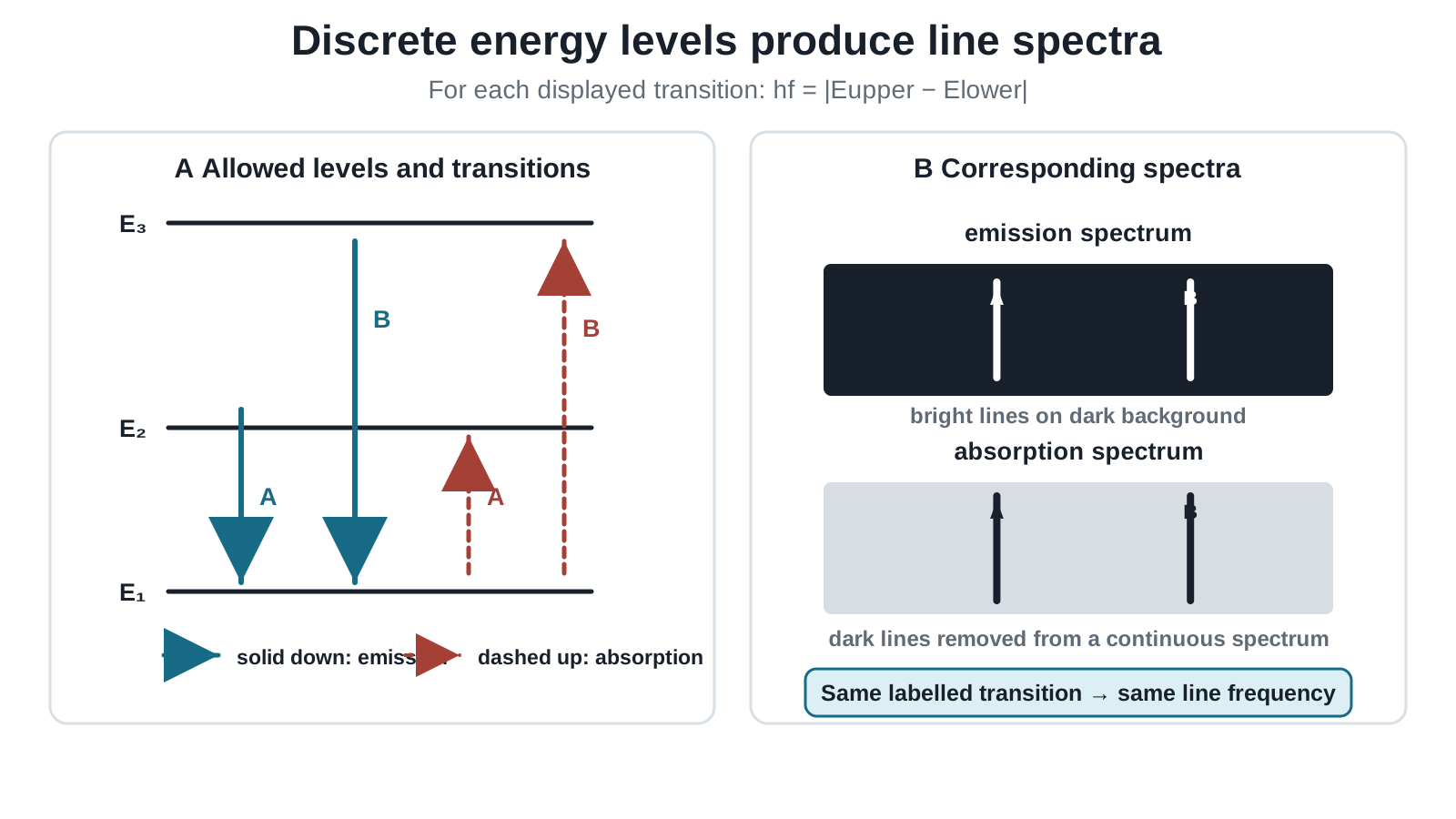
Figure: The diagram pairs the displayed and transitions with exactly two aligned spectral frequencies. A downward transition emits a photon; the reverse upward transition absorbs a photon. In each case , so the same energy gap gives the same line frequency.
Electrons in atoms occupy discrete allowed energies.
When electrons move between levels:
- photons are emitted or absorbed
This explains line spectra.
How the Two Line Spectra Are Produced
An emission line spectrum is produced when atoms in a low-density gas are excited, for example by an electrical discharge. Electrons in the atoms move to higher allowed levels. When they return to lower levels, the atoms emit photons whose energies equal the allowed downward energy gaps. Against a dark background, these appear as bright lines at particular frequencies or wavelengths.
An absorption line spectrum is produced when radiation with a continuous range of wavelengths passes through a cooler, low-density gas. An atom absorbs a photon only when its energy matches an allowed upward energy gap from an occupied lower level. Those photons are removed from the transmitted beam, so dark lines appear within the continuous spectrum.
For the same atomic species, a corresponding upward and downward transition has the same energy gap. Its absorption and emission lines therefore occur at the same frequency or wavelength, although the complete observed line sets depend on which lower and upper states are populated.
For emission:
- an electron moves from a higher energy level to a lower energy level
- the atom emits a photon
- the photon energy equals the energy difference
For absorption:
- an electron absorbs a photon only if the photon energy matches an allowed energy gap
- this explains why atoms absorb particular wavelengths
Detailed treatment:
Line Spectra as Evidence for Quantisation
Line spectra are one of the clearest pieces of evidence that atomic energies are quantised.
Atoms emit or absorb light at specific wavelengths rather than all wavelengths continuously. Since photon energy is:
specific wavelengths imply specific photon energies.
For atomic transitions:
So a line spectrum shows that only certain energy differences are allowed inside the atom. This supports the quantum model in which electrons occupy discrete energy levels.
Use this section as the quantum-physics bridge:
- discrete spectral lines imply discrete photon energies
- discrete photon energies imply discrete atomic energy gaps
- discrete atomic energy gaps imply quantised electron energy levels
The detailed home for energy-level diagrams, emission spectra, absorption spectra, ionisation, transition calculations, and possible spectral lines remains Atomic Structure.
X-Ray Production Overview
High-speed electrons striking a metal target can produce X-rays.
There are two main parts of an X-ray spectrum:
- continuous Bremsstrahlung spectrum: electrons decelerate by different amounts in the target
- characteristic X-ray lines: inner-shell transitions in target atoms emit photons of specific energies
The minimum wavelength occurs when one electron transfers all its kinetic energy to one photon:
where is the tube accelerating voltage.
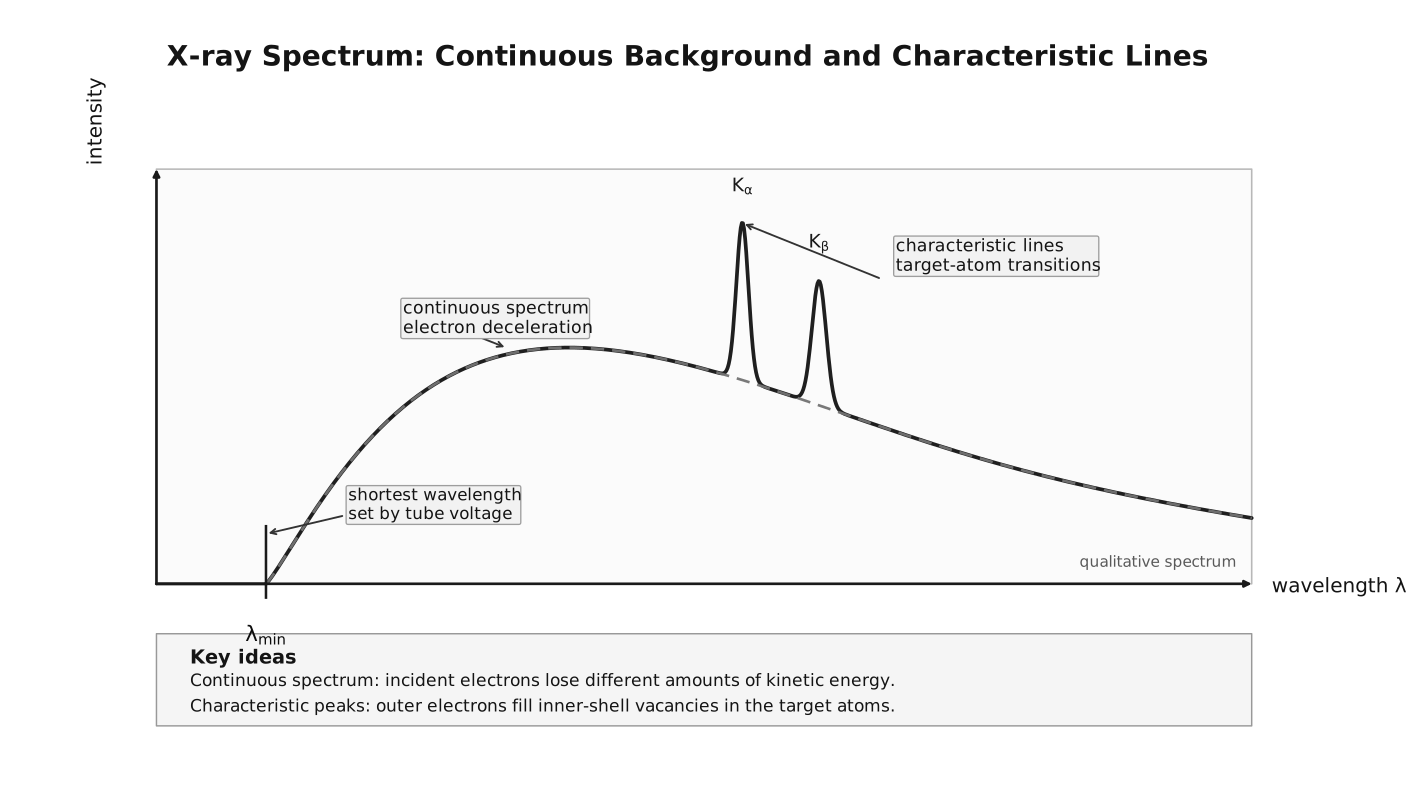
Figure: The continuous X-ray spectrum has a short-wavelength cutoff set by the tube p.d. Characteristic peaks depend on target-atom transitions; on a wavelength axis, is at shorter wavelength than .
Changing experimental conditions:
- increasing tube voltage decreases and can increase maximum photon energy
- increasing tube current increases intensity but not the cutoff wavelength
- changing target material changes the characteristic-line positions
See X-Ray Production and Spectra.
Uncertainty Overview
In quantum physics, a microscopic particle is not always well described as a tiny object with a perfectly definite position and momentum. A more useful picture is often a wave packet.
A narrow wave packet gives better localisation in position, but it requires a wider spread of wavelengths and momenta. This leads qualitatively to the uncertainty principle:
Meaning:
- smaller means position is known more precisely
- larger means momentum is less precisely known
- this is a fundamental quantum limit, not just a limitation of poor apparatus
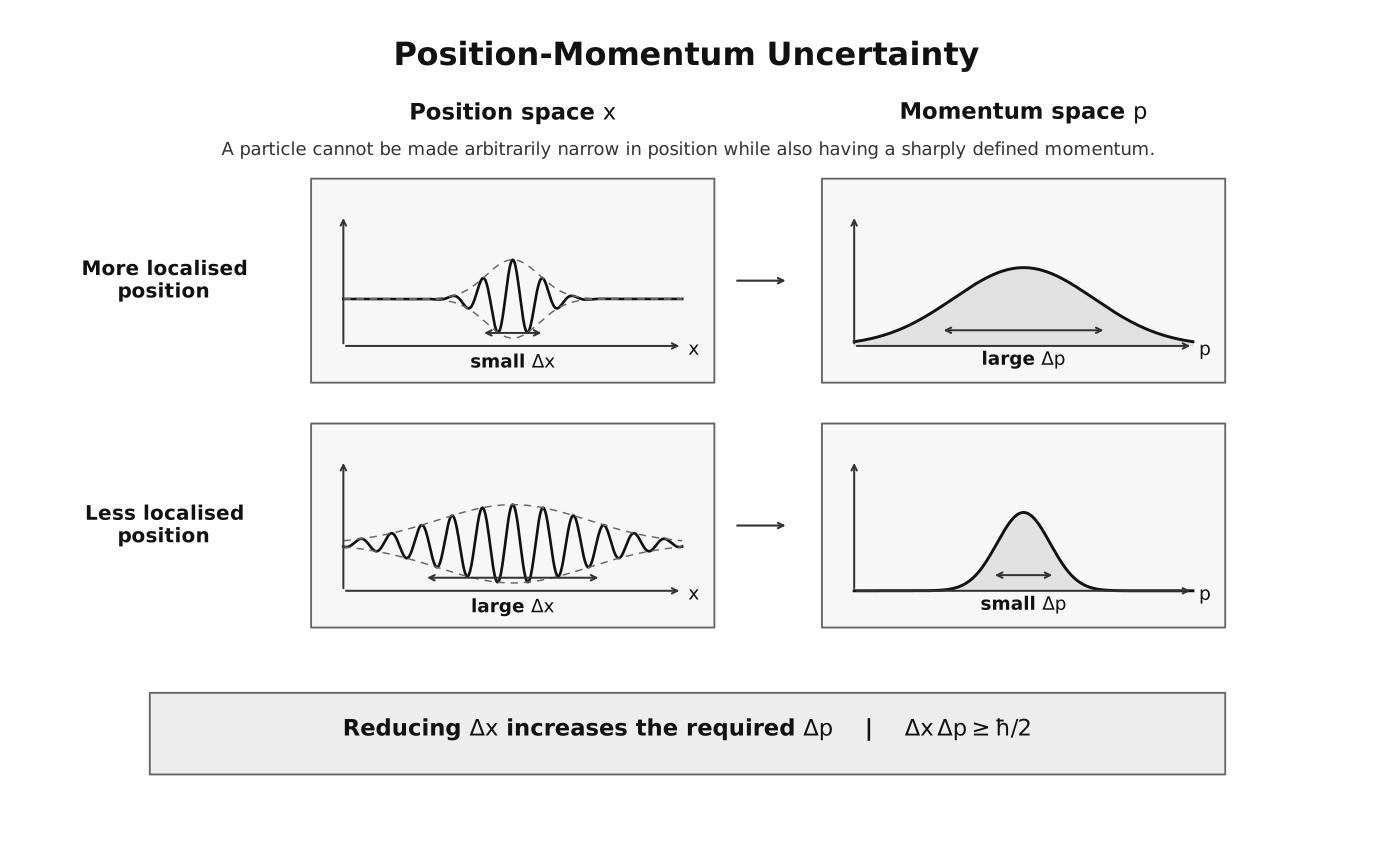
Figure: Each row compares a non-negative position probability-density distribution with a non-negative momentum probability-density distribution. A narrower position distribution (smaller ) is paired with a broader momentum distribution (larger ), while a broader position distribution is paired with a narrower momentum distribution. The probability-density representation is visual enrichment; the assessed conclusion is the order-of-magnitude relation , not an exact equality.
Enrichment: wavefunction language
In fuller quantum mechanics, a particle is described by a wave function . The quantity is interpreted as a probability density. This formalism is useful background but is not an explicit Topic 19(a–o) outcome.
Enrichment: 1D Infinite Potential Well Overview
The one-dimensional infinite potential well is a simple model of a particle confined inside a region of length .
The key quantum idea is that the wavefunction must fit the boundary conditions at the walls. Only certain standing-wave patterns are allowed, so the particle can have only certain energies.
For a well of width :
and the allowed energies are:
where .
Important meanings:
- is not allowed
- the ground-state energy is not zero
- gives probability density
- narrower wells produce larger energy spacing
- the model connects confinement with the uncertainty principle
See 1D Infinite Potential Well.
Enrichment extension: Tunnelling
Quantum tunnelling is the possibility that a particle has a non-zero probability of being found beyond a barrier even when classical energy reasoning says it should not pass through. This idea underlies devices such as the scanning tunnelling microscope. Treat this as enrichment unless explicitly required by your syllabus or teacher.
How the Main Ideas Connect
Light
- wave behaviour: diffraction, interference
- particle behaviour: photons
Electrons
- particle behaviour: charge, collisions
- wave behaviour: diffraction
Atoms
- electrons occupy quantised energy levels
- transitions emit or absorb photons
- line spectra provide evidence for discrete energy gaps
Enrichment: Confined Quantum Particles
- wavefunctions must satisfy boundary conditions
- confinement produces discrete standing-wave states
- probability density is given by
X-Rays
- accelerated electrons produce high-energy photons
- spectra reveal both continuous energy loss and discrete atomic transitions
Measurements
- uncertainty limits simultaneous precision
- Enrichment: fuller quantum mechanics uses probability distributions to predict detection outcomes
The assessed ideas above form the 9749 Topic 19 core; the explicitly labelled extensions provide a broader view of quantum physics.
Exam Relevance
For the assessed 9749 Topic 19 core, students should be able to:
- distinguish classical and quantum explanations
- interpret the photoelectric effect qualitatively and quantitatively
- use electron diffraction as evidence for the wave nature of matter and apply
- explain why line spectra are evidence for quantised atomic energy levels
- distinguish emission from absorption line spectra and apply
- explain the difference between continuous and characteristic X-rays
- interpret the X-ray cutoff and characteristic-line positions
- apply as an order-of-magnitude uncertainty relation
- explain what a graph or spectrum says physically before doing algebra
Enrichment study goals
Interpreting wavefunctions, probability density, the one-dimensional infinite potential well and tunnelling can deepen understanding, but these are not listed as required Topic 19 examination outcomes.
Formula Summary
| Formula | Use it when | Key warning |
|---|---|---|
| Finding energy of one photon | Frequency controls photon energy, not intensity alone. | |
| Photon energy is given by wavelength | Use SI units for , , and . | |
| Photoelectric-effect energy balance | Applies to maximum kinetic energy of emitted electrons. | |
| Relating stopping potential to fastest photoelectrons | Stopping potential is not photocurrent. | |
| Matter-wave de Broglie wavelength | Momentum must be in SI units. | |
| Atomic emission or absorption transitions | Use the magnitude of the energy difference for photon energy. | |
| Enrichment: | 1D infinite potential well energy levels | starts from 1, not 0; energy scales as . |
| Minimum X-ray wavelength from tube voltage | This is the maximum-photon-energy limiting case. | |
| Position-momentum uncertainty | Use this assessed order-of-magnitude form; it is a fundamental limit, not bad apparatus. |
Revision Roadmap
Use this learning path:
- Start with why classical models fail.
- Learn photon energy and the intensity-frequency distinction.
- Study Photoelectric Effect as the clearest photon-model example.
- Study Wave-Particle Duality to compare wave and particle evidence.
- Study Atomic Structure for energy levels and line spectra.
- Enrichment: study 1D Infinite Potential Well to see how boundary conditions lead to quantised energies.
- Return to X-Ray Production and Spectra to connect high-energy electrons, photons, and spectra.
- Finish with Uncertainty Principle and the assessed order-of-magnitude relation .
Common Exam Traps
Frequent mistakes include:
- confusing intensity with photon energy
- forgetting threshold frequency
- mixing wave evidence with particle evidence
- confusing continuous and characteristic X-rays
- using the wrong formula for stopping potential
- treating line spectra as continuous rather than discrete
Enrichment trap
If you choose to study the one-dimensional infinite potential well, remember that is not an allowed state. This is enrichment, not a required Topic 19 exam trap.
Use the dedicated checklist after revision:
Quantum Physics Common Exam Traps
Summary
Quantum physics explains microscopic phenomena that classical models cannot handle alone.
Assessed 9749 Topic 19 Core
- electromagnetic radiation transfers energy in photons with
- interference and diffraction provide wave evidence, while the photoelectric effect provides particle evidence for light
- electron diffraction provides wave evidence for matter, with
- photoelectric emission requires , and
- isolated atoms have discrete electronic energy levels, giving emission and absorption lines with
- an X-ray tube produces a continuous background and target-specific characteristic lines, with at the cutoff
- position and momentum spreads obey the assessed order-of-magnitude relation
Enrichment
- wavefunctions and probability density provide a fuller description of quantum states
- the one-dimensional infinite potential well illustrates confinement and discrete standing-wave energies
- tunnelling, STM, photon momentum and time–energy uncertainty extend the assessed model
For examination work, choose the assessed model that matches the evidence: wave model, photon model, matter-wave model, energy-level model, X-ray-production model or uncertainty relation. Use the explicitly labelled enrichment models only when studying beyond the required Topic 19 outcomes or when a question supplies the needed framework.
Links
- Quantum Physics
- Photoelectric Effect
- X-Ray Production and Spectra
- Quantum Physics Common Exam Traps
- Wave-Particle Duality
- Atomic Structure
- Uncertainty Principle
- 1D Infinite Potential Well
Provenance
- source files:
- revised as a topic-local conceptual hub on 2026-06-24
- updated for line spectra as quantisation evidence and 1D infinite potential well on 2026-06-27