Geostationary Orbit
Branch note: This page deepens one part of Gravitational Fields.
Overview
A geostationary orbit is a special circular orbit around Earth in which a satellite appears fixed above the same point on Earth’s surface.
This is possible only when the satellite:
- moves in a circular orbit;
- lies in the plane of the equator;
- travels in the same direction as Earth’s rotation;
- has the same angular velocity vector as Earth.
Geostationary satellites are important for communications, broadcasting, weather observation, and long-duration regional monitoring.
This topic connects Gravitational Fields and Orbital Motion in Gravity.
Definition
A geostationary satellite remains above the same fixed point on the equator as Earth rotates. To an observer on Earth, it appears stationary in the sky.
Why It Matters
Geostationary orbit is a high-value JC example because it combines:
- gravitational force as the source of centripetal acceleration;
- circular motion equations;
- the distinction between radius from Earth’s centre and height above Earth’s surface;
- conceptual conditions, not only calculation.
It is also a common explanation question: matching Earth’s rotation period alone is necessary but not sufficient.
Key Representations
For a satellite of mass orbiting Earth of mass at radius , gravitational force provides the radial force:
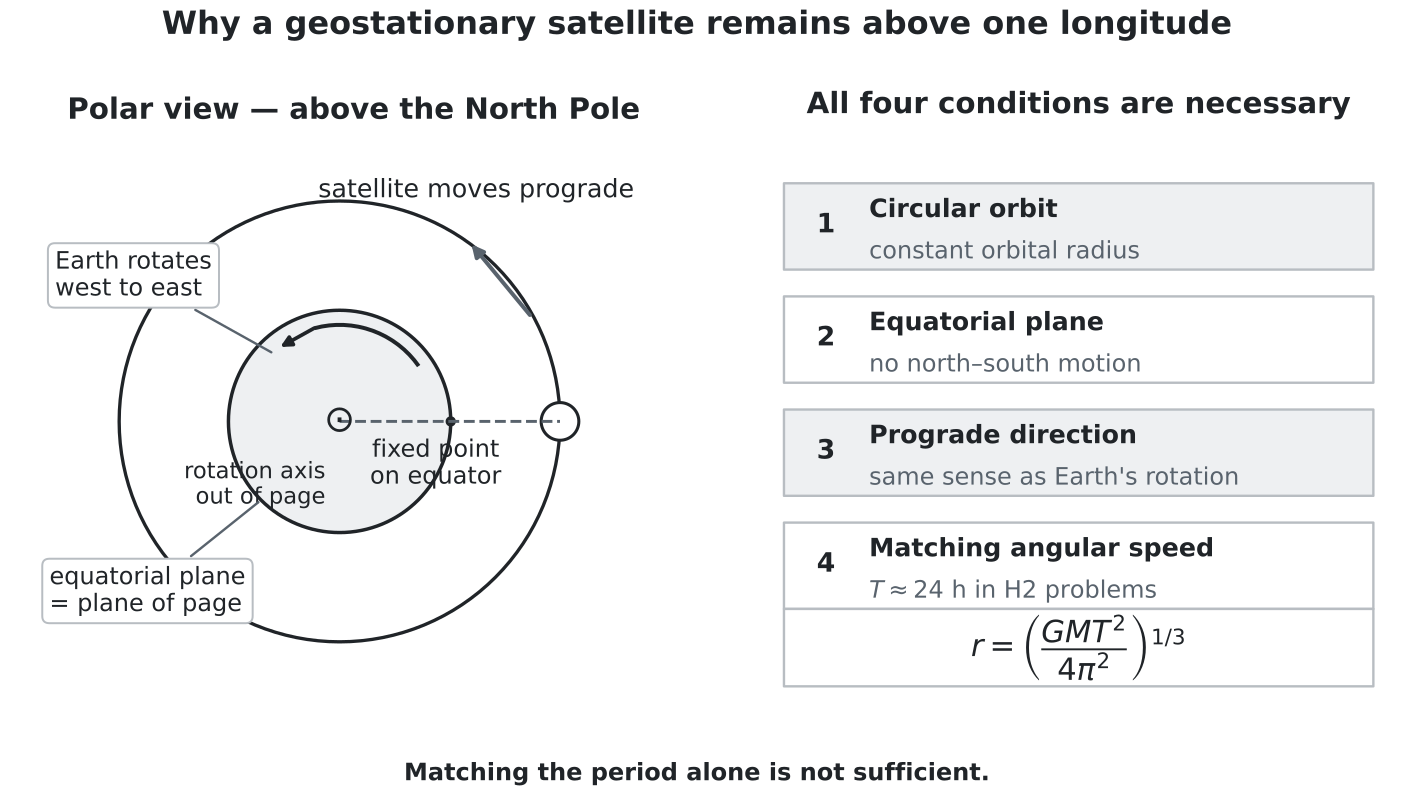
Figure: The orbit must be circular and lie in Earth’s equatorial plane. The satellite must move prograde with the same angular speed as Earth; only then does the line from Earth’s centre to the satellite continue to meet the same equatorial longitude.
where:
For circular motion, using :
Substitute this into the radial-force relation:
Simplifying:
Hence:
so:
The orbital radius depends on Earth’s mass, , and orbital period . It does not depend on satellite mass. Therefore all geostationary satellites have the same orbital radius.
Core Ideas
- A geostationary satellite must be circular, equatorial, and moving in the same direction as Earth rotates.
- Its period matches Earth’s rotation, so it has the same angular velocity as Earth.
- The orbital radius is measured from Earth’s centre, not from Earth’s surface.
- Satellite mass cancels from the orbital-radius derivation.
Exam Relevance
Use this branch for explaining the full geostationary conditions, deriving the geostationary radius, distinguishing radius from height, and avoiding the common mistake that a 24 h period alone is sufficient.
Conditions for a Geostationary Orbit
A satellite is geostationary only if all of the following are satisfied.
1. Circular Orbit
The radius must remain constant. If the orbit were elliptical, the speed and distance would vary, so the satellite would not remain fixed relative to Earth.
2. Orbital Period Equal to Earth’s Rotation Period
The satellite must have the same period as Earth’s rotation:
More precisely, Earth turns once relative to the distant stars in one sidereal day, about . H2 calculations normally use unless another value is supplied.
3. Orbit in the Equatorial Plane
The satellite must orbit directly above the equator. If not, it would move north and south relative to Earth’s surface and would not stay above one fixed point.
4. Same Direction as Earth’s Rotation
Earth rotates from west to east. The satellite must also orbit from west to east. If it orbited the other way, its apparent position would change rapidly.
Why the Orbit Must Be Above the Equator
Gravity always acts toward Earth’s centre. For a circular orbit, the centre of the orbit must coincide with Earth’s centre.
Only an orbit in the equatorial plane can allow the satellite to remain above one fixed latitude. If the orbit were tilted:
- the satellite would move between northern and southern hemispheres;
- it would not remain over a single point on Earth.
This is a classic explanation question.
Standard Value for Earth
Using Earth’s data and:
gives:
This is measured from Earth’s centre. Since:
the height above Earth’s surface is:
or:
Orbital Speed
Using:
a geostationary satellite has a fixed orbital speed because all such satellites have the same and .
Thus all geostationary satellites have the same:
- orbital radius;
- angular velocity vector ;
- orbital speed.
Uses, Advantages, and Limitations
Uses include:
- television broadcasting;
- telephone signals;
- internet relay;
- satellite communications;
- weather observation.
Advantages:
- appears fixed in the sky;
- no moving ground-tracking dish is needed;
- continuous coverage of the same region;
- useful for real-time communications.
Limitations:
- very high orbit;
- significant signal delay compared with low-orbit satellites;
- poor coverage of polar regions;
- high launch cost.
Because geostationary satellites are above the equator, regions near the poles are viewed at very shallow angles or not well covered.
Enrichment — Geostationary vs Geosynchronous
Terminology extension
The syllabus requires understanding geostationary orbits. The broader classification below is useful clarification, not a separate stated outcome.
A geosynchronous orbit has a period equal to Earth’s sidereal rotation period.
A geostationary orbit is the special case that is also:
- circular;
- equatorial;
- in the same direction as Earth’s rotation.
Therefore:
A matching period is necessary, but not sufficient.
Common Exam Traps
- Saying “geostationary” means only a period of approximately is incomplete.
- Use orbital radius from Earth’s centre: , not just .
- Gravity provides the radial force.
- Satellite mass cancels, so different geostationary satellites have the same orbital radius and speed.
- Do not confuse geostationary with general geosynchronous orbit.
Problem-Solving Strategy
If asked to derive orbital radius, start with:
Use:
Then solve for .
If asked why it must be above the equator, explain:
- gravity acts toward Earth’s centre;
- the orbit centre must be Earth’s centre;
- only an equatorial circular orbit keeps constant latitude.
If asked why all geostationary satellites have the same speed, use the fact that all have the same and , so:
is the same.
Summary
A geostationary satellite:
- remains above one fixed point on Earth;
- must have circular equatorial orbit;
- moves west to east;
- has a period equal to Earth’s sidereal rotation period (usually approximated as in H2 calculations).
Core relation:
and:
For Earth:
Geostationary orbit is a special application of gravitational circular motion that allows continuous fixed-position observation and communication.
Links
- Main topic: Gravitational Fields
- Related concept: Orbital Motion in Gravity
- Misconception: Apparent Weightlessness and Gravity