Orbital Motion in Gravity
Branch note: This page deepens one part of Gravitational Fields.
Overview
Orbital Motion in Gravity explains how gravity provides the inward resultant force required for circular motion. Planets, moons, satellites, and space stations move in orbits because gravitational attraction continuously changes the direction of velocity.
This topic links:
Why It Matters
Orbital motion combines several major JC Physics ideas in one setting:
- Newton’s laws and resultant force
- circular motion and centripetal acceleration
- gravitational fields and inverse-square forces
- the distinction between force, acceleration, velocity, and orbital geometry
It also explains why satellites can remain in orbit even though gravity is still acting, and why apparent weightlessness does not mean zero gravity.
Definition
An orbit is produced when forward tangential motion is continuously redirected inward by gravitational acceleration.
Without gravity, an object would move in a straight line at constant velocity. With gravity acting toward the central body:
- the direction of continuously changes
- the path curves inward
- an orbit can result
Key Representations
Core Ideas
An orbiting body has tangential velocity , but gravity pulls it toward the central mass.
Therefore:
- the direction of changes continuously,
- the motion curves inward,
- a circular orbit is possible if gravity exactly provides the required centripetal force.
Thus:
orbital motion = forward motion + continuous inward gravitational acceleration.
Exam Relevance
Use this branch for circular-orbit derivations, satellite-speed comparisons, Kepler’s third law, apparent weightlessness explanations, and questions where gravitational force supplies the radial resultant force.
Gravity as Centripetal Force
For a body of mass orbiting a central mass at radius :
Gravitational Force
Vector form:
where points radially outward.
Circular Motion Condition
Required inward resultant magnitude:
For circular orbit:
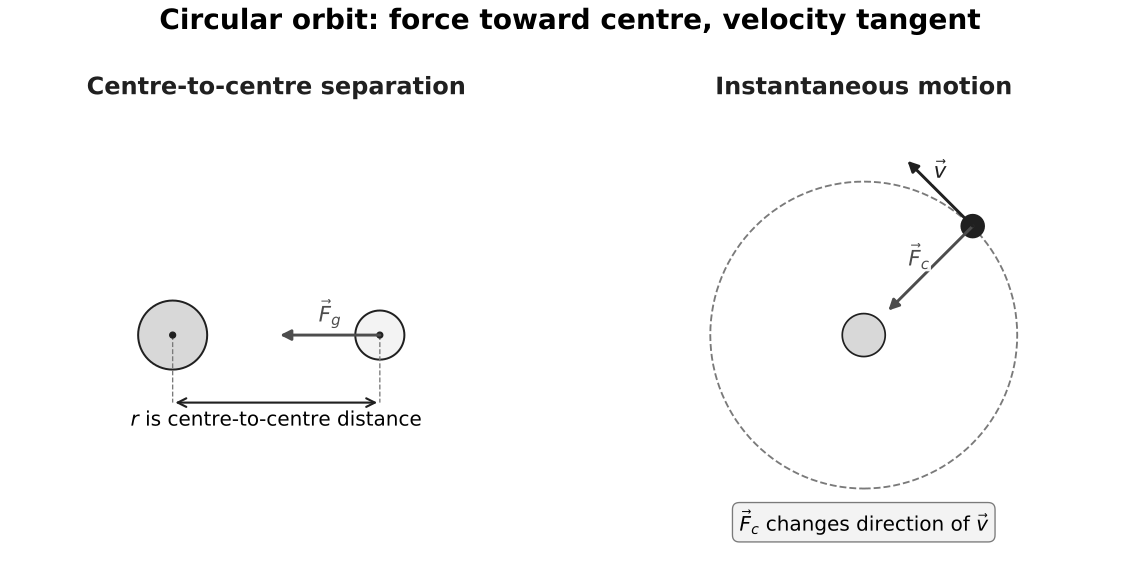
Figure: Velocity is tangent to the circular path. Gravitational force and acceleration point radially inward. The diagram does not add a separate “centripetal force”: gravity itself is the inward resultant.
Orbital Speed
From:
Cancel :
Meaning
- larger larger
- larger smaller
Important Result
Orbital speed is independent of satellite mass.
Angular Speed
Using:
Hence:
where is perpendicular to the orbital plane by the right-hand rule.
Orbital Period
Since:
Substitute for :
Hence:
This is the circular-orbit form of Kepler’s Third Law.
For objects orbiting the same central mass:
Orbital Acceleration
The acceleration is centripetal and directed toward the centre:
Using orbital speed:
This equals the gravitational field strength magnitude at radius :
Why Satellites Do Not Fall Straight Down
Satellites are continuously falling under gravity, but they also have sufficient tangential speed to keep missing Earth.
Thus:
- gravity changes direction of motion,
- not necessarily speed,
- the object remains in orbit.
Why Astronauts Feel Weightless
Astronauts in orbit are not beyond gravity.
They feel weightless because:
- spacecraft and astronauts are in free fall together,
- no normal contact force acts significantly on them.
Weightlessness does not mean zero gravity.
Enrichment — Energy in Circular Orbit
Beyond the stated Topic 08 outcomes
The results in this section follow from gravitational potential energy and circular-orbit equations, but detailed satellite-energy and orbital-decay analysis is not explicitly listed in the 2026 gravitational-field outcomes.
Kinetic Energy
Gravitational Potential Energy
Total Energy
Since , the satellite is gravitationally bound.
Low Orbit vs High Orbit
Low Earth Orbit
- smaller
- larger speed
- shorter period
- more negative total energy
Higher Orbit
- larger
- smaller speed
- longer period
- less negative total energy
If Energy Is Lost
If drag removes energy:
- total energy decreases,
- orbit radius decreases,
- the satellite moves toward a lower orbit,
- a lower circular orbit has a higher orbital speed,
- satellite spirals inward.
This is a useful enrichment insight.
Geostationary Orbit (Overview)
A geostationary satellite:
- moves in circular orbit,
- lies above the equator,
- moves west to east,
- has the same period as Earth’s rotation (approximately in H2 calculations),
- appears fixed above one point on Earth.
Useful for:
- communications,
- weather monitoring,
- broadcasting.
See Geostationary Orbit.
Worked Example 1: Orbital Speed Near Earth
Find the orbital speed of a satellite at:
Take:
Solution
Worked Example 2: Orbital Period
Using the same radius:
Worked Example 3: Compare Two Orbits
Satellite A orbits at radius .
Satellite B orbits at radius .
Compare speeds.
Solution
Since:
Satellite B moves at half the speed of A.
Common Exam Pitfalls
1. Using Height Instead of Orbital Radius
Use:
where is planet radius.
2. Thinking Heavier Satellite Needs Higher Speed
Satellite mass cancels.
3. Confusing Weightlessness with No Gravity
Gravity is still acting strongly.
4. Thinking Higher Orbit Means Higher Speed
Higher orbit means lower speed.
5. Mixing Period and Angular Speed
6. Forgetting Force Direction
is radial inward, not tangential.
Summary
Gravity provides the centripetal force required for orbital motion.
Circular Orbit Condition
Orbital Speed
Angular Speed
Orbital Period
Acceleration
Orbital motion is a direct application of gravitation plus circular motion.