Gravitational Fields
Topic hub: This is the main overview page for Topic 08. Use it as the starting point, then follow the branch notes for deeper treatment of specific subtopics.
Overview
Gravitation describes the universal attractive interaction between masses. It explains:
- why objects fall toward Earth,
- why planets orbit the Sun,
- why moons orbit planets,
- why satellites remain in orbit.
Gravitational interactions are long-range and act through a gravitational field. This topic connects ideas from Forces, Dynamics, Circular Motion, and Work, Energy and Power.
Syllabus boundary
The 2026 H2 Physics 9749 core includes gravitational force, field strength, potential, circular orbits, the gravitational–electric analogy, and geostationary orbits. This page labels escape speed and detailed satellite-energy results as Enrichment so that useful anchor material is retained without implying that it is a stated gravitational-field learning outcome.
Core Ideas
Newton’s Law of Gravitation
Any two point masses attract each other. For masses and separated by centre-to-centre distance , Newton’s law gives the magnitude
where
If is a unit vector directed outward from source mass to test mass , then the force on is:
The negative sign belongs to this chosen vector convention: it shows that the force is opposite to the outward direction , hence toward . Do not attach a negative sign to the magnitude .
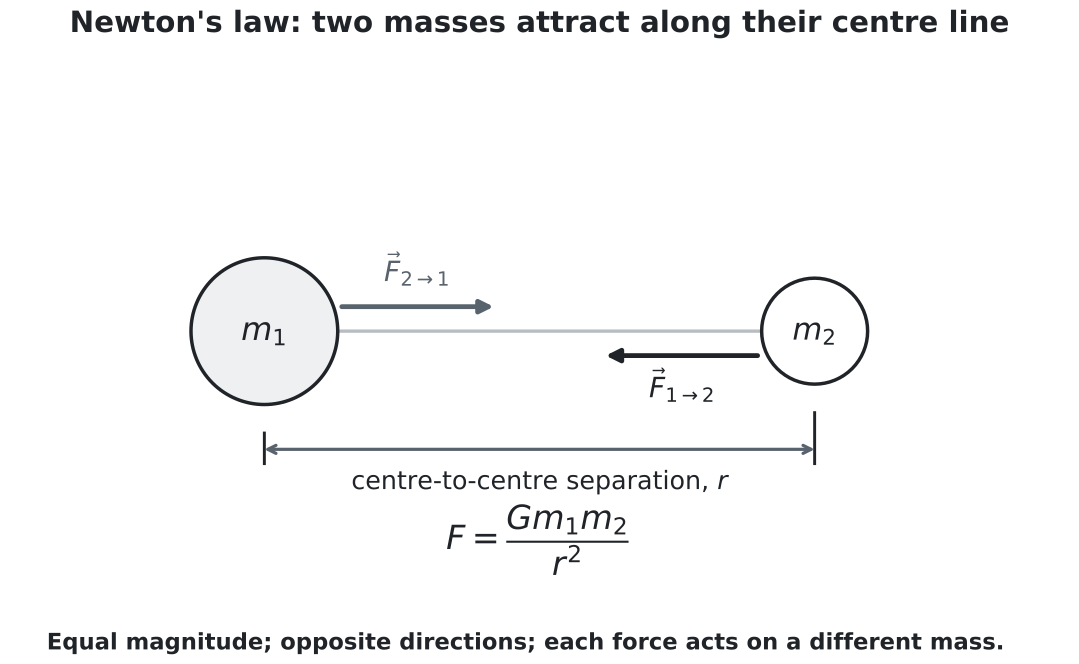
Figure: Each mass pulls the other along the same centre line. The two arrows form a Newton’s-third-law pair: equal magnitude, opposite direction, and acting on different bodies. The separation is measured between centres, not between surfaces.
Key Features
- Always attractive.
- Acts along the line joining centres.
- Obeys inverse-square law:
- If doubles, force becomes .
- Outside a spherically symmetric body, the field is the same as if all its mass were concentrated at its centre. For a non-spherical body, the point-mass approximation is good only when the separation is much larger than the body’s dimensions.
Gravitational Field Strength
A gravitational field is a region in which a mass would experience a gravitational force. The source mass creates the field; a sufficiently small test mass reveals the field without significantly altering the source configuration.
Gravitational field strength at a point is the gravitational force per unit mass on a small test mass placed at that point:
For a point mass :
Its direction is the direction of force on a positive test mass. For a single spherical source it points radially inward. Its magnitude is
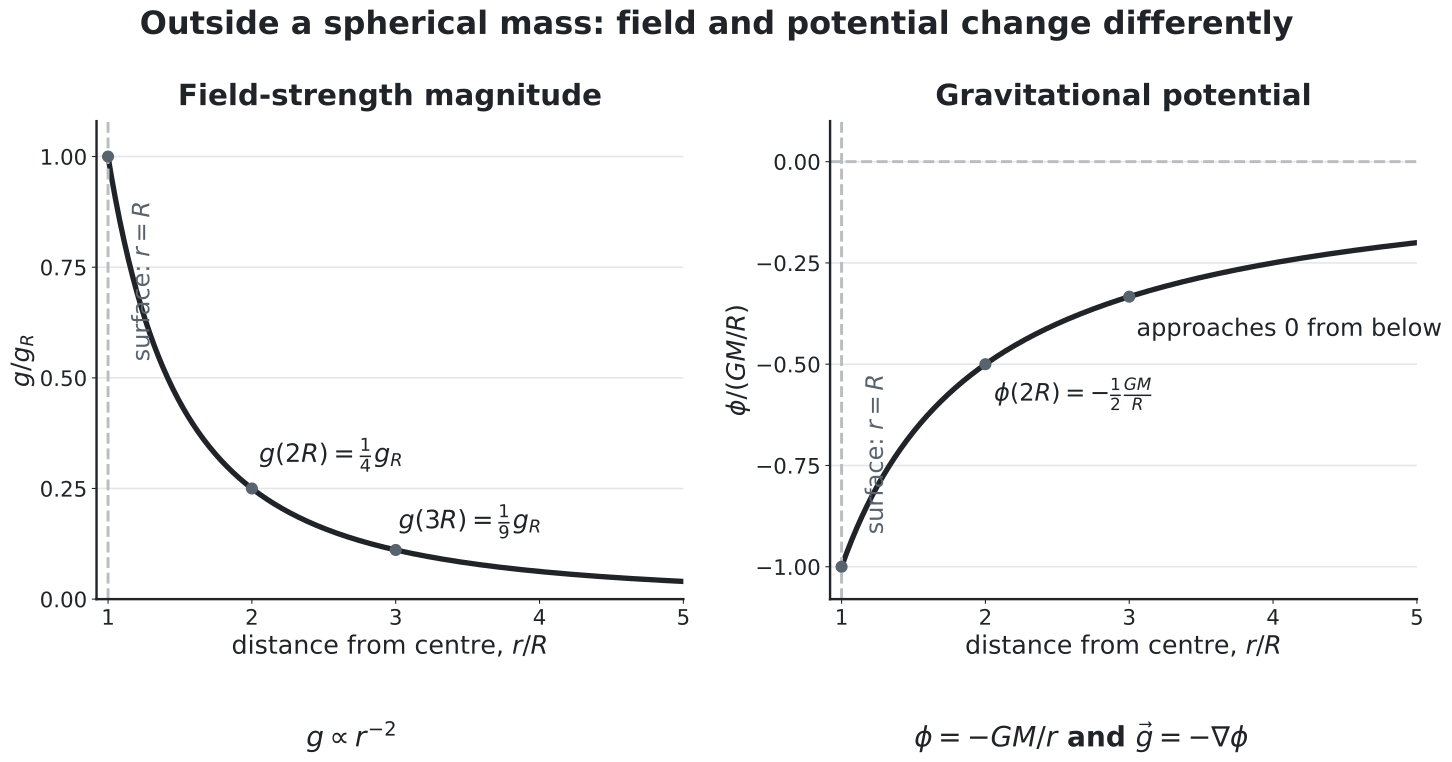
Figure: Outside a spherical body (), field strength falls as , whereas gravitational potential rises from a negative value toward zero as . The field magnitude is the magnitude of the potential gradient: a steeper potential curve means a stronger field. The plots do not describe the body’s interior.
Units of field strength are
Near Earth’s Surface
Near Earth’s surface, a small height change satisfies . Consequently,
- height changes are small compared with Earth’s radius,
- the change in distance from Earth’s centre is a small fraction of ;
- field lines over a small region are approximately parallel and equally spaced;
- is approximately uniform.
Hence:
Often taken as:
The same symbol is also used for free-fall acceleration because, when gravity is the only significant force,
This equality does not mean that is constant everywhere; it is a local statement.
Superposition of Fields
Gravitational field strength is a vector quantity.
If several masses are present:
Thus:
- direction matters,
- fields may reinforce,
- fields may cancel at certain points.
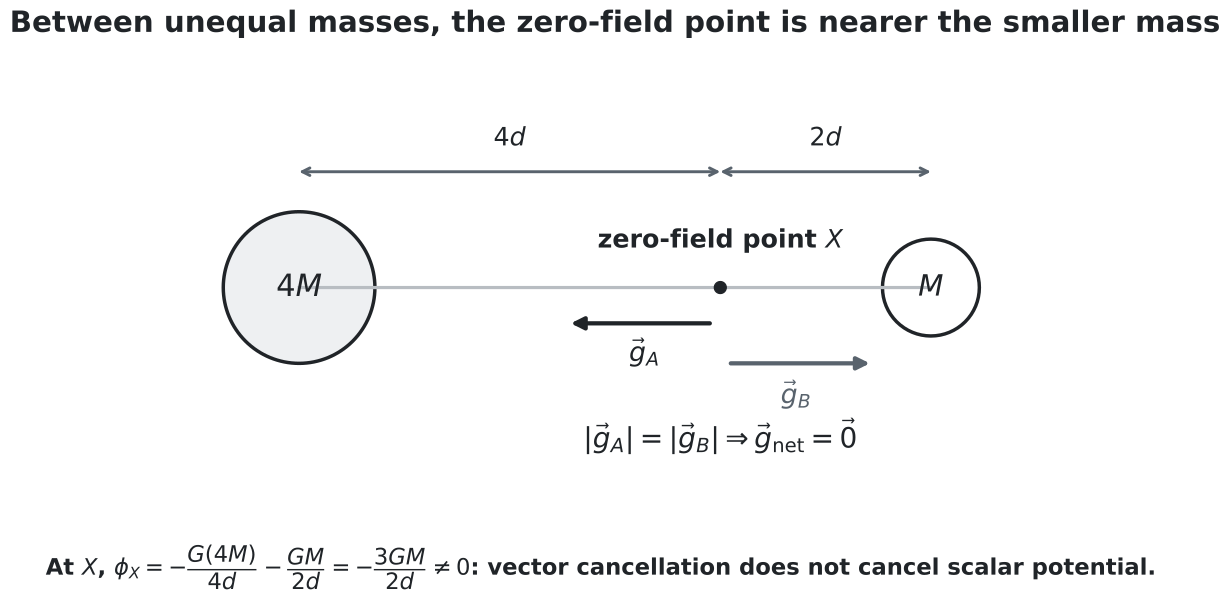
Figure: Here is an arbitrary length scale. Between unequal masses, the two field contributions point in opposite directions. Their magnitudes cancel at a point nearer the smaller mass, because a smaller distance is required to compensate for its smaller source mass. Zero resultant field does not mean zero gravitational potential: the two negative scalar potentials add.
Gravitational Potential
Gravitational potential at a point is the work done per unit mass by an external agent in bringing a small test mass from infinity to that point without a change in kinetic energy. Equivalently, it is the gravitational potential energy per unit mass.
For a point mass:
Units:
Key Ideas
- Potential is a scalar.
- The reference is at infinity.
- The external agent does negative work when moving the mass slowly inward, because gravity does positive work.
- Hence is negative at every finite distance from an isolated positive mass.
- Moving outward makes increase: it becomes less negative and approaches zero.
Superposition
Potentials add algebraically.
Gravitational Potential Energy
For a mass placed at gravitational potential :
Hence:
Meaning
- Energy of the mass-position system.
- Scalar quantity.
- Negative at every finite for positive masses when at infinity. It is negative total mechanical energy, not negative potential energy alone, that identifies a bound orbit.
Energy must be supplied to separate masses to infinity.
For motion from point A to point B,
If only gravity does work, . Always compare final minus initial potential before deciding the sign.
Relation Between Field and Potential
Force and field:
Field and potential:
Mathematical consolidation
The full vector-gradient notation below is useful but is not required mathematical formalism for Topic 08. For an H2 radial graph, read the examinable idea as: the signed outward field component equals the negative gradient of the – graph.
For a radial field with directed outward:
Since , , so the radial component is negative and the vector points inward. On a graph of against outward distance , the field component is the negative gradient, not the value of itself.
Force and potential energy:
For one-dimensional radial motion:
Circular Orbits
For a satellite of mass in a circular orbit around a much more massive central body , gravity is the real inward resultant force:
So:
Angular speed:
Orbital period:
Hence:
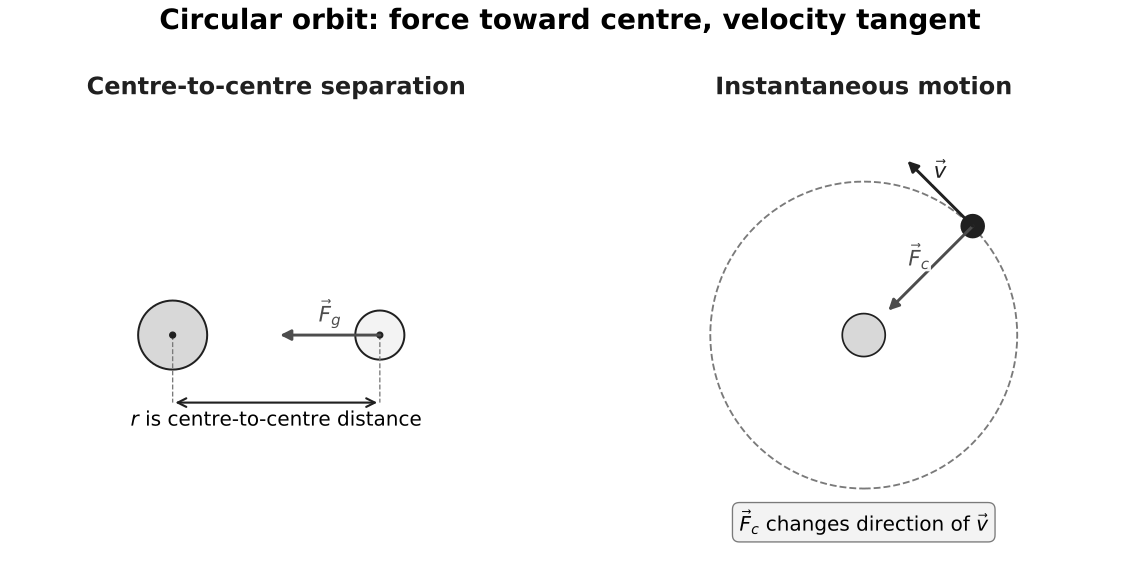
Figure: At every point, velocity is tangent to the orbit while gravitational force and acceleration point toward the centre. “Centripetal force” is not an additional force here; it is the name for the inward resultant supplied entirely by gravity.
Higher orbit:
- lower speed,
- longer period.
See Orbital Motion in Gravity.
Enrichment — Energy of a Circular Satellite
Beyond the stated Topic 7 outcomes
These energy formulae follow from examinable gravitational potential and circular-motion ideas, but they are not listed explicitly in the 2026 gravitational-field outcomes.
For circular orbit:
Total energy:
Since , the satellite is gravitationally bound.
If orbital energy decreases (e.g. drag):
- radius decreases,
- the satellite moves toward a lower orbit,
- a lower circular orbit has a higher orbital speed,
- satellite spirals inward.
Enrichment — Escape Velocity
Beyond H2 Physics 9749 syllabus scope
Escape speed is retained because it is useful physics and appears in the anchor notes, but it is not an explicit 2026 gravitational-field learning outcome.
Minimum launch speed from distance from centre to reach infinity with zero final speed.
This is an ideal energy benchmark: no air resistance, no further thrust, and no energy losses are assumed.
Using conservation of energy:
Thus:
For Earth:
See Escape Velocity.
Geostationary Orbit
A geostationary satellite remains above the same point on Earth’s equator.
Conditions:
- circular orbit,
- above equator,
- west to east,
- same angular velocity as Earth, so its period is one sidereal day (about , commonly approximated as in H2 problems).
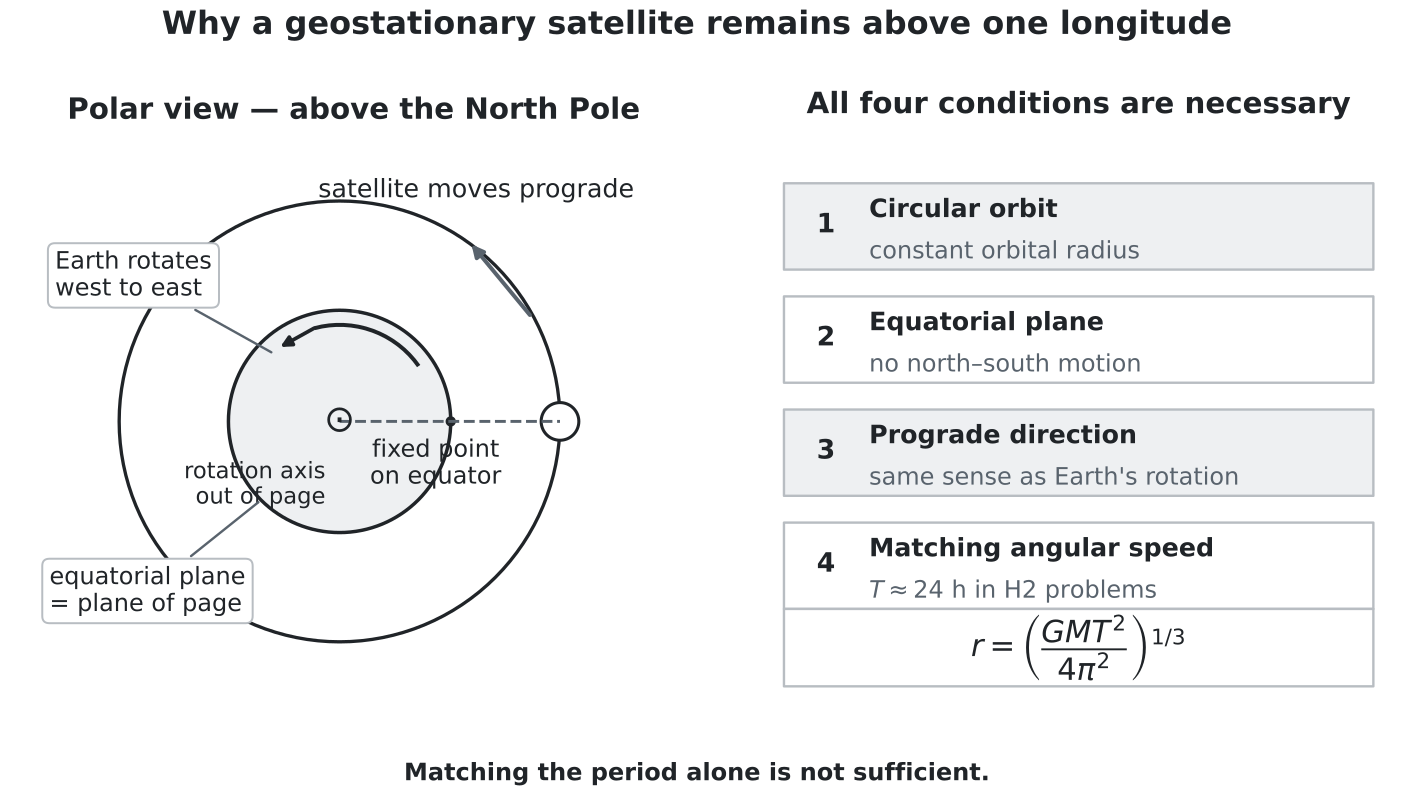
Figure: Only a circular, equatorial, prograde orbit with Earth’s angular speed can remain above one longitude. A tilted orbit crosses different latitudes, while a retrograde satellite moves across the sky in the opposite direction.
Uses:
- communications,
- weather monitoring,
- broadcasting.
See Geostationary Orbit.
Worked Examples
Example 1: Field Strength at Earth’s Surface
Using:
For Earth:
Gives:
Example 2: Orbital Speed
A satellite orbits Earth at radius .
So increasing decreases orbital speed.
Enrichment Example 3: Escape Speed from Moon
Use:
Same method as Earth, but Moon gives much smaller value.
Exam Relevance
Common Exam Pitfalls
- Confusing with .
- Confusing (vector) with (scalar).
- Using positive gravitational potential.
- Using altitude where the formula requires centre distance .
- Thinking gravity is zero in orbit.
- Thinking higher orbit means higher speed.
- Using constant far from Earth.
- Assuming zero field means zero potential.
- Confusing potential with potential energy .