Single-Slit Diffraction and Resolution
Branch note: This page covers the 2026 syllabus outcomes for the first minima of a single-slit pattern and the Rayleigh criterion. The older anchor note does not cover these outcomes fully, so the syllabus is the controlling source.
Overview
Single-slit diffraction shows that a finite aperture cannot produce an infinitely sharp beam or image. Light from different parts of the slit interferes, producing a broad central maximum and weaker side maxima.
The same diffraction limit explains resolution: two nearby sources cannot be separated clearly if their diffraction patterns overlap too strongly.
Core Ideas
- A slit of width produces minima at directions where contributions from different parts of the slit cancel.
- The first minima satisfy .
- The central maximum lies between the two first minima.
- A smaller aperture or longer wavelength gives greater spreading and poorer resolution.
- Rayleigh’s criterion gives the approximate minimum resolvable angular separation for a single aperture.
Exam Relevance
You should be able to:
- apply to find the first-minimum angle;
- use the small-angle approximation when appropriate;
- estimate central maximum width on a distant screen;
- apply for resolution;
- explain qualitatively why diffraction limits image sharpness.
From a slit to an intensity pattern
When monochromatic light passes through a slit of width , different parts of the wavefront across the slit act as secondary sources. Their contributions interfere on a distant screen. The result is not a uniformly illuminated spread: it is a broad central maximum with weaker side maxima separated by minima.
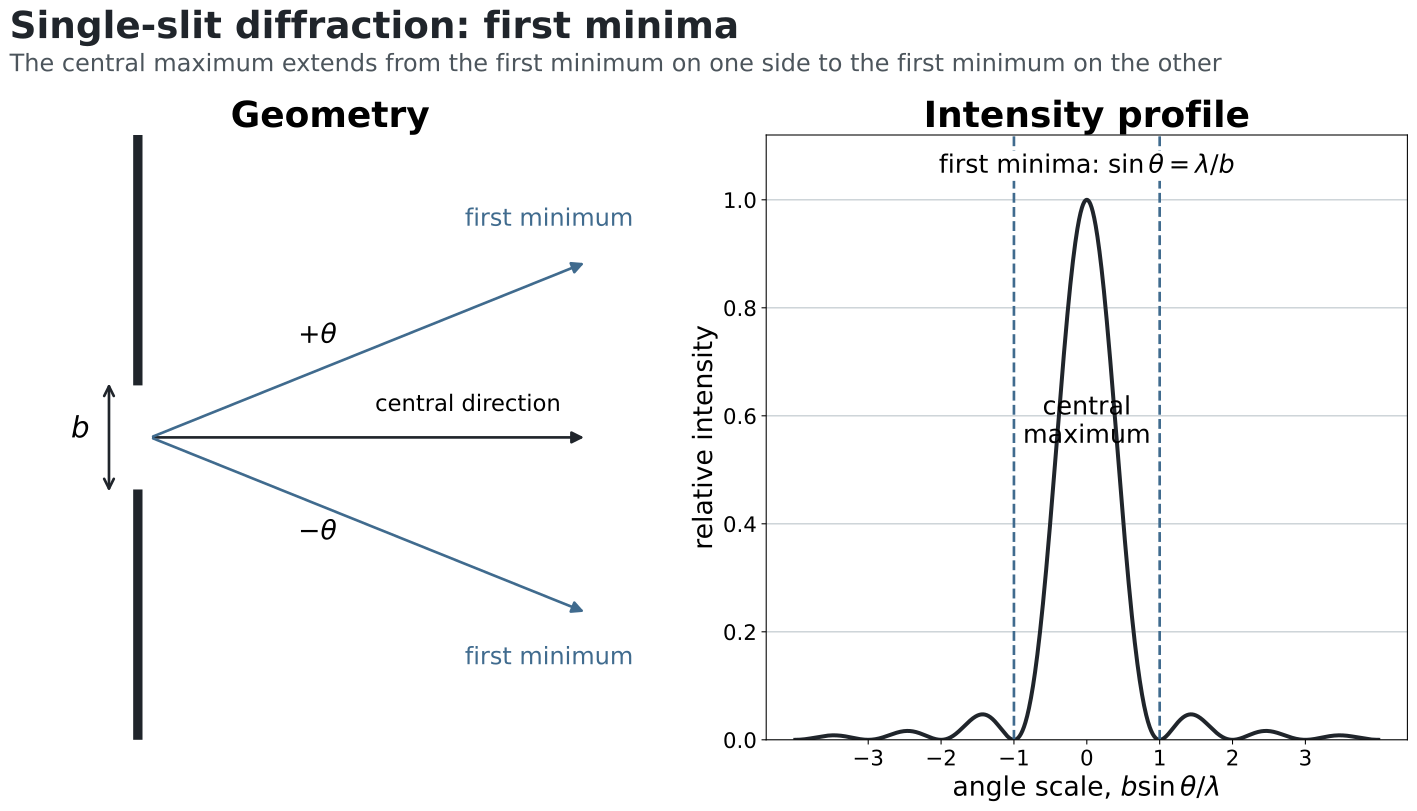
Figure: The slit width is . The first minima occur at equal angles and from the forward direction. The plotted intensity is generated from the single-slit diffraction relation, not drawn as an arbitrary wave.
For the first minimum on either side,
Here is measured from the normal to the slit, which is also the straight-ahead direction for normal incidence.
The relation shows that:
- increasing wavelength increases the angular width of the central maximum;
- decreasing slit width increases diffraction;
- the central maximum lies between the two first minima and therefore has angular width .
For small angles, in radians. If a screen is a distance away, the central maximum has approximate linear width
This last expression is a useful consequence, not a separate syllabus formula to memorise blindly.
Why the first minimum occurs
At the first minimum, imagine dividing the slit into two equal halves. For every element in the upper half, there is a corresponding element in the lower half whose path is longer by . Their contributions arrive in antiphase and cancel pairwise. The total path difference from one edge of the full slit to the other is therefore one wavelength, giving .
Resolution and the Rayleigh criterion
Diffraction also limits the ability of an aperture to distinguish two distant point sources. Each point source forms a diffraction pattern rather than an infinitely narrow image.
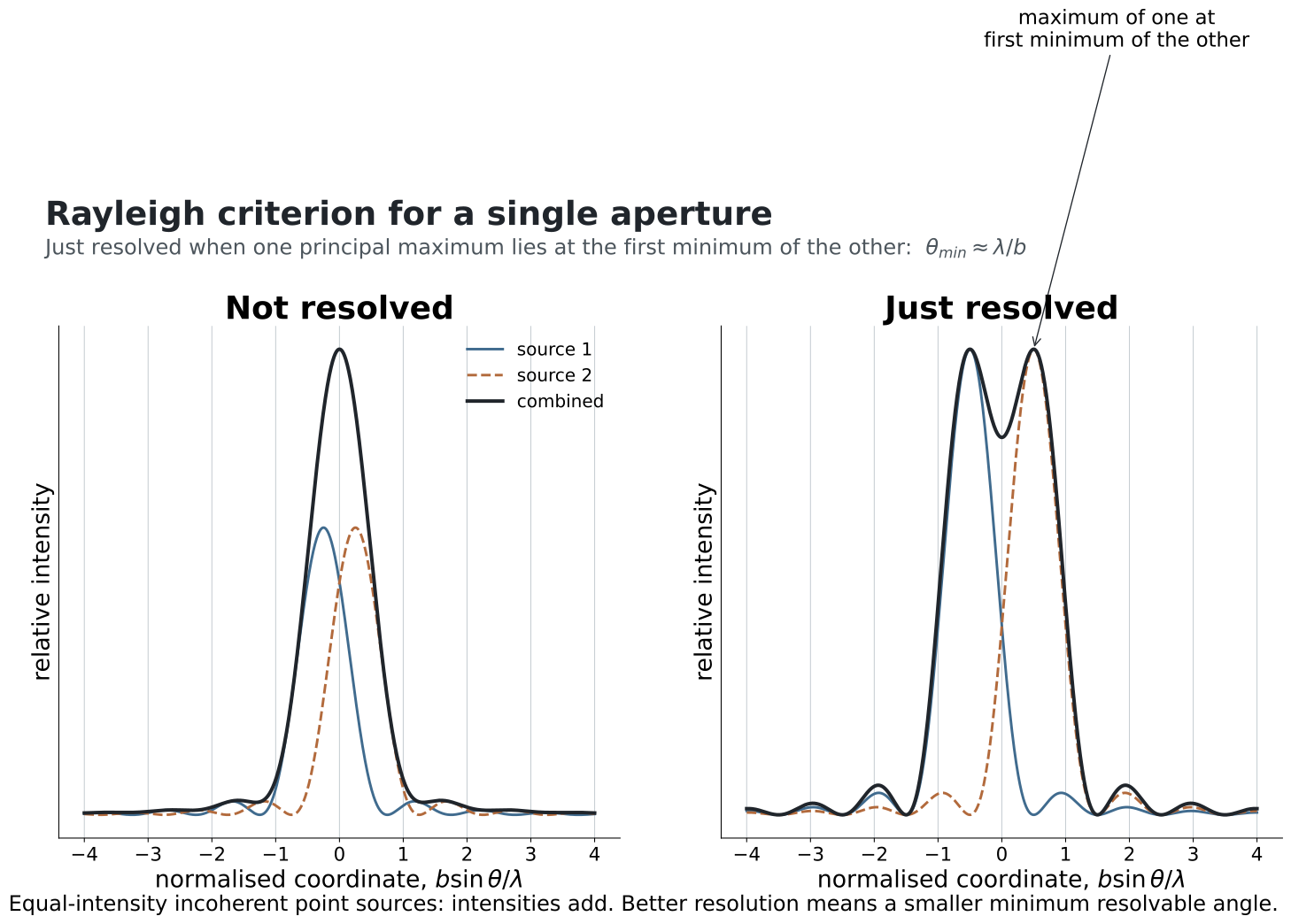
Figure: Two sources are just resolved when the principal maximum of either diffraction pattern falls at the first minimum of the other. A smaller separation produces strongly overlapping patterns that are not resolved.
For a single aperture of width , the Rayleigh criterion is
where is the smallest angular separation at which the sources are just resolved. The approximation uses the small-angle relation .
Therefore resolution improves when:
- is larger, because diffraction is reduced;
- is smaller, because the diffraction patterns are narrower.
“Better resolution” means that a smaller angular separation can be distinguished. It does not mean a larger value of .
Worked example 1: first minimum and central width
Light of wavelength passes through a slit of width .
Hence . On a screen away,
The central maximum is approximately wide.
Worked example 2: diffraction-limited resolution
An aperture has width and receives light of wavelength .
Two point sources separated by a smaller angle will not be resolved under this model.
Common pitfalls
- Using slit separation from Young double slit instead of aperture width .
- Calling the full angular width of the central maximum; it is the angle from the centre to one first minimum.
- Forgetting that the full angular width is .
- Saying a narrower slit improves resolution. A narrower slit produces more diffraction and a larger .
- Treating the Rayleigh criterion as an abrupt physical boundary. It is an operational criterion for “just resolved”.
Links
- Main hub: Superposition of Waves
- Related branch: Diffraction and Gratings
- Common traps: Superposition Common Exam Traps