Diffraction and Gratings
Branch note: This page deepens one part of Superposition of Waves.
Overview
Diffraction is the spreading of waves after they pass through a gap or around the edge of an obstacle.
A diffraction grating is a regular array of many closely spaced slits or lines. Each slit diffracts the wave, and the diffracted waves then interfere to produce sharp bright maxima.
This page treats diffraction and gratings as core Topic 11 content because they are direct applications of wave behaviour and superposition.
A useful way to connect the two ideas is this:
- diffraction explains why waves spread from each opening
- interference explains why overlapping waves reinforce only in certain directions
- a diffraction grating combines both ideas: each slit diffracts the light, then waves from many slits interfere
So a grating pattern is not produced by diffraction alone. It is produced by diffraction followed by many-slit interference.
Core Ideas
- Diffraction is the spreading of waves through a gap or around an edge.
- Diffraction is strongest when aperture width is comparable to wavelength.
- The wavelength does not change after diffraction if the medium is unchanged.
- A diffraction grating contains many equally spaced slits or lines.
- Each slit diffracts the incident wave.
- Waves from different slits then interfere.
- Grating maxima occur when waves from adjacent slits have path difference .
- The grating equation for normal incidence is .
- White light forms spectra because different wavelengths are diffracted to different angles.
Exam Relevance
Diffraction questions often test qualitative aperture-size reasoning. Grating questions usually test unit conversion, correct use of order number , and maximum-order reasoning using .
This branch is also closely connected to Young double-slit interference and to later wave evidence in quantum physics.
You should be able to:
- define diffraction clearly
- compare diffraction through wide and narrow gaps
- explain why wavelength is unchanged when the medium is unchanged
- explain how a grating produces sharp maxima
- use to find grating spacing
- apply
- find the maximum observable order by rounding down
- recognise white-light spectra and order overlap as useful enrichment
Definition
Diffraction is the spreading of waves when they pass through an aperture or around an obstacle.
The effect is most noticeable when the aperture width is comparable to the wavelength :
If the aperture is much wider than the wavelength:
then spreading is small.
Why It Matters
Diffraction is evidence for wave behaviour. Sound can be heard around corners because sound wavelengths are large enough for noticeable diffraction. Light also diffracts, but its wavelength is very small, so ordinary gaps do not usually produce obvious spreading.
Diffraction gratings make this wave behaviour precise. They separate colours and allow wavelength measurement using angles.
A student-friendly way to remember the topic is:
Diffraction makes waves spread; interference decides where the spread waves reinforce.
Key Representations
The main representations are aperture-size sketches for diffraction, grating ray diagrams, spectra on both sides of the central maximum, and order-counting inequalities.
A good diagram should show not only the formula, but also the physical reason behind the formula.
Diffraction Through a Gap
When a plane wave reaches a gap, the part of the wave that passes through the gap spreads out.
For a wide gap:
- wavefronts mostly continue forward
- only slight spreading occurs near the edges
- the central forward direction remains dominant
For a narrow gap with :
- the emerging wavefronts spread strongly
- the wave behaves as though the gap has become a secondary source
- semicircular wavefronts may be seen in a ripple tank
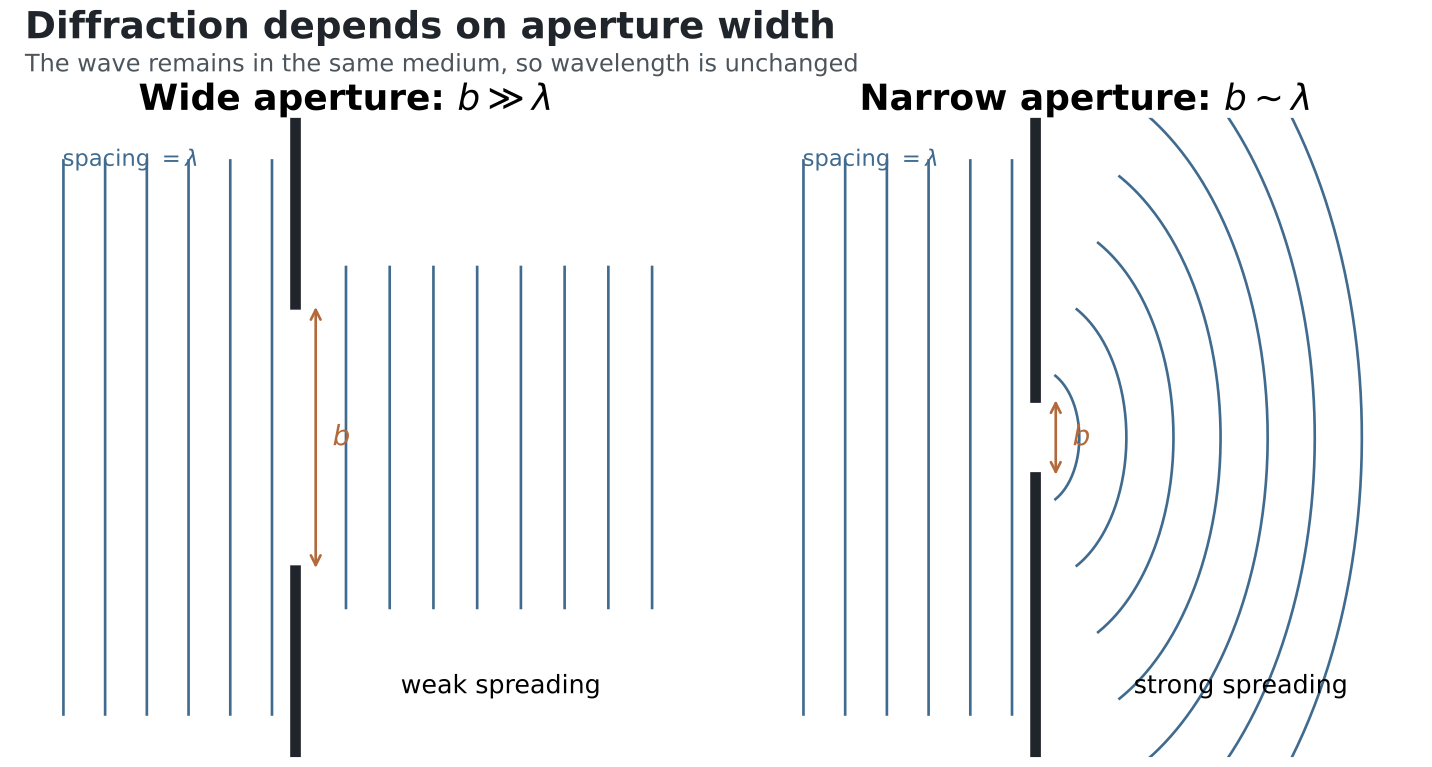
Figure: Diffraction through a wide and a narrow aperture. Here is aperture width: spreading is weak for and strong for . Wavefront spacing remains unchanged because the medium is unchanged.
The wavelength does not change just because the wave passes through the gap, provided the medium is unchanged.
This is a common diagram mistake: do not draw wavefronts closer together or further apart after diffraction unless the wave speed or frequency has changed.
Ripple-Tank Demonstration
Diffraction can be demonstrated with water waves in a ripple tank.
Use a straight wave source to send plane waves toward a barrier with a gap.
If the gap is wide compared with the wavelength:
- the wavefronts remain mostly straight after the gap
- spreading is weak
- noticeable bending occurs mainly near the edges of the gap
If the gap is comparable to the wavelength:
- the wavefronts spread strongly
- semicircular wavefronts are observed after the gap
- the gap behaves approximately like a point source of waves
This experiment is important because it makes diffraction visible with macroscopic waves.
How to Draw Diffraction Correctly
When drawing diffraction diagrams:
- keep the wavelength the same before and after the gap if the medium is unchanged
- show only slight bending for
- show strong spreading for
- do not draw the wavefronts closer together after the gap unless the wave speed has decreased
- do not draw the wavefronts further apart after the gap unless the wave speed has increased
- do not say the wave slows down just because it passes through a gap
This point is often tested because students sometimes confuse diffraction with refraction. Diffraction changes the direction of spreading of the wavefronts, but it does not by itself change the speed, frequency, or wavelength in the same medium.
Diffraction and Intensity
Diffraction redistributes wave energy.
For a single slit, the central maximum is broad and the side maxima are weaker. The 2026 syllabus requires the first-minimum relation and its connection to resolution:
Study these carefully in Single-Slit Diffraction and Resolution. The qualitative energy idea remains important:
- spreading does not create extra energy
- wider spreading means energy is distributed over a larger angular range
- diffraction is strongest when aperture size is comparable to wavelength
A narrow gap can therefore give strong spreading, but the wave energy is spread over a wider region.
Diffraction Gratings
A diffraction grating has many equally spaced slits.
If the number of lines per metre is , the grating spacing is:
where is the distance between adjacent slits.
For a grating, the mechanism is:
- incident light reaches many closely spaced slits
- each slit diffracts the light
- the diffracted waves overlap
- bright maxima occur only in directions where waves from adjacent slits arrive in phase
This is why the grating equation is both a diffraction idea and an interference idea. Diffraction allows light from each slit to spread into many directions; interference selects the directions where the waves remain in phase.
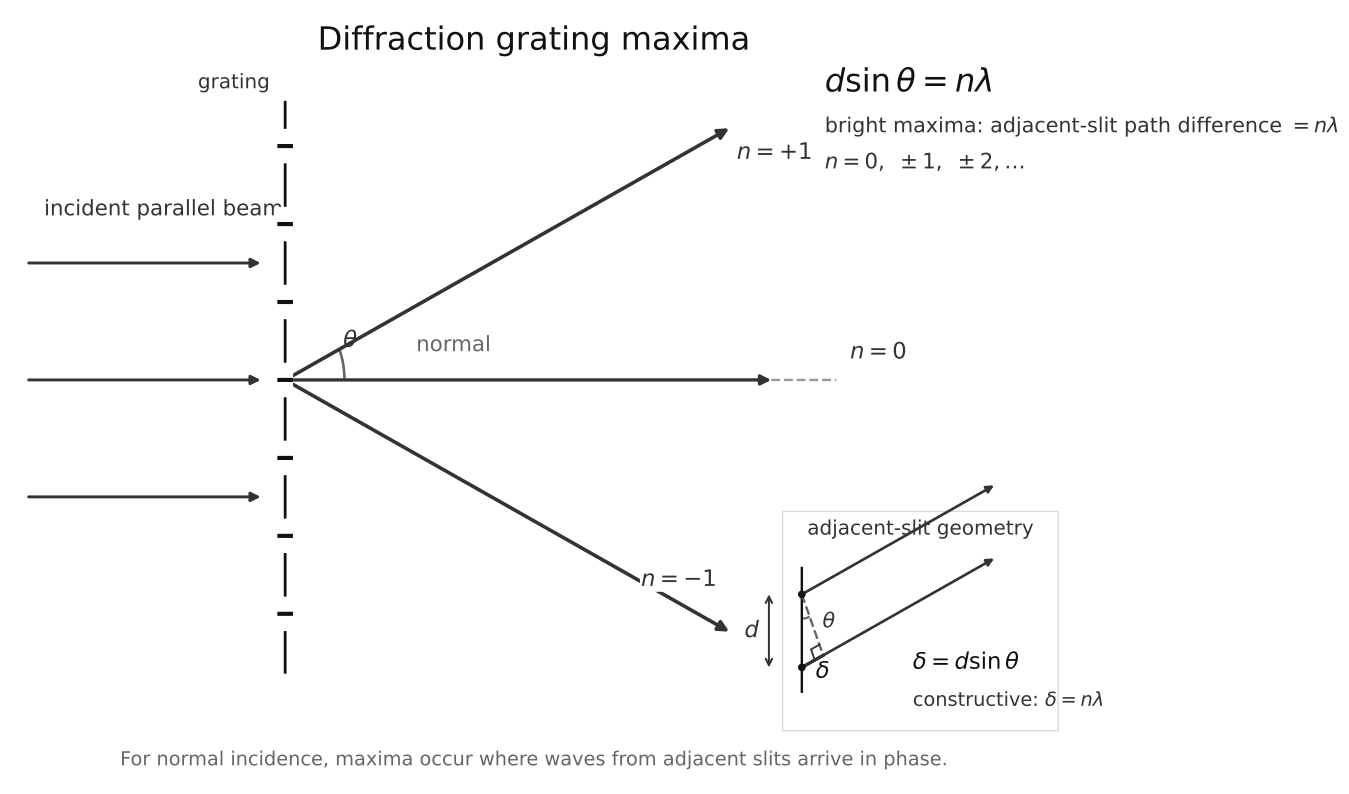
Figure: For normal incidence on a diffraction grating, bright maxima occur when the path difference between waves from adjacent slits is .
Grating Equation
For normal incidence:
where:
- = grating spacing
- = angle between the maximum and the normal
- = order number
- = wavelength
The central maximum has:
so:
The first-order maxima are and on opposite sides of the central maximum.
Physical Meaning of the Grating Equation
The grating equation is a path-difference condition.
For the first-order maximum, light from one slit travels one wavelength further than light from the adjacent slit:
For the second-order maximum, the path difference is two wavelengths:
In general:
The integer matters. A non-integer value does not correspond to a bright order.
The central maximum has because the path difference between adjacent slits is zero in the straight-through direction.
Maximum Observable Order
Because:
the grating equation implies:
so:
The maximum observable order is the greatest whole number satisfying this inequality.
Do not round to the nearest integer. Round down.
Order-Counting Rule
The value is not usually an order. It is only the upper limit for possible integer orders.
For example, if:
then the largest possible order is:
not .
If the question asks for the total number of maxima, count both sides and the central maximum:
If the question asks for the number of diffracted images excluding the straight-through image, then do not count the central image.
Measuring Wavelength
If the grating spacing is known and the angle for order is measured, the wavelength is:
The structure and use of a spectrometer are not normally required here, but the practical idea is:
- shine monochromatic light normally onto the grating
- locate the same order on both sides of the central maximum
- measure the total angle between the symmetric and maxima and divide by two to obtain
- repeat or use several orders where visible
- calculate using the grating equation
Using symmetric readings reduces the effect of a small zero-angle offset.
Higher orders can sometimes give larger angular separations and improve precision, but they may be dimmer or may not exist if .
Enrichment: White Light and Spectra
This section is useful for interpreting spectra but is not an explicit 2026 syllabus outcome for Topic 12.
White light contains many wavelengths.
From:
larger wavelength gives larger angle for the same order.
Therefore:
- the central maximum is white because all wavelengths overlap at
- first and higher orders spread into spectra
- red light appears at larger angles than violet light
- spectra appear symmetrically on both sides of the central maximum
- different orders may overlap if their angular ranges overlap
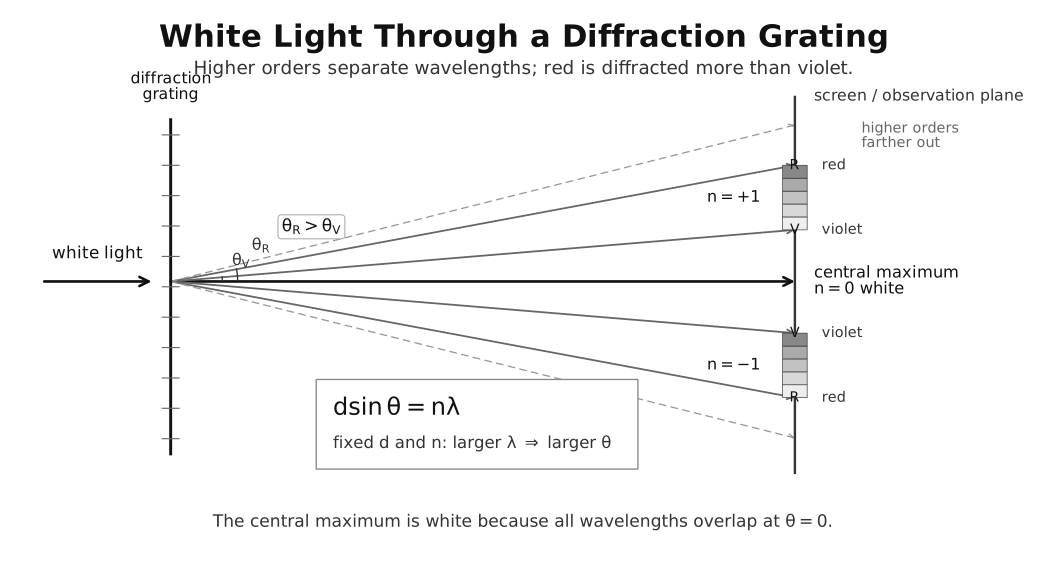
Figure: White light through a diffraction grating. The central maximum is white because all wavelengths overlap at . In higher orders, red appears at a larger angle than violet because . Adjacent orders may overlap.
The ordering of colours follows directly from the grating equation. For the same and , a larger requires a larger , so red is further from the central maximum than violet.
Why Many Slits Give Sharp Maxima
A double slit gives broad interference fringes.
A diffraction grating has many slits, so constructive interference must occur between waves from many adjacent slit pairs at the same time.
Compared under otherwise similar conditions, concentrating the transmitted energy into narrow principal maxima can make them:
- more intense and easier to locate
- narrower
- more sharply defined
Between these maxima, the waves from many slits tend to cancel strongly. That is why gratings are better than double slits for precise wavelength measurement.
Young Double Slit vs Diffraction Grating
| Feature | Young double slit | Diffraction grating |
|---|---|---|
| Number of slits | 2 | many |
| Pattern | broad bright and dark fringes | sharp bright maxima |
| Main formula | ||
| Main measurement | fringe spacing | angle |
| Best use | showing interference clearly | measuring wavelength accurately |
See Young Double Slit.
In the Young double-slit formula, means slit separation. In single-slit diffraction, means aperture width. In a grating, means adjacent-slit spacing. Keep these three lengths distinct.
Worked Example 1: Grating Spacing
A grating has lines per millimetre.
Convert to lines per metre:
Thus:
Worked Example 2: Wavelength from First Order
For the grating above, the first-order maximum is observed at .
Using:
with :
So:
This is red light.
Worked Example 3: Maximum Order
For and :
The maximum order is therefore:
The value does not mean there is a third-order maximum. The order number must be an integer, so the answer is rounded down.
Worked Example 4: Counting Images
If the maximum order on one side is , then:
- five diffracted images occur on one side, not counting the central image
- five occur on the other side
- one central maximum occurs at
Total number of maxima:
Total number of diffracted images excluding the straight-through central image:
This distinction is commonly tested.
Common Exam Pitfalls
- Saying diffraction changes wavelength in the same medium.
- Thinking a wider gap gives more diffraction.
- Drawing wavefronts with a different spacing after diffraction even though the medium is unchanged.
- Using slit separation from Young double slit as if it were grating spacing .
- Forgetting to convert lines per millimetre or per centimetre into lines per metre.
- Treating as non-integer.
- Rounding maximum order to the nearest integer instead of rounding down.
- Forgetting the central maximum is .
- Saying red is closer to the central maximum than violet in a grating spectrum.
- Confusing total number of maxima with number of diffracted images on one side.
Exam Strategy
For diffraction questions:
- Identify whether the question is about a wide gap or a narrow gap.
- Compare aperture width with wavelength .
- State that diffraction is stronger when .
- Keep wavelength unchanged if the medium is unchanged.
For diffraction-grating questions:
- Convert line density into spacing using .
- Identify the order .
- Use .
- Check whether the light is monochromatic or white.
- For maximum order, use and round down.
- For total number of maxima, count both sides plus the central maximum.
Formula Summary
| Quantity | Formula | Use |
|---|---|---|
| Strong diffraction condition | Aperture size comparable to wavelength. | |
| Weak diffraction condition | Aperture much wider than wavelength. | |
| First single-slit minimum | Locate the first minimum from the forward direction. | |
| Rayleigh criterion | Estimate the smallest resolvable angular separation. | |
| Grating spacing | Convert line density into slit spacing. | |
| Maxima condition | Locate bright grating orders. | |
| Wavelength | Find wavelength from measured angle. | |
| Maximum order | Find greatest possible integer order. | |
| Total maxima | Count both sides and central maximum. |
Links
- Main hub: Superposition of Waves
- Related branch: Stationary Waves
- Related branch: Two-Source Interference
- Related concept: Interference
- Related concept: Interference and Diffraction
- Related concept: Young Double Slit
- Common traps: Superposition Common Exam Traps
- Prerequisite topic: Waves
Summary
Diffraction is wave spreading through gaps or around obstacles. It is strongest when the gap width is comparable to the wavelength, and the wavelength remains unchanged if the medium is unchanged. A diffraction grating uses many slits to produce sharp interference maxima satisfying , allowing precise wavelength measurement and colour separation.