Superposition of Waves
Topic hub: This is the main overview page for Topic 11. Use it as the starting point, then follow the branch notes for deeper treatment of specific subtopics.
Overview
Superposition of waves is the study of what happens when two or more Waves overlap in the same region of space.
It explains several major wave phenomena:
- stationary waves
- interference patterns
- diffraction
- Young double-slit fringes
- diffraction grating spectra
The central idea is simple: when waves of the same type meet, their displacements add. The consequences are much richer. The same rule explains why rope pulses pass through each other, why coherent sources make bright and dark regions, why strings and air columns support only certain modes, and why gratings can measure wavelengths precisely.
This chapter is highly important because many exam questions test both conceptual understanding and formula application. Most mistakes are not caused by hard algebra; they come from choosing the wrong condition, misreading a spacing, or confusing a travelling wave with a stationary pattern.
For deeper study:
- Stationary Waves
- Two-Source Interference
- Diffraction and Gratings
- Single-Slit Diffraction and Resolution
- Stationary-Wave Modes and End Correction — Enrichment
- Interference and Diffraction
- Superposition Common Exam Traps
Core Ideas
- when waves overlap, displacements add according to superposition
- temporary overlap is not the same as a stable interference pattern
- intensity depends on amplitude, not on instantaneous displacement alone
- coherence is required for steady interference fringes
- stationary waves are a special superposition of opposite-travelling identical waves
- diffraction is wave spreading through a gap or around an edge
- diffraction gratings use many-slit interference to produce sharp maxima
Exam Relevance
This topic is heavily tested because it combines physical interpretation with standard formulas. Many marks are lost through phase, coherence, spacing, or path-difference mistakes rather than difficult algebra.
The main examinable skills are:
- state and apply the principle of superposition
- explain stationary-wave formation using incident and reflected progressive waves
- identify nodes, antinodes, phase relationships, and node spacing
- explain diffraction and how aperture size affects spreading
- explain coherence and two-source interference
- use the Young double-slit formula
- apply to the first minimum of a single-slit pattern
- apply the Rayleigh criterion
- use the grating equation
- determine maximum grating order by using
Learning Pathway
Study the topic in this order:
- Start with the principle of superposition and pulse overlap.
- Use superposition to understand constructive and destructive interference.
- Learn two-source interference and coherence, because stable interference patterns require a constant phase relationship.
- Study stationary waves as a special case of two identical opposite-travelling waves.
- Study diffraction as wave spreading, including single-slit minima and the resolution limit of an aperture.
- Connect gratings to interference from many slits.
- Practise formula choice: path difference, double-slit fringe spacing, single-slit minima, Rayleigh resolution, or grating maxima.
Principle of Superposition
When two or more waves meet, the resultant displacement at any point is equal to the sum of the displacements produced by the individual waves at that point.
For the common case of two overlapping waves in one-dimensional wave diagrams, displacement is usually treated as a signed scalar:
where:
- = resultant displacement
- = displacement produced by the first wave
- = displacement produced by the second wave
Positive values may represent upward displacement, while negative values may represent downward displacement.
For more than two overlapping waves:
Physical Meaning
Superposition does not mean waves permanently merge.
Instead:
- waves overlap temporarily
- resultant displacement is formed during overlap
- after crossing, each wave continues unchanged (ideal case)
This is why two pulses can pass through one another.
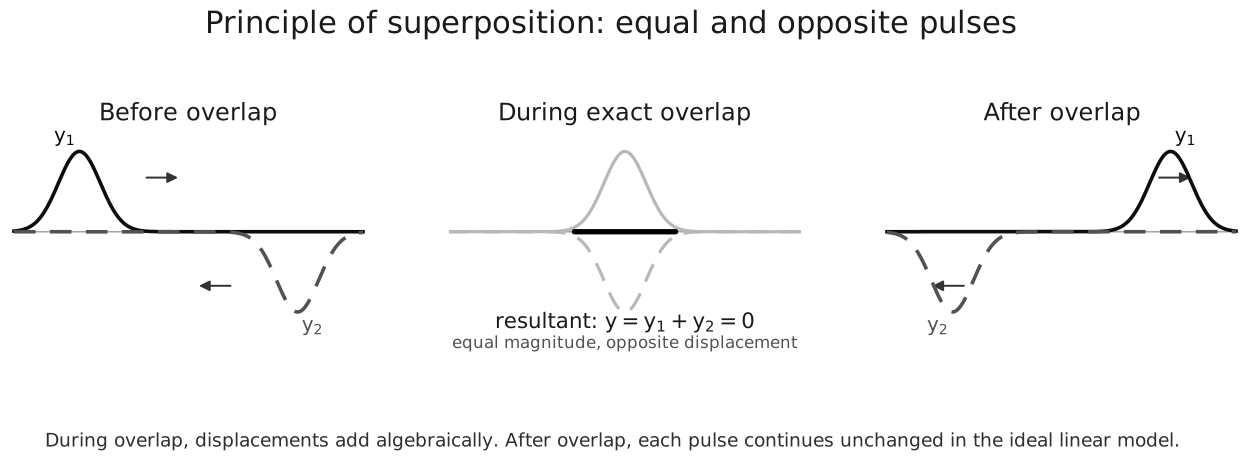
Figure: Two pulses add only while they overlap, then continue in their original directions in the ideal model.
Constructive and Destructive Interference
Constructive Interference
Constructive interference occurs when two waves arrive in phase, so their displacements have the same sign and reinforce each other.
Examples:
- crest + crest
- trough + trough
For stable constructive interference patterns, the sources must be coherent.
Let denote path difference. If coherent sources start in phase, constructive interference occurs when is an integer multiple of the wavelength:
where:
This is because a path difference of one wavelength corresponds to a phase difference of:
which brings the waves back into phase.
Destructive Interference
When two waves arrive in antiphase, amplitudes cancel partially or completely.
For coherent sources that start in phase:
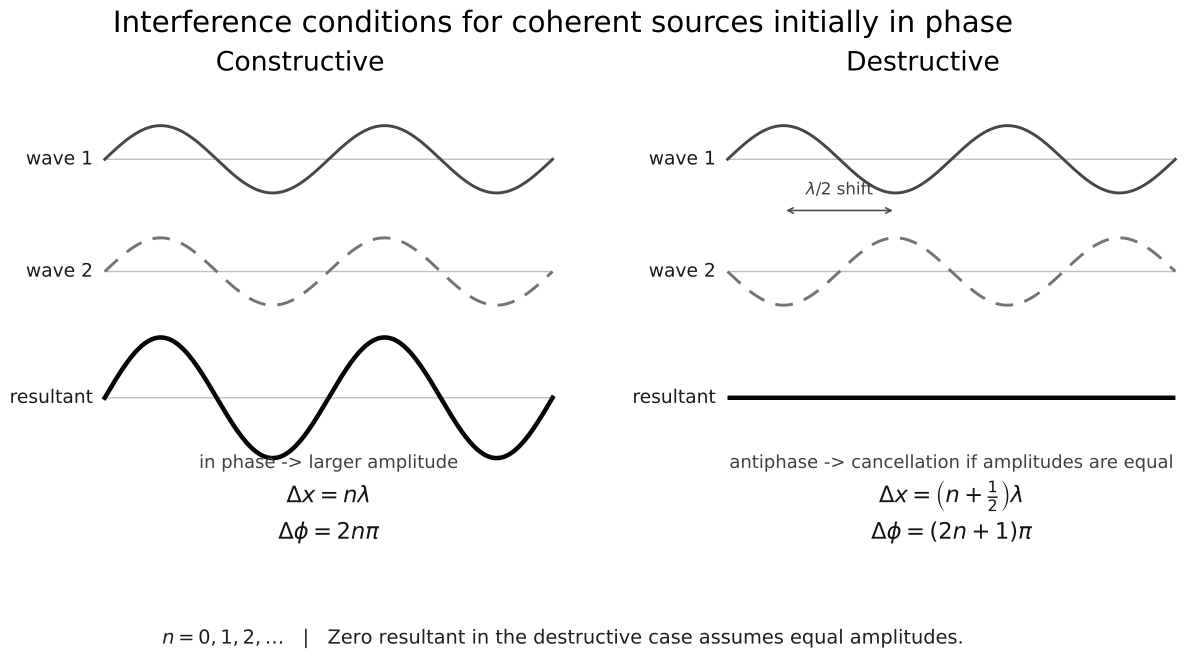
Figure: For coherent sources that start in phase, constructive interference occurs at path difference and destructive interference at path difference . The zero resultant shown is the ideal equal-amplitude case.
If the two coherent sources start in antiphase, the constructive and destructive path-difference conditions are swapped. Always check whether the sources start in phase before applying the standard conditions.
For sources with a non-zero initial phase difference, path difference alone does not determine whether the waves reinforce or cancel. Apply the standard conditions only after confirming that the sources start in phase; otherwise reason from the stated source phase.
Coherence
Stable interference patterns require coherent sources.
Coherent sources have:
- same frequency
- constant phase difference
Same frequency alone is insufficient because two independent sources may undergo random phase changes over time.
As a result:
- the phase difference does not remain fixed
- maxima and minima shift continuously
- no stable interference pattern is observed
This explains why two independent lamps usually do not produce stable interference fringes.
In practice, coherent light sources are commonly produced by splitting light from a single source into two paths.
Temporary Overlap vs Stable Patterns
Temporary Overlap
Two isolated pulses crossing on a rope:
- combine briefly
- separate afterwards
Stable Interference Pattern
Two continuous coherent sources:
- repeated maxima and minima
- fixed spatial pattern
This distinction is often tested.
Stationary-Wave Overview
See: Stationary Waves
A stationary wave forms when two identical progressive waves travel in opposite directions and superpose.
This usually happens when a wave reflects from a boundary. The incident and reflected waves have the same frequency, wavelength, and speed, but travel in opposite directions. Their superposition produces a fixed pattern.
Key features:
- nodes: zero amplitude
- antinodes: maximum amplitude
- no net average energy transfer along the pattern
- fixed pattern
- adjacent nodes separated by
- adjacent antinodes separated by
- node to nearest antinode separated by
Typical systems:
- stretched strings
- air columns
- microwaves
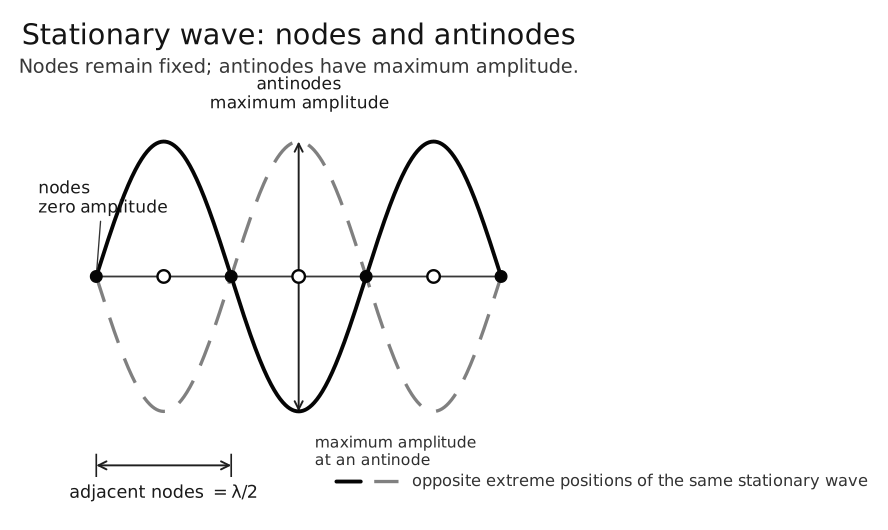
Figure: The two extreme positions of a stationary wave show fixed nodes of zero amplitude, antinodes of maximum amplitude, and adjacent nodes separated by .
For detailed boundary-condition rules, harmonics, open and closed pipes, and microwave experiments, use the branch note:
Interference Overview
Interference occurs when coherent waves overlap to produce regions of:
- reinforcement (maxima)
- cancellation (minima)
Examples:
- sound loud/soft spots
- ripple tank nodal lines
- light bright/dark fringes
For water waves, the important observable pattern is a set of antinodal lines and nodal lines. The same path-difference conditions also explain sound, microwave, and light interference patterns.
Diffraction Overview
Diffraction is the spreading of waves after passing through a gap or around an obstacle.
Strong diffraction occurs when aperture width is comparable to wavelength:
Examples:
- water waves through narrow gap
- sound around corners
- light through narrow slits
If , spreading is weak. If , spreading is significant. The wavelength is unchanged after the gap if the medium is unchanged.
For a single slit of width , the first minima satisfy
The same angular scale sets the diffraction-limited resolution of a single aperture. By the Rayleigh criterion,
See Single-Slit Diffraction and Resolution for the geometry and meaning of these two relations.
Diffraction is important because it provides evidence for wave behaviour. It also makes two-source interference possible in light experiments: narrow slits spread the light enough for the waves to overlap.
Young Double-Slit Overview
Young double slit demonstrates light interference clearly.
Two narrow slits act as coherent sources.
Alternate bright and dark fringes form on a screen.
Let be the separation between adjacent bright fringes (or adjacent dark fringes). Then
where:
- = fringe spacing
- = wavelength
- = slit-screen distance
- = slit separation
Larger or gives wider fringes. Larger gives narrower fringes.
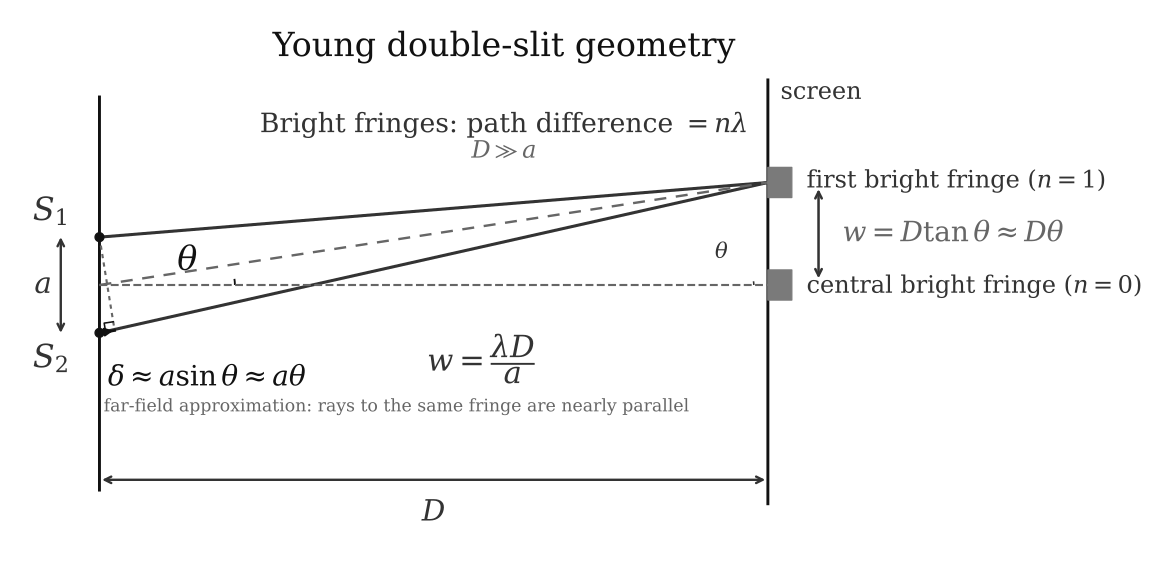
Figure: A single source slit illuminates and , so the two slits are coherent. For , and ; adjacent bright fringes therefore have separation .
Young double-slit fringe spacing follows from an approximate far-field construction. For a screen far from the slits, , the two rays from the slits to a given fringe are nearly parallel, so . For small angles, and . Since the th bright fringe has , ; subtracting adjacent positions gives .
Diffraction-Grating Overview
A diffraction grating contains many equally spaced slits.
Bright maxima occur when:
where:
- = grating spacing
- = angle to normal
- = order number
Uses:
- measuring wavelength
- separating colours
- spectroscopy
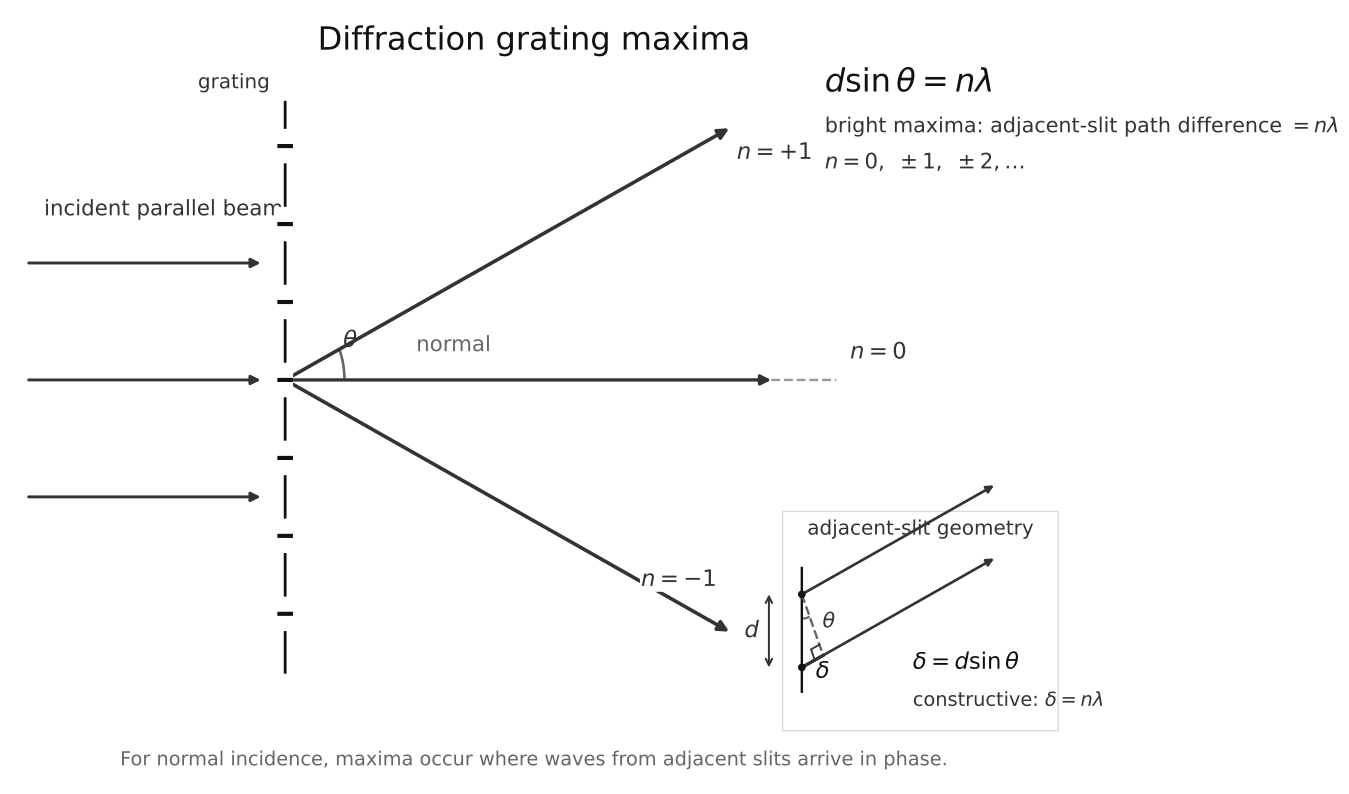
Figure: For normal incidence on a diffraction grating, bright maxima occur when the path difference between waves from adjacent slits is .
The integer labels the order of the maximum. The central maximum is , while the first-order maxima are and on opposite sides of the normal.
For maximum order questions, use:
so:
The largest observable order is the greatest whole number satisfying this inequality. Do not round to the nearest integer.
Worked Examples
Example 1: Resultant Displacement
Two pulses overlap with displacements:
Then:
The resultant displacement is 2 cm upward.
Example 2: Maxima or Minima?
Two coherent waves starting in phase have path difference:
Since this equals , where , the waves arrive in phase.
Therefore the interference is constructive, giving a maximum.
Example 3: Double-Slit Fringe Spacing
Given:
So:
Example 4: Maximum Grating Order
A grating has spacing:
Monochromatic light has wavelength:
For a maximum:
Since :
So the maximum order is:
The third order is not possible because must be an integer and would require .
Formula Summary
| Idea | Formula | Use |
|---|---|---|
| Wave speed | Connect frequency, wavelength, and speed. | |
| Resultant displacement | Add overlapping displacements. | |
| Constructive interference | Maxima for coherent in-phase sources. | |
| Destructive interference | Minima for coherent in-phase sources. | |
| Young double slit | Fringe spacing for light double-slit interference. | |
| First single-slit minimum | Angle from the centre to either first minimum. | |
| Rayleigh criterion | Smallest angular separation just resolved by an aperture. | |
| Diffraction grating | Bright grating maxima. | |
| Grating spacing | Convert line density to slit spacing. | |
| Maximum order | Find largest possible grating order. |
Common Exam Pitfalls Overview
Common mistakes include:
- forgetting coherence requirement
- mixing path difference with phase difference
- using wrong constructive/destructive condition
- assuming stationary waves transfer energy like progressive waves
- using non-integer grating order
- confusing slit width with slit separation
- thinking destructive interference destroys energy
See full page:
Superposition Common Exam Traps
Revision Strategy
Before exams, ensure you can:
- explain superposition physically
- add displacements correctly
- distinguish overlap vs interference
- identify coherence requirement
- apply fringe and grating formulas
- recognise stationary-wave features
- explain aperture-size effects in diffraction
- identify whether a formula needs slit separation or grating spacing
Links
- Related branch: Stationary Waves
- Related branch: Two-Source Interference
- Related branch: Diffraction and Gratings
- Related concept: Interference and Diffraction
- Related concept: Superposition Common Exam Traps
- Related topic: Waves
Final Summary
Superposition is the central wave principle stating that overlapping waves combine by adding displacement. From this simple rule come stationary waves, interference fringes, diffraction behaviour, and powerful measurement tools such as the diffraction grating.