Kinetic Theory and Ideal Gases
Branch note: This page deepens one part of Thermal Physics B.
Overview
This page develops the microscopic model of matter and applies it to gases. It explains how particle motion gives rise to temperature, pressure, internal energy and the gas laws.
This is one of the most important conceptual sections of Thermal Physics B.
Main skills:
- explain thermal behaviour using particle ideas
- apply gas laws
- use the ideal gas equation
- relate temperature to molecular kinetic energy
- calculate rms speed
- distinguish real gases from ideal gases
Related hub:
Definition
Kinetic theory models matter in terms of particles in constant motion and uses that motion to explain measurable quantities such as pressure, temperature, and internal energy.
Why It Matters
This topic links the microscopic and macroscopic views of thermal physics. If the particle model is weak, gas laws and thermodynamic explanations often become memorised instead of understood.
Key Representations
Core Ideas
- Microscopic particle motion explains macroscopic temperature, pressure, and phase behaviour.
- Internal energy is the sum of random kinetic energy and intermolecular potential energy.
- An ideal gas neglects molecular volume and intermolecular forces.
- Gas laws are special cases of the ideal gas equation.
- Temperature in gas-law and kinetic-theory equations must be in kelvin.
Exam Relevance
Use this branch for particle explanations, gas-law calculations, ideal-gas assumptions, mole-number relations, rms speed, and internal energy of an ideal gas.
1. Kinetic Theory of Matter
Core Idea
Matter is modelled as constituent particles—atoms, molecules or ions—undergoing microscopic motion.
The observable properties of matter arise from:
- motion of particles
- collisions between particles
- interparticle interactions
- particle spacing
Particle Behaviour in States of Matter
Solid
- particles closely packed
- vibrate about fixed positions
- strong interparticle interactions maintain an ordered arrangement
- fixed shape and volume
Liquid
- particles close together
- move past one another
- particles are not fixed to lattice positions and can rearrange
- fixed volume, no fixed shape
Gas
- particles far apart
- rapid random motion
- negligible intermolecular forces (approximately)
- no fixed shape or volume
2. Internal Energy
Definition
Internal energy is the total microscopic energy stored in a system.
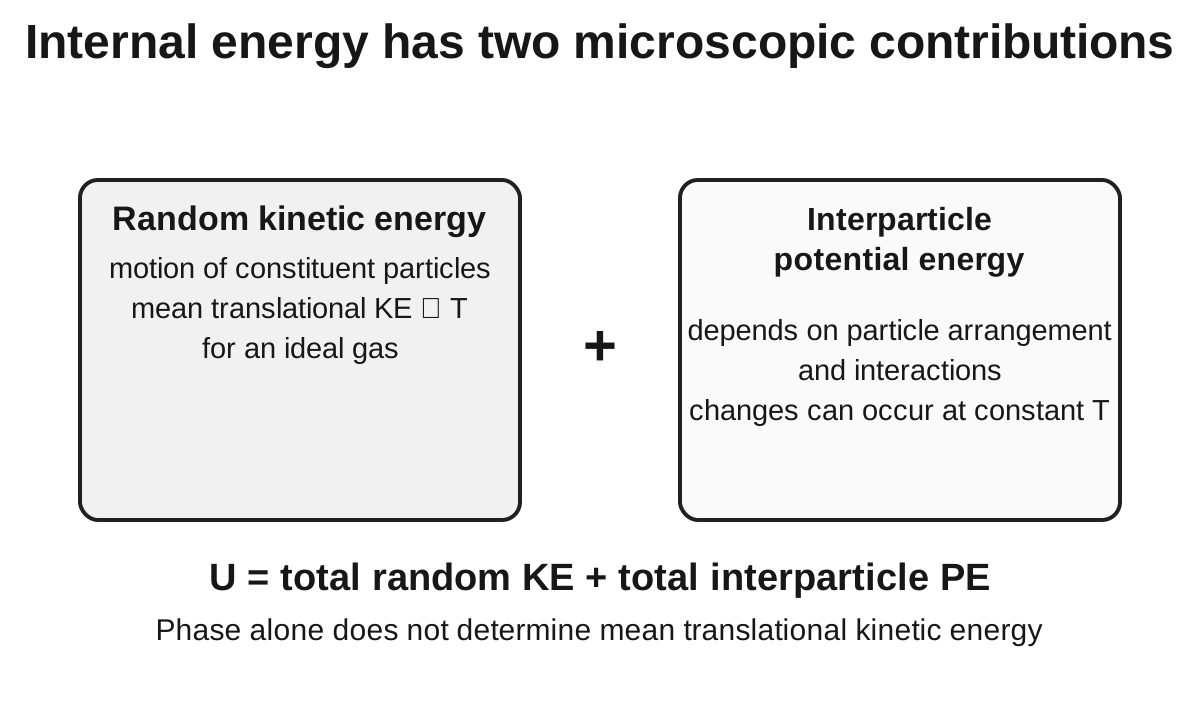
Figure: Internal energy depends on microscopic particle motion and intermolecular potential energy, so it can change without a temperature rise during a change of state.
It is the sum of:
- random kinetic energy of particles
- intermolecular potential energy
Important Clarification
Internal energy does not include:
- kinetic energy of the whole object moving through space
- gravitational potential energy of the whole object
- macroscopic elastic potential energy unless stated
State Property
Internal energy depends only on the state of the system:
- temperature
- pressure
- volume
- amount of substance
These variables describe the state subject to an equation of state; they are not four independently selectable determinants.
3. Random Kinetic Energy and Temperature
For an ideal gas, thermodynamic temperature is proportional to the mean translational kinetic energy per molecule. In solids and liquids, temperature still tracks microscopic agitation, but the simple translational relation is not applied to the whole internal energy.
Higher temperature means:
- particles move faster on average
- more energetic collisions
- larger average kinetic energy
For gases:
where is in Kelvin.
4. Intermolecular Potential Energy
Potential energy depends on particle separation.
When Particles Move Further Apart
- attractive forces are overcome
- potential energy increases
When particles move closer
Within the attractive part of an interparticle potential, moving towards the equilibrium separation lowers potential energy. At separations smaller than equilibrium, strong repulsion makes potential energy rise sharply. Therefore “closer always means lower potential energy” is not a general rule.
This explains why phase changes often involve changes in potential energy.
5. Particle View of Changes of State
Melting
During melting:
- particles gain energy
- vibrations become large enough to break fixed lattice arrangement
- particles can move past each other
Temperature remains constant during melting of a pure substance at fixed pressure while both phases coexist.
Energy supplied increases potential energy.
Boiling
During boiling:
- particles throughout liquid gain enough energy to separate widely
- bubbles form inside liquid
Temperature remains constant during boiling of a pure substance at fixed pressure while both phases coexist.
Why
Specific latent heat of vaporisation is usually larger than fusion because:
- particles separate much further
- more intermolecular attraction must be overcome
- gas expansion may do work on surroundings
6. Cooling by Evaporation
Evaporation occurs from the liquid surface.
Higher-energy surface molecules are more likely to escape.
Therefore remaining liquid has lower average kinetic energy.
Hence temperature falls.
Everyday Examples
- sweating cools body
- perfume evaporates quickly
- alcohol wipes feel cold
Exam Tip
Evaporation can occur below boiling point.
Boiling occurs throughout liquid at fixed boiling temperature.
7. Ideal Gas Assumptions
An ideal gas is a simplified model gas.
Assumptions:
- molecules are point particles with negligible volume
- no intermolecular forces except during collision
- collisions are perfectly elastic
- molecules move randomly in straight lines between collisions
- collision time is negligible
- the very large number of molecules gives a random, isotropic distribution, so there is no preferred direction
- molecular motion and collisions obey Newton’s laws
When Real Gases Behave Ideally
Most closely at:
- high temperature
- low pressure
8. Gas Pressure from Molecular Collisions
Gas pressure is the macroscopic result of repeated molecular momentum changes at the container walls. The following derivation is an explicit 2026 syllabus requirement.
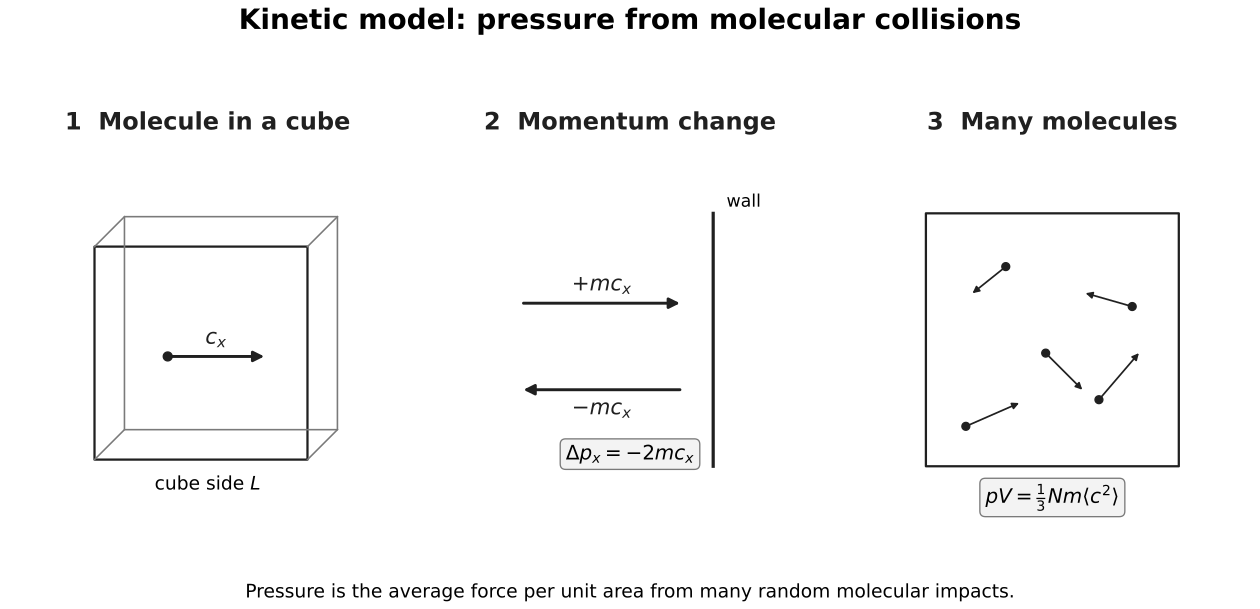
Figure: One molecule first supplies the one-dimensional momentum argument. Summing over all molecules and then using isotropy converts the -component result into the three-dimensional relation. The factor comes from direction averaging, not from the collision itself.
Step 1: one molecule in a cube
Consider a cube of side and volume . A molecule of mass has velocity component perpendicular to a chosen wall.
An elastic collision reverses this component from to . The magnitude of the molecule’s momentum change is
The molecule travels a distance before colliding with the same wall again, so the time between those collisions is
Hence the mean force contributed to that wall is
Step 2: sum over molecules
For many molecules,
The wall area is , so
Step 3: extend from one direction to three
Random isotropic motion gives
because . Therefore
Here is the mean square speed. It is not .
Step 4: connect microscopic motion to temperature
For the same gas, . Equating the two expressions gives
so
The left side is the mean translational kinetic energy of one ideal-gas molecule. Thus thermodynamic temperature is proportional to mean translational kinetic energy—not to the speed of every individual molecule.
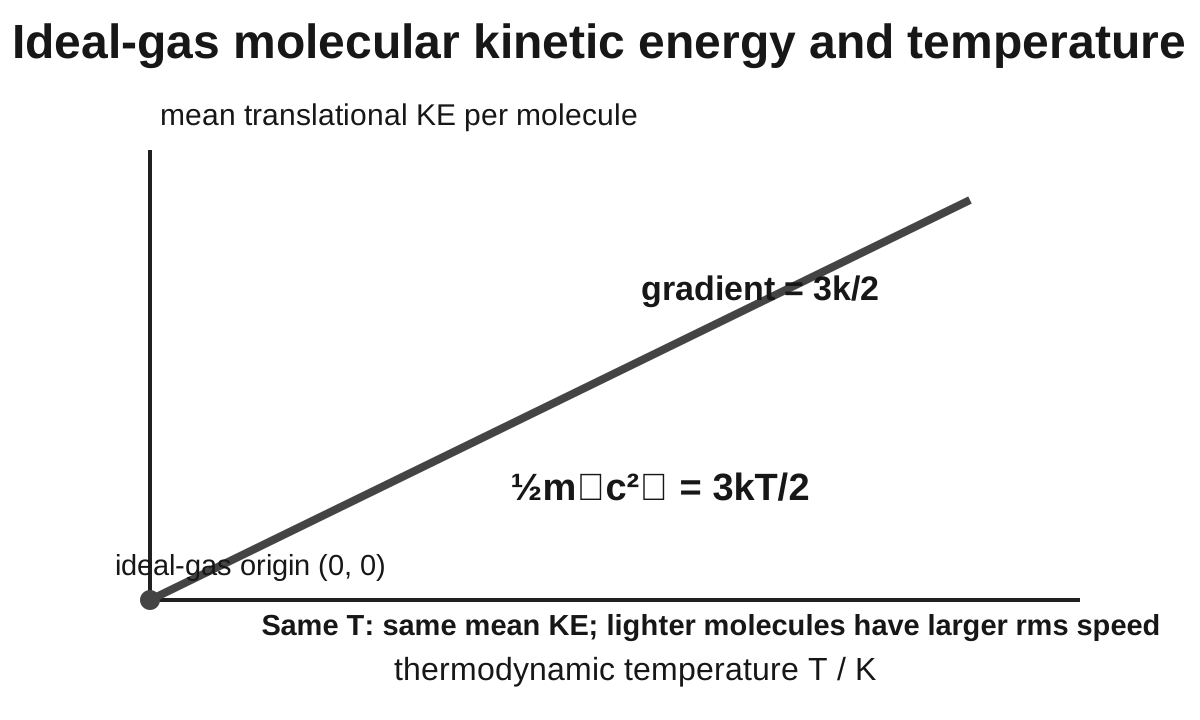
Figure: The mean translational kinetic energy per ideal-gas molecule is a straight-line function of absolute temperature with gradient . The origin corresponds to the idealised limit .
9. Boyle’s Law
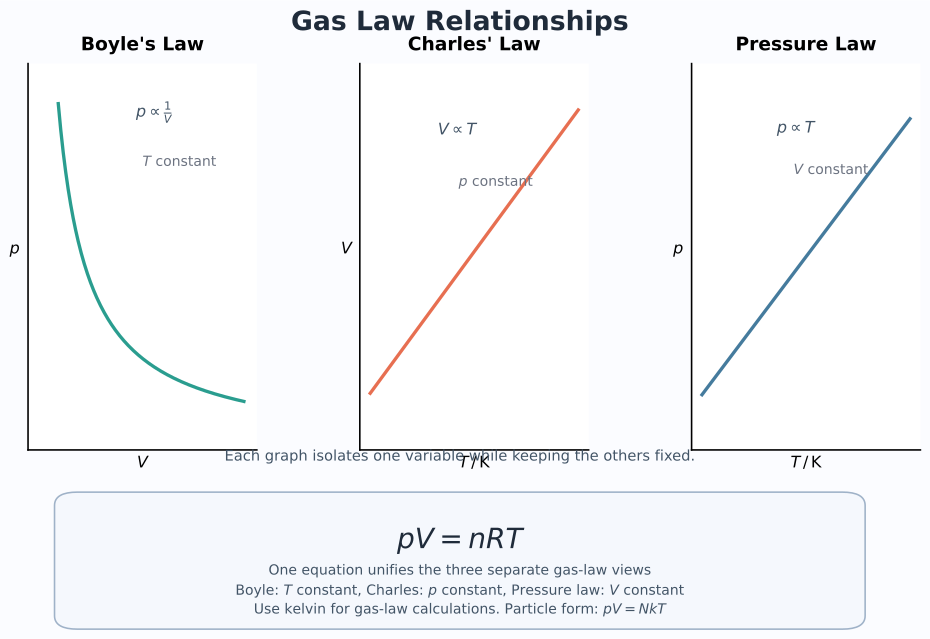
Figure: Boyle’s law, Charles’ law, and the pressure law are fixed-variable views of the same ideal-gas relation.
For fixed mass of gas at constant temperature:
Microscopic View
Reducing volume causes:
- more frequent wall collisions while remains constant
- pressure increases
10. Charles’ Law
For fixed mass of gas at constant pressure:
Microscopic View
Higher temperature increases mean square molecular speed. To maintain the same pressure for a fixed amount of gas, the volume must increase sufficiently to reduce collision frequency per unit wall area.
11. Pressure Law
For fixed mass of gas at constant volume:
Microscopic View
Higher mean square speed gives a larger momentum change per collision and a higher collision rate.
So pressure rises.
12. Ideal Gas Equation
Combining all gas laws:
Where:
- : pressure
- : volume
- : number of moles
- : molar gas constant
- : Kelvin temperature
Alternative form:
Where:
- : number of molecules
- : Boltzmann constant
13. Mole Concept
Avogadro Constant
One mole contains particles.
Conversion
Constant Relation
Comparing the two gas equations:
gives:
14. Enrichment: internal energy of a monatomic ideal gas
Beyond the explicit 2026 requirement
The core syllabus requires the mean molecular translational kinetic-energy relation above. The formula for the total internal energy below is a useful monatomic ideal-gas extension.
For a monatomic ideal gas:
- intermolecular potential energy is negligible
Hence internal energy is kinetic only.
For monatomic ideal gas:
Key Result
For fixed amount of ideal gas:
So if temperature is unchanged:
15. Enrichment: root-mean-square speed
The core relation uses . Defining gives the useful extension below.
Definition
Root mean square speed:
Formula
Hence:
or
Where:
- : mass of one molecule
- : molar mass
Trends
- higher temperature → larger rms speed
- lighter molecules → larger rms speed
16. Worked Examples
Example 1: Ideal Gas Equation
A gas occupies at pressure and .
Find number of moles.
Example 2: Boyle’s Law
Gas volume changes from to at constant temperature.
Initial pressure .
Example 3: RMS Speed Ratio
If temperature rises from to ,
RMS speed doubles.
Links
- Thermal Physics B
- First Law and Thermodynamic Processes
- p-V Diagrams and Cycles
- Thermal Physics B Common Exam Traps
Summary
Kinetic theory and the ideal-gas model explain why gases obey simple laws. The main discipline is to connect every macroscopic result back to particle motion, collisions, and temperature.