Thermal Physics B
Teaching-route hub: “Thermal Physics B” is a wiki learning route, not an official 2026 syllabus topic label. The core here is kinetic theory, ideal gases, internal energy and the first law. Detailed p–V work, named processes and cycles are retained as enrichment.
Overview
Thermal Physics B studies the microscopic explanation of thermal behaviour and introduces thermodynamics. It explains how particle motion gives rise to pressure, temperature and internal energy, and how gases exchange energy through heating and work.
This topic builds directly on Thermal Physics A.
It is the continuation of the thermal syllabus into kinetic theory and thermodynamics.
You should be able to:
- explain internal energy using particle ideas
- apply gas laws and the ideal gas equation
- relate temperature to molecular kinetic energy
- derive pressure from molecular collisions
- relate mean molecular translational kinetic energy to absolute temperature
- solve first-law energy problems
Boundary reminder:
- this page focuses on particle models, gas behaviour, and thermodynamic processes
- thermometer calibration, calorimetry, latent heat, heating curves, and electrical thermal methods belong mainly to Thermal Physics A
Core Ideas
Thermal Physics B is built around four ideas:
- Particle motion explains temperature, pressure, phase behaviour, and internal energy.
- The ideal-gas model gives simple laws linking pressure, volume, and temperature.
- Internal energy is a state property, while heat and work are energy-transfer processes.
- Detailed processes and p–V diagrams can extend this core, but they are beyond the explicit 2026 outcomes.
Exam Relevance
This chapter is conceptually dense and calculation-heavy. Many exam errors come from mixing up heat with internal energy, using Celsius instead of kelvin, or applying the wrong sign convention for work. Clear process identification is often the difference between a correct and incorrect answer.
1. Kinetic Theory Overview
Core Model
Matter is made of atoms or molecules in constant random motion.
Macroscopic properties arise from microscopic behaviour:
- thermodynamic temperature of an ideal gas ↔ mean translational kinetic energy per molecule
- pressure ↔ collisions with container walls
- phase ↔ constituent-particle arrangement and interparticle potential energy
- internal energy ↔ total microscopic energy stored
For a fuller treatment of particle models, gas laws, ideal-gas assumptions, and rms speed, see Kinetic Theory and Ideal Gases.
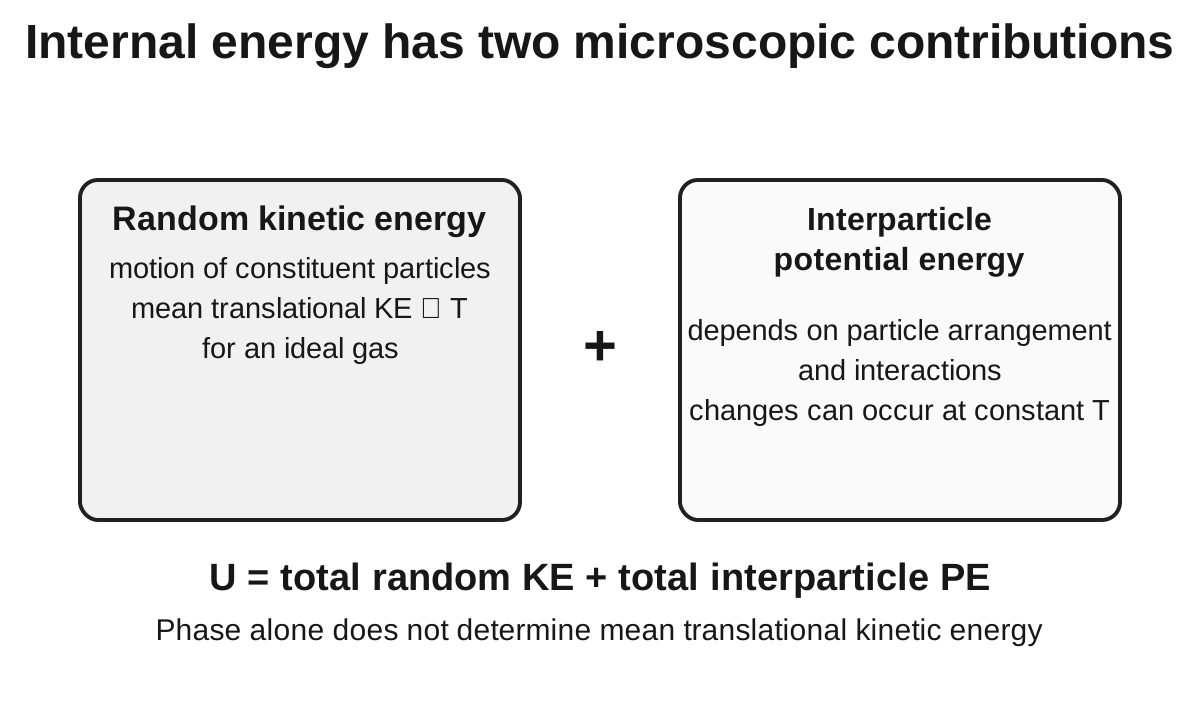
Figure 1. Internal energy is the sum of random microscopic kinetic energy and interparticle potential energy. A temperature rise increases the mean random kinetic-energy contribution; a phase change at constant temperature can instead change the potential-energy contribution. Phase alone does not determine the mean translational kinetic energy.
2. Internal Energy
Here internal energy is treated at the microscopic and thermodynamic level. For the macroscopic language of heat transfer and calorimetry, refer back to Thermal Physics A.
Definition
Internal energy is the sum of:
- total random kinetic energy of particles
- total intermolecular potential energy
State Property
Internal energy depends only on the state of the system. Variables such as , , and amount describe that state subject to an equation of state; this list does not imply that all four can be independently chosen.
- pressure
- volume
- temperature
- amount of particles
It does not depend on the path taken to reach that state.
3. Supporting context: changes of state and evaporation
Scope
This particle explanation is retained from the older anchor as a useful bridge to specific latent heat. It is not a separately named 2026 syllabus outcome.
Melting / Boiling at Constant Temperature
For a pure substance melting or boiling at fixed pressure while two phases coexist:
- energy supplied weakens intermolecular attractions
- potential energy increases
- average kinetic energy unchanged
Therefore temperature stays constant.
Why Specific Latent Heat of Vaporisation is Larger
For the same substance:
where:
- = specific latent heat of vaporisation
- = specific latent heat of fusion
This is because vaporisation requires:
- almost complete separation of molecules
- a much larger increase in intermolecular potential energy
- expansion work against the surroundings
Cooling by Evaporation
Higher-energy molecules at the liquid surface are more likely to escape.
Remaining liquid has lower average kinetic energy.
Hence:
- temperature falls
- evaporation causes cooling
Examples:
- sweating
- perfume evaporating
- alcohol wipes cooling skin
4. Ideal Gases
Ideal Gas Assumptions
An ideal gas is a model where:
- molecules occupy negligible volume
- intermolecular forces are negligible
- collisions are perfectly elastic
- molecules move randomly
- collision duration is negligible and motion obeys Newtonian mechanics
- the large molecular population has random isotropic motion
Real gases behave more ideally at:
- high temperature
- low pressure
Gas Pressure from Collisions
Pressure is caused by molecules repeatedly colliding with container walls and changing momentum.
More frequent or harder collisions produce higher pressure.
5. Gas Laws
Boyle’s Law (constant temperature)
Charles’ Law (constant pressure)
Pressure Law (constant volume)
Important Note
Use Kelvin in all gas-law calculations.
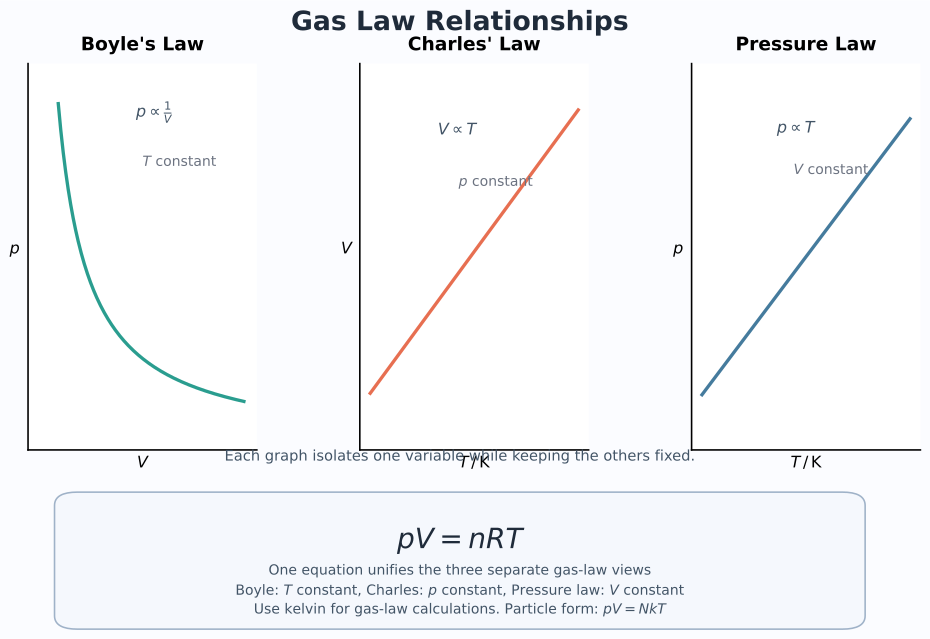
Figure 2. For a fixed amount of ideal gas, Boyle’s relation at fixed is inverse, while the – relation at fixed and the – relation at fixed are direct proportionalities through when absolute pressure and kelvin temperature are used. For the empirical Celsius extrapolation and real-gas caveat, see [Thermal Measurement and Scales](/content/topics/12_thermal_physics_A/thermal_measurement_and_scales#Pressure-Temperature Graph).
In ideal gas law, the temperature must be expressed in Kelvin unit. The Kelvin reading is obtained by adding 273.15 to the Celsius reading.
If a temperature has Celsius value , then its Kelvin value is:
Examples:
A temperature interval has the same numerical value on both scales:
The full ideal-gas development, including mole relations and internal energy of an ideal gas, is expanded in Kinetic Theory and Ideal Gases.
6. Ideal Gas Equation
Combining gas laws:
Where:
- : pressure
- : volume
- : moles
- : molar gas constant
- : Kelvin temperature
Alternative form:
Where:
- : number of molecules
- : Boltzmann constant
7. Mole Concept
Avogadro Constant
One mole contains particles.
Relationship:
8. Molecular origin of pressure and temperature
For a cube of side , an elastic wall collision changes one molecule’s -momentum by magnitude , and successive collisions with the same wall are separated by . Summing the resulting forces and using isotropy gives
Since ,
The full line-by-line derivation and its diagram are in Kinetic Theory and Ideal Gases.
9. Enrichment: monatomic ideal-gas internal energy and RMS speed
Beyond the explicit syllabus
The exact mean-kinetic-energy relation above is core. The total-energy and rms-speed formulae below are useful derived extensions for a monatomic ideal gas.
For an ideal gas:
- intermolecular forces negligible
- potential energy ≈ 0
So internal energy is purely kinetic.
For monatomic ideal gas:
Key Result
Internal energy is the total microscopic kinetic and potential energy of the particles in a system. For an ideal gas, intermolecular forces are neglected, so the internal energy is the sum of the kinetic energies of all particles, which depends only on temperature.
At constant temperature:
Root-mean-square speed
Root mean square speed:
Formula
Hence:
or
Where is molar mass.
Trends
- higher → higher
- lower mass → higher
10. Enrichment: pressure-volume work
Scope and convention
The detailed p–V formalism from this point to the cycle section is beyond the explicit 2026 syllabus. It is included to deepen the first law. Here ; do not switch conventions mid-solution.
Formula
For a quasistatic path, work done on the gas is:
For a general boundary motion, use the external pressure instead.
Interpretation
Compression
- volume decreases
- surroundings do work on gas
Expansion
- gas does work on surroundings
p–V Graph Meaning
The magnitude of pressure-volume work equals the area under the p–V path. The sign depends on whether the quantity is work done on the gas or work done by the gas.
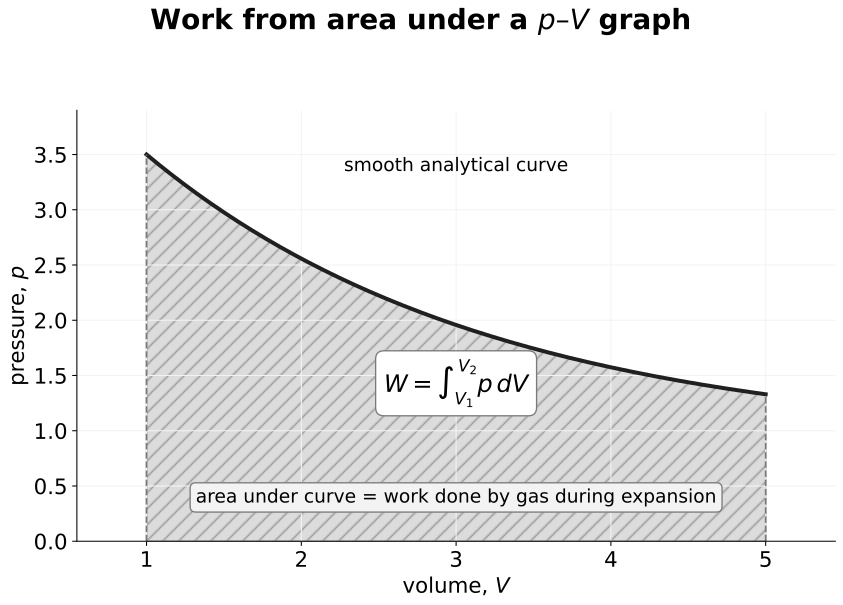
Figure 3. For a quasistatic gas process, and . For a general non-quasistatic boundary motion, use the external pressure in the work integral.
11. First Law of Thermodynamics
Where:
- : change in internal energy
- : heat supplied to system
- : work done on system
Sign Convention
Heat
- into system:
- out of system:
Work
- on gas:
- by gas:
For a deeper treatment of sign convention, worked first-law problems, and standard process reasoning, see First Law and Thermodynamic Processes.
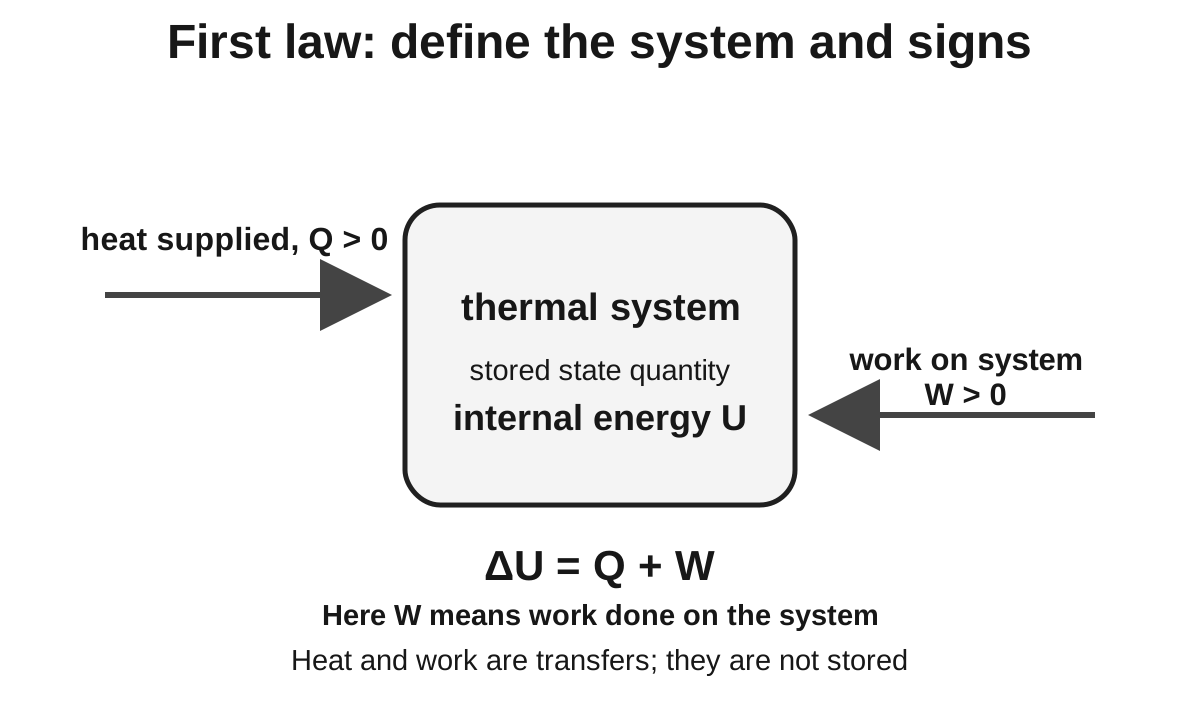
Figure 4. The system boundary sets the signs: and are transfers into the system. The first law accounts for how these transfers change stored internal energy; heat and work are not themselves stored.
12. Enrichment: named thermodynamic processes
Isochoric (constant volume)
Pressure and temperature may change.
Isobaric (constant pressure)
Isothermal (constant temperature, ideal gas)
Adiabatic
No heat transfer.
Approximated by effective insulation or by a process rapid enough that heat transfer is negligible during the change.
Exam Process Summary
Use the process condition first, then simplify the first law. With the convention in this topic, means work done on the gas.
| Process | Fixed quantity | Graph shape | First-law shortcut | Main physical meaning |
|---|---|---|---|---|
| Isochoric | vertical line | , so | heat changes internal energy only | |
| Isobaric | horizontal line | heat may change internal energy and do expansion work | ||
| Isothermal ideal gas | rectangular hyperbola | , so | heat transfer balances work | |
| Adiabatic | no heat transfer | steeper than isothermal only for comparable reversible ideal-gas paths through the same state | , so | work changes internal energy and temperature |
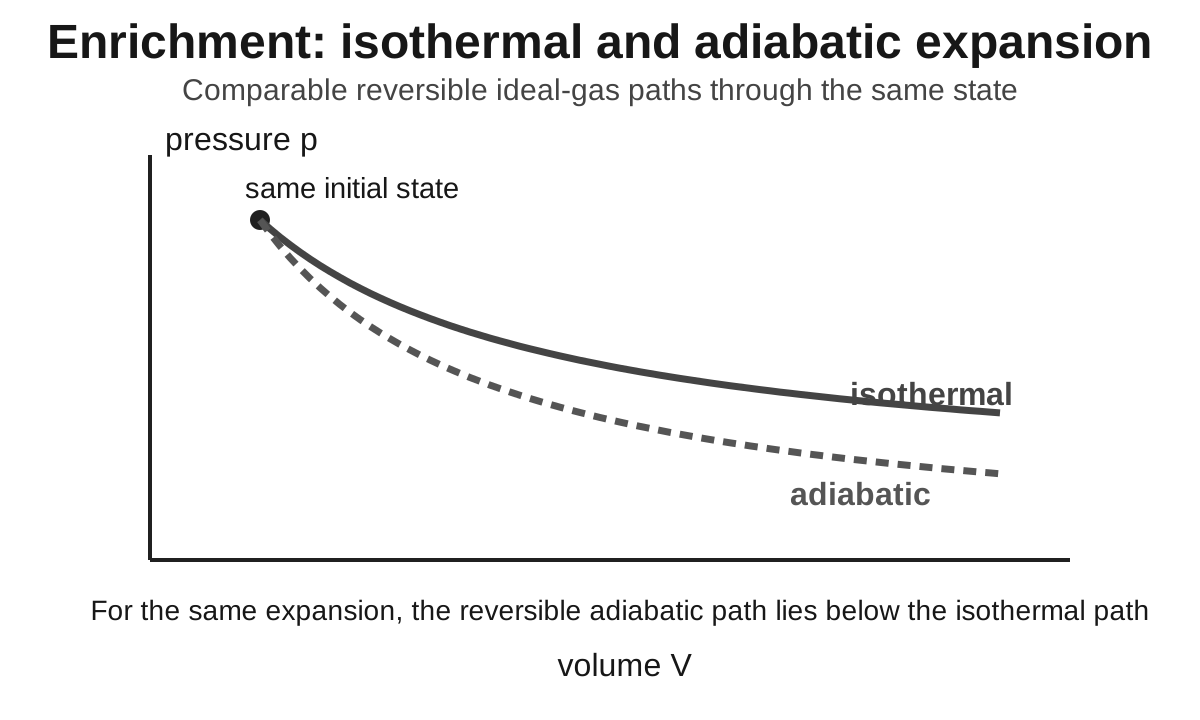
Figure 5. For comparable reversible ideal-gas expansions from the same initial state, the adiabatic path lies below and is steeper than the isothermal path.
These process types are developed in more detail, with process-by-process energy interpretation, in First Law and Thermodynamic Processes.
13. Enrichment: cyclic processes
Gas returns to original state.
Therefore:
So:
Equivalently:
The magnitude of the net work equals the enclosed area on the p–V graph; the sign depends on the loop direction and the chosen work convention.
Used in heat engines and refrigerators.
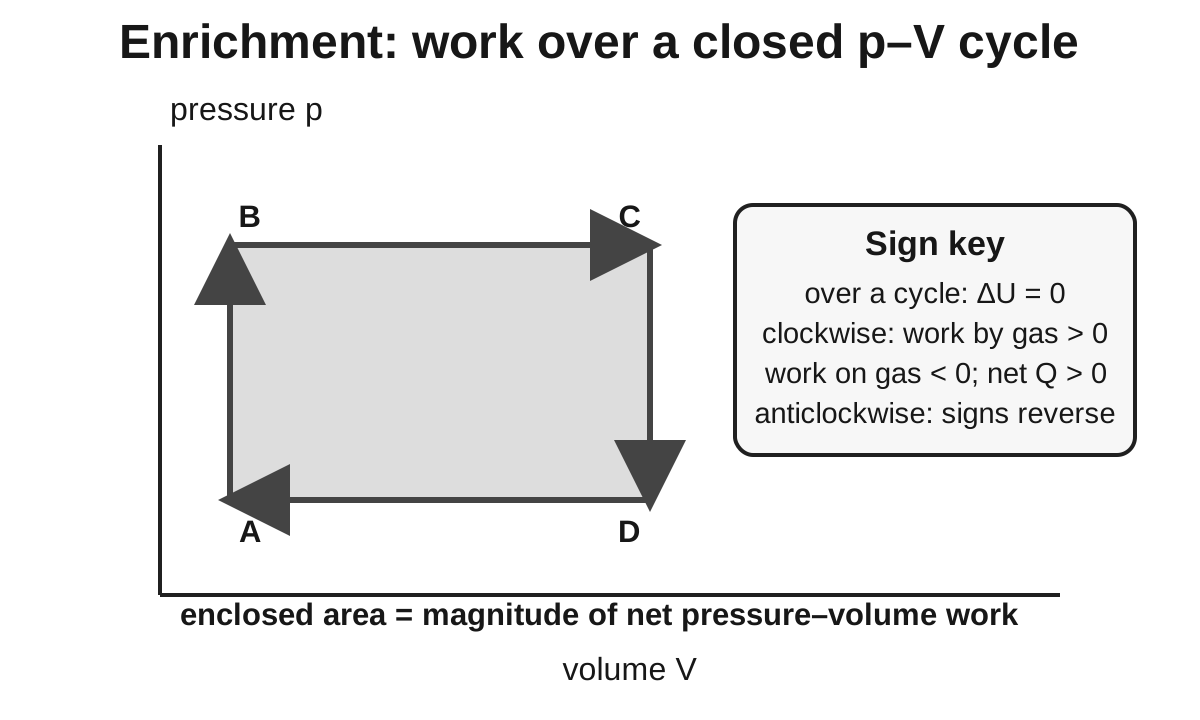
Figure 6. A closed cycle returns to the starting state, so over the cycle. The enclosed area gives the magnitude of the net pressure-volume work.
14. Enrichment: p–V diagram interpretation
Common Shapes
- horizontal line → constant pressure
- vertical line → constant volume
- rectangular hyperbola → isothermal ideal-gas path
- an adiabatic curve is steeper than an isothermal curve only when comparing reversible ideal-gas paths through the same state
Area Rules
- area under path = magnitude of the work along that path
- enclosed loop = magnitude of the net work over the cycle
With the sign convention used here, a clockwise loop means the gas does net work on the surroundings, so and .
For detailed p-V graph reading, work-from-area arguments, and cycle interpretation, see p-V Diagrams and Cycles.
15. Worked Examples
Example 1: Ideal Gas Equation
A gas has:
Find .
Example 2: First Law of Thermodynamics
A gas absorbs of heat and expands, doing of work on the surroundings.
Using the sign convention:
where is the work done on the gas.
Since the gas does work on the surroundings, the work done on the gas is:
Hence:
Example 3: Constant-Volume Heating
At constant volume, there is no volume change, so no pressure-volume work is done:
If of heat is supplied:
16. Formula Summary
Boyle’s Law (constant temperature)
Charles’s Law (constant pressure)
Pressure Law (constant volume)
Ideal Gas Equations
Mole Relations
Enrichment: internal energy of a monatomic ideal gas
Enrichment: RMS speed
First Law of Thermodynamics
Using the convention that is the work done on the gas:
Enrichment: pressure–volume work
For a quasistatic path, gas-pressure work in the work-on convention is:
For a general non-quasistatic boundary motion, use the external pressure in the work integral.
17. Common Exam Pitfalls
- using Celsius instead of Kelvin
- wrong sign for work done by gas
- thinking heat is internal energy
- assuming all gases are ideal always
- thinking p–V area gives internal energy
- forgetting in a cycle
- forgetting in isothermal ideal gas process
- confusing rms speed with mean speed
For a focused revision checklist of these errors, see Thermal Physics B Common Exam Traps.
Links
- Kinetic Theory and Ideal Gases
- First Law and Thermodynamic Processes
- p-V Diagrams and Cycles
- Thermal Physics B Common Exam Traps
- Thermal Physics A
- Work, Energy and Power
Summary
Thermal Physics B explains how microscopic particle behaviour connects to macroscopic gas laws and thermodynamic energy changes. Strong performance comes from keeping state properties, transfer quantities, and process conditions clearly separated.