Charged Particles in Magnetic Fields
Branch note: This page develops force direction, magnetic trajectories, electric-versus-magnetic beam deflection and crossed-field velocity selection. Helix pitch and cyclotron period are marked enrichment.
Overview
This branch note focuses on how magnetic fields deflect individual charged particles. It is self-contained because charged-particle path questions are common exam contexts: students must combine magnetic-force direction, charge sign, circular motion and energy reasoning.
Core Ideas
- Magnetic force acts only on moving charges and depends on the component of velocity perpendicular to .
- Use for magnitudes and use charge sign only for direction.
- A magnetic force alone does no work because it is always perpendicular to velocity.
- Perpendicular entry into a uniform field gives circular motion.
- Oblique entry gives helical motion as enrichment.
- Crossed electric and magnetic fields can select charged particles by speed.
Exam Relevance
Students are expected to decide whether a charged particle is deflected, determine the direction of deflection for positive and negative charges, derive and use , compare electric and magnetic beam deflection, and apply only after checking the force directions.
1. Force law and angle
For a particle of charge and velocity ,
is the angle between and .
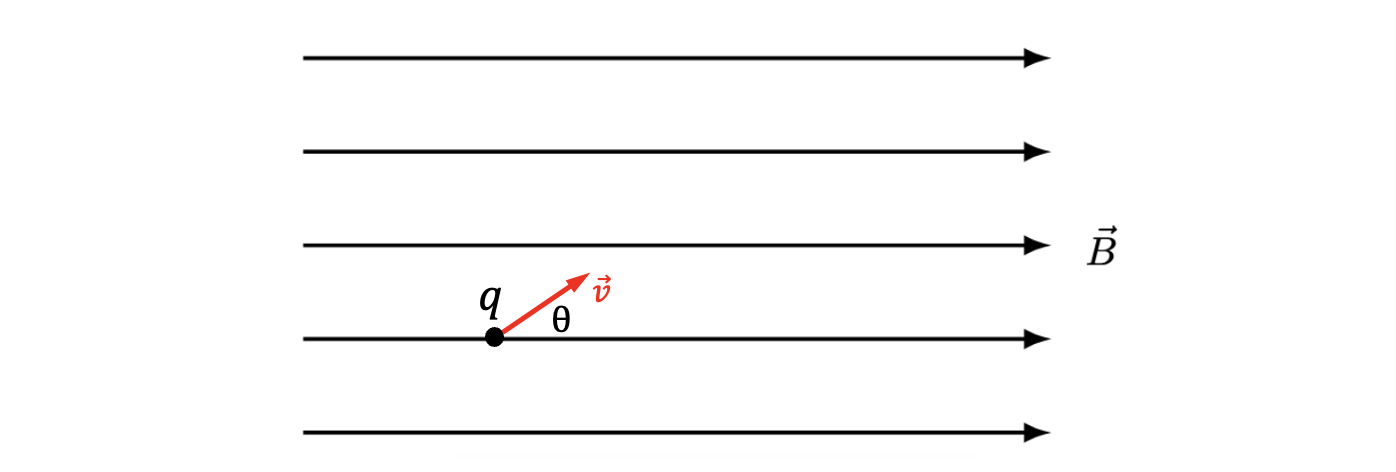
Figure: The magnetic force on a moving charge depends on the angle between velocity and magnetic field. It is maximum for and zero for motion parallel or antiparallel to .
- : no magnetic force.
- or antiparallel: no magnetic force.
- : maximum force .
2. Direction without sign mistakes
- Temporarily treat the particle as positive.
- Use or Fleming’s rule with positive-charge velocity replacing conventional current.
- If the actual charge is negative, reverse the result.
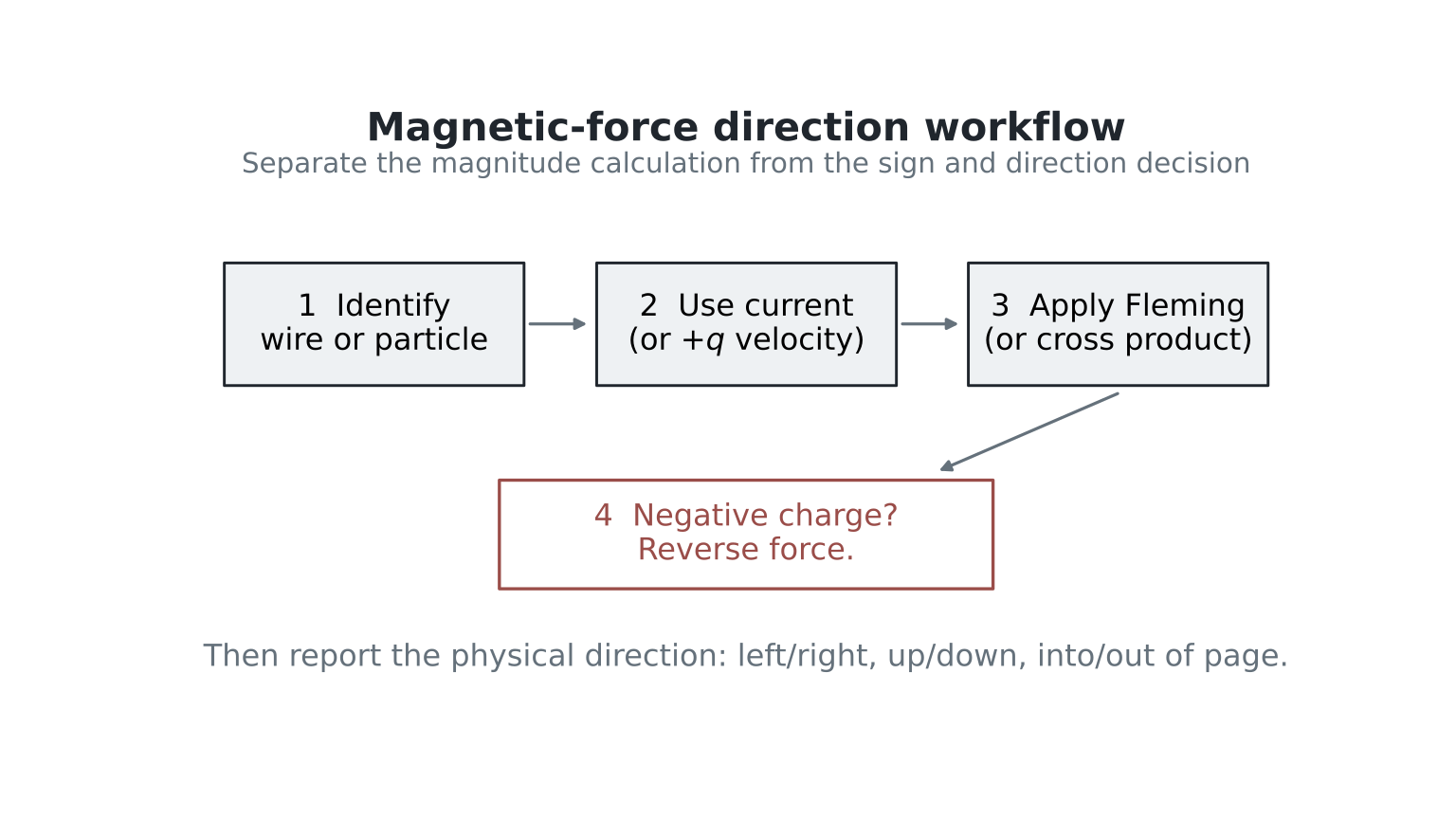
Figure: A reliable direction method is to determine the force for a positive charge first, then reverse the force if the actual particle has negative charge.
Example: for to the right and into the page, a positive charge is forced upward and a negative charge downward.
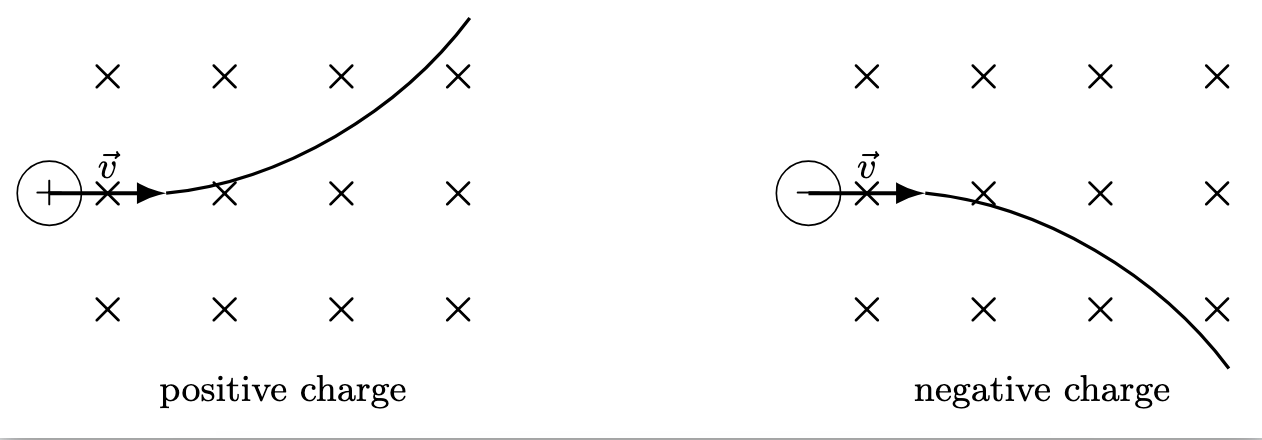
Figure: Opposite charge signs curve in opposite directions in the same magnetic field because the magnetic force reverses when changes sign.
3. Why a magnetic field alone cannot change speed
At every instant, . Hence
and the magnetic work is zero. Kinetic energy and speed remain constant, while direction may change.
This conclusion applies to the magnetic force alone. An electric field, gravity or another force may still do work.
4. Perpendicular entry: circular motion
Assume a non-relativistic particle moves in a uniform magnetic field, , with no other resultant force. Then
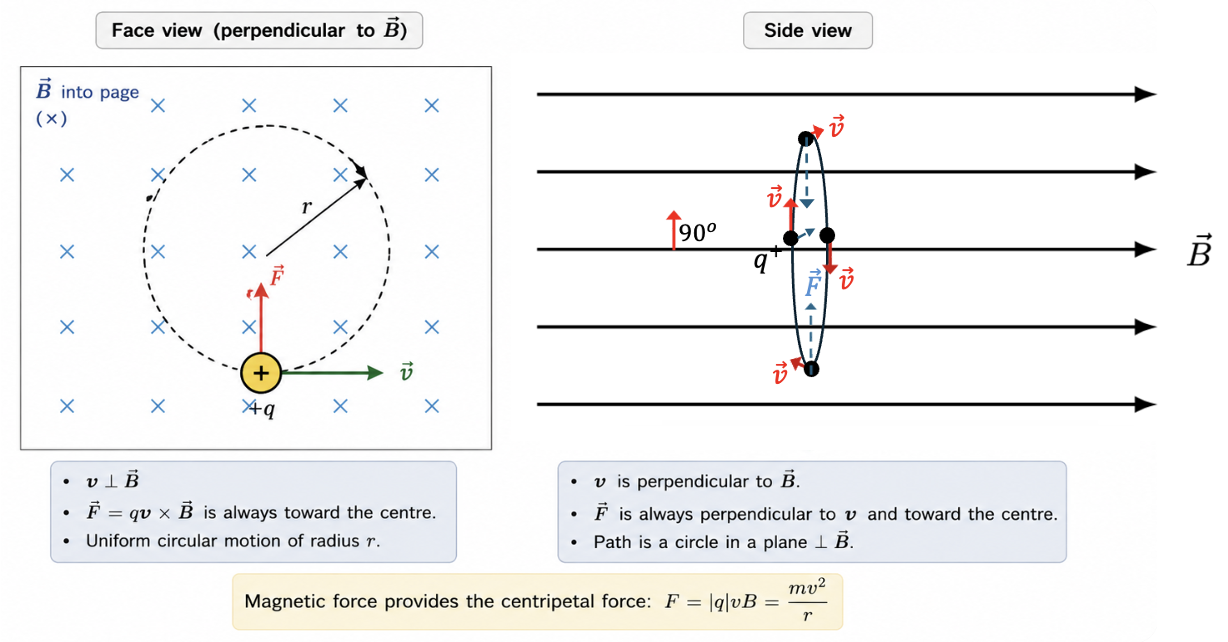
Figure: In uniform circular magnetic motion, the magnetic force is always directed towards the centre while the velocity is tangent to the path. This is why the magnetic force changes direction but not speed.
The path is a circle because the force has constant magnitude and always points towards the instantaneous centre. Velocity remains tangent to the path.
Worked comparison
Two particles enter the same field with equal speed. Particle A has twice the mass and the same as B:
If the particles instead have opposite charge signs but equal , and , they curve in opposite senses with equal radii.
5. Leaving a finite magnetic-field region
Within the field, the path is a circular arc. At the boundary, the particle leaves along the tangent to the arc. Outside the field, it continues in a straight line at constant speed if no other force acts.
Do not extend the circle outside a region where .
6. Electric versus magnetic deflection
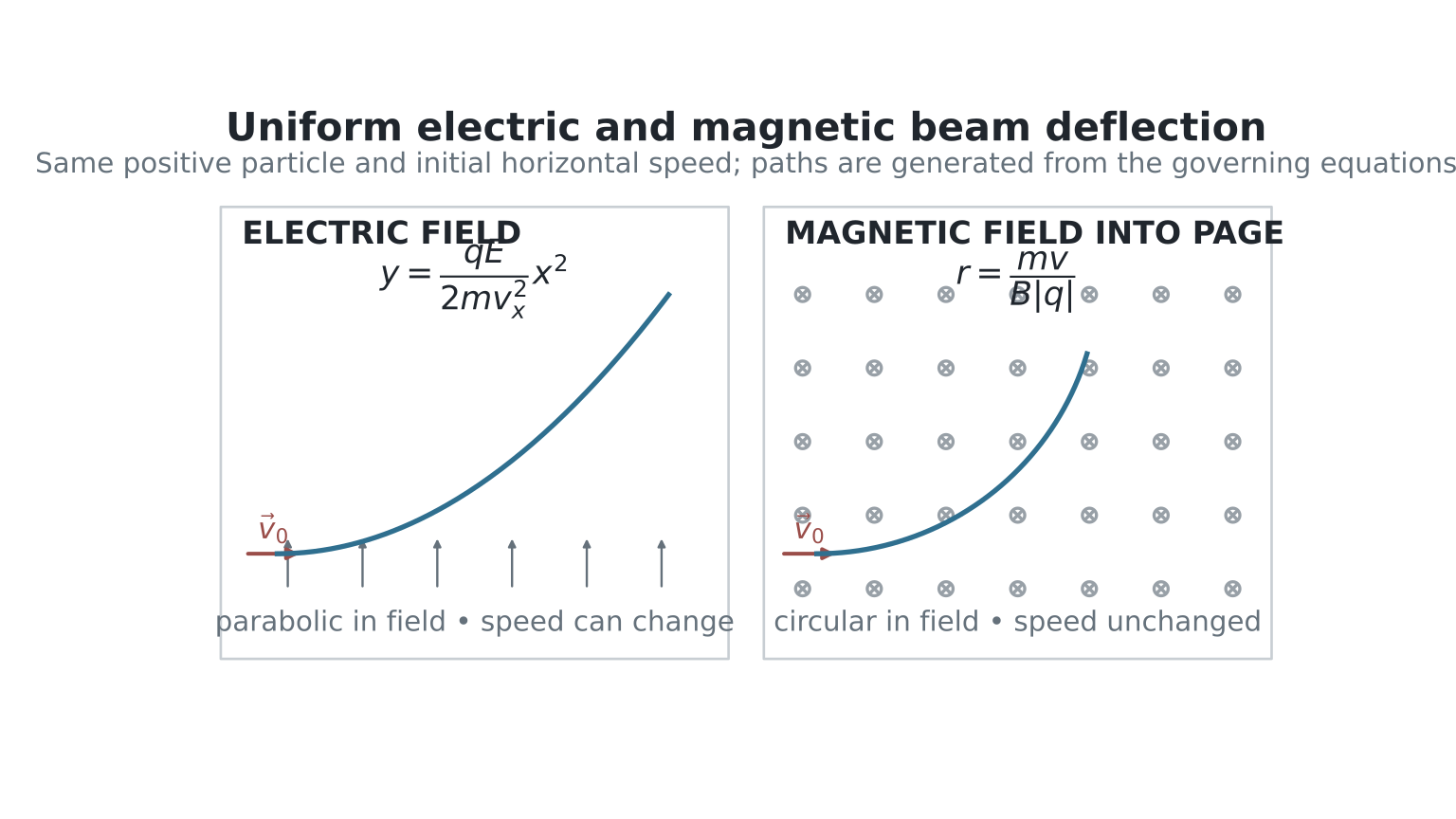
Figure: Electric deflection and magnetic deflection look different because an electric force has a fixed direction in a uniform field, while the magnetic force remains perpendicular to the changing velocity.
For a uniform transverse electric field and initial horizontal speed ,
while the particle remains between the plates. The transverse path is parabolic under the stated ideal assumptions, and the electric field can change kinetic energy.
For a uniform magnetic field perpendicular to the velocity, the path is a circular arc with
and speed remains constant.
7. Crossed fields: velocity selector
Let , and be mutually perpendicular, with electric and magnetic forces opposing.
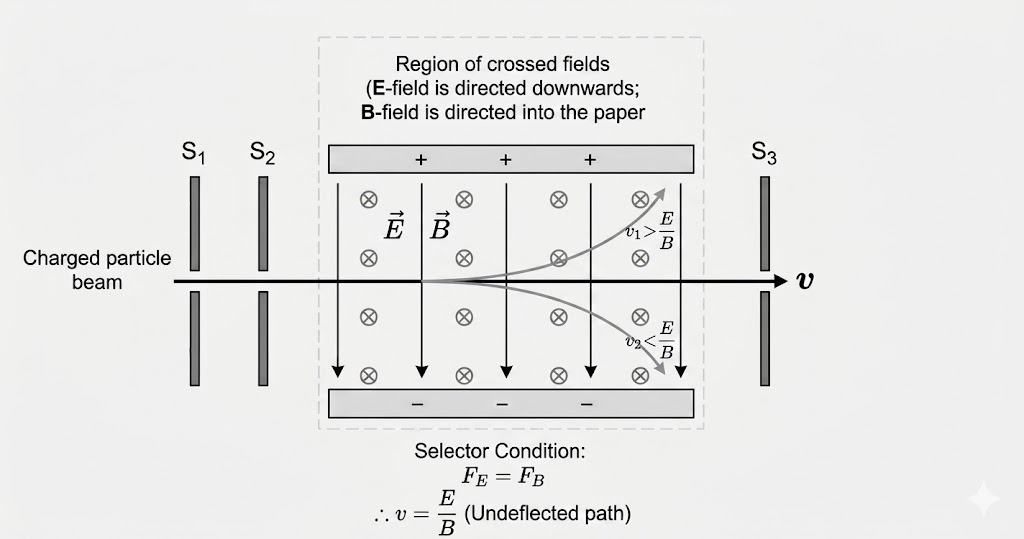
Figure: In the stated crossed-field geometry, the electric and magnetic forces are opposite for the beam direction shown. Undeflected particles have speed .
For no deflection,
For charged particles entering in the prescribed direction, this selects speed, not momentum or kinetic energy. The result is independent of and ; direction still has to be checked separately. Neutral particles are undeflected at every speed, so they are not speed-selected.
For the figure’s positive beam, if magnetic force is upward and electric force downward:
- : magnetic force is larger, so the particle deflects upward;
- : electric force is larger, so it deflects downward.
For a negative beam both directions reverse.
8. Enrichment: oblique entry and helical motion
Resolve velocity into
- is unchanged because it is parallel to ;
- produces circular motion.
Therefore the path is a helix:
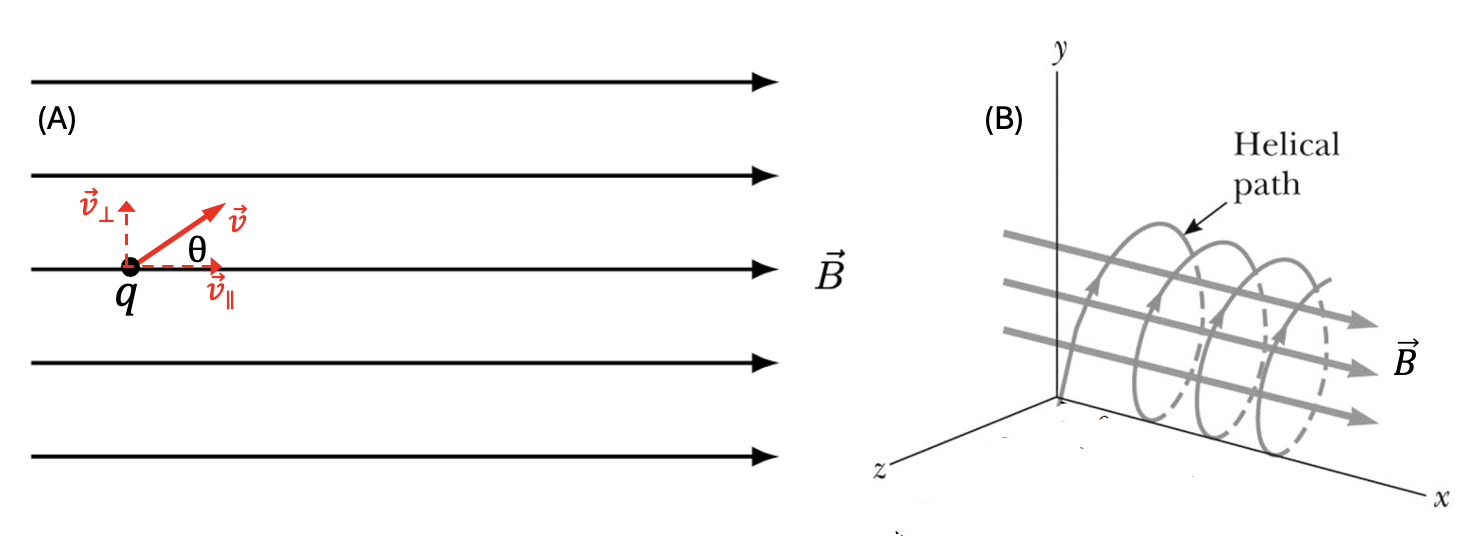
Figure: Oblique entry can be resolved into parallel and perpendicular velocity components. The perpendicular component gives circular motion, while the parallel component carries the particle along the field to form a helix.
The period and pitch are
At fixed particle and velocity components, increasing decreases both radius and pitch. Reversing the charge reverses the helix handedness but not or magnitudes.
9. Calculation example
A proton enters a field perpendicularly at . With and ,
The sense of curvature must be found from the stated directions of and .
10. Final checks
- Use in magnitude, radius and period equations.
- Reverse direction—not magnitude—for a negative charge.
- A magnetic field changes velocity direction, not speed.
- Circular motion requires and a uniform field.
- A particle leaves a finite field along the tangent.
- In a selector, balance magnitudes only after confirming that the forces oppose.