Magnetic Force
Syllabus position
This dossier completes official Electromagnetism outcomes (e)–(m). Magnetic Fields explains how fields are produced; this dossier explains forces on currents and moving charges, how is measured, and how charged-particle beams are deflected or selected.
Overview
Magnetic force links field geometry to motion. A magnetic field can push on a current-carrying conductor, deflect a moving charged particle, and make parallel current-carrying wires attract or repel. The central rule is directional: when the magnetic force is non-zero, it is perpendicular to both the magnetic field and the relevant current or velocity.
Core Ideas
- A stationary charge has no magnetic force, and a current or velocity parallel to gives zero magnetic force.
- applies to a straight current-carrying conductor of active length in a uniform field.
- applies to a moving charge; charge sign affects direction, not scalar magnitude.
- Magnetic force alone does no work because it is perpendicular to velocity.
- A current balance can define or measure by balancing magnetic and gravitational moments.
- Circular magnetic deflection, velocity selectors and parallel-current forces all follow from the same force geometry.
Exam Relevance
Students are expected to choose the correct force formula, identify the correct angle and active length, determine force directions using conventional current or positive-charge logic, explain charged-particle circular motion, apply for crossed fields, and calculate forces between long parallel currents.
1. The central idea
A magnetic field does not exert the same force on every object placed in it. For the systems studied here:
- a current-carrying conductor may experience a force;
- an individual free point charge may experience magnetic force only when it moves;
- a stationary free point charge has zero magnetic force;
- motion or current exactly parallel or antiparallel to gives zero magnetic force.
When a magnetic force acts, it is perpendicular to both the field and the relevant motion/current direction. This geometric fact explains most of the topic.
2. Force on a current-carrying conductor
For a straight conductor carrying conventional current in a uniform magnetic field,
where:
- is magnetic flux density;
- is the length of conductor actually inside the field;
- is the included angle from to between the conventional-current direction and .
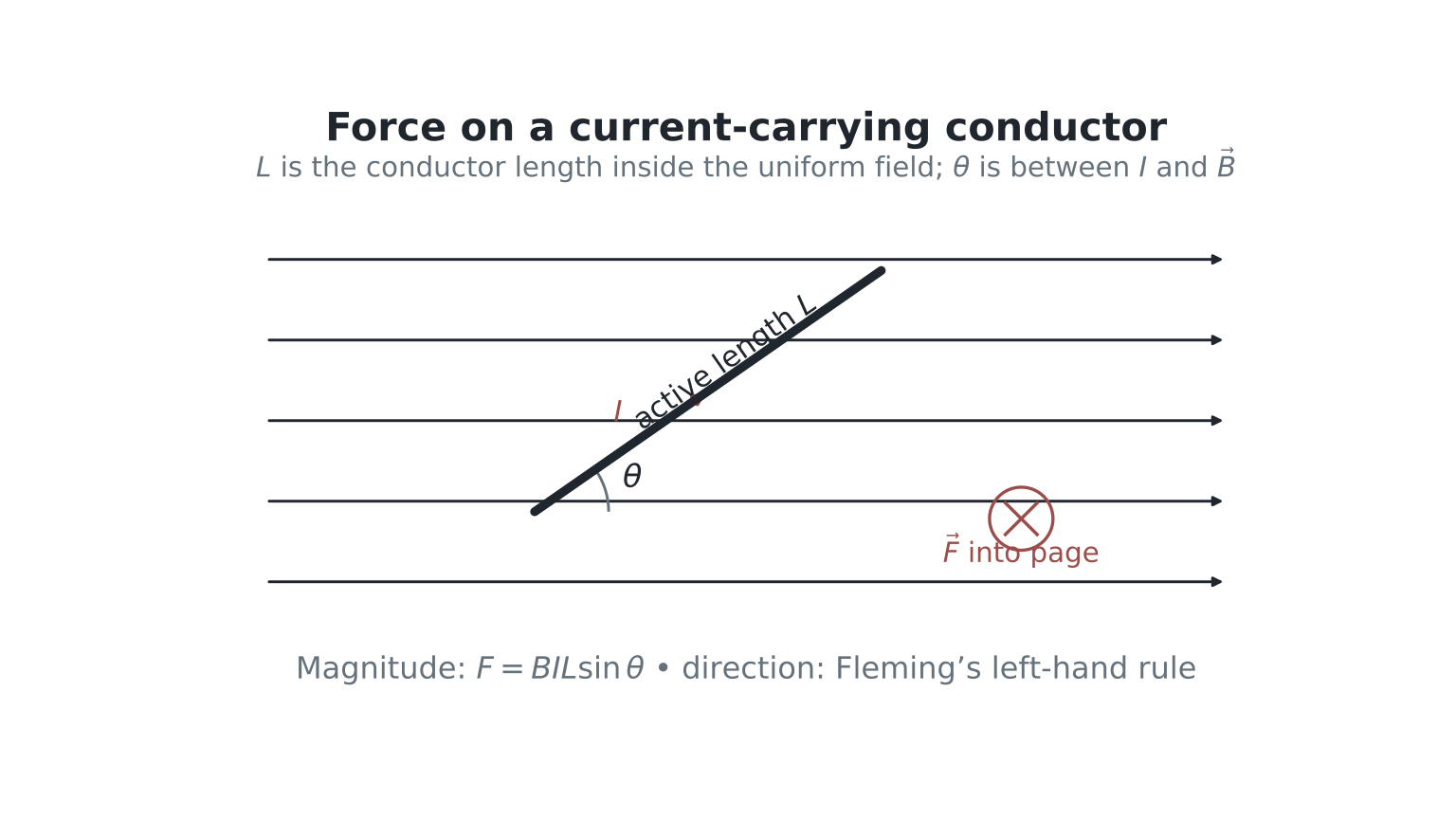
Figure: For a straight conductor in a uniform magnetic field, only the component of the current direction perpendicular to contributes to the magnetic force. The active length is the length of conductor inside the field.
Special cases:
Direction: Fleming’s left-hand rule
Use conventional current:
- first finger: magnetic field, from N to S;
- second finger: conventional current;
- thumb: force on the conductor.
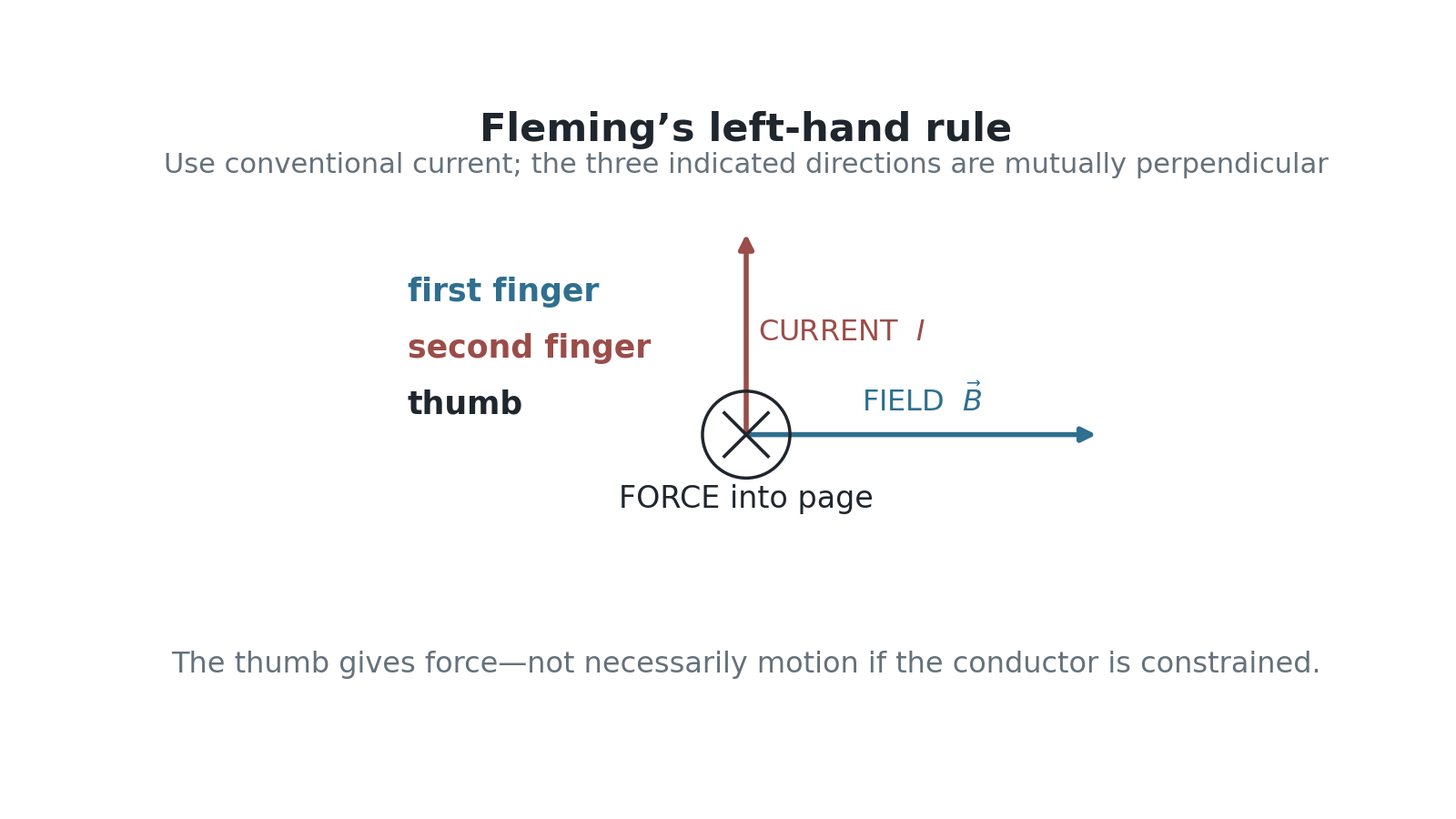
Figure: Fleming’s left-hand rule uses conventional current: first finger for field, second finger for current, and thumb for the magnetic force on the conductor.
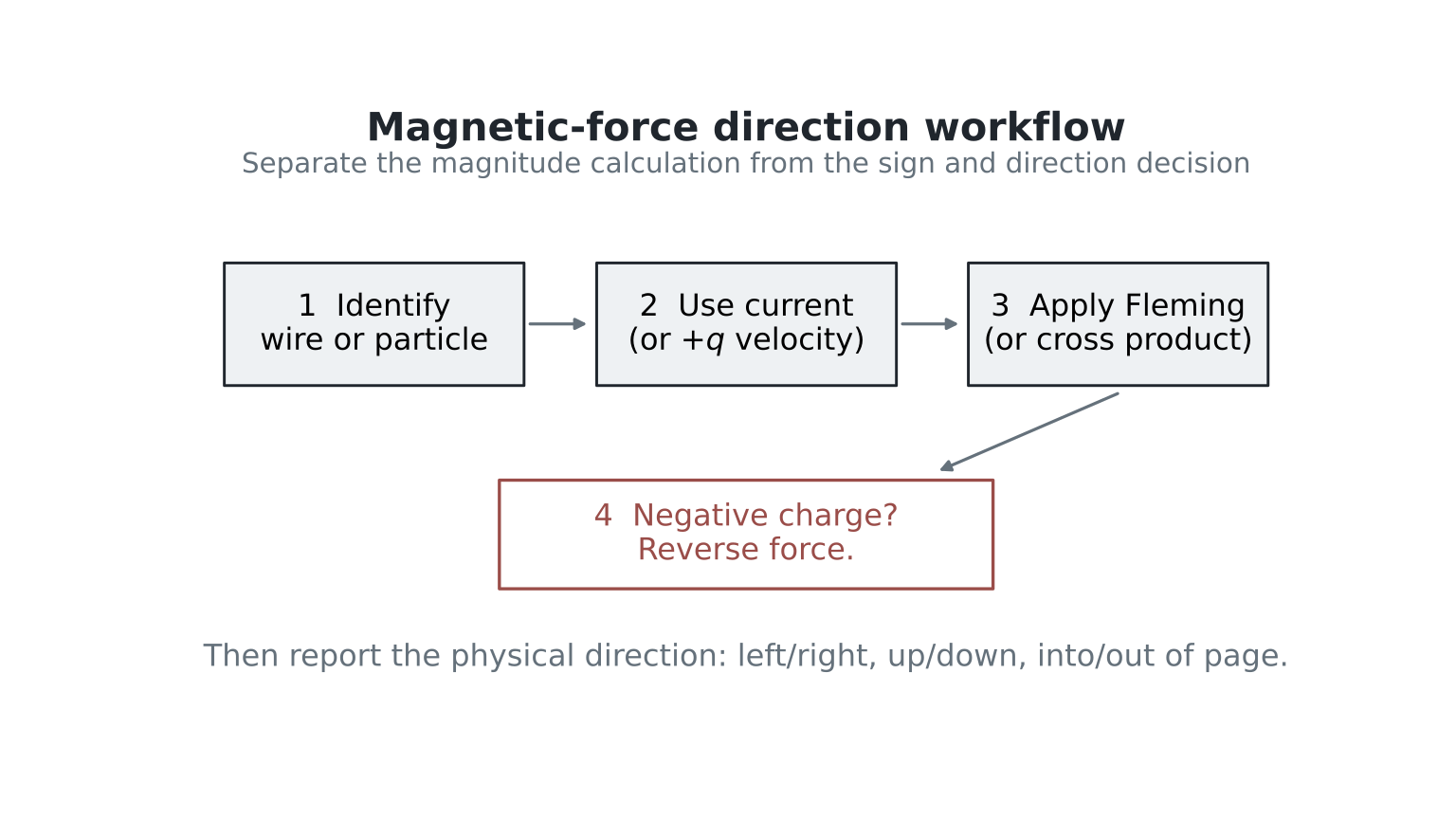
Figure: A direction workflow reduces sign mistakes. Work out the direction for conventional current or a positive charge first, then reverse the force if the moving particle is negatively charged.
Vector form
If points along conventional current and has magnitude equal to the conductor length in the field,
The cross product explains why the force is perpendicular to both vectors. Fleming’s rule is sufficient for the required direction questions.
3. Magnetic flux density and the tesla
Place a straight conductor perpendicular to a uniform field, so . Then
Magnetic flux density is the force per unit current per unit length on a straight conductor placed normal to the magnetic field.
One tesla is the field that produces a force of on a length of straight conductor carrying perpendicular to the field:
This operational definition requires the conductor to be straight, normal to the field and within a uniform-field region.
4. Worked conductor-force example
A segment carries at to a uniform field.
The magnitude calculation does not determine whether the force is into or out of the page; apply Fleming’s rule to the directions shown in the question.
5. Measuring with a current balance
A current balance converts an unknown magnetic force into a measurable turning effect.
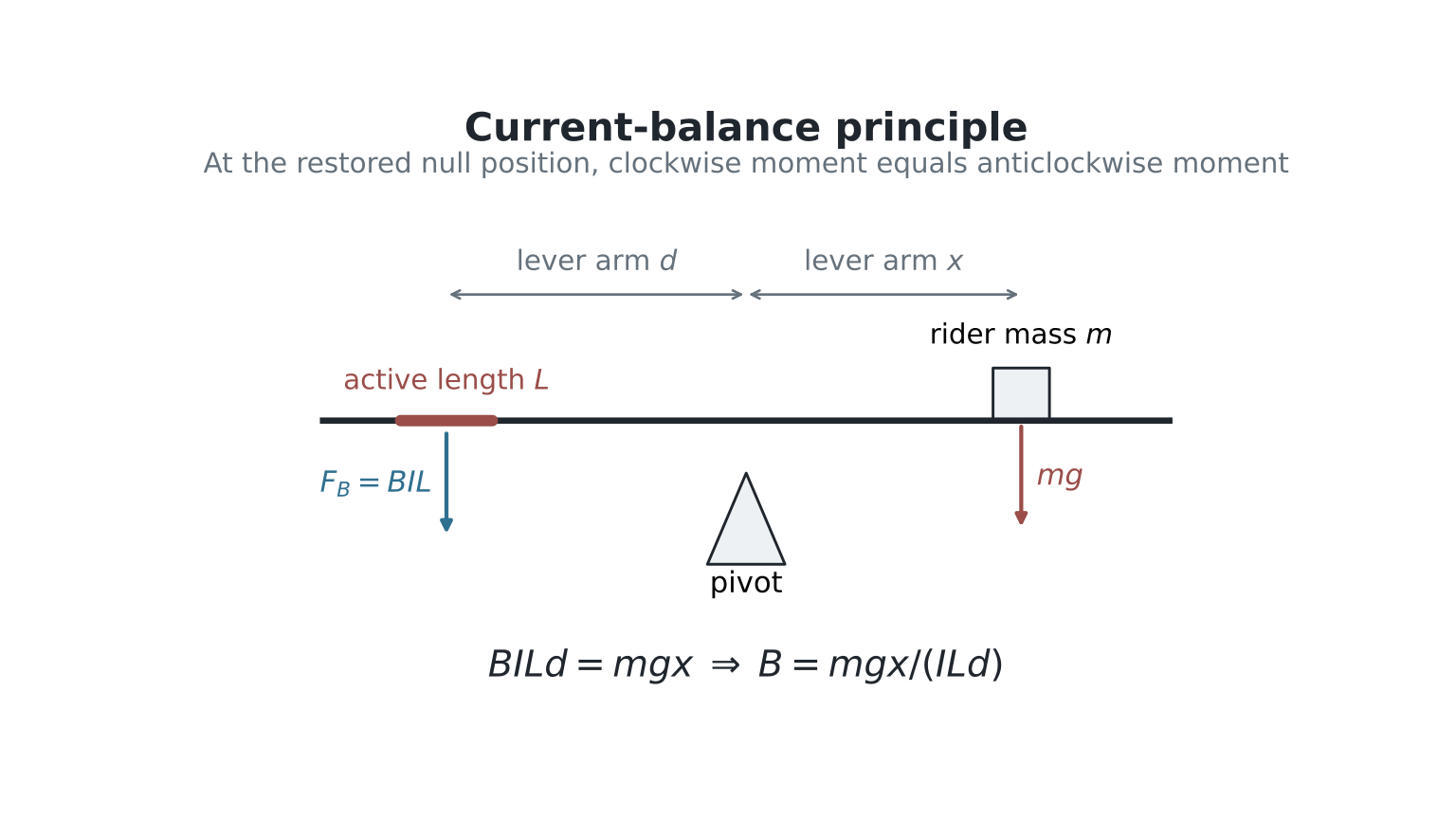
Figure: In a current balance, the magnetic force on the active wire segment produces a moment about the pivot. At the restored null position, this magnetic moment is balanced by the moment of the rider’s weight.
In the idealised arrangement:
- a straight segment of length is perpendicular to the field;
- it carries current , so the magnetic force is ;
- the line of action of is perpendicular distance from the pivot;
- a rider of mass is placed perpendicular distance from the pivot to restore balance.
Taking moments about the pivot,
so
Experimental reasoning
- With no current, adjust the balance to a horizontal zero.
- Switch on the current and observe the magnetic turning effect.
- Move a known rider until the original null position is restored.
- Measure , , and , then calculate .
At balance, the pointer returning to the original position matters: it ensures the lever arms match the geometry used in the equation. Reverse the current as a check—the magnetic force and deflection should reverse, while many mechanical offsets do not.
Numerical current-balance example
A active segment carries . Its magnetic force acts from the pivot. A rider placed from the pivot restores the null position. Taking ,
6. Force on an individual moving charge
For a charge moving with velocity in a magnetic field,
and the magnitude is
where is the angle between and .
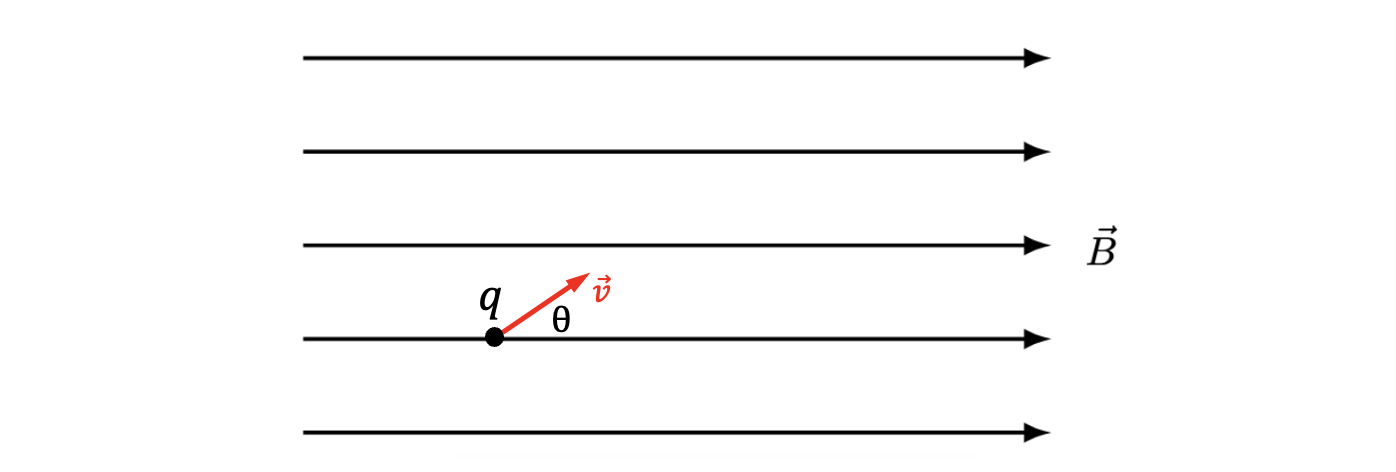
Figure: The magnetic force on a moving charge is perpendicular to both and when the charge has a velocity component across the field. Reverse the force direction for a negative charge.
Determine direction for a positive charge using , then reverse it for a negative charge. Using in the magnitude equation prevents the impossible result of a negative force magnitude.
Because ,
Therefore a magnetic field alone does no work on the particle: kinetic energy and speed remain constant, although velocity direction may change.
7. Circular magnetic deflection
If a non-relativistic particle has in a uniform field, the force has constant magnitude and continually points perpendicular to the velocity. It supplies the centripetal force:
so
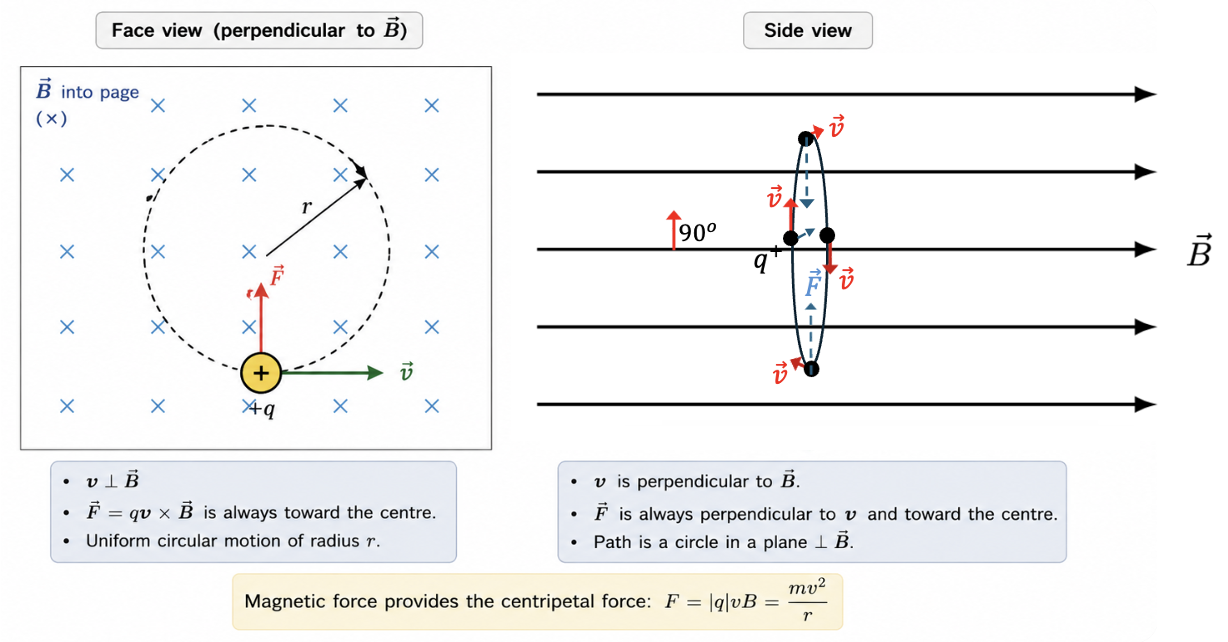
Figure: For perpendicular entry into a uniform magnetic field, the magnetic force is always radial and provides the centripetal force. The velocity remains tangent to the circular path.
The radius increases with momentum and decreases with or . The sign of changes the sense of curvature, not the radius magnitude.
Period and helical motion
For perpendicular entry, the circular period is
independent of speed in the non-relativistic model. If velocity also has a constant component parallel to , the combined path is a helix. See Charged Particles in Magnetic Fields.
8. Electric versus magnetic beam deflection
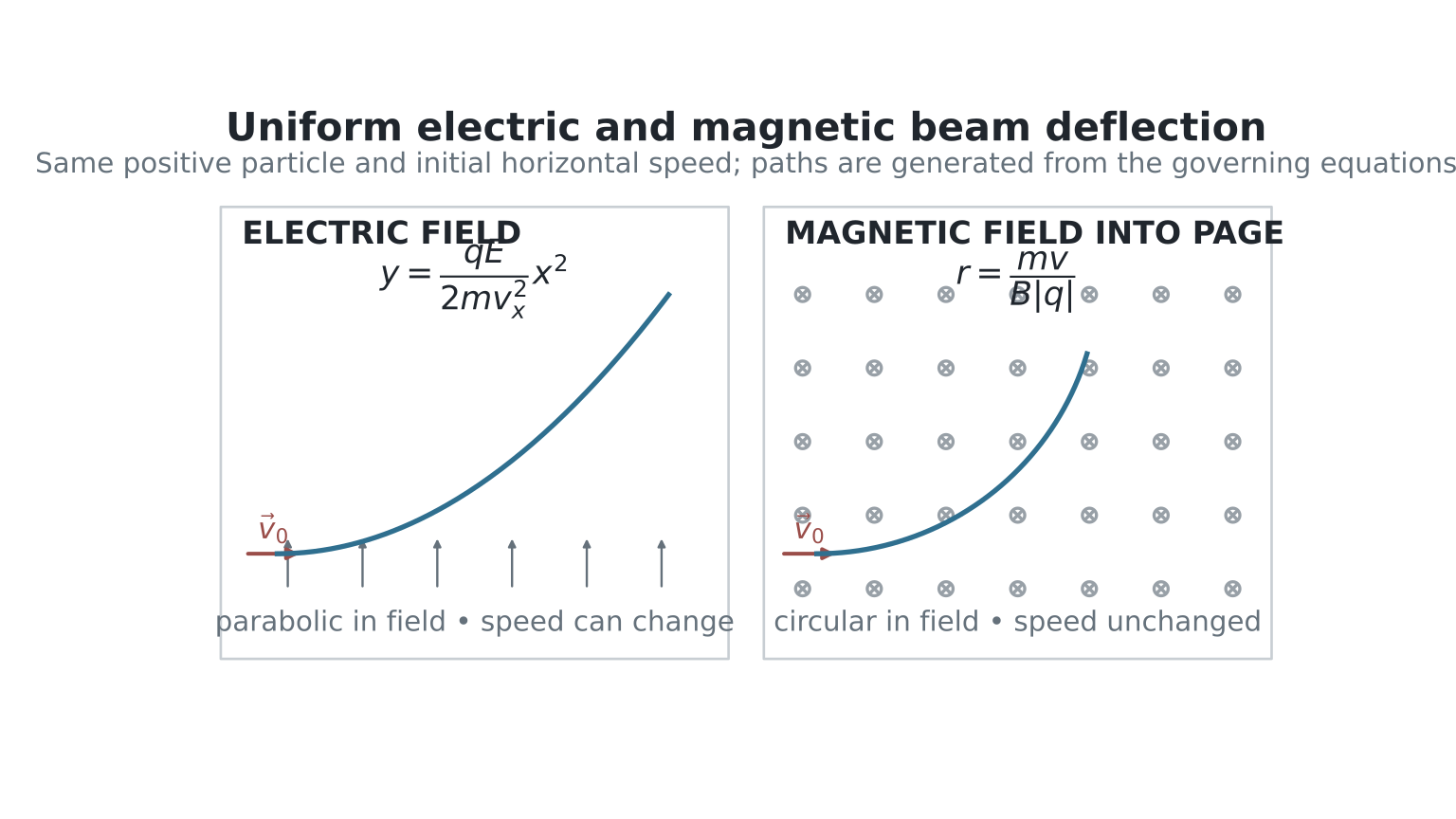
Figure: A uniform electric field gives a constant force direction and can change speed, while a magnetic field perpendicular to the velocity gives a force that changes direction and bends the path without changing speed.
| Uniform electric field | Uniform magnetic field |
|---|---|
| force direction is fixed if is fixed | force direction changes as changes |
| can do work and change speed | does no work; speed remains constant |
| for a uniform transverse field and the stated ideal conditions, the path is parabolic | for , path is circular |
These statements apply within ideal uniform-field regions. On leaving the field, the particle travels along the tangent with constant velocity if no other force acts.
9. Crossed fields and velocity selection
Arrange , and the beam velocity mutually perpendicular so electric and magnetic forces oppose.
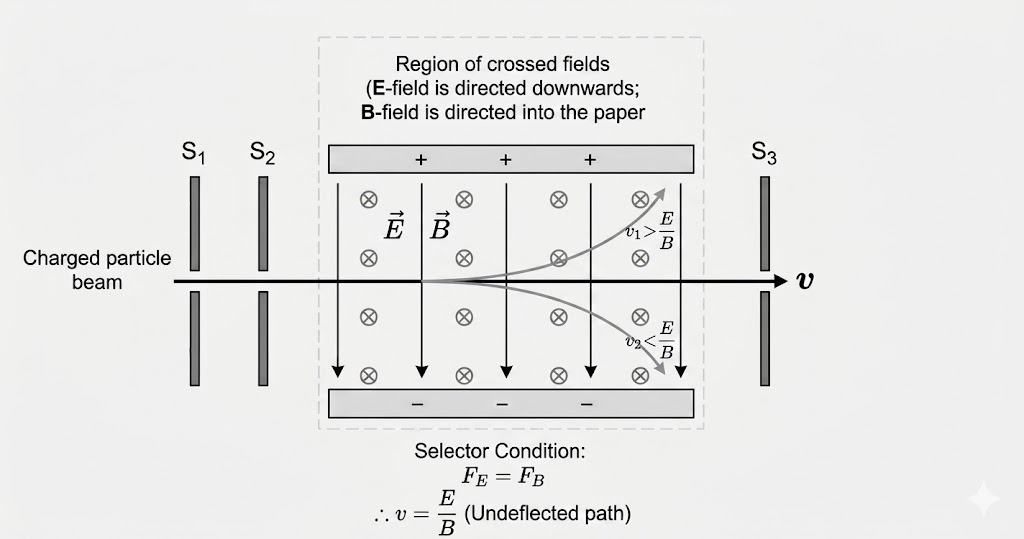
Figure: In a crossed-field velocity selector, the electric and magnetic forces oppose each other for the stated beam direction. Only particles with pass through undeflected.
For an undeflected particle,
so
For charged particles entering in the prescribed direction, the selected speed is independent of charge magnitude and mass. Reversing the charge reverses both forces, so either sign can remain undeflected at the same speed if the field geometry is unchanged. Charged particles with other speeds are deflected and may be blocked by the exit slit. Neutral particles are undeflected at every speed and are therefore not speed-selected by this balance.
10. Forces between parallel currents
Each wire lies in the field produced by the other:
- currents in the same direction attract;
- currents in opposite directions repel.

Figure: Each long wire produces a magnetic field at the position of the other wire. Same-direction currents attract; opposite-direction currents repel.
For long straight parallel wires separated by in air or free space,
or
The forces on the two selected equal-length segments have equal magnitude and opposite direction, even if .
Detailed derivation: Force Between Parallel Currents.
11. Formula and condition summary
| Situation | Magnitude | Essential condition |
|---|---|---|
| straight conductor | is length in uniform field | |
| moving charge | $F=B | q |
| circular magnetic path | $r=mv/(B | q |
| velocity selector | crossed fields; forces oppose | |
| parallel wires | long, straight, parallel wires | |
| current balance | stated null geometry and perpendicular segment |