Motional emf
Branch note: This note explains how motion through a magnetic field separates charge, when is valid, and how a closed sliding-rod circuit transfers mechanical energy to electrical energy.
Overview
Motional emf is induced when a conductor moves through a magnetic field in a geometry that separates charge along the conductor. This branch note distinguishes an isolated moving rod, which can have an emf without sustained current, from a closed sliding-rod circuit, where induced current and magnetic drag occur.
Core Ideas
- Mobile charges in a moving conductor experience .
- Charge separation can produce an emf even when the circuit is open.
- is a special-case result requiring the correct mutual geometry of , and rod length .
- In a closed sliding-rod circuit, Lenz’s law gives a magnetic force opposing the imposed motion.
- Under ideal constant-speed assumptions, external mechanical power becomes electrical power and thermal power in the circuit resistance.
Exam Relevance
Students are expected to check the geometry before using , determine rod polarity from , decide whether current can flow, and connect motional emf with energy conservation in sliding-rod problems.
1. Isolated moving rod: emf without sustained current
Consider a straight conducting rod moving with velocity through a magnetic field . Mobile charges share the rod’s translational velocity and experience
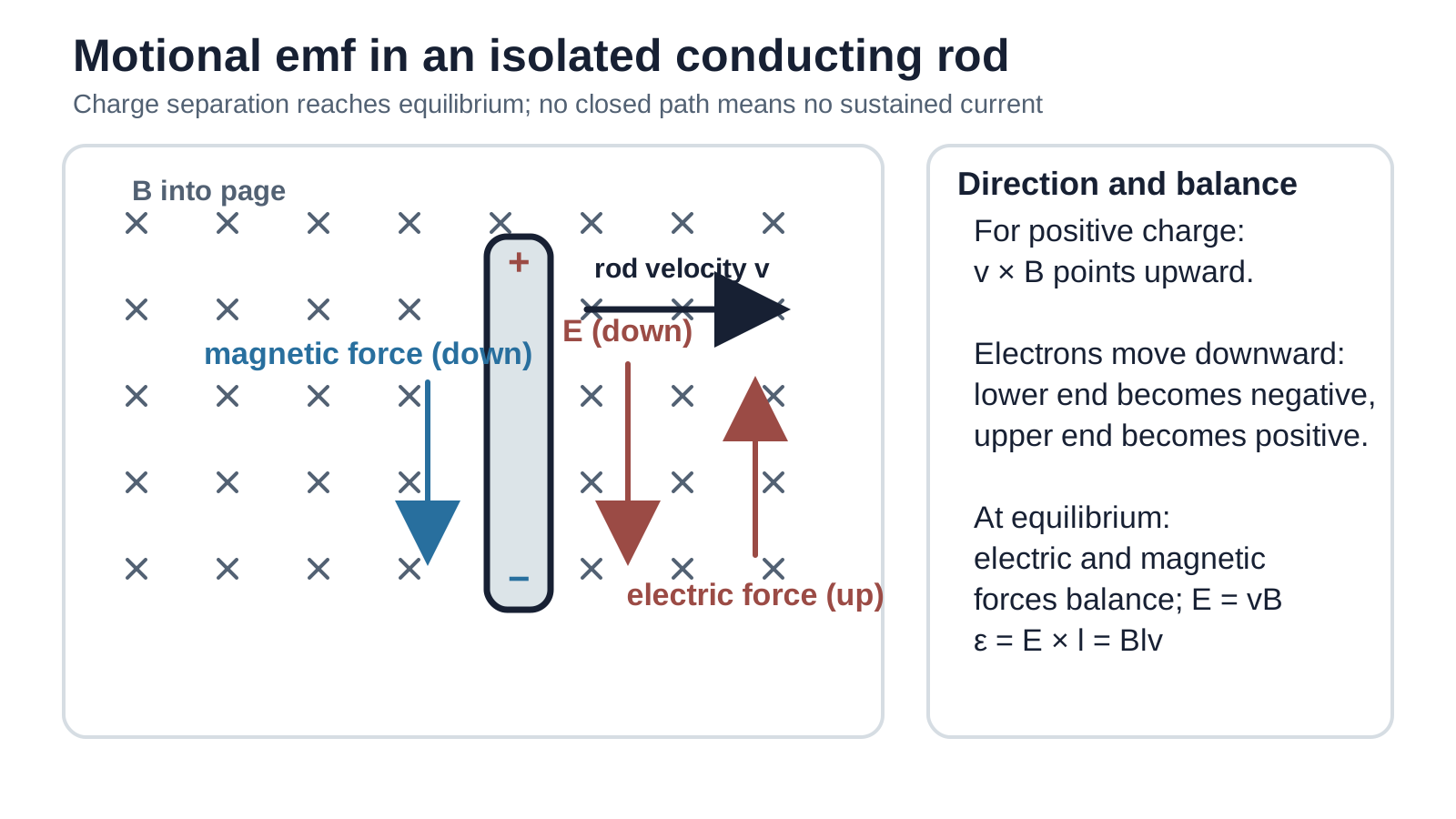
Figure: For a rod moving right in a field into the page, points upward. Positive charge would be driven upward; mobile electrons are driven downward. The top becomes positive and the bottom negative. The induced electric field points downward, so the electric force on an electron points upward and eventually balances its magnetic force.
Charge separation produces an internal electric field. At equilibrium for a charge,
for perpendicular and , hence . If the rod length is parallel to , the potential difference between its ends is
The isolated rod then has an emf across its ends but no sustained current, because there is no closed path.
2. Conditions for
The simple formula applies when:
- the rod is straight and has effective length inside a uniform field;
- ;
- the rod is parallel to , so its length is perpendicular to both and ;
- all parts move with the stated velocity.
It is unsafe to say only “use the velocity perpendicular to the field”. The rod’s orientation also matters.
For a straight rod aligned with , but with angle between and ,
Polarity method
- Use to find the force direction on a positive charge.
- The end toward that direction becomes positive.
- If a circuit is closed, conventional current leaves the positive end through the external circuit.
This vector method avoids ambiguity. Fleming’s right-hand generator rule may also be used for mutually perpendicular field, motion, and induced conventional current; it is not Fleming’s left-hand motor rule.
3. Sliding rod on conducting rails
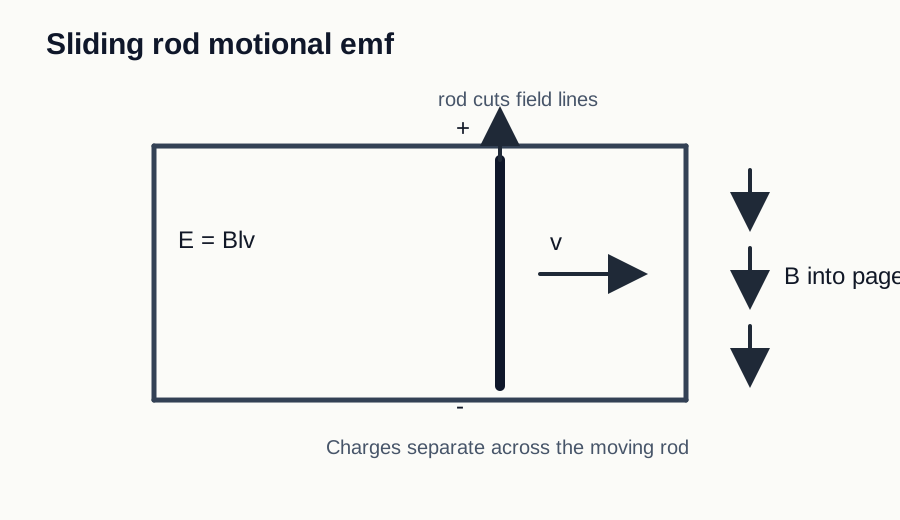
Figure: A rod of length moves right at constant speed on conducting rails in a field into the page. The loop area grows at rate , so the into-page flux increases. The induced current is anticlockwise to produce a field out of the page, and the magnetic force on the rod is leftward, opposing the imposed motion.
3.1 Flux-change derivation
If the rod has moved a distance , the loop area is . For uniform perpendicular to the loop,
Therefore,
This agrees with the charge-separation derivation.
3.2 Current and magnetic drag
If the total circuit resistance is ,
For the perpendicular geometry, the magnetic force on the current-carrying rod has magnitude
Its direction opposes the motion by Lenz’s law. To maintain constant speed when other resistive forces are negligible, an external force of equal magnitude must act in the direction of motion.
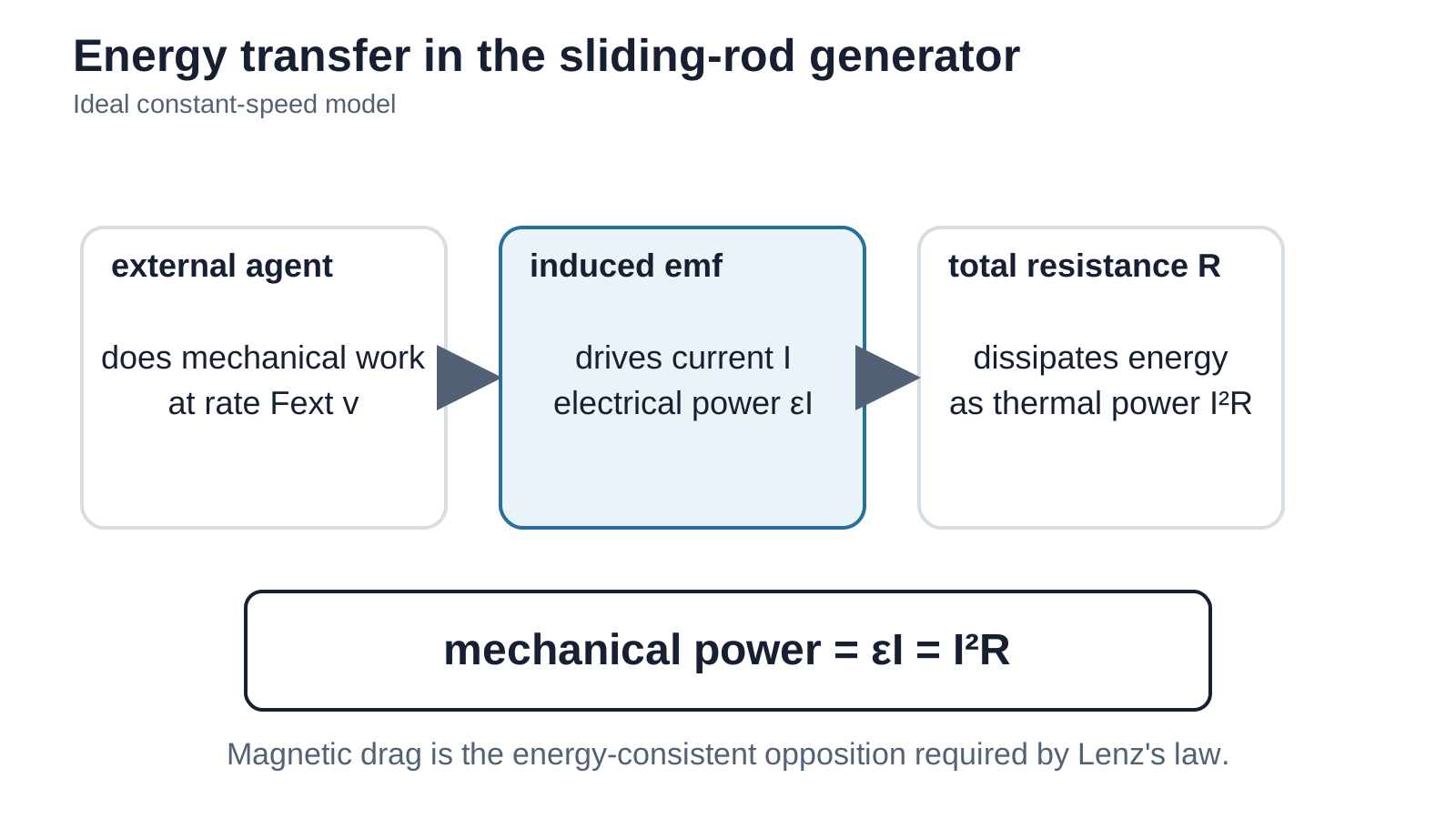
Figure: Under the ideal constant-speed assumptions, external mechanical power becomes electrical power and ultimately thermal energy in the total circuit resistance: .
3.3 Energy consistency
With at constant speed,
This equality assumes ideal rails and a rod with no change in kinetic energy, and that represents the total resistance in which electrical energy is dissipated.
4. Worked examples
Example 1: complete sliding-rod chain
A rod of length moves at perpendicular to a field. The total circuit resistance is .
The checks agree:
Example 2: oblique motion
A rod is aligned with . It moves at through a field, with angle between and .
Example 3: no emf despite motion
If the rod moves parallel to , then . No magnetic charge separation occurs and the motional emf is zero.
5. Common reasoning failures
- “The rod moves, so there is emf.” Motion alone is insufficient; the magnetic-force direction must have a component along the rod.
- “Use the left-hand rule.” That is the motor-force mnemonic in its usual form. Use , or the right-hand generator rule.
- “There is always current.” An isolated rod develops emf but not a sustained current.
- “The magnetic force drives the rod.” In the passive sliding-rod generator, the induced-current force opposes the imposed motion.
- “ is the load only.” In , must be the total circuit resistance unless the problem explicitly neglects every other resistance.
6. Enrichment — beyond H2 Physics 9749 syllabus scope
For a straight rod represented by a directed length vector and translating in uniform fields,
More generally, motional emf along a moving conducting path is described by
These expressions explain why the orientations of the field, velocity, and conductor all matter. They are useful conceptual extensions, not required formulae for the 9749 examination.