Scalars, Vectors and Components
Syllabus-core branch: This note covers 9749 Measurement outcomes (g)–(i).
Overview
This branch note explains how to distinguish scalar and vector quantities, represent vectors with arrows or components, and combine coplanar vectors reliably.
Core Ideas
- Scalars need magnitude and unit only.
- Vectors need magnitude, unit and direction.
- Vector addition and subtraction must preserve direction.
- Components are signed quantities along chosen perpendicular axes.
1. Scalar or vector?
A scalar quantity is completely specified by its magnitude: a numerical value and unit. A vector quantity requires magnitude and direction.
| Scalar examples | Vector examples |
|---|---|
| distance, speed | displacement, velocity |
| mass, energy | acceleration, force |
| time, temperature | momentum, electric field strength |
| density, pressure | magnetic flux density |
Mass and weight are not scalar/vector versions of the same quantity. Mass is measured in kilograms; weight is the force , measured in newtons.
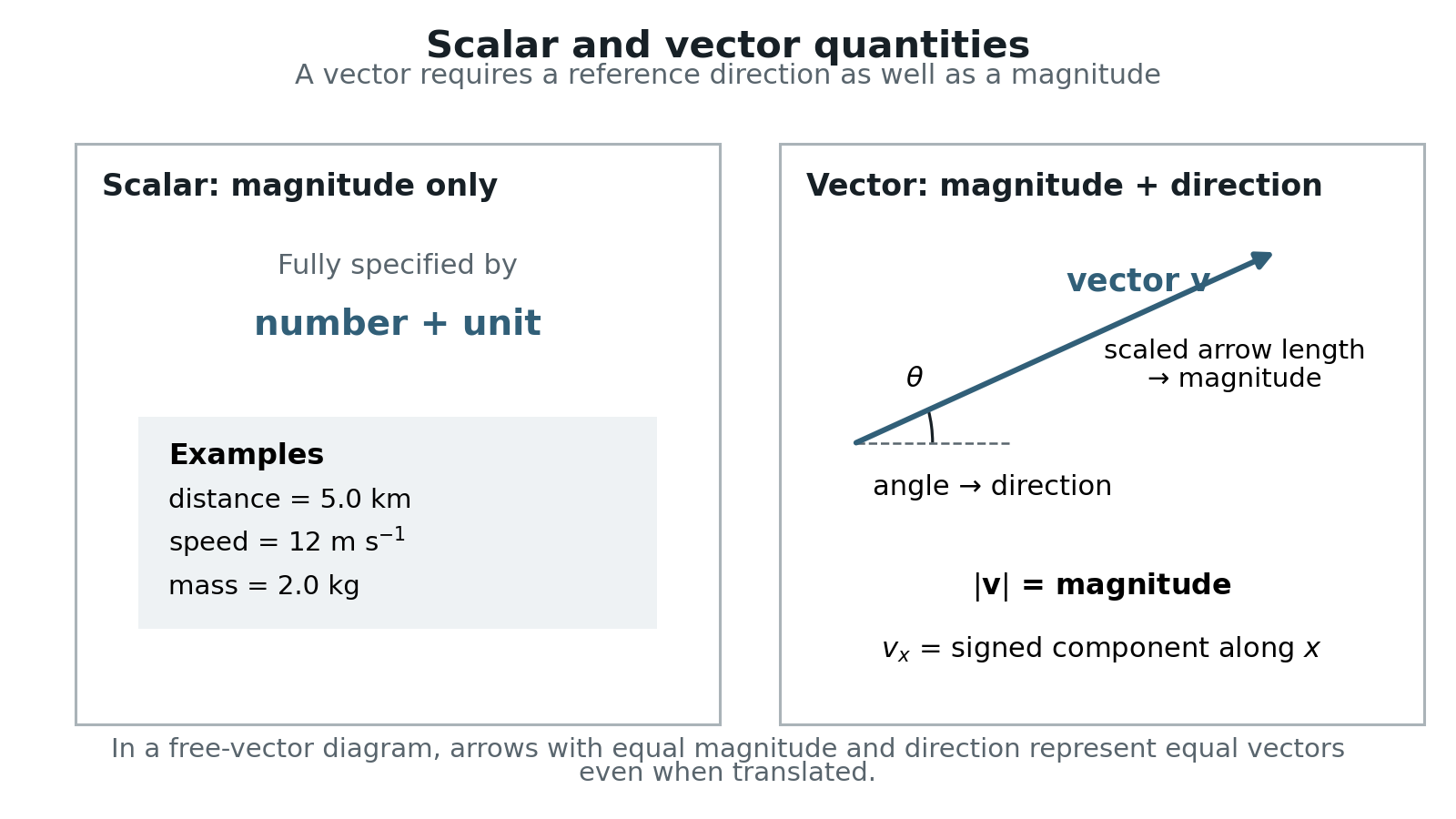
Figure: A scalar is fully specified by magnitude, whereas a vector also needs direction. The marked angle specifies the vector’s direction relative to the chosen dashed reference direction. When the diagram states a scale, the arrow’s scaled length represents magnitude; an arbitrary sketch length does not by itself give a physical magnitude.
Direction is not optional
“” specifies a speed. “ due east” can specify a velocity.
2. Representing a vector
A vector may be written in bold, such as , or with an arrow, such as . Its magnitude is written or and is a scalar.
In a vector diagram:
- the arrow direction gives the vector direction;
- the arrow length is proportional to magnitude when a scale is stated;
- in a vector-addition diagram, an arrow representing a free vector may be translated parallel to itself without rotation or rescaling.
This translation preserves the mathematical vector. It does not mean that moving the physical point or line of application of a force is always irrelevant; doing so can change the turning effect on a body.
Two vectors are equal when they have the same magnitude and direction. The negative vector has the same magnitude as but the opposite direction.
3. Adding coplanar vectors
Coplanar vectors lie in the same plane.
Head-to-tail method
- Draw the first vector to scale.
- Place the tail of the second vector at the head of the first without changing its magnitude or direction.
- Draw the resultant from the tail of the first to the head of the last.
The order may be reversed: .
Parallelogram method
Draw both vectors tail-to-tail, complete the parallelogram, and draw the diagonal from the common tail. This diagonal is the resultant.
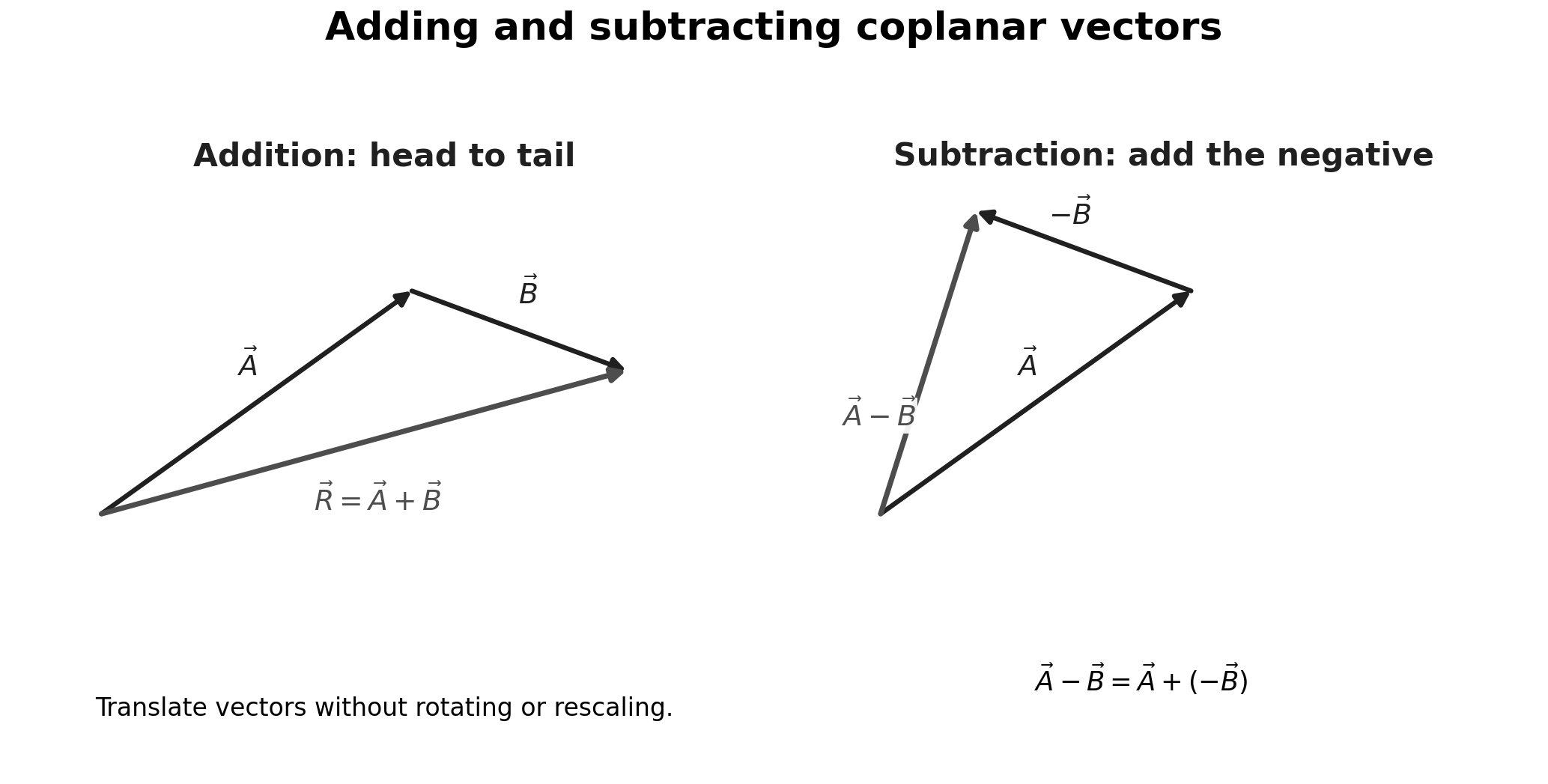
Figure: In a free-vector diagram, arrows may be translated without rotation or rescaling so that they can be placed head-to-tail. The resultant points from the first tail to the final head, so its arrow gives both resultant magnitude and direction. For subtraction, reverse to form , then add it: .
Analytical methods
- For perpendicular vectors, use Pythagoras and trigonometry.
- For a non-right-angled triangle, use the cosine and sine rules.
- Alternatively, resolve every vector into perpendicular components and add components.
Worked example
A ship travels north and then east. The resultant displacement is
Measured east of north,
The complete answer is , east of north.
4. Subtracting vectors
Vector subtraction means adding the negative vector:
This matters when finding a change in a vector quantity:
Do not subtract only the magnitudes unless the two vectors lie along the same line and signs have been assigned consistently.
Worked subtraction: change in velocity
An object initially moves at east and finally moves at south. Taking east as and north as ,
Therefore,
Its magnitude is
and its direction is
south of west. Thus the change in velocity is , south of west.
5. Resolving a vector into perpendicular components
Resolving reverses vector addition. If a vector makes angle measured from the positive -axis, then
These expressions depend on where is measured from. The component adjacent to the stated angle uses cosine; the opposite component uses sine. Assign signs from the actual directions of the components.
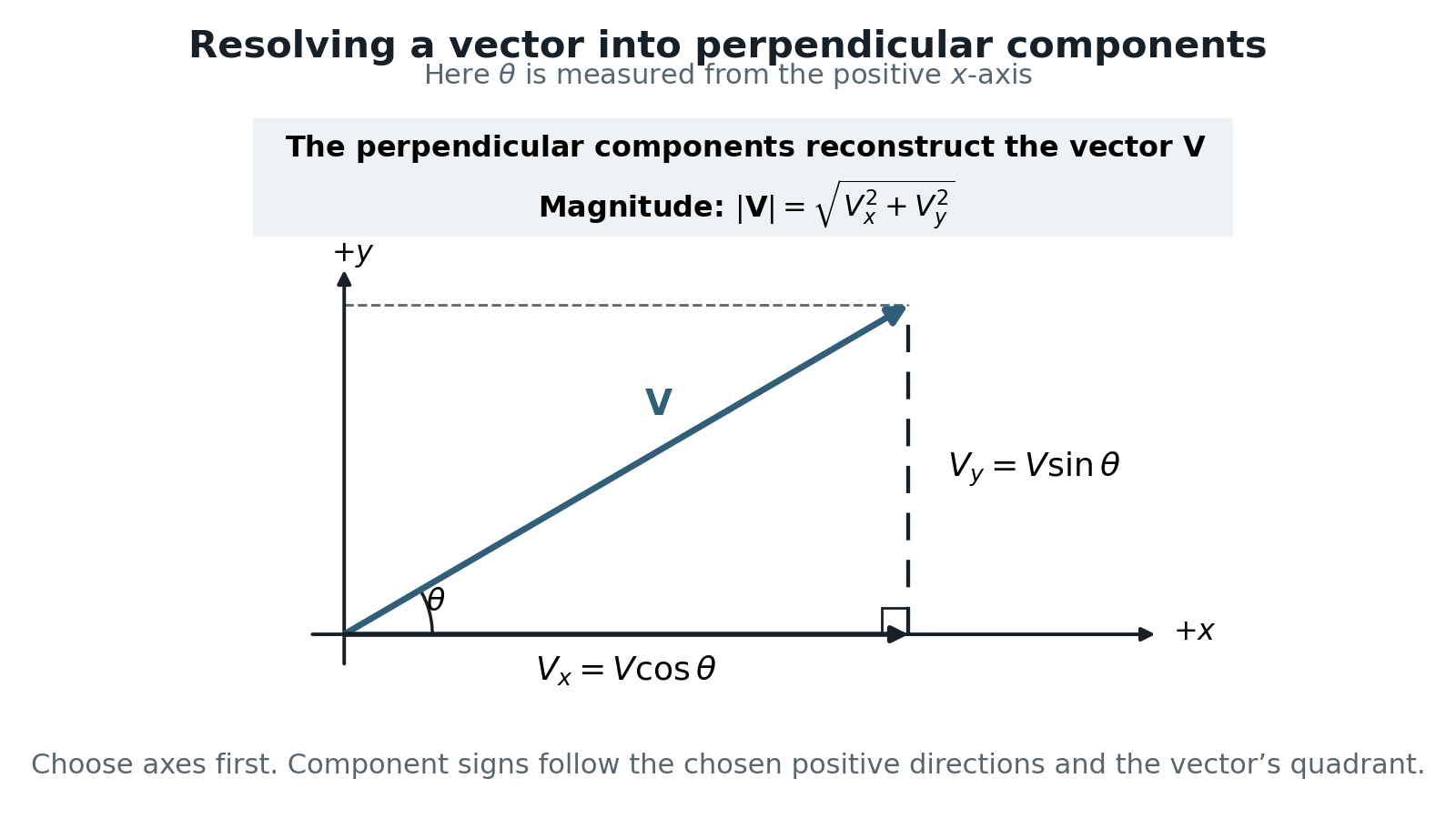
Figure: The accepted figure uses as a generic vector, with adjacent to the marked angle and opposite it. This is the same method as the surrounding notation; only the chosen vector symbol differs. Component signs follow the chosen axes.
Worked signed components
A force acts above the negative -axis. Its direction is measured anticlockwise from , so
The negative -component and positive -component place the vector in the second quadrant. Checking the reconstruction,
as required.
Reconstructing a resultant from components
If the total components are and ,
Use the component signs to identify the quadrant before reporting direction. A calculator value from alone does not always identify the correct quadrant.
6. A reliable multi-vector method
- Choose perpendicular positive axes.
- Resolve every vector into signed - and -components.
- Add all -components to obtain .
- Add all -components to obtain .
- Calculate and determine its direction from the correct quadrant.
- State magnitude, unit and direction.
Common mistakes
- giving only the magnitude of a vector answer;
- drawing vectors tail-to-tail but treating the line between their heads as the sum;
- subtracting magnitudes instead of adding the negative vector;
- using sine and cosine without checking where the angle is measured from;
- losing negative component signs;
- reporting an angle without a reference direction.
Exam Relevance
Measurement questions may test whether a quantity is scalar or vector, whether a vector answer includes direction, and whether components have been resolved with the correct signs. The same skills are reused later in kinematics, forces, circular motion, electric fields and magnetic fields.
Syllabus boundary
Everything above is core 9749 Measurement content. Unit-vector notation, scalar products, vector products and three-dimensional vector methods are useful extensions, but are not required by outcomes (g)–(i). See Vectors for that enrichment.