Kinematics
Overview
Kinematics describes how objects move without first asking which forces cause the motion. Its language, graphs and models recur throughout mechanics, electric fields and oscillations.
How to use this topic
Read the hub for the conceptual map. Use the branches for full definitions, derivations, worked examples and graph reasoning.
Topic route
- Kinematic Quantities and Sign Conventions
- Kinematics Graphs and Calculus
- Constant Acceleration Models
- Motion with Air Resistance
- Projectile Motion for detailed two-dimensional applications
1. Reference frame before formulae
In one dimension, choose:
- an origin ;
- a positive direction; and
- a time origin.
The coordinate gives position relative to the origin. The signed displacement during an interval is
The sign records direction along the chosen axis. It is the signed component of a vector, not a claim that the vector has become a scalar.
2. Five basic quantities
| Quantity | Meaning | Type | SI unit |
|---|---|---|---|
| distance | total path length travelled | scalar, non-negative | |
| displacement | directed change in position | vector; signed component in 1D | |
| speed | rate of increase of distance travelled; magnitude of velocity | scalar, non-negative | |
| velocity | rate of change of displacement/position | vector; signed component in 1D | |
| acceleration | rate of change of velocity | vector; signed component in 1D |
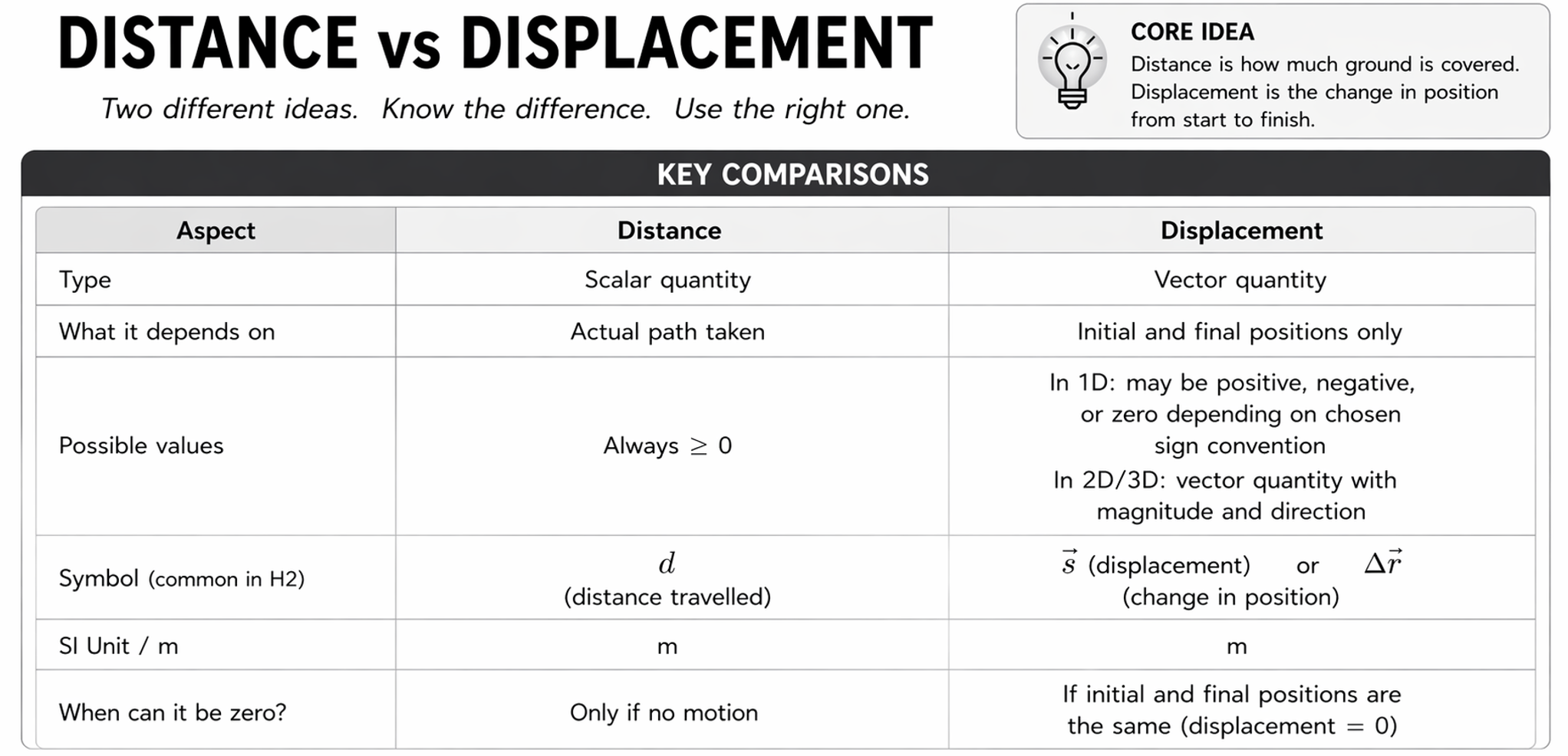
Distance accumulates the actual path length. Displacement is the directed change from the initial to final position. A return to the starting point gives zero displacement but a positive distance.
Average and instantaneous quantities
At one instant,
Instantaneous speed is .
3. Signs, direction and change of speed
The sign of a one-dimensional vector component tells direction relative to the chosen axis.
- and in the same direction: speed increases.
- and in opposite directions: speed decreases.
This rule applies over an interval while their non-zero directions persist. At , inspect the motion immediately before and after.
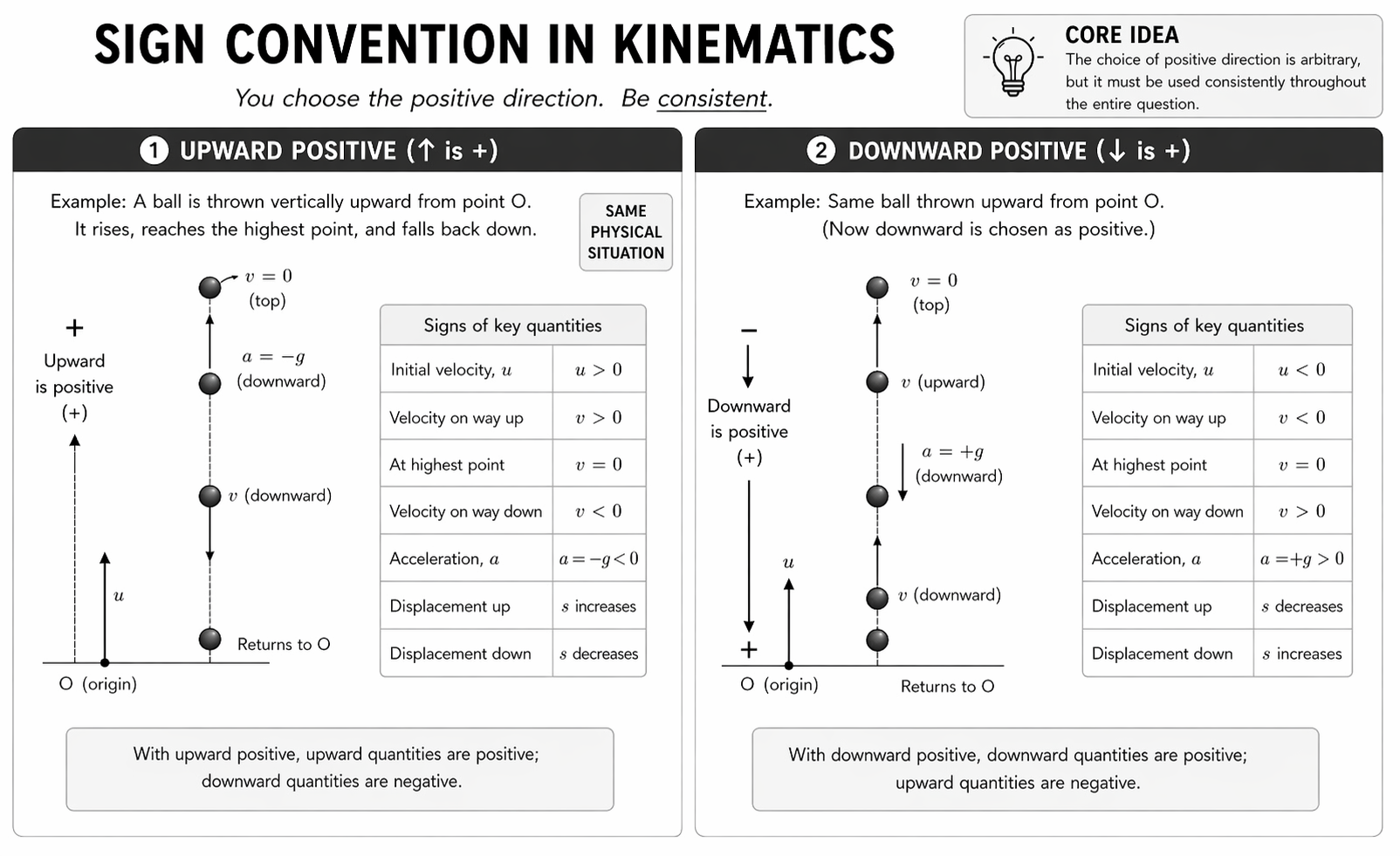
Both vertical sign conventions describe the same physical motion. With upward positive, gravitational acceleration is ; with downward positive, it is . Choose once and use the signs consistently.
Two common errors
Negative acceleration does not automatically mean slowing down. Also, at one instant does not imply .
4. Motion graphs
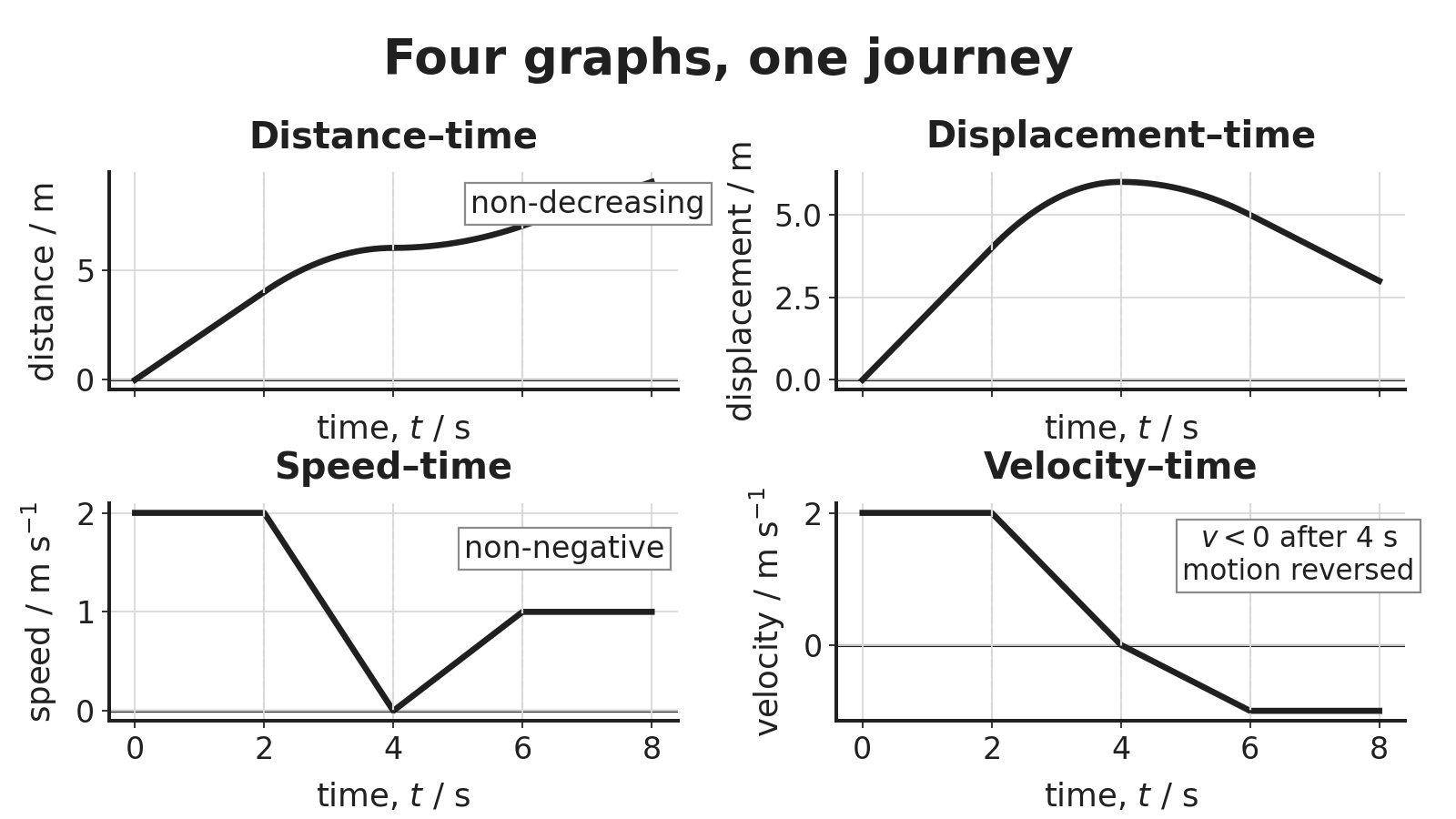
Distance and speed are non-negative scalar quantities; displacement and velocity retain direction through sign. A falling displacement–time graph can represent motion in the negative direction, whereas an accumulated distance–time graph cannot decrease.
Core relationships
is the gradient of a displacement–time graph, and
is the gradient of a velocity–time graph.
The signed area under a velocity–time graph is
Area above the time axis is positive displacement and area below is negative displacement. Total distance is the sum of the magnitudes of these areas.
As a useful additional relationship, for acceleration–time graphs,
Initial velocity is still required to find the final velocity or direction of motion.
Non-uniform acceleration
A curved velocity–time graph has a changing gradient. Draw a tangent to estimate instantaneous acceleration at one time; use the bounded signed area to obtain displacement over an interval. See the full worked example in Kinematics Graphs and Calculus.
5. Constant acceleration
For one interval/component with constant acceleration:
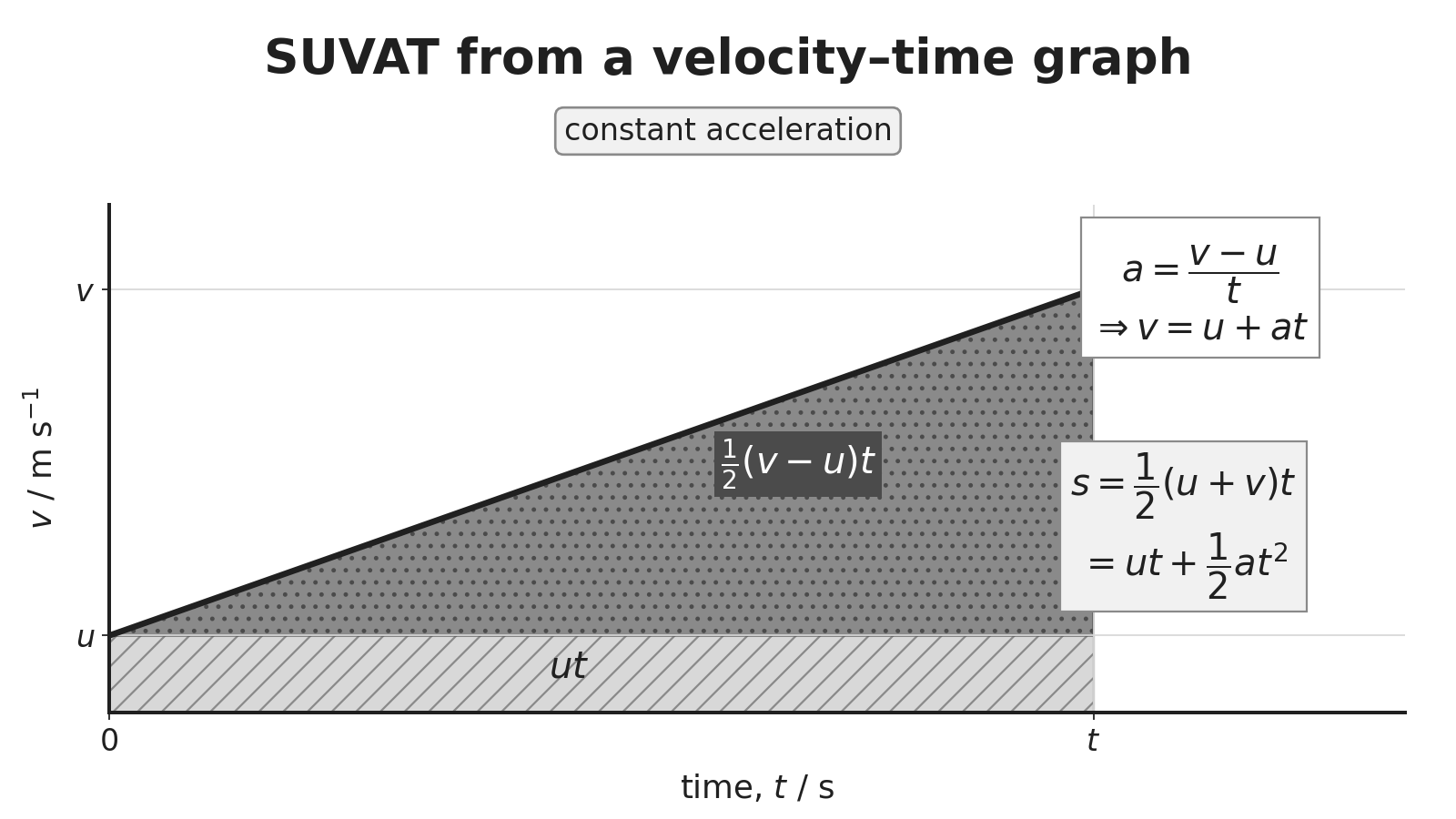
A straight velocity–time graph represents constant acceleration. Its gradient gives , hence ; its trapezium area gives . Substitution and elimination give the other equations. The full derivation is in the branch note.
Applicability checklist
Before using SUVAT, confirm:
- one interval and one component have been isolated;
- acceleration is constant;
- all signed quantities use the same positive direction; and
- multi-stage motion has been split at each change of acceleration.
See Constant Acceleration Models for the complete derivation and examples.
6. Gravity: without and with air resistance
Negligible air resistance
Near Earth’s surface, gravitational acceleration is approximately uniform and downward. With upward positive,
The constant-acceleration equations apply. At the highest point of a vertical throw, momentarily but .
Air resistance included
For a body released from rest:
- drag is initially zero/negligible, so acceleration is approximately downward;
- speed rises, so upward drag rises;
- the downward resultant and acceleration decrease;
- drag eventually balances weight; and
- acceleration becomes zero while a non-zero terminal velocity continues.
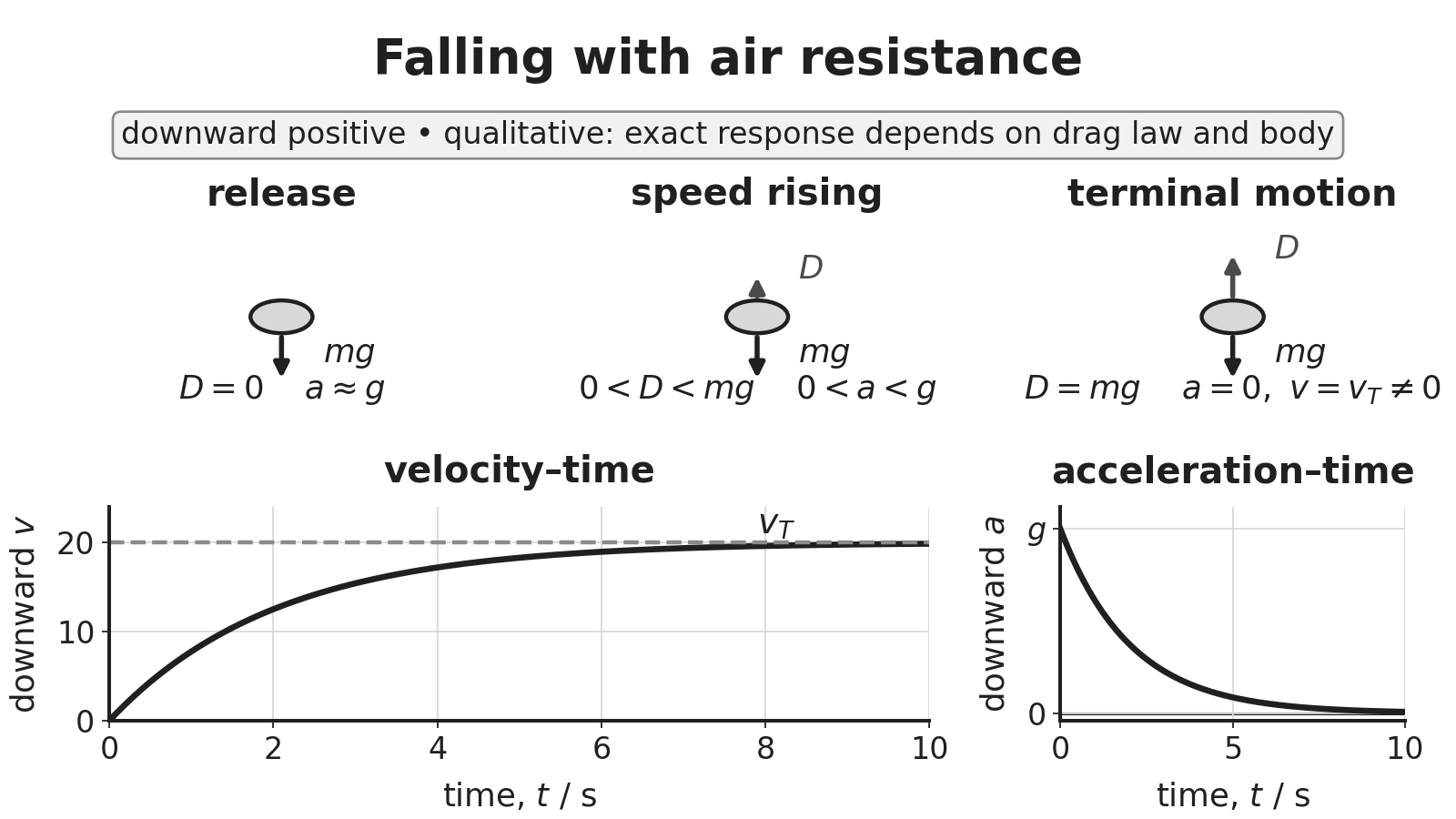
With downward positive, the velocity curve approaches terminal speed while the acceleration curve approaches zero. Terminal motion has balanced weight and drag, not absent forces. The changing acceleration means one SUVAT model cannot describe the whole fall.
See Motion with Air Resistance.
7. Perpendicular components: the two-dimensional bridge
Syllabus core
Describe and explain motion produced by uniform velocity in one direction and uniform acceleration in a perpendicular direction.
The two components obey separate equations but share the same time and initial event.
For an ideal projectile in a uniform gravitational field with negligible air resistance, choose horizontal and upward:
If launch speed is at angle above the horizontal,
Take the launch event as and the launch point as . With those coordinate initial conditions:
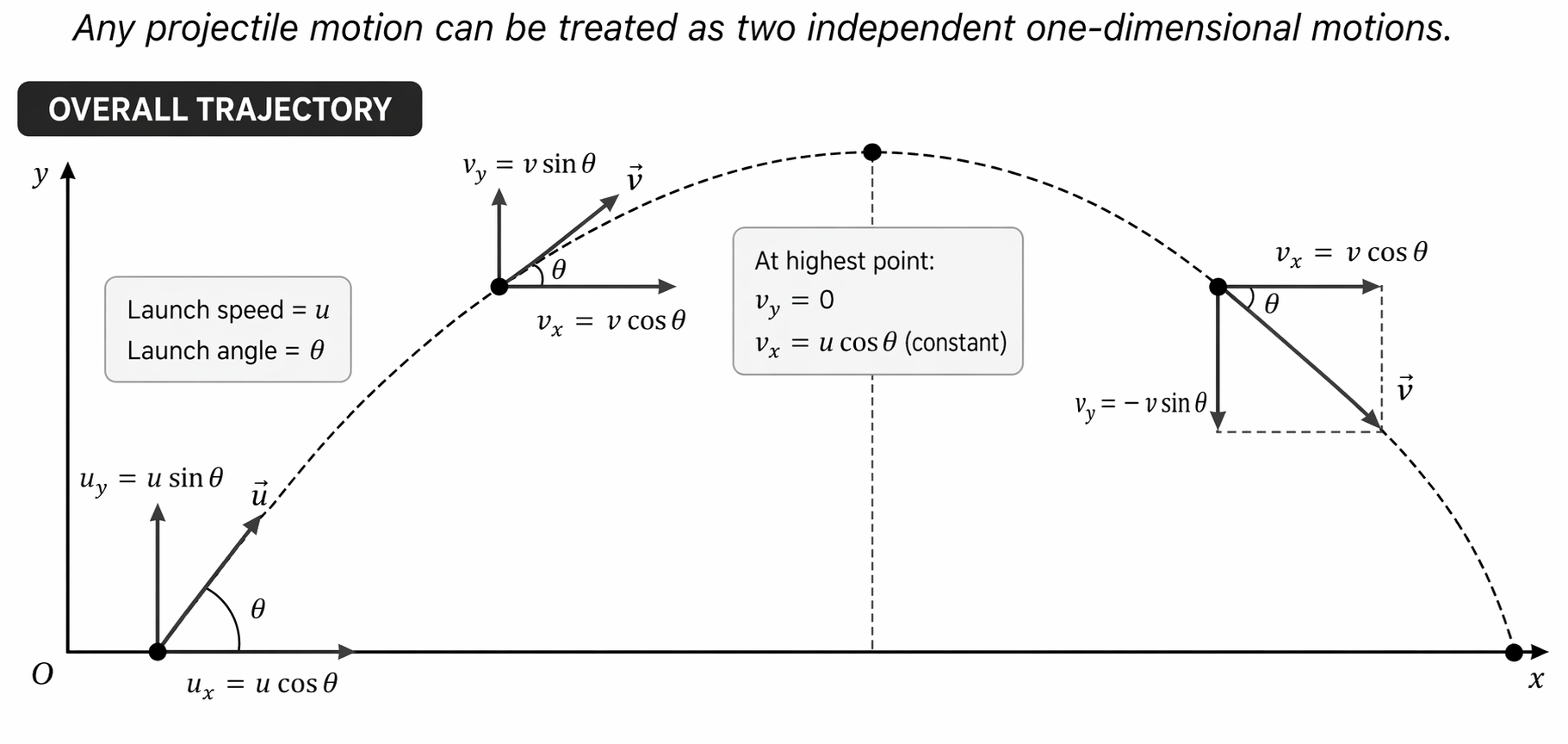
In the ideal gravitational model, horizontal velocity remains constant and vertical acceleration is . The components share the same time; do not insert a horizontal quantity into a vertical equation or use separate times for the same event.
For a non-vertical launch with , at the highest point while remains non-zero. Such a projectile is therefore not at rest at the apex. For a purely vertical launch, both velocity components are momentarily zero there, although acceleration remains downward.
The same perpendicular-component idea can later describe a charged particle entering a uniform electric field with an initial velocity perpendicular to the field. Detailed force calculations belong to Electric Fields.
Use Projectile Motion for detailed projectile problem solving. Closed-form range, flight-time and maximum-height formulae should be derived with their assumptions rather than memorised as universal shortcuts.
8. Enrichment — relative velocity
Enrichment: not an explicit Topic 02 outcome
Relative velocity is useful but should not be confused with the required perpendicular-acceleration outcome.
If and are measured in the same reference frame,
This is the velocity of as observed from . Reverse the order and the vector reverses:
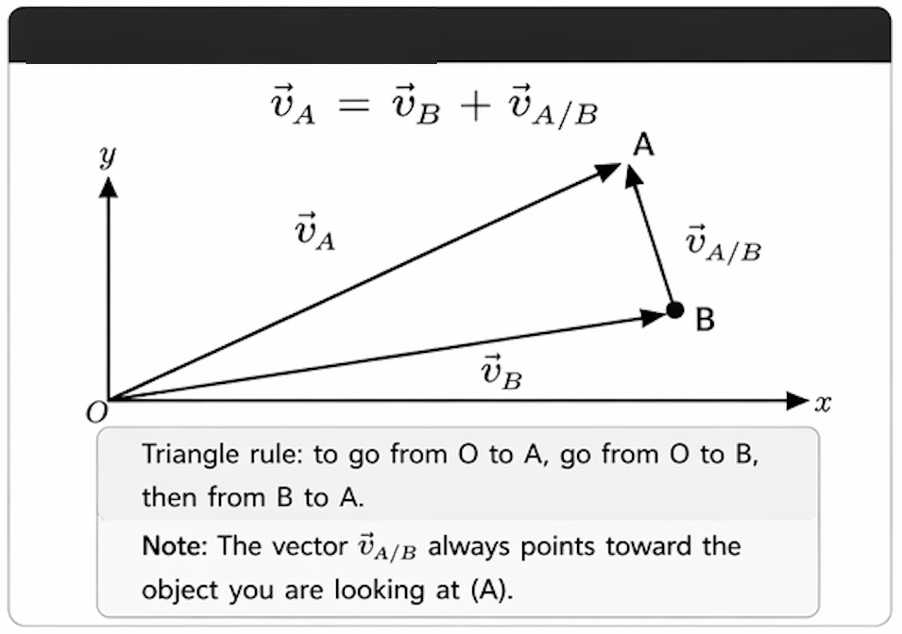
Enrichment: both velocities must refer to the same instant and first be expressed in one common reference frame and coordinate basis. In a velocity triangle, runs from the tip of to the tip of . It is a velocity vector, not the spatial position vector from B to A. Integrate this note only with the corrected relative-velocity figure.
See Projectile and Relative Motion for extension material.
9. Master misconception check
| Claim | Verdict and correction |
|---|---|
| “Distance and displacement are interchangeable.” | False: one is path length; the other is directed change in position. |
| “Negative acceleration always slows an object.” | False: compare directions of and . |
| “Area under a velocity graph is always distance.” | False: signed area is displacement; sum absolute areas for distance. |
| “SUVAT applies to any motion.” | False: acceleration must be constant over the selected interval/component. |
| “At terminal speed there are no forces.” | False: weight and drag balance. |
| “At a projectile’s top, its velocity is always zero.” | Only the vertical component is zero for a non-vertical launch; the horizontal component remains non-zero. A purely vertical launch is the special case. |
10. Problem-solving checklist
- Draw the axis or component directions.
- Separate scalar magnitudes from signed vector components.
- Identify whether the question asks for a graph height, gradient or area.
- Test the constant-acceleration assumption before selecting SUVAT.
- Split stages or perpendicular components when required.
- State assumptions and interpret the sign and unit of the answer.
Core ideas
Choose a reference frame, distinguish scalar magnitudes from directed quantities, use graph gradient/area deliberately, and apply each mathematical model only under its stated conditions.
Exam relevance
Kinematics questions reward explicit sign conventions, correct graph operations, justified constant-acceleration models and clean separation of stages or perpendicular components. A correct formula with an unstated or invalid model can still lead to a wrong conclusion.