Forces
Topic hub: Begin here, then use the branch notes for full derivations and extended examples.
Overview
Forces is the main Topic 04 hub. It introduces force as an interaction, then connects force identification, free-body diagrams, vector resolution, Hooke’s law, pressure, upthrust, terminal velocity, moments, couples, equilibrium, centre of gravity and stability.
Core Ideas
- A force is a vector interaction on a chosen system.
- A free-body diagram should contain only real external forces on that system.
- Resultant force is the vector sum of the real forces; it is not another interaction force.
- Components replace angled forces in equations; they are not extra forces.
- Hooke’s law, fluid pressure, upthrust, drag, moments and equilibrium each require clear modelling conditions.
- For rigid bodies, full equilibrium requires both zero resultant force and zero resultant moment.
1. The organising idea: forces are interactions
A force is a vector interaction exerted on a chosen object by another object, a surface, a string, a fluid or a field. A force can change momentum, deform an object or produce a turning effect. Motion by itself does not create an additional “motion force”.
The most general Newtonian relationship used at H2 is
For a body of constant mass , this becomes
Here is the resultant force: the vector sum of the real forces acting on the chosen system. It is not an extra force to draw on a free-body diagram.
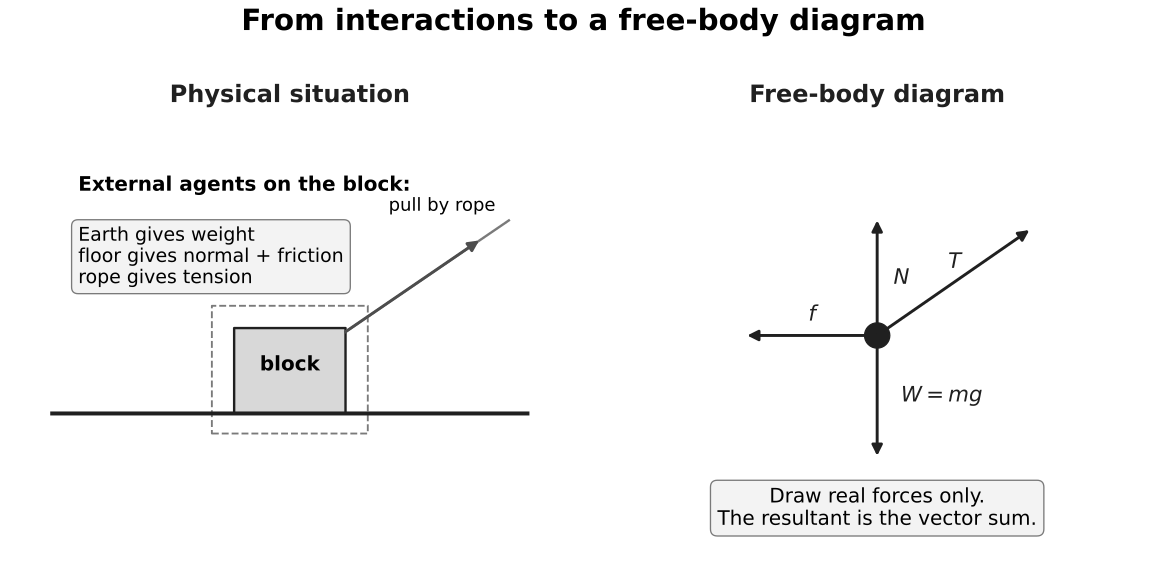
Figure: First choose the body inside the system boundary. The free-body diagram then contains only forces exerted on that body: weight by Earth, normal and tangential contact forces by the surface, and any applied pull. A Newton’s-third-law partner force acts on the other interacting body, so it belongs on that body’s diagram. The resultant is calculated from the arrows; it is not added as another arrow.
What does zero resultant force mean?
If
then . The object may be at rest, or it may move with constant velocity. Zero resultant force does not imply zero velocity.
2. A reliable force-analysis workflow
- Choose the system. State exactly which body or collection of bodies is analysed.
- List interactions. Ask what touches the system and what fields act on it.
- Draw a free-body diagram. Include only external forces acting on the chosen system.
- Choose axes and signs. Align an axis with the expected acceleration or a surface when useful.
- Resolve angled forces. Components replace their original vector; do not draw both in the final force sum.
- Write one equation per direction. For example, and .
- For an extended body, also consider moments. Force balance alone does not guarantee rotational equilibrium.
- Check the answer. State magnitude, direction, unit and modelling assumptions.
See Force Diagrams and Resolution.
3. Common forces: source and direction
| Force | Source | Direction or important condition |
|---|---|---|
| Weight | gravitational field acting on mass | along the local gravitational field; near Earth, vertically downward |
| Normal contact force | surface deforming against a body | perpendicular to the surface; not automatically equal to |
| Friction | tangential interaction between contacting surfaces | opposes relative sliding or the tendency to slide |
| Tension | taut string, rope or cable | along the string, pulling away from the body |
| Drag | surrounding fluid | opposes the body’s velocity relative to the fluid |
| Upthrust | resultant of fluid-pressure forces | upward in the usual hydrostatic situation |
| Elastic force | deformed elastic object | restoring direction, towards its undeformed state |
| Electric or magnetic force | field acting on charge/current | determined by the relevant field-force law |
For the assumptions behind these directions, see Force Types and Interactions.
Weight is not mass
Mass is a scalar measured in kilograms. Weight is a force:
with magnitude measured in newtons.
Friction is not always at a fixed value
At H2 Physics 9749, friction is treated qualitatively; coefficients of friction are not required. Static friction adjusts to the value needed to prevent relative slipping, up to a limiting value. Its direction must be reasoned from the tendency of relative motion at the contact, not guessed from the object’s overall velocity.
4. Resolving forces
If a force makes angle from the positive -axis, its signed components are
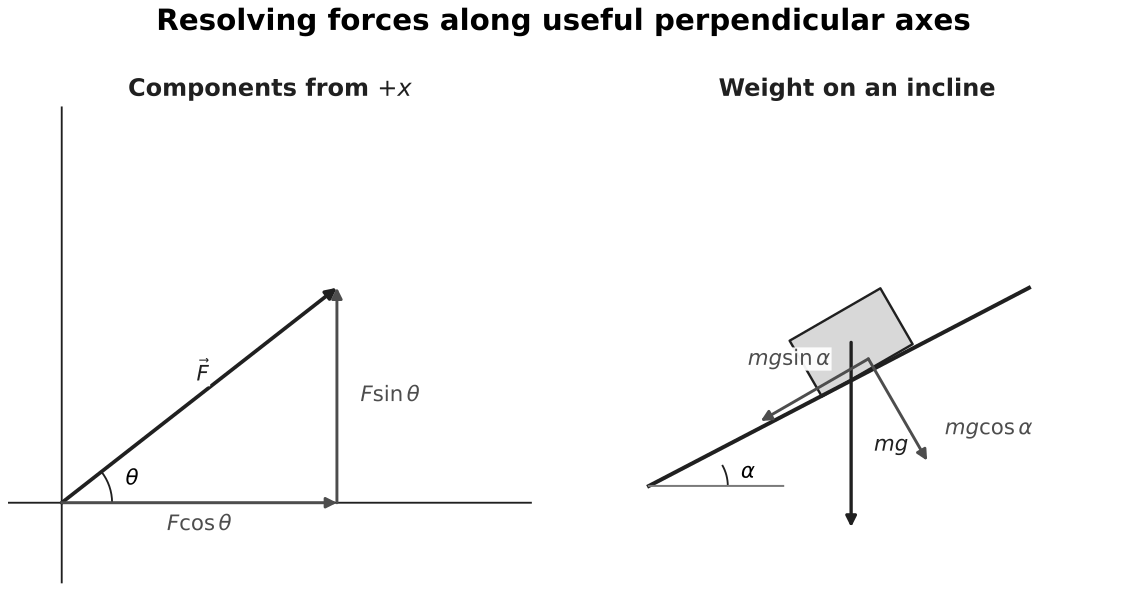
Figure: Left: the two perpendicular component arrows add vectorially to the original angled force; they replace it in component equations. Right: on an incline at angle , weight remains vertical, but resolving it along axes parallel and perpendicular to the plane gives downslope and into the plane. The normal force equals only when no other force has a perpendicular component and perpendicular acceleration is zero.
Components are not extra interactions
A resolved component is part of a chosen vector description. Drawing , and as three independent forces would count the same interaction twice.
5. Hooke’s law
Let be an elastic object’s natural length and let
be its extension. Within the limit of proportionality, Hooke’s law states that the magnitude of the deforming force is proportional to :
where is the force constant in . Along an axis whose positive direction is increasing extension, the force exerted by the spring is restoring:
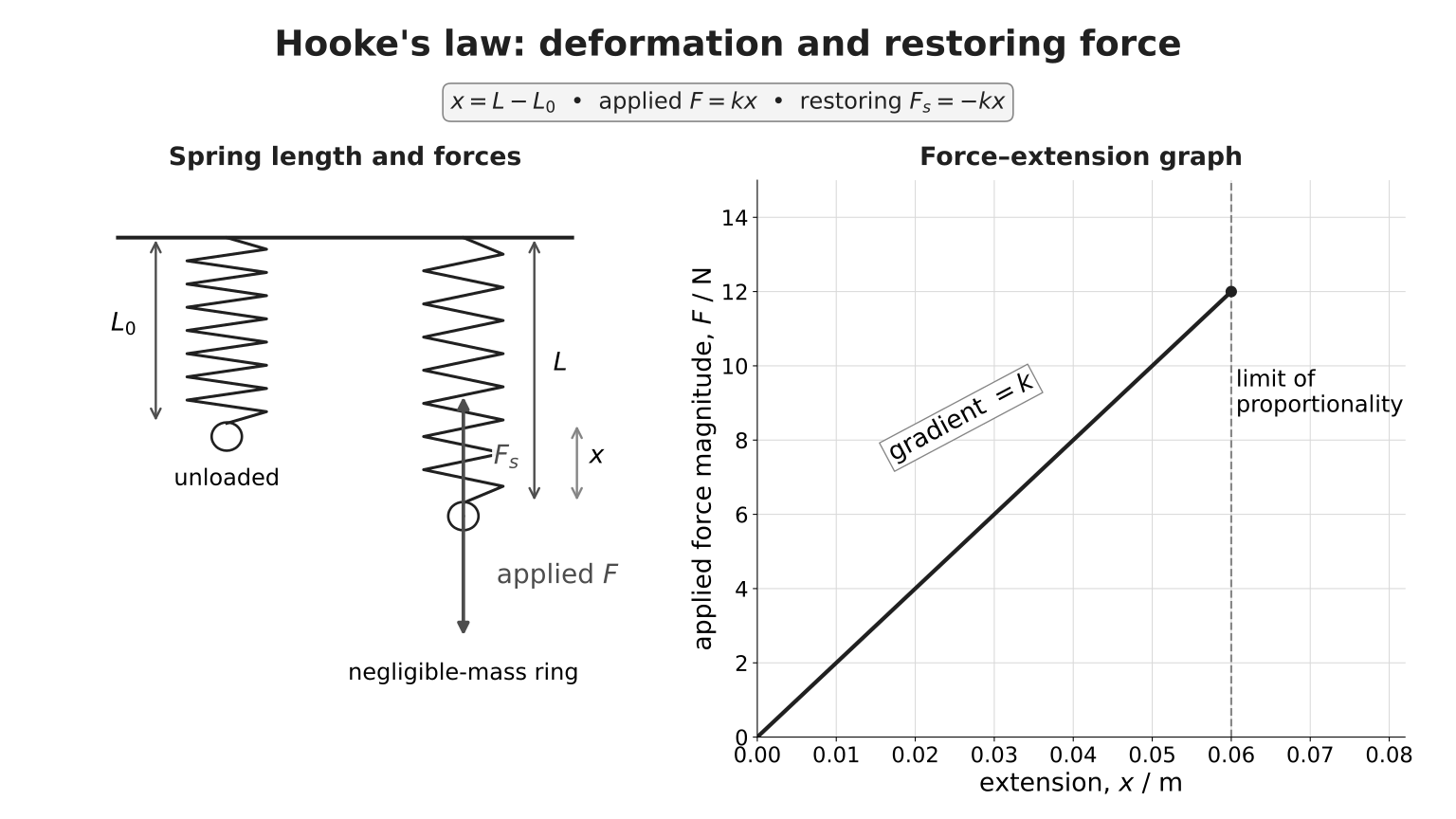
Figure: The graph plots the magnitude of the applied deforming force against extension from natural length. In the proportional region it is a straight line through the origin, and its gradient is . The separate arrows show that the force exerted by the spring points opposite to the displacement. The equilibrium position of a loaded spring need not be its natural length.
See Elastic Forces and Hooke’s Law.
Cross-topic bridge: elastic energy
The area under a force–extension graph represents work done in deformation. For a Hooke’s-law spring extended from to , this gives . This is developed in Work, Energy and Power, not required as a separate Topic 04 learning outcome.
6. Pressure in a static fluid
Pressure is a scalar defined from the normal force on area :
Pressure itself has no direction; the force due to pressure on a small surface acts normal to that surface.
Density is mass per unit volume:
For a stationary fluid column of uniform density , the mass of a column of area and height is . Balancing the pressure-force difference against its weight gives
If is atmospheric pressure at the surface, the absolute pressure at depth is ; the gauge pressure is .
7. Upthrust and floatation
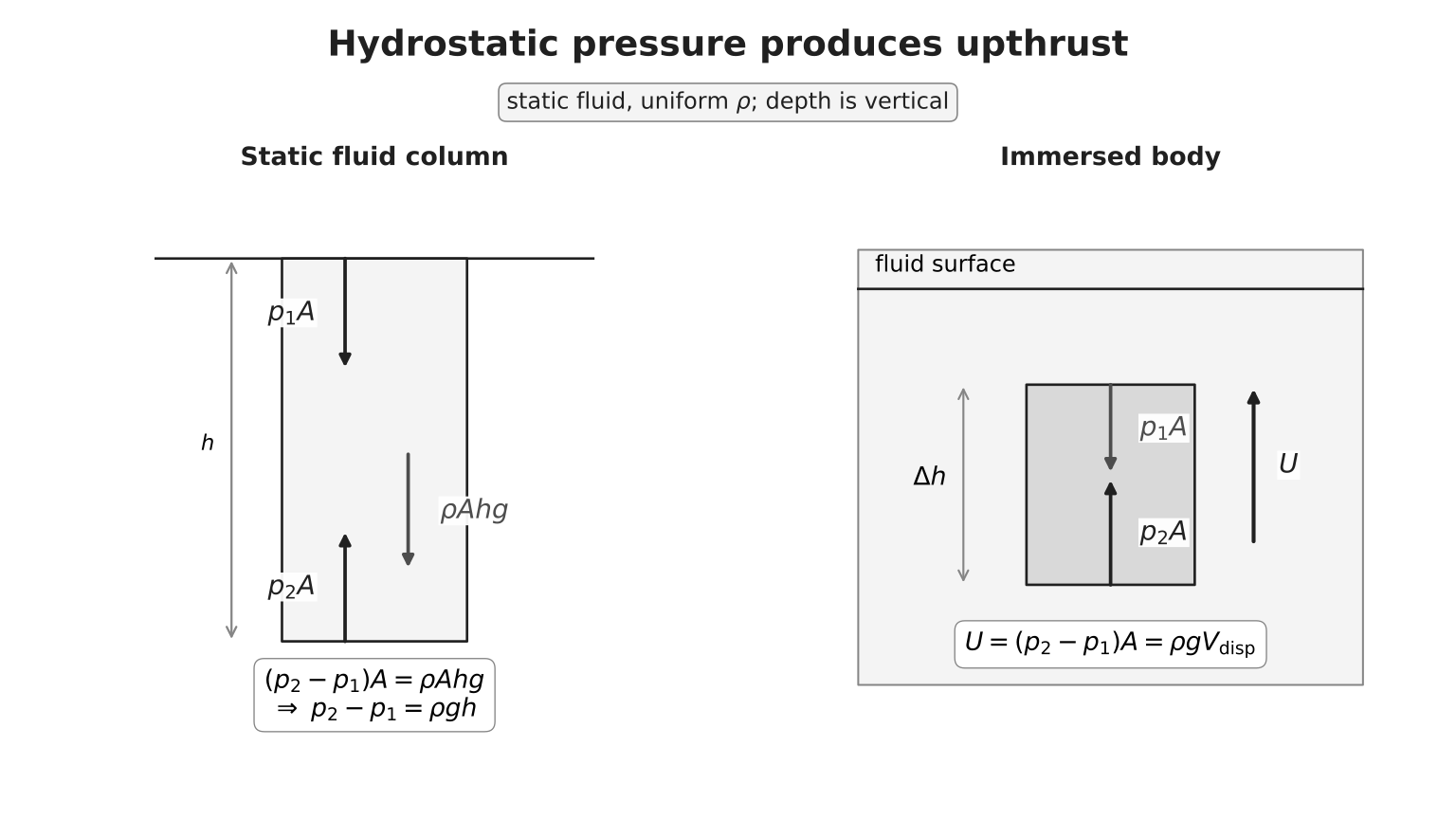
Figure: The lower face is deeper, so and the upward pressure force exceeds the downward pressure force . Their difference is , the upthrust. The same reference pressure appears on both faces and cancels. For the symmetric teaching body, horizontal pressure-force components cancel.
Archimedes’ principle states that the upthrust on a submerged or floating object is equal in magnitude and opposite in direction to the weight of the fluid displaced:
is the volume of displaced fluid. It equals the whole object’s volume only when that object is fully submerged.
For an object floating in equilibrium,
so . Equality here follows from equilibrium; upthrust and weight are not generally equal for every immersed object.
See Fluid Forces and Resistive Motion.
8. Drag and terminal speed
Drag opposes relative motion through a fluid and generally increases with relative speed. The exact relationship depends on the regime; use a proportionality such as or only when it is stated or justified.
Enrichment — analytical illustration beyond the explicit Topic 04 outcome
The syllabus requires qualitative understanding of viscous resistance. The following exact exponential curves belong to one stated linear-drag model and are included to connect the force sequence to graph shapes; the formulae are not universal terminal-speed laws.
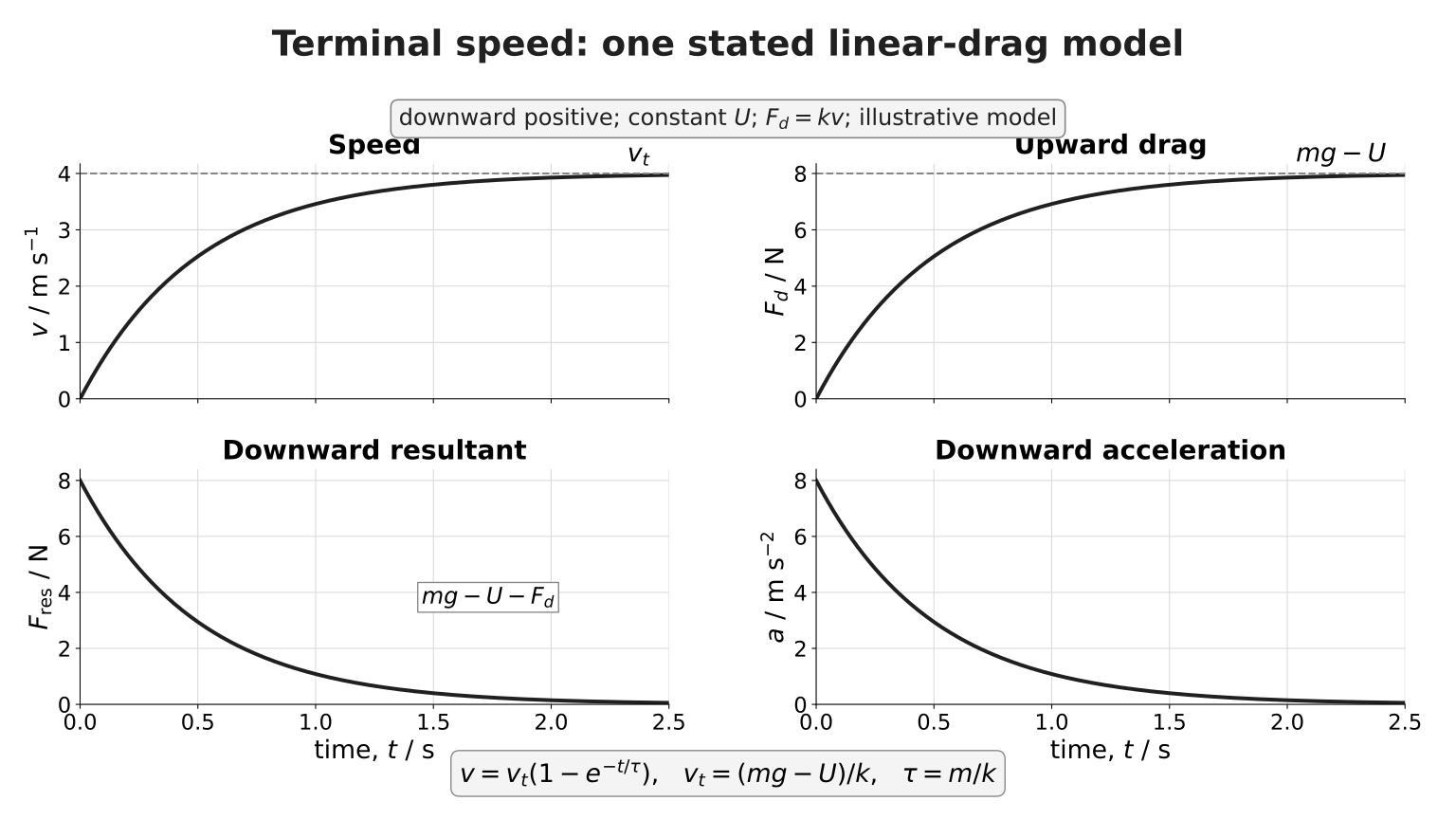
Figure: This explicitly labelled illustrative model uses downward-positive motion and linear drag with constant upthrust. As speed rises, drag increases, so the downward resultant and acceleration both decrease. They approach zero while velocity approaches the non-zero terminal value . Terminal speed means balanced forces and constant velocity, not absence of forces.
9. Moments and couples
The moment of a force about a point is the product of the force magnitude and the perpendicular distance from the point to the force’s line of action:
The SI unit is . In a planar problem, choose clockwise or anticlockwise as positive and keep the convention consistent.
A couple consists of two equal, opposite, parallel forces whose lines of action do not coincide. Its resultant force is zero, but its torque is
where is the perpendicular separation of the two lines of action.
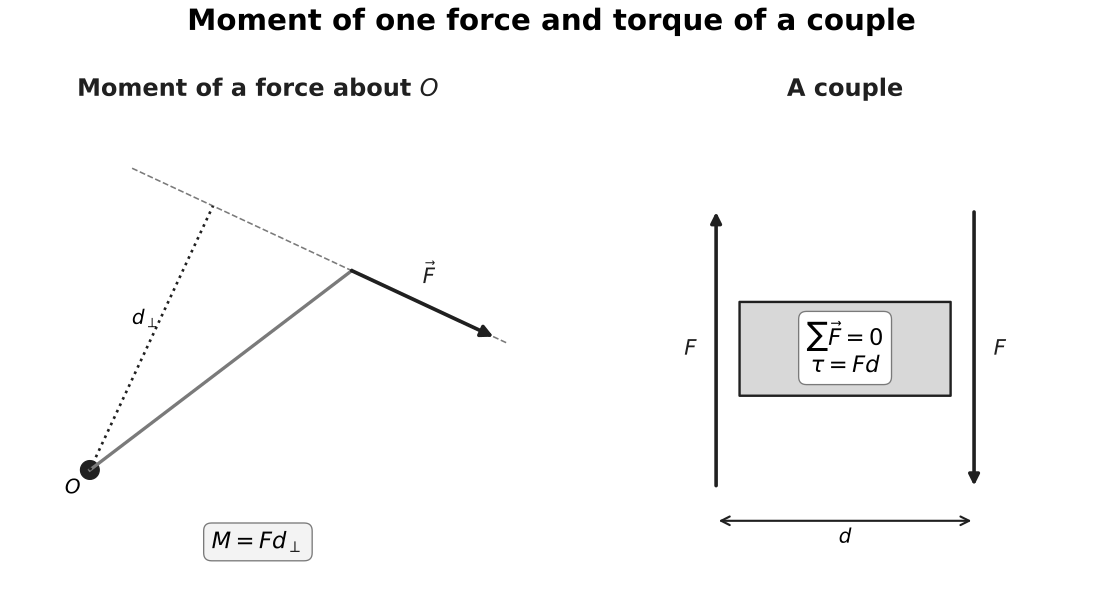
Figure: Left: the lever arm is the shortest distance from the pivot to the extended line of action, not necessarily the distance to the point where the force is applied. Right: the two forces of a couple cancel translationally but their moments have the same rotational sense, giving total torque . A couple’s torque is independent of the chosen pivot.
10. Equilibrium
A body is in mechanical equilibrium when it has neither linear nor angular acceleration:
Here may be any chosen point because force balance also holds. Without , the numerical moment generally changes when the reference point changes; rotational dynamics is most safely expressed using moments about the centre of mass.
It is in static equilibrium when it is also at rest. In the planar fixed-axis H2 model, a body moving with constant linear velocity and constant angular velocity may satisfy mechanical equilibrium without being static.
For a body in rotational equilibrium, the principle of moments gives
about the same point.
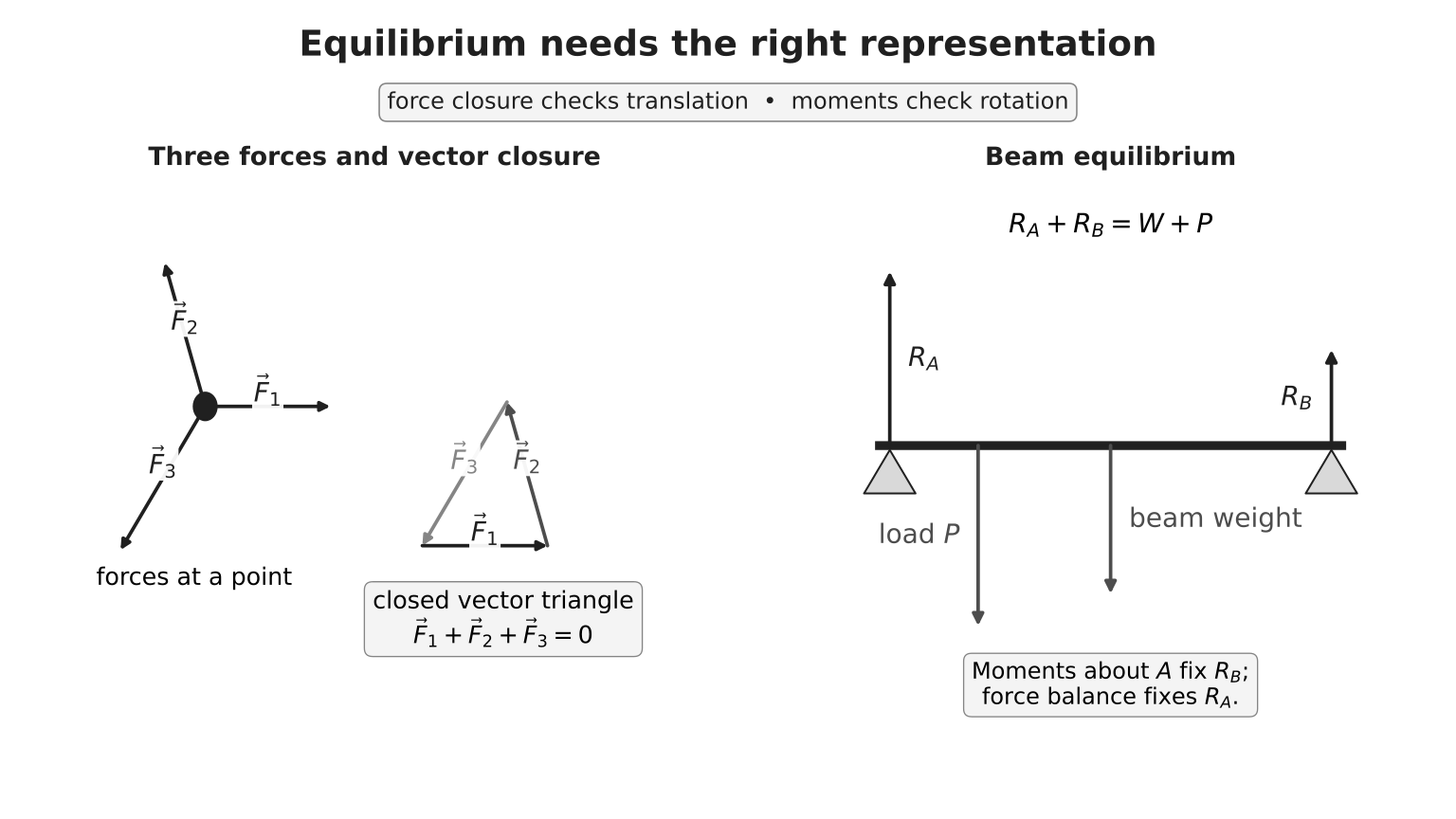
Figure: A physical diagram shows forces at their real points or lines of action. A separate head-to-tail vector triangle represents and must close. For the beam, force balance fixes the total support force while moment balance fixes how the reactions are shared. Neither diagram should be mistaken for the other.
For complete methods, see Equilibrium, Moments, and Couples.
11. Centre of gravity and stability
The centre of gravity is the point through which a body’s resultant weight may be considered to act. In a uniform gravitational field it coincides with the centre of mass.
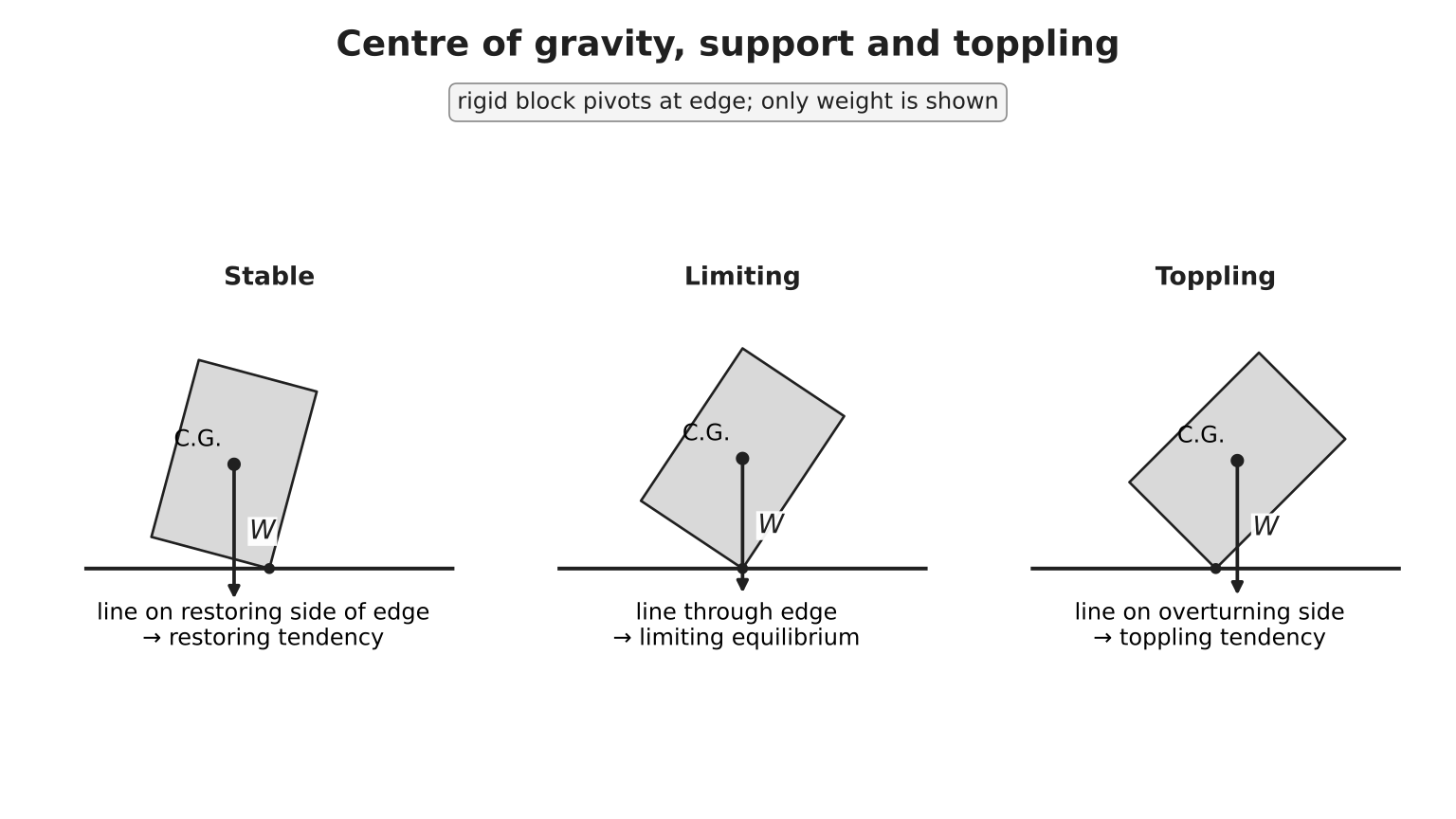
Figure: The vertical line of action of weight is compared with the support region. If it falls inside the base, weight tends to restore the body after a small tilt; through the edge gives limiting equilibrium; outside the base gives a toppling moment about the edge. A lower centre of gravity or wider base increases the tilt required to reach the limiting case.
See Centre of Gravity and Stability.
12. Integrated worked example
A uniform horizontal beam of length and weight is supported vertically at its ends and . A load is placed from . Find the support reactions and .
Take upward as positive. Vertical force balance gives
so
Taking moments about removes :
Hence
Using (1),
Both values are positive and sum to the total downward load, providing a useful check.
13. Conditional formula summary
| Relationship | Meaning and condition |
|---|---|
| general resultant-force relation | |
| constant mass | |
| weight magnitude in field strength | |
| deforming-force magnitude within proportional limit | |
| pressure definition | |
| static uniform-density fluid | |
| weight of displaced fluid | |
| moment about a point | |
| torque of a couple; separates force lines | |
| , | full rigid-body equilibrium |
Exam Relevance
In examination questions, start by identifying the chosen system and drawing a free-body diagram. Then decide whether the problem needs force balance, Newton’s second law, pressure/upthrust reasoning, Hooke’s law, moment balance, or a combination.
14. Common exam traps
- treating the resultant force as another real force;
- drawing forces exerted by the object instead of forces exerted on it;
- assuming or without checking every perpendicular force and acceleration;
- drawing friction opposite the object’s velocity rather than opposing relative slip at the contact;
- using components as extra forces;
- measuring a moment arm along a beam rather than perpendicular to the line of action;
- applying only force balance to an extended rigid body;
- using the object’s full volume instead of displaced-fluid volume;
- saying terminal velocity means no forces act;
- calling the loaded equilibrium position of a spring its natural length.
Links
- Force Types and Interactions
- Force Diagrams and Resolution
- Elastic Forces and Hooke’s Law
- Fluid Forces and Resistive Motion
- Equilibrium, Moments, and Couples
- Centre of Gravity and Stability
- Dynamics
- Work, Energy and Power
Provenance
- source file: 1_PDFsam_03_Forces.pdf
- generated by:
bridging_tools/ingest_JC_phy_wiki.py - manifest entry:
inbox/lecture_notes/1_PDFsam_03_Forces.pdf - source hash:
671bbdecd3ce882a5447a54db5a6b7b0f9dd6c3ec14ff801b31e23795a154df9