Centre of Gravity and Stability
Branch note: Centre of gravity is core 9749 content. The extended toppling discussion is a useful application of centre of gravity and moments under the usual gravity-dominated rigid-body/base-support model.
Overview
This branch note explains centre of gravity and how the line of action of weight determines stability and toppling in common rigid-body models.
Core Ideas
- Centre of gravity is the point through which resultant weight may be considered to act.
- In a uniform gravitational field, weight acts vertically downward through the centre of gravity.
- Stability depends on where the line of action of weight falls relative to the support region.
- Toppling begins when the line of action of weight passes beyond the supporting edge.
1. Centre of gravity
The centre of gravity is the point through which the resultant weight of a body may be considered to act.
In a uniform gravitational field, centre of gravity and centre of mass coincide. If the field varies appreciably over an extended body, they need not coincide exactly; that distinction is beyond the usual near-Earth H2 model.
For a homogeneous symmetric body in a uniform field, the centre of gravity lies on every applicable axis or plane of symmetry. For an irregular or non-uniform body, it depends on mass distribution and can even lie outside the material, as for a ring.
2. Weight and moments
In a free-body diagram, draw the total weight vertically downward through the centre of gravity. Its moment about a pivot has magnitude
where is the perpendicular distance from the pivot to the vertical line of action of weight.
3. Support region and stability
The support region is the region bounded by the object’s contacts with its support. For a rectangular block on a floor, it is the base area between the two bottom edges.
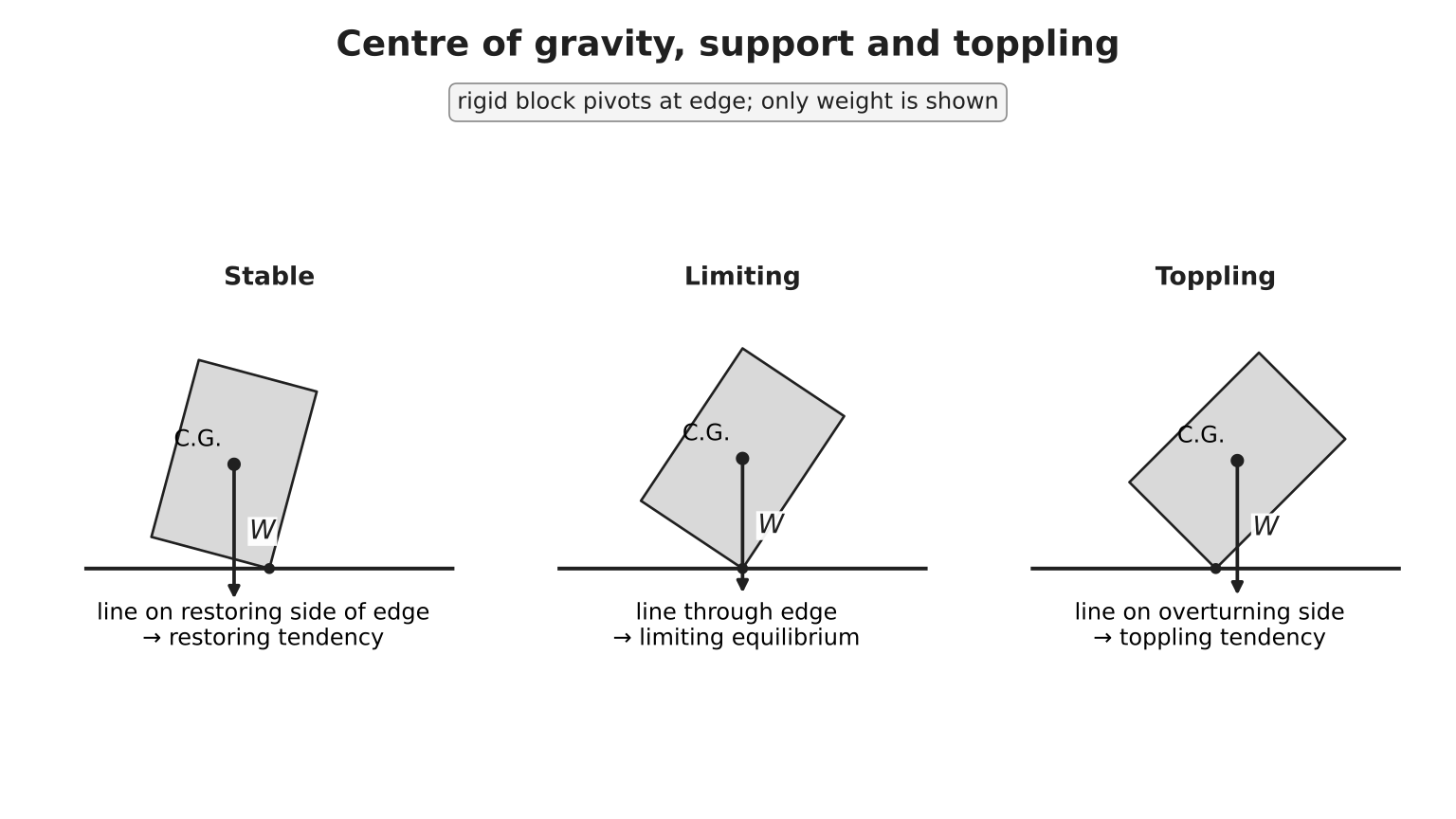
Figure: Compare the vertical line of action of with the support region. When it lies inside the base, a small tilt produces a restoring tendency. When it passes through the edge, the body is in limiting equilibrium. Once it lies outside, weight produces a moment about that edge which increases the tilt, so the body topples.
Why a lower centre of gravity helps
For the same base width, a lower centre of gravity requires a larger tilt angle before its vertical line reaches the edge. The phrase “lower centre of gravity is more stable” therefore compares bodies under otherwise similar support conditions.
Why a wider base helps
For the same centre-of-gravity height, a wider base moves the limiting edge farther from the central vertical line, again requiring a larger tilt before toppling begins.
4. Limiting-equilibrium calculation
Define the limiting tilt angle as the angle through which the initially upright body has rotated when the vertical line through its centre of gravity first passes through the supporting edge. For a rigid rectangular body with half-width and centre-of-gravity height above the base, with weight providing the relevant turning tendency, the geometry gives
This geometry is an application of the line-of-action criterion, not a separate universal stability formula for every shape or support arrangement.
5. Worked comparison
Object A has and ; object B has the same base but .
B can be tilted farther before the line of action reaches the edge, so it is more resistant to toppling in this comparison, assuming no external stabilising or overturning forces and a rigid non-slipping support.
Exam Relevance
Stability questions usually require the line of action of weight, the support region, and a moment about the possible toppling edge. Do not replace this geometry with vague statements about “balance”.
6. Common mistakes
- assuming centre of gravity is always at the geometric centre;
- drawing weight perpendicular to a tilted base instead of vertically downward;
- comparing only centre-of-gravity height while ignoring base width;
- saying the body topples merely because it is tilted;
- using distance to the centre of gravity instead of perpendicular distance to the weight’s line of action.