Equilibrium, Moments, and Couples
Branch note: Rigid-body equilibrium requires both force balance and moment balance.
Overview
This branch note develops moments, couples, vector triangles and the two conditions needed for rigid-body equilibrium.
Core Ideas
- Translational equilibrium requires zero resultant force.
- Rotational equilibrium requires zero resultant moment.
- A moment uses the perpendicular distance to the force’s line of action.
- A couple has zero resultant force but non-zero torque.
- A force triangle checks force balance only; moment balance must still be considered for extended bodies.
1. Translational, rotational and static equilibrium
A body is in translational equilibrium when
so its centre of mass has no linear acceleration.
It is in rotational equilibrium about its centre of mass when
so it has no angular acceleration. When translational equilibrium also holds, the resultant moment is zero about every chosen point, because shifting the reference point changes the moment by a term involving the zero resultant force.
Full mechanical equilibrium requires both conditions. Static equilibrium additionally means the body is at rest. In the planar fixed-axis H2 model, a body moving with constant linear velocity and constant angular velocity can satisfy mechanical equilibrium without being static.
2. Moment of a force
The line of action of a force is the infinite straight line through its point of application in the force direction.
The moment of a force about point is
where is the force magnitude and is the perpendicular distance from to the force’s line of action.
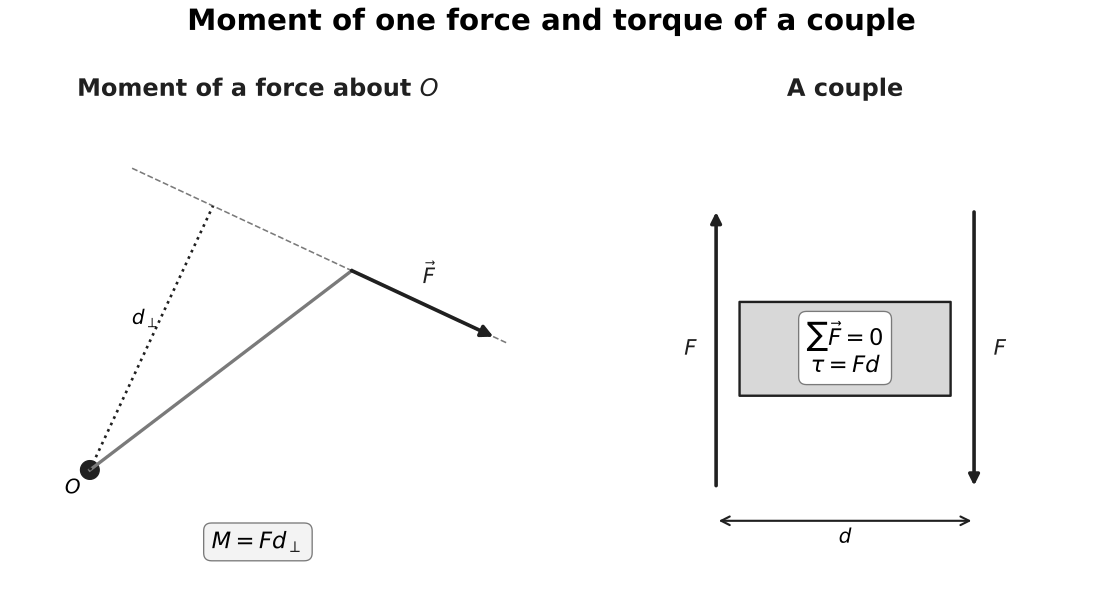
Figure: In the single-force panel, the sloping distance from pivot to application point is not the moment arm; the dashed perpendicular is. In the couple panel, two equal and opposite parallel forces have zero vector sum but both produce the same rotational sense, so the torque is .
The moment unit is . Although dimensionally equal to a joule, a moment is not energy and should not be written in joules.
In two-dimensional problems, choose a sign convention such as anticlockwise positive. Then
means the signed moments cancel.
3. Couple and torque of a couple
A couple is a pair of forces that:
- are equal in magnitude;
- are opposite in direction;
- are parallel; and
- have non-coincident lines of action.
The resultant force is zero. The torque of the couple is
where is either force magnitude and is the perpendicular separation of their lines of action.
Because moving the reference point adds equal and opposite changes to the two individual moments, the net torque of a couple is independent of the chosen pivot.
4. Principle of moments
For a body in rotational equilibrium,
about the same point.
Choose a moment centre through one or more unknown forces when possible; their perpendicular distances are then zero, so they do not appear in that moment equation.
Force balance is not enough
Two equal opposite forces have zero resultant force, but if their lines of action differ they form a couple and can produce angular acceleration.
5. Physical force diagram and vector triangle
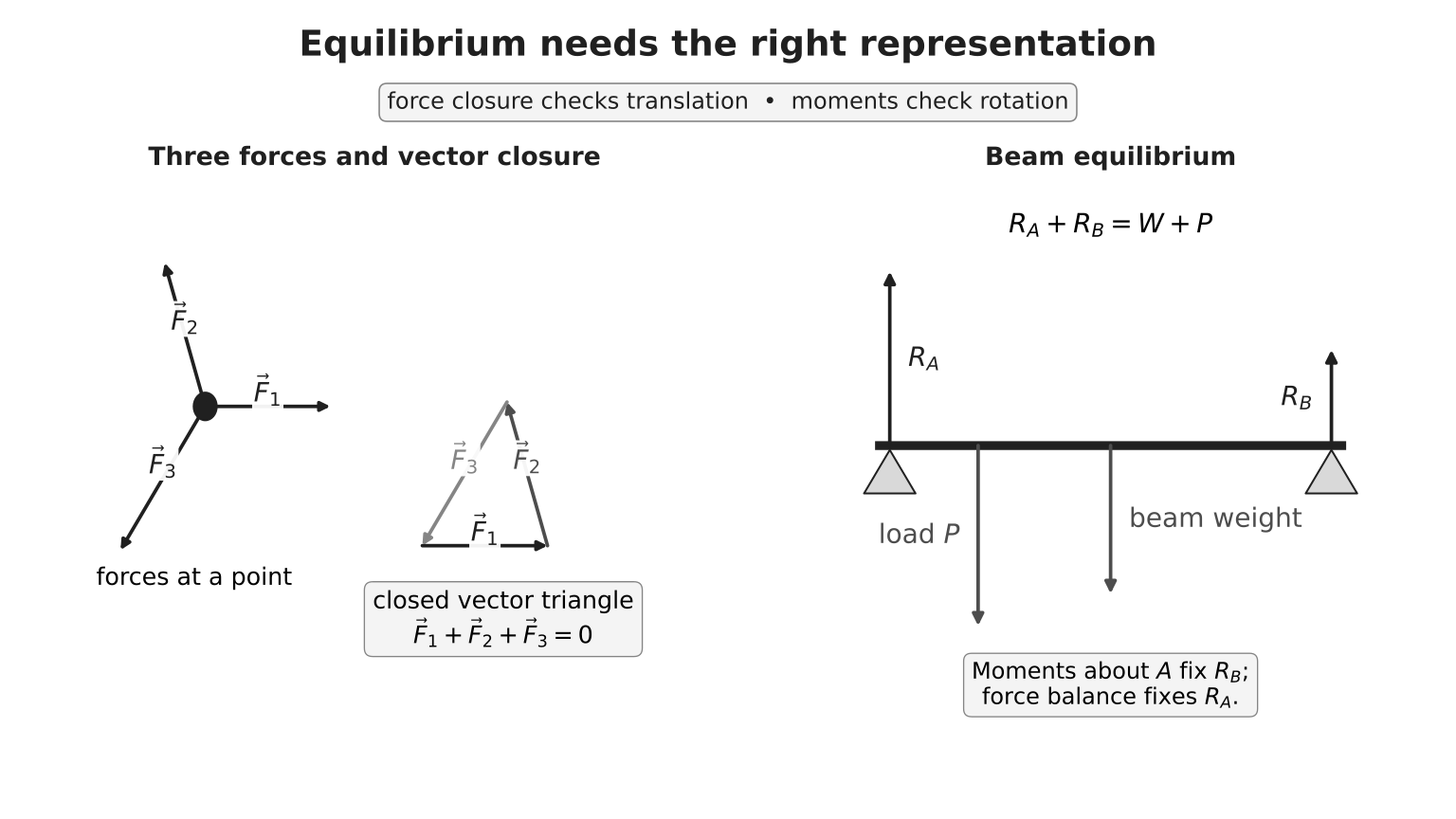
Figure: The left physical diagram preserves actual force lines and application geometry. The closed triangle is a separate vector-addition representation: each force is translated parallel to itself and arrows follow head-to-tail. Closure proves zero resultant force, but says nothing by itself about resultant moment. The beam panel therefore also applies moment balance.
Enrichment/application — three-force geometry
The following theorem is useful for anchor-style statics problems but is not stated as a separate 9749 learning outcome.
For exactly three non-parallel coplanar forces on a rigid body in equilibrium, their lines of action must be concurrent. If they were not, taking moments about the intersection of two would leave a non-zero moment from the third. If all three are parallel, suitable magnitudes and positions may also give equilibrium.
Concurrency or parallelism is necessary but not sufficient: the vector sum must still be zero, and the relevant moment condition must be satisfied.
6. Worked example: non-central load on a beam
A uniform beam is long and weighs . It rests horizontally on vertical supports at and . A load is placed from .
Let the upward reactions be and .
Vertical force balance:
Taking moments about :
Hence
and from (1),
The nearer support carries the greater load, as expected. Both reactions are positive and sum to .
7. Worked example: torque of a couple
Two forces form a couple with perpendicular separation .
Its direction is stated as clockwise or anticlockwise from the diagram; it cannot be inferred from magnitudes alone.
8. Statics workflow
- Isolate the rigid body.
- Draw all external forces at their correct lines of action.
- Include the body’s weight through its centre of gravity.
- Choose axes and write and .
- Choose a useful moment centre and write .
- Solve and check signs, units and physical plausibility.
Exam Relevance
For statics questions, draw forces at correct lines of action, apply , then choose a useful pivot and apply . A closed force triangle alone does not prove full rigid-body equilibrium.
9. Common mistakes
- using distance to the application point instead of perpendicular distance to the line of action;
- calling any two opposite forces a couple without checking equal magnitude, parallelism and separation;
- using only for a rigid body;
- confusing a physical diagram with a force triangle;
- treating three-force concurrency as sufficient for equilibrium;
- forgetting the weight of a uniform beam at its midpoint;
- describing a moving constant-velocity body as static.