Elastic Forces and Hooke’s Law
Branch note: This page develops syllabus outcome 4(a) and links the force model to later energy and oscillation work.
Overview
This branch note explains Hooke’s law, natural length, extension, restoring force direction and force-extension graph interpretation.
Core Ideas
- Hooke’s law applies only within the proportional limit.
- Extension or compression is measured from natural length.
- The applied-force magnitude graph uses .
- The spring’s signed restoring force acts opposite displacement and can be written along a chosen axis.
1. Natural length and extension
The natural length is the length of an elastic object when it is not deformed by an applied force. If its length becomes , its signed extension is
Thus for extension and for compression along the chosen axis.
Do not automatically identify natural length with the equilibrium position of a loaded system. For example, a vertical spring holding a mass is in equilibrium at an extended length because spring force balances weight.
2. Hooke’s law
Within the limit of proportionality, extension is directly proportional to the magnitude of the applied deforming force:
for in the usual magnitude graph. The force constant measures stiffness and has unit .
The law is a conditional empirical model. It does not state that every elastic material has a linear force–extension relationship for every deformation.
3. Applied force and spring force
For a spring held at rest at extension , the external deforming force and the spring’s restoring force are equal in magnitude and opposite in direction. Along an axis whose positive direction increases ,
The minus sign belongs to the signed restoring-force equation. It is not inserted when plotting the positive applied-force magnitude against positive extension .
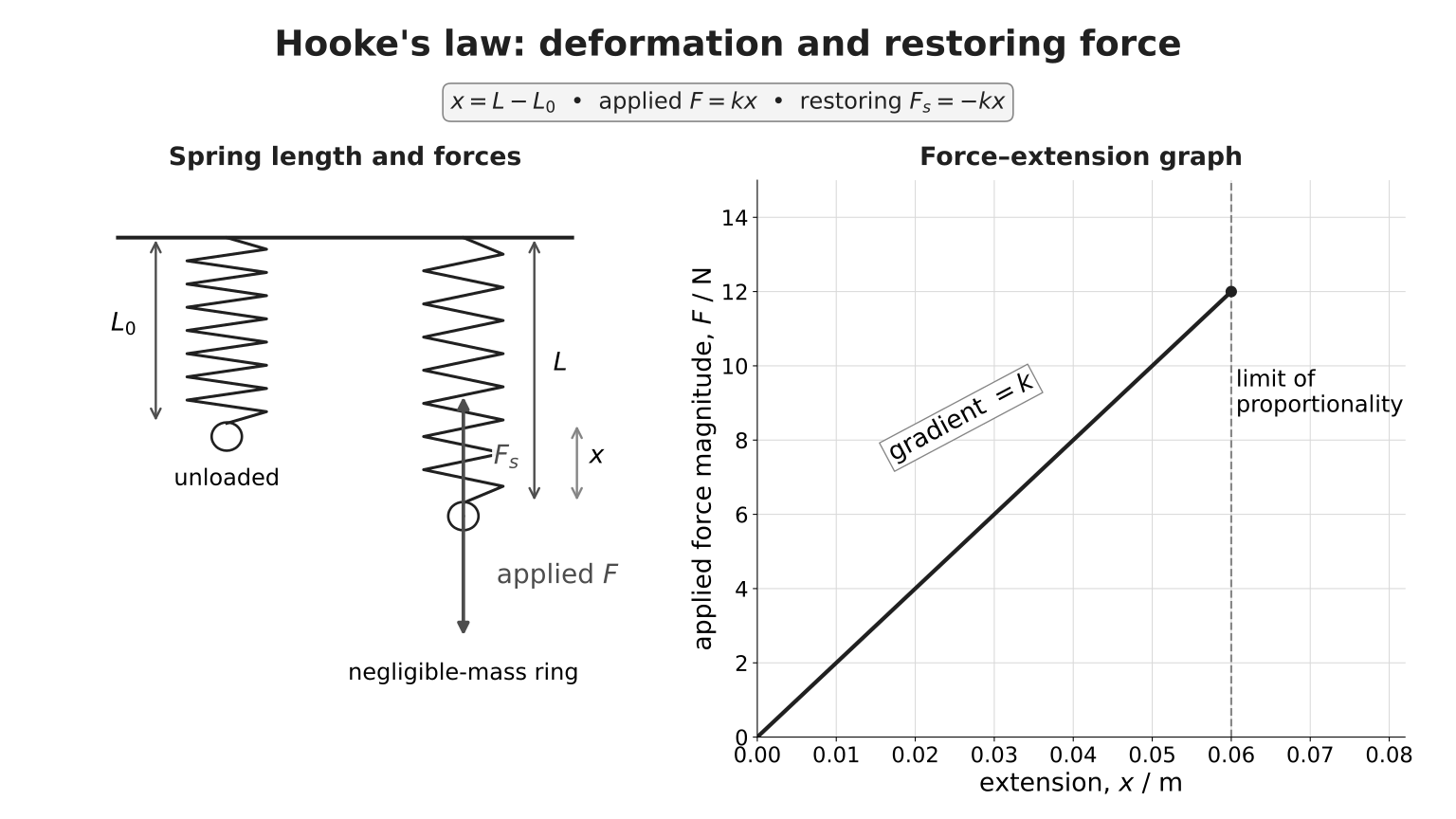
Figure: The spring sketches define natural length and the restoring direction. The analytical graph uses the applied-force magnitude within the proportional region, so its gradient is . The dashed vertical marker identifies the limit of proportionality; the plotted line deliberately stops there because behaviour beyond that point must be obtained from data or an explicitly supplied model.
4. Reading a force–extension graph
For a straight graph through the origin,
The gradient unit is
The limit of proportionality is the point beyond which is no longer constant. It is not necessarily the same as the elastic limit, which concerns whether the material returns fully to its original length after unloading.
5. Worked example
A spring has natural length . Its length is under a steady applied force of , and it remains within the proportional limit.
The extension is
Hence
The spring exerts a restoring force opposite to the extension direction.
6. Cross-topic bridge: elastic potential energy
Work, Energy and Power bridge
The area under an applied-force–extension graph equals the work done in slowly deforming the spring. For , the area from to is . This is developed in Work, Energy and Power rather than treated as a separate Topic 04 outcome.
Exam Relevance
In exams, define extension from natural length, keep the proportional-limit condition visible, and distinguish applied-force magnitude from the spring’s signed restoring force.
7. Common mistakes
- using total length instead of extension ;
- applying Hooke’s law beyond the proportional limit;
- confusing the positive applied-force magnitude with the signed restoring force;
- calling a loaded equilibrium position the natural length;
- reading from instead of on an – graph.