Damping and Resonance
Branch note: This page deepens one part of Oscillations and Simple Harmonic Motion.
Overview
Most real oscillating systems do not behave as ideal simple harmonic oscillators forever. Energy is usually lost through friction, air resistance, internal deformation, electrical resistance, or sound emission. This gradual loss of mechanical energy is called damping.
If an external periodic force supplies energy repeatedly, the system undergoes forced oscillation. When the driving frequency is close to the system’s natural frequency, the response amplitude can become large. This is resonance.
The central idea is:
Core Ideas
- Damping removes energy from an oscillating system and reduces amplitude.
- Damping does not necessarily change the equilibrium position.
- Light damping gives oscillations with decreasing amplitude.
- Critical damping returns the system to equilibrium in the shortest time without oscillation.
- Heavy damping gives a slower non-oscillatory return to equilibrium.
- Forced oscillation occurs when an external periodic driver supplies energy.
- In steady forced oscillation, the oscillator moves at the driving frequency.
- Resonance occurs when the driving frequency is close to the natural frequency, giving maximum steady-state amplitude.
- Greater damping lowers and broadens the resonance peak.
Exam Relevance
Damping and resonance questions usually test qualitative graph interpretation, practical examples, and the effect of damping on amplitude and resonance curves. They often require careful language rather than long calculations.
You should be able to:
- distinguish light, critical, and heavy damping from displacement-time graphs
- explain how damping changes energy and amplitude
- define forced oscillation and resonance
- distinguish natural frequency from driving frequency
- interpret resonance curves for different damping levels
- explain why damping reduces the maximum amplitude at resonance
- explain useful and dangerous examples of resonance
Definition
Damping is the gradual loss of mechanical energy from an oscillating system due to resistive or dissipative forces.
A forced oscillation occurs when a system is driven by an external periodic force.
For fixed driving-force amplitude and damping, the resonant frequency is the driving frequency at which the steady-state response amplitude is maximum. It lies near the undamped natural frequency ; for negligible damping, , while appreciable damping can shift the displacement-amplitude peak slightly below .
For a simple forced oscillator, the driving force may be modelled as:
where is the driving-force amplitude and is the driving angular frequency.
Why It Matters
Damping and resonance are central to engineering design, structural safety, musical acoustics, electronics, and many natural systems. The same ideas explain vehicle suspensions, musical instruments, bridge vibrations, radio tuning, and unwanted machinery vibration.
In design work, damping is not simply “bad”. It is often deliberately added to reduce unwanted oscillations. The aim is usually to keep useful motion while avoiding excessive amplitude.
Key Representations
Damping
Common causes of damping include:
- air resistance;
- friction;
- fluid drag;
- internal material deformation;
- electrical resistance;
- sound radiation.
As energy decreases, amplitude decreases. For many oscillators, the total mechanical energy is proportional to amplitude squared:
So if the amplitude halves, the energy is reduced to about one quarter of its previous value. This is why a visibly smaller amplitude represents a much larger fractional loss of energy.
Damped Oscillation Graph
Typical displacement-time behaviour:
- oscillatory motion continues;
- successive peaks become smaller;
- equilibrium position remains unchanged.
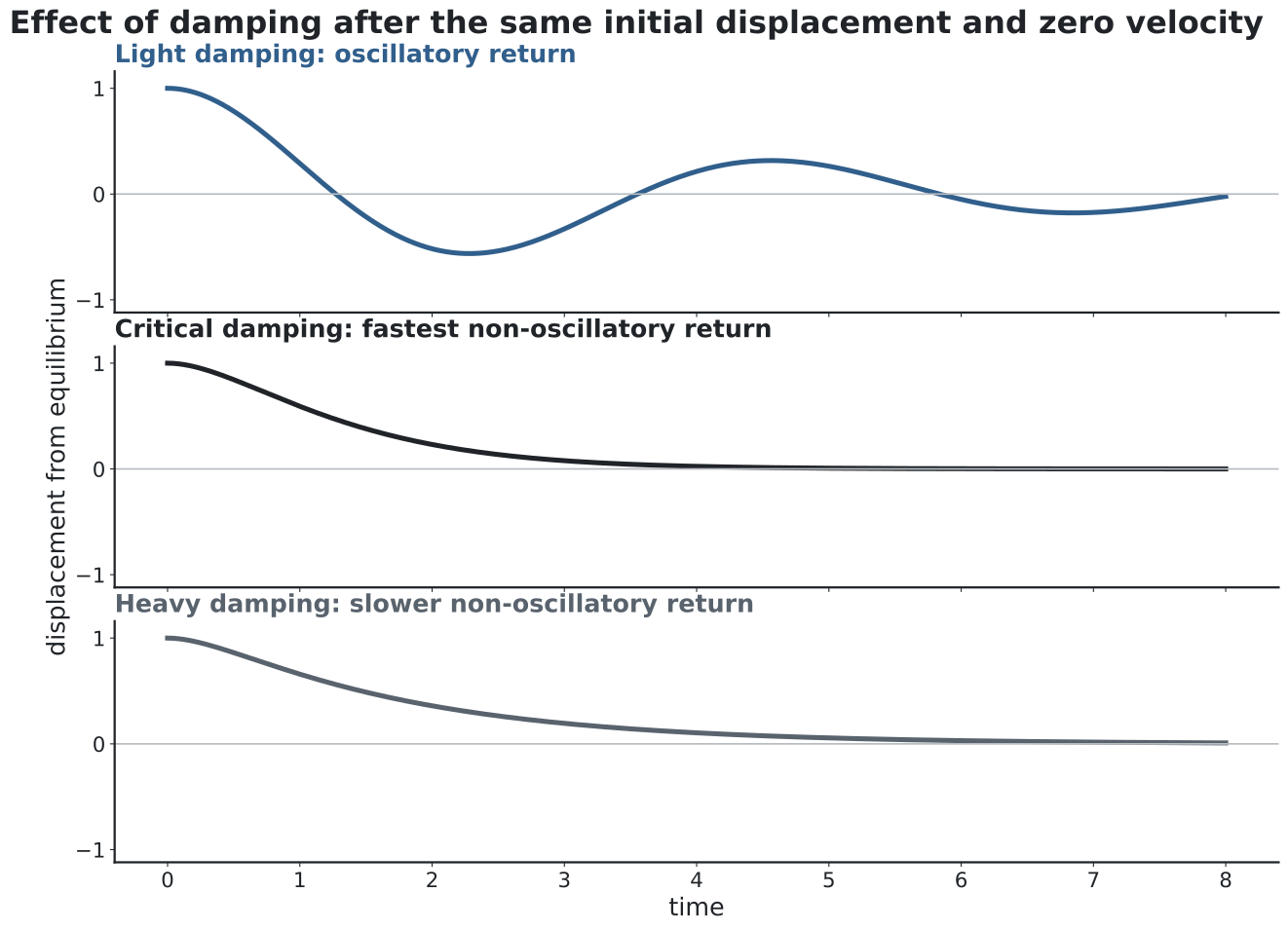
Figure: For the same oscillator, initial displacement, and zero initial velocity, light damping allows oscillatory crossings with decreasing amplitude. Critical damping gives the fastest return without crossing equilibrium; heavy damping also avoids crossing but returns more slowly.
Enrichment — mathematical envelope model
For linear viscous damping in the underdamped regime, the amplitude envelope is exponential. The exact model is useful background, but the 9749 syllabus requires qualitative damping behaviour rather than derivation of the envelope.
The envelope may be modelled as:
where is the amplitude-decay constant, measured in . It is not the spring stiffness .
This exact exponential model is not usually the main target of H2-level questions. The important graph-reading idea is that the amplitude envelope decreases while the motion may still cross the equilibrium position repeatedly.
Reading a Damping Graph
Use this workflow:
- Check whether the graph crosses equilibrium repeatedly.
- If it oscillates with decreasing amplitude, it is lightly damped.
- If it does not oscillate and returns as fast as possible, it is critically damped.
- If it does not oscillate but returns slowly, it is heavily damped.
- Do not confuse decreasing amplitude with decreasing period. The graph can lose amplitude while still having nearly regular crossings.
Types of Damping
Light damping, or underdamping, allows oscillations to continue while amplitude gradually decreases.
Critical damping returns the system to equilibrium in the shortest possible time without oscillating. This is often desirable in engineering systems such as car suspensions and analog meter needles.
Heavy damping, or overdamping, returns the system to equilibrium without oscillating, but more slowly than critical damping.
| Type | Oscillates? | Speed of Return |
|---|---|---|
| Light damping | Yes | Slow to settle |
| Critical damping | No | Fastest without overshoot |
| Heavy damping | No | Slower than critical |
Worked Reasoning: Identifying Damping Type
Suppose a displacement-time graph starts above equilibrium and then crosses equilibrium several times while each peak is smaller than the previous peak.
This is light damping. The repeated crossings show that the system is still oscillating. The decreasing peak size shows that mechanical energy is being dissipated.
Suppose instead the graph approaches equilibrium without crossing it. If it reaches equilibrium faster than the other non-oscillatory curve shown, it represents critical damping. If it approaches equilibrium more slowly, it represents heavy damping.
Forced Oscillations
Immediately after the driver starts, the motion may contain both a decaying transient response and a driven response. After the transient has died away, the steady-state oscillator moves at the driving frequency, not necessarily its natural frequency. Its amplitude depends on driving frequency, damping, and driving-force amplitude.
A forced oscillator therefore has two important frequencies:
| Quantity | Meaning |
|---|---|
| Natural frequency | Frequency at which the system tends to oscillate when disturbed and left alone |
| Driving frequency | Frequency of the external periodic force |
The steady-state motion follows the driving frequency . The size of the response depends strongly on how close is to .
Natural Frequency
Every oscillating system has one or more natural frequencies determined by its physical properties.
For an ideal undamped spring-mass oscillator:
For an ideal small-angle undamped pendulum:
Changing the driver does not change the undamped natural frequency set by the oscillator’s parameters. In a damped free oscillation, the observed oscillation frequency is slightly lower than the undamped natural frequency; this distinction is usually qualitative at H2 level.
Resonance
For light damping, resonance occurs when:
or:
More generally, resonance is identified operationally by the maximum of the steady-state amplitude-versus-driving-frequency curve. Energy transfer is then especially effective, so the steady-state amplitude becomes large.
This does not mean that the system has no damping. In a real system, damping is still present. At steady state, the average power supplied by the driver balances the average power dissipated by damping.
Energy View of Resonance
Far from resonance, the driver is poorly matched to the oscillator. Energy is not transferred efficiently each cycle, so the response amplitude is small.
Near resonance, the driver supplies energy at the right timing relative to the oscillator’s motion. The oscillator can build up a large amplitude until energy input per cycle is balanced by energy loss per cycle.
With greater damping, more energy is dissipated each cycle. The amplitude cannot build up as much, so the resonance peak becomes lower and broader.
Frequency Response
A graph of amplitude against driving frequency is called a frequency response curve. It has:
- small amplitude far from resonance;
- a peak near natural frequency;
- lower response again beyond resonance.
Greater damping causes:
- lower resonance peak;
- broader peak;
- less sharp resonance;
- lower maximum amplitude.
Less damping gives a taller and sharper peak.
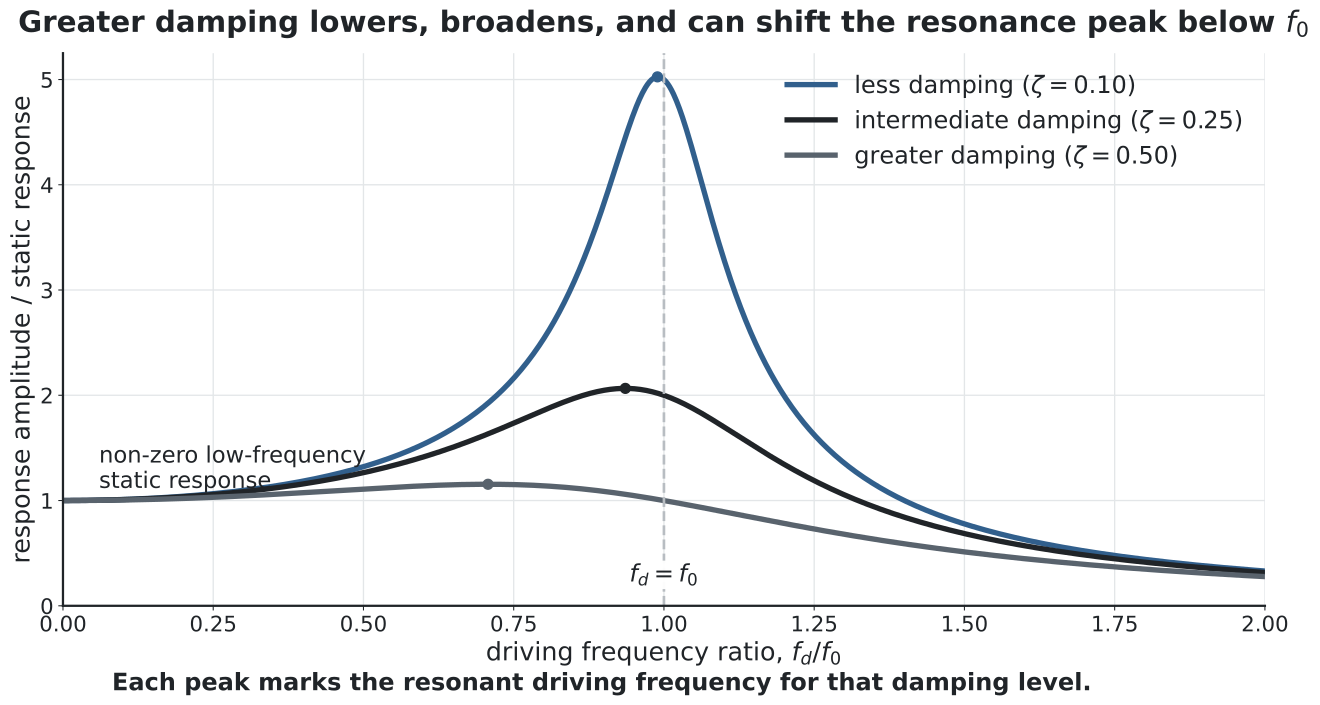
Figure: These displacement-amplitude curves are generated from a damped driven-oscillator response model with the same driving-force amplitude. Increasing damping lowers and broadens the peak; the resonant frequency lies near for light damping and can shift below as damping increases.
Reading a Resonance Curve
Use this workflow:
- Identify the horizontal axis as driving frequency, not time.
- Identify the vertical axis as response amplitude.
- Locate the peak; its horizontal coordinate is the resonant driving frequency .
- Compare peak height to judge maximum amplitude.
- Compare peak width to judge sharpness of resonance.
- The lower, broader curve represents greater damping.
Worked Reasoning: Effect of More Damping
If damping is increased while the same oscillator is driven over a range of frequencies:
- the maximum amplitude decreases;
- the resonance peak becomes less sharp;
- the response is spread over a wider range of driving frequencies;
- the displacement-amplitude resonant frequency may shift below as damping increases, but H2 questions usually focus on the lower and broader peak.
So the safe exam answer is: greater damping reduces the resonance peak and makes it broader.
Enrichment — Phase in Forced Motion
As driving frequency increases:
- at low frequency, the oscillator is nearly in phase with the driver;
- near resonance, phase lag increases;
- at high frequency, the oscillator approaches antiphase.
This is useful enrichment for interpreting resonance curves.
At H2 level, most questions do not require detailed phase calculations. The useful qualitative idea is that the timing between the driver and oscillator changes as the driving frequency changes.
Applications and Risks
Useful resonance examples include musical instruments, radio tuning, MRI/NMR, filters, and sensors.
Dangerous resonance examples include bridges, buildings during earthquakes, rotating machinery, and repeated vibration of mechanical supports.
Soldiers break step on bridges because marching in step applies periodic forces. If this matches a bridge’s natural frequency, resonance may occur.
Car suspension combines a spring and a damper. Too little damping causes repeated bouncing. Too much damping gives a harsh, sluggish response. Near critical damping is often preferred.
Example: Car Suspension
A car suspension must absorb bumps without allowing the car body to keep oscillating.
If the damping is too small, the car continues bouncing after a bump. If the damping is too large, the suspension responds sluggishly and the ride becomes harsh. A practical design aims for a response close to critical damping: fast return to equilibrium without repeated oscillation.
Example: Bridge and Marching
Marching soldiers apply periodic forces to a bridge. If the marching frequency is close to a natural frequency of the bridge, resonance can increase the vibration amplitude. Breaking step makes the applied forces less periodic, reducing the chance of sustained energy transfer at a resonant frequency.
Example: Musical Instruments
Resonance is useful in musical instruments. A body of air, a string, or a soundboard responds strongly at particular natural frequencies. This increases the sound amplitude at selected frequencies and shapes the tone.
Example: Radio Tuning
A radio receiver can be adjusted so that an electrical oscillator responds strongly to one frequency and weakly to others. This is an electrical resonance effect. The selected station is the frequency where the response is largest.
Enrichment — Mathematical Model
Beyond the required 9749 mathematical treatment
Use this equation to interpret the roles of inertia, damping, restoring force, and driving. Solving it and calculating phase response are not required core outcomes.
A damped driven oscillator can be modelled by:
where is mass, is damping constant, and is stiffness. This equation explains resonance curves and phase lag, but detailed solution is beyond H2 core requirements.
The terms have clear physical roles:
| Term | Physical role |
|---|---|
| inertia of the oscillator | |
| damping force proportional to velocity | |
| restoring force from displacement | |
| external periodic driving force |
This model is useful for interpretation, but exam questions normally expect qualitative reasoning about amplitude, damping, and resonance rather than solving the differential equation.
Concept Checkpoints
- If a graph shows repeated crossings of equilibrium with decreasing peak height, what type of damping is shown?
- Why does damping reduce amplitude?
- Why is critical damping useful in measuring instruments or suspensions?
- In steady forced oscillation, does the oscillator move at its natural frequency or the driving frequency?
- What happens to the resonance peak when damping is increased?
- Why is resonance sometimes useful and sometimes dangerous?
Common Mistakes
- Thinking damping always stops motion immediately.
- Thinking critical damping means “very large damping”.
- Confusing natural frequency with driving frequency.
- Assuming resonance is always destructive.
- Forgetting damping reduces the resonance peak.
- Thinking a resonance graph is a displacement-time graph.
- Saying resonance occurs only when there is no damping.
- Assuming resonance only occurs in mechanical systems.
Summary
Damping removes energy from an oscillator and reduces amplitude over time. Forced oscillation supplies periodic energy from a driver. Resonance gives maximum steady-state amplitude when the driving frequency is close to the natural frequency. Greater damping makes the resonance peak lower and broader, and can be deliberately used to control unwanted oscillations.
Links
- Main topic: Oscillations and Simple Harmonic Motion
- Related branch: Simple Harmonic Motion
- Related branch: Spring Motion
- Related branch: Pendulum Motion
- Related concept: Phase Difference