Spring Motion
Branch note: This page deepens one part of Oscillations and Simple Harmonic Motion.
Overview
A spring-mass system is the cleanest standard physical model of simple harmonic motion because Hooke’s law gives a restoring force directly proportional to displacement.
For an ideal spring within its linear Hooke’s-law region:
where is the signed extension or compression measured from the spring’s natural length. The negative sign means the spring force opposes that deformation. In a horizontal arrangement with natural length as equilibrium, ; in a vertical arrangement, they are not the same quantity.
This page expands the spring examples in Oscillations and Simple Harmonic Motion. The main hub keeps the essential result; this branch explains why horizontal and vertical spring systems have the same period formula when displacement is measured correctly.
Core Ideas
- A Hooke’s-law spring provides a restoring force proportional to displacement.
- Horizontal spring motion is the simplest SHM model: .
- A vertical spring has a shifted equilibrium position because weight is constant.
- For vertical spring SHM, displacement must be measured from the new equilibrium position.
- The ideal spring-mass period is .
- The period depends on mass and spring constant, not amplitude, provided the spring remains linear.
- In ideal horizontal spring SHM, energy transfers between kinetic energy and elastic potential energy. For a vertical spring, use kinetic energy and the combined elastic-plus-gravitational potential, or the equivalent effective potential measured from equilibrium.
Exam Relevance
Spring SHM questions often test whether you measure displacement from the correct equilibrium position, especially in vertical spring systems.
You should be able to:
- derive from Hooke’s law and Newton’s second law
- distinguish extension from natural length and displacement from equilibrium
- explain why weight shifts equilibrium in a vertical spring but does not change the SHM period
- use
- interpret energy exchange in spring SHM
- avoid using amplitude as if it changes the ideal period
Definition
A spring-mass oscillator consists of a mass attached to a spring so that displacement from equilibrium produces a restoring force.
For an ideal linear spring:
where:
- is the spring constant
- is signed extension or compression from natural length
- the spring force opposes that deformation
The resultant force during oscillation is written in terms of displacement from equilibrium. For example, a vertical oscillator displaced by signed amount from its static equilibrium has:
Why It Matters
Spring motion is the most direct example of the SHM condition:
The spring model also clarifies a common exam issue: the natural length, static equilibrium length, and instantaneous displacement are different ideas.
Key Representations
Horizontal Spring-Mass System
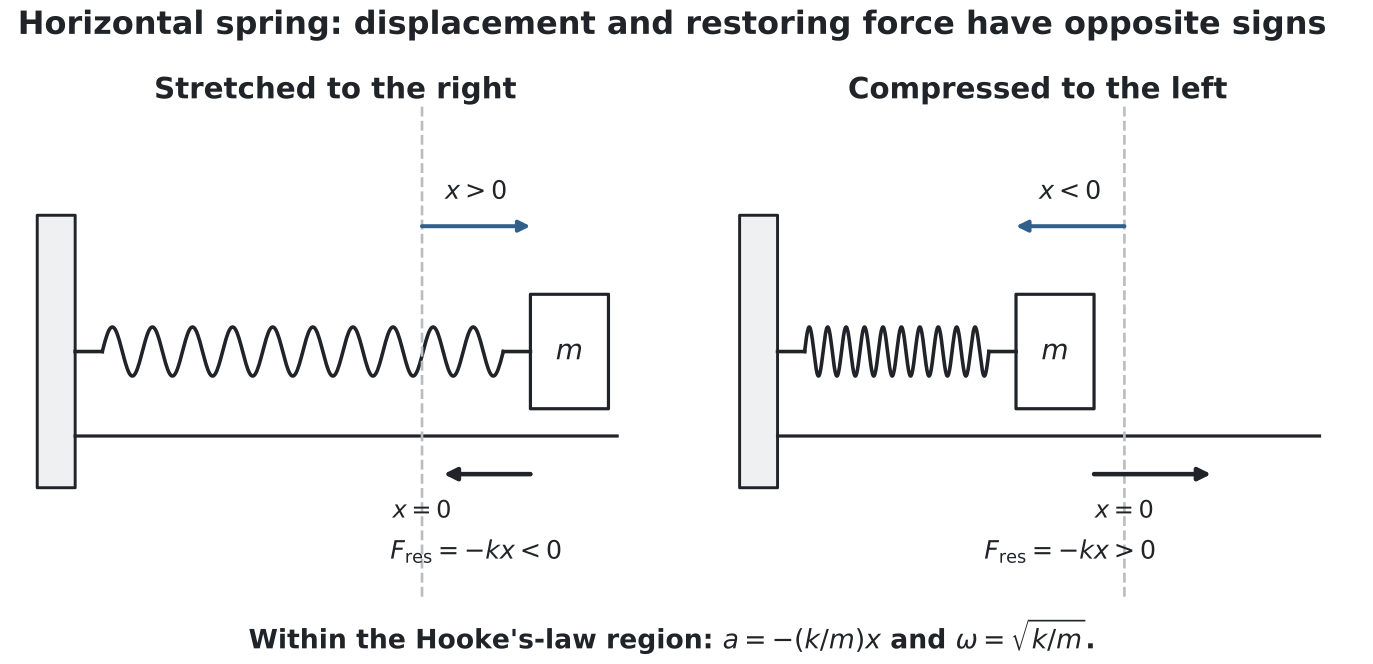
Figure: In a horizontal spring-mass system, displacement from equilibrium stretches or compresses the spring. The spring force acts opposite to displacement, so .
For a horizontal spring on a smooth surface, equilibrium is usually the spring’s natural length. If the mass is displaced to the right and right is chosen as positive:
Newton’s second law gives:
so:
Compare with the SHM condition:
Therefore:
and:
Using :
What the Sign Means
The sign convention is not decorative. It carries the restoring-force information.
If , the spring force is negative and pulls back.
If , the spring force is positive and pushes back.
In both cases, acceleration is directed toward equilibrium.
Vertical Spring-Mass System
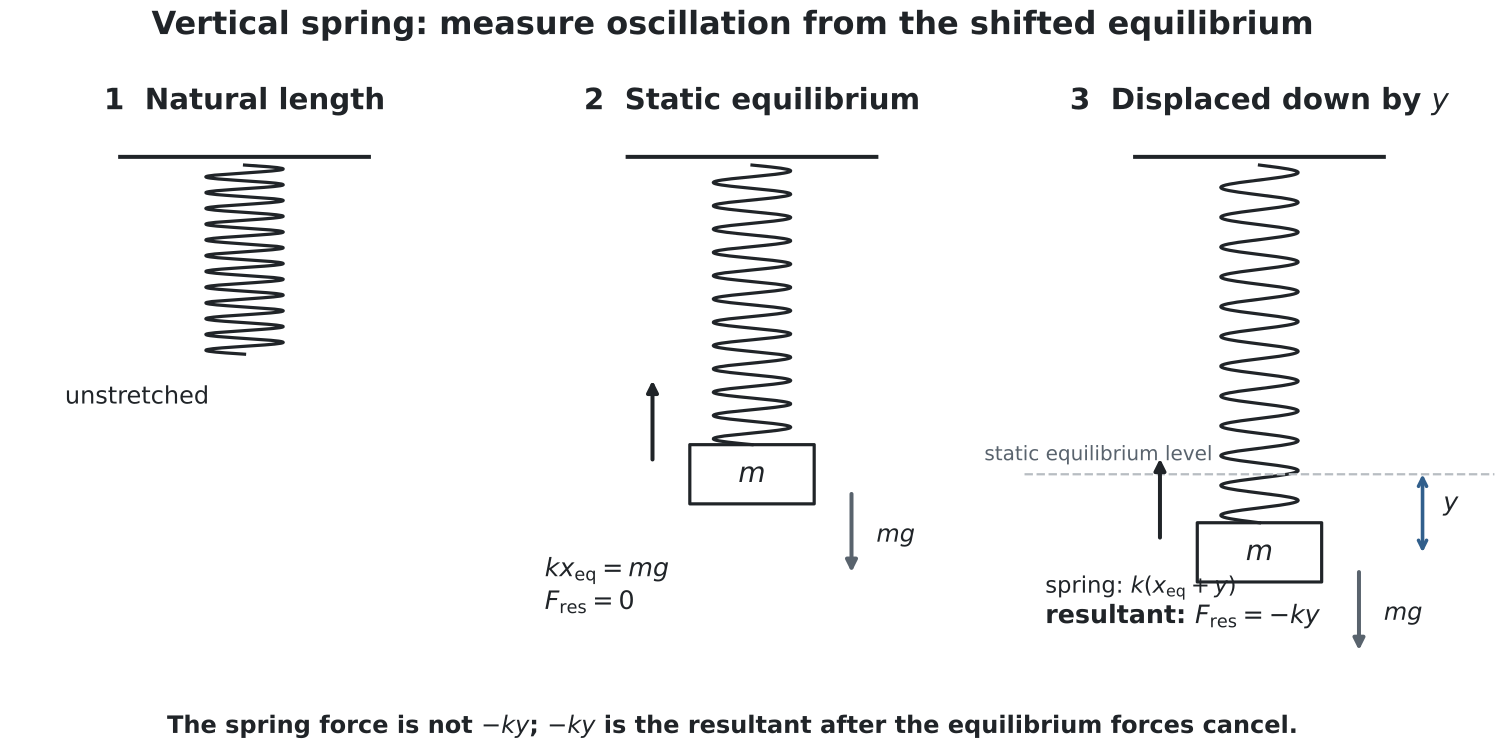
Figure: Weight shifts the equilibrium extension so that . At a further displacement , the actual spring force has magnitude ; after subtracting the constant weight, the resultant is .
A vertical spring is slightly more subtle because weight is always present.
Let the downward extension from the spring’s natural length be . At static equilibrium:
This means the spring is already stretched before oscillation begins. If the mass is then displaced by a further signed amount from the equilibrium position, the total extension is:
Taking downward as positive, the forces are:
Using :
so:
Therefore:
and:
So the vertical spring also executes SHM about its equilibrium position, with:
and:
Equilibrium Position vs Natural Length
This distinction is the main reason vertical spring questions cause mistakes.
Natural length:
- length of the unstretched spring
- no attached mass or no extension
Static equilibrium length:
- length after the mass has been attached and allowed to hang at rest
- spring force balances weight
Displacement for SHM:
- measured from the static equilibrium position
- usually denoted in vertical-spring derivations
- determines the restoring force
Using extension from natural length as if it were the SHM displacement gives the wrong force equation because it fails to account for the constant weight already balanced at equilibrium.
Energy in Spring SHM
For an ideal horizontal spring:
where:
and:
At equilibrium:
- displacement is zero
- spring potential energy is minimum
- speed and kinetic energy are maximum
At the extremes:
- displacement magnitude is maximum
- speed is zero
- elastic potential energy is maximum
For vertical spring motion, both gravitational potential energy and elastic potential energy change. When is measured from static equilibrium, their sum can be written as:
where depends on the chosen zero of potential energy. Choosing the combined potential to be zero at equilibrium gives . It is this combined effective potential, not elastic energy alone, that has the simple form about equilibrium.
Experimental Graphical Test
For a fixed spring obeying Hooke’s law,
A graph of against oscillating mass should therefore be a straight line with gradient . Time many oscillations, use , repeat measurements, and keep the amplitude small enough that the spring remains in its linear region. A non-zero intercept may indicate unmodelled effective spring mass or a systematic timing/length issue rather than a failure of all SHM reasoning.
Amplitude and Period
For ideal linear SHM:
The period does not depend on amplitude. A larger amplitude gives a larger maximum speed and larger total energy, but the oscillator also travels a larger distance in a way that preserves the same period in the ideal model.
This amplitude independence only holds if:
- the spring obeys Hooke’s law
- damping is negligible
- the support and spring are ideal
- the motion remains one-dimensional
Worked Example: Vertical Spring Equilibrium
A mass hangs from a vertical spring of spring constant . It is displaced downward by from its equilibrium position and released.
At equilibrium:
At displacement below equilibrium, the total extension is:
Net downward force:
Substitute :
So:
The acceleration is:
Therefore the motion is SHM with:
Common Mistakes
- Measuring vertical-spring SHM displacement from natural length instead of equilibrium.
- Forgetting that weight is already balanced at the vertical equilibrium position.
- Thinking the vertical spring has a different period formula because weight is present.
- Using without defining what is measured from.
- Assuming amplitude changes the ideal period.
- Forgetting the spring must obey Hooke’s law for the SHM model to apply.
Summary
Spring-mass systems are direct SHM models because a linear spring gives a restoring force proportional to displacement. Horizontal spring motion gives immediately. In a vertical spring, weight shifts the equilibrium position, but motion about that new equilibrium still obeys . In both cases, the ideal period is .
Links
- Main topic: Oscillations and Simple Harmonic Motion
- Related branch: Simple Harmonic Motion
- Related branch: Floating Object SHM
- Related branch: Pendulum Motion
- Related branch: Damping and Resonance
- Common traps: Oscillations and SHM Common Exam Traps