Pendulum Motion
Branch note: This page deepens one part of Oscillations and Simple Harmonic Motion.
Overview
A pendulum is one of the most important oscillating systems in physics. It consists of a bob suspended from a fixed point so that it can swing freely under the influence of gravity.
For small angular displacements, a simple pendulum executes motion that closely approximates SHM. Because of its regular period, the pendulum has historically been used in clocks, timing devices, and experiments to determine gravitational field strength.
Core Ideas
- A pendulum oscillates because the tangential component of weight acts as a restoring force.
- For small angular displacements, .
- Under the small-angle approximation, restoring acceleration is proportional to displacement and directed toward equilibrium.
- The ideal simple pendulum period is .
- The ideal period depends on length and gravitational field strength, not bob mass.
- The formula is a model result and should not be used uncritically for large amplitudes.
Exam Relevance
Pendulum questions usually test the assumptions behind the model, the small-angle approximation, and the interpretation of period measurements.
You should be able to:
- resolve weight to identify the tangential restoring component
- explain why the pendulum is only approximately SHM
- derive or use
- state why mass does not affect the ideal period
- use a against graph to determine
Definition
A simple pendulum is an idealised model consisting of:
- a point-mass bob of mass ;
- a light inextensible string of length ;
- a fixed frictionless pivot;
- motion under gravity with negligible air resistance.
The equilibrium position is the lowest point of the swing, where the string is vertical.
Why It Matters
Pendulum motion links mechanics, oscillations, circular motion, energy methods, and practical measurement. It is also a standard example showing how an approximate SHM model arises from a physical force law.
The pendulum formula is useful but conditional: it requires small angular displacement.
Key Representations
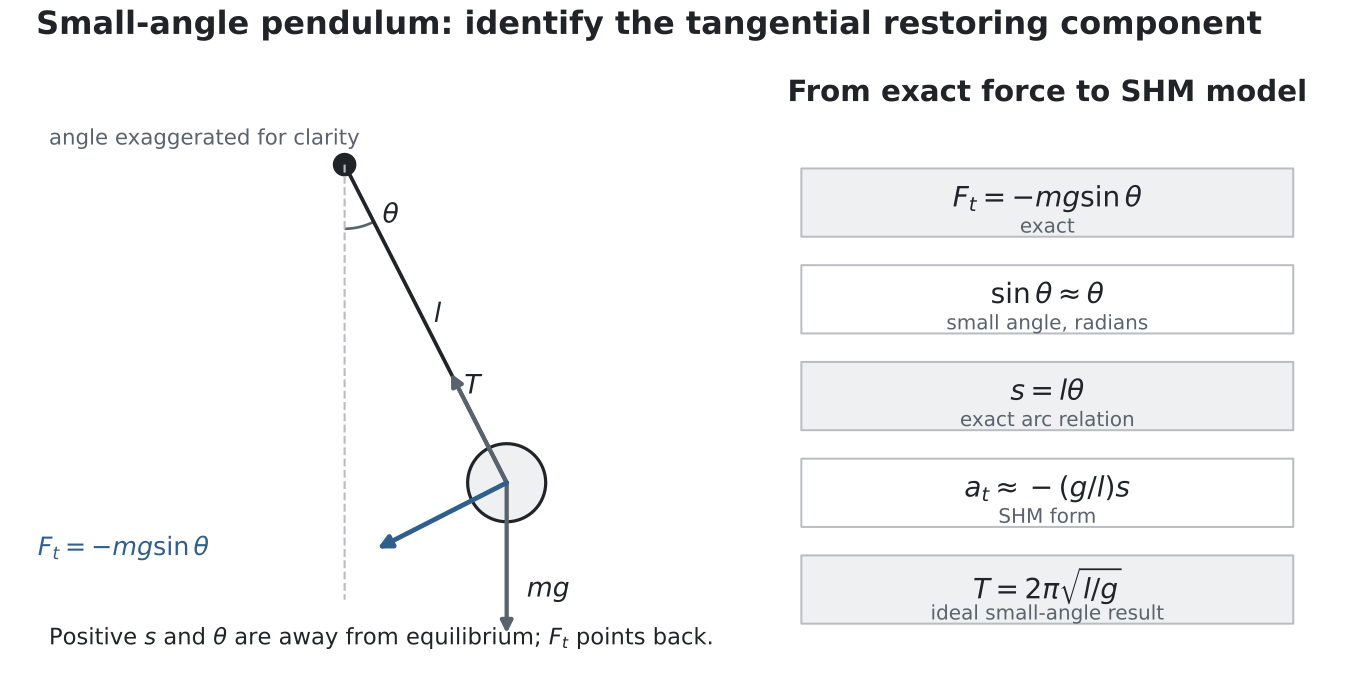
Figure: Tension acts radially and does not provide the tangential restoring component. Along the arc, . Since the signed arc displacement is exactly when is in radians, the small-angle approximation gives .
The figure shows the essential modelling chain:
- displace the bob by an angle from the vertical;
- resolve the weight into radial and tangential components;
- identify the tangential component as the restoring force;
- use the small-angle approximation to convert the force law into SHM form.
The radial component is not the restoring component for oscillation along the arc. It mainly affects the tension in the string and the radial force balance. The tangential component changes the bob’s speed along the arc and points back toward the equilibrium position.
Restoring Force
When displaced by angle , weight acts downward. Resolving weight gives a signed tangential restoring-force component:
The negative sign indicates that this tangential component acts toward equilibrium after a positive angular displacement is chosen. Here is a signed tangential component along the chosen arc direction, not a full vector equation.
If the bob is displaced to the other side, the sign of the tangential displacement reverses and the tangential component of weight also reverses. This is the physical meaning of the negative sign: the force always acts opposite to the displacement from equilibrium.
Why the Pendulum Oscillates
If displaced:
- restoring force accelerates the bob toward equilibrium;
- the bob gains speed;
- inertia carries it past equilibrium;
- restoring force reverses direction;
- the cycle repeats.
Thus oscillation results from gravity providing restoring force and inertia carrying motion through equilibrium.
Small-Angle Approximation
For small angular displacements measured in radians:
How small is ‘small’ depends on the required accuracy. At , replacing by introduces a relative difference of about ; the approximation improves as the amplitude decreases. Do not treat one angle cutoff as universal.
Then:
Derivation of SHM
The signed arc displacement from equilibrium is exactly:
when is measured in radians. Therefore:
Using signed tangential components, :
Substitute :
Therefore:
Comparing with:
gives:
Hence pendulum motion is SHM for small angles.
This derivation also shows why the approximation is conditional. The exact restoring component is proportional to , not . The motion becomes SHM only when the angle is small enough that .
Period
Since:
the period is:
The period depends on pendulum length and gravitational field strength . It does not depend on bob mass, and it is independent of amplitude only for small oscillations.
The mass cancels because both the restoring force and inertia are proportional to . A heavier bob has a larger weight, but it also has proportionally larger inertia, so the ideal period is unchanged.
Key Trends
A longer pendulum has larger and oscillates more slowly. A stronger gravitational field gives smaller and faster oscillation.
A pendulum clock taken to a mountain where is slightly smaller will have a larger period and run slow.
Energy in Pendulum Motion
Ignoring air resistance, total mechanical energy is constant.
At highest points:
- speed is zero;
- kinetic energy is zero;
- gravitational potential energy is maximum.
At the lowest point:
- speed is maximum;
- kinetic energy is maximum;
- gravitational potential energy is minimum.
As the pendulum swings:
Large-Angle Motion
If amplitude is large:
Then motion is no longer exact SHM. The period becomes slightly larger and the motion is no longer perfectly sinusoidal.
Measuring g Experimentally
Rearrange:
Square both sides:
Measure from the pivot to the bob’s centre of mass. Use a small angular amplitude, release without a push, time complete oscillations using the same-direction crossing of a fiducial mark, calculate , and repeat before changing .
Plotting against gives a straight line with gradient:
so:
The gradient has units , so the calculated has units . A large intercept suggests a systematic issue such as an incorrect effective length or timing offset; scatter should be represented with suitable uncertainty or error bars when required.
Common Mistakes
- Using the pendulum formula for large amplitudes.
- Thinking a heavier bob swings faster.
- Measuring length to the top or bottom of the bob instead of its centre of mass.
- Forgetting local affects period.
- Confusing arc displacement with vertical height.
Summary
A simple pendulum approximates SHM only for small angular displacement, where and the restoring acceleration is proportional to displacement. Under that model, , so period depends on length and local gravitational field strength, not bob mass.
Links
- Main topic: Oscillations and Simple Harmonic Motion
- Related branch: Simple Harmonic Motion
- Related branch: Spring Motion
- Related branch: Damping and Resonance
- Related topic: Circular Motion
- Related topic: Gravitational Fields