Floating Object SHM
Branch note: This page deepens one part of Oscillations and Simple Harmonic Motion.
Contextual application
Floating-object SHM is not named as a required system in the 2026 H2 Physics 9749 Oscillations outcomes. It is retained as a useful transfer problem for applying to an unfamiliar restoring-force model.
Overview
A floating object can execute vertical simple harmonic motion if it is displaced slightly and released. The restoring effect comes from upthrust.
At equilibrium:
If the object is pushed down, it displaces more liquid. The upthrust increases, so the resultant force is upward. If the object is lifted up, it displaces less liquid. The upthrust decreases, so the resultant force is downward.
This page expands the short floating-object block in Oscillations and Simple Harmonic Motion.
Core Ideas
- Upthrust equals the weight of fluid displaced.
- At floating equilibrium, upthrust balances weight.
- A small downward displacement increases immersed volume and hence upthrust.
- The extra upthrust acts opposite to the displacement.
- For a uniform cylinder of cross-sectional area , extra displaced volume is .
- The restoring force is .
- This has SHM form if remains effectively constant during the motion.
Exam Relevance
Floating-object SHM is a useful transfer problem for recognising SHM from a force law rather than from a memorised spring or pendulum formula.
You should be able to:
- identify the equilibrium condition
- use upthrust as weight of displaced fluid
- express the change in immersed volume as
- derive
- compare with or
- state the modelling assumptions clearly
Definition
A floating object executes vertical SHM when a small vertical displacement produces a resultant force proportional to displacement and directed back toward equilibrium.
For a uniform vertical cylinder or rod floating in a liquid:
where:
- is the liquid density
- is the constant cross-sectional area of the object at the waterline
- is signed vertical displacement from equilibrium
- is gravitational field strength
Why It Matters
This example is important because it does not start from a spring force. It shows the same SHM logic in a fluid-force context:
It also tests careful sign reasoning. The extra upthrust is upward for a downward displacement, so the force is opposite to the displacement.
Key Representations
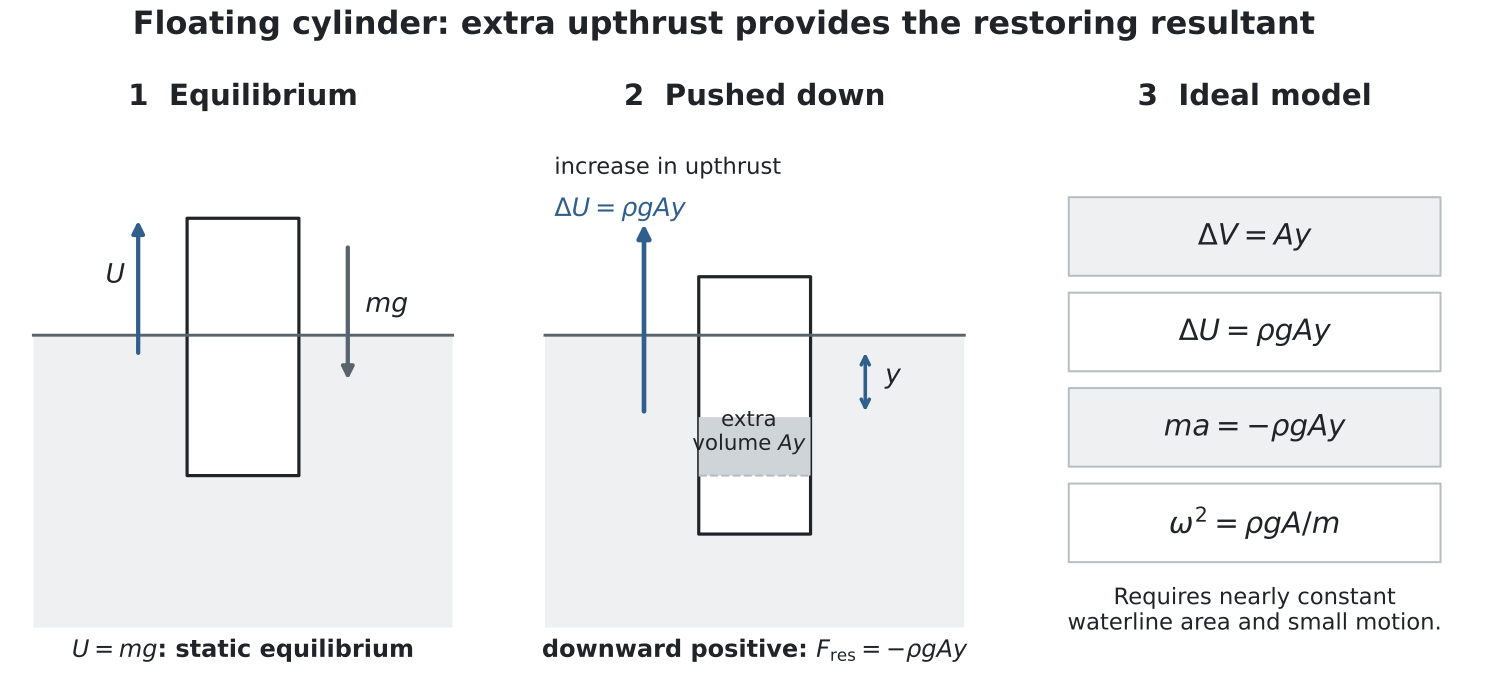
Figure: A small downward displacement increases the immersed volume by , increasing upthrust by . This extra upthrust is opposite to the displacement, giving and hence vertical SHM.
Equilibrium Condition
In the static equilibrium configuration, the object is stationary and the resultant vertical force is zero:
So:
where is the upthrust and is the weight.
During oscillation, the object can pass through this same equilibrium position with non-zero, and in ideal SHM maximum, speed. ‘Equilibrium position’ means zero resultant force at that position; it does not mean the moving object must stop there.
By Archimedes’ principle, upthrust is the weight of liquid displaced:
At equilibrium:
The equilibrium submerged volume is therefore determined by the object’s weight and the liquid density.
Downward Displacement
Suppose downward displacement from equilibrium is chosen as positive. Let the object be pushed down by a small distance .
For a cylinder or rod of constant cross-sectional area , the extra immersed volume is:
The extra upthrust is:
so:
This extra upthrust acts upward. Since downward is positive, the upward force is negative:
This is the restoring force.
SHM Derivation
Using Newton’s second law:
So:
Compare with the SHM condition:
Therefore:
and:
The period is:
Upward Displacement Check
The sign reasoning should also work for upward displacement.
If the object is lifted upward, using downward as positive means:
The immersed volume decreases, so upthrust becomes smaller than weight. The resultant force is downward, which is positive.
From:
if , then . This correctly predicts a downward restoring force.
Model Assumptions
The formula is not universal for every floating object. It assumes:
- the object remains floating and partially immersed
- the displacement is small
- the cross-sectional area at the waterline is approximately constant
- the liquid density is uniform
- damping from water resistance is negligible for the ideal SHM model
- the object moves vertically without significant rotation
If the object has a changing cross-sectional area near the waterline, the restoring force may not remain exactly proportional to displacement.
The ideal model also neglects surface-wave production, splashing, and the effective inertia of liquid that moves with the object. These effects can add damping or alter the measured period, so the derived period is an ideal approximation rather than a universal floating-body formula.
Worked Example: Deriving the Period
A uniform cylinder of mass and cross-sectional area floats vertically in a liquid of density . It is pushed down slightly and released.
Extra immersed volume:
Extra upthrust:
The extra upthrust is upward for a downward displacement, so:
Then:
so:
Therefore:
and:
Common Mistakes
- Forgetting that upthrust changes because displaced volume changes.
- Treating the total upthrust as the restoring force instead of the change in upthrust.
- Forgetting that equilibrium upthrust already balances weight.
- Using the object’s density instead of the liquid density in .
- Forgetting that the cross-sectional area must be approximately constant for .
- Using the spring formula without identifying the effective .
Summary
A floating object can execute SHM because a small vertical displacement changes the immersed volume and therefore the upthrust. For a uniform cylinder of cross-sectional area , the extra upthrust is , opposite to displacement. Hence , giving and in the ideal model.
Links
- Main topic: Oscillations and Simple Harmonic Motion
- Related branch: Simple Harmonic Motion
- Related branch: Spring Motion
- Related concept: Fluid Forces and Resistive Motion
- Common traps: Oscillations and SHM Common Exam Traps