Stationary Waves
Branch note: This page deepens one part of Superposition of Waves.
Overview
A stationary wave, also called a standing wave, is formed when two progressive waves of the same type, frequency, wavelength, speed, and amplitude travel in opposite directions and superpose.
The pattern does not travel along the medium. Instead, some points always have zero amplitude, while other points oscillate with maximum amplitude.
This is why the word stationary is used: the shape of the pattern is fixed in space even though particles of the medium are still oscillating.
Core Ideas
- A stationary wave is formed by superposition of two identical progressive waves travelling in opposite directions.
- Nodes are fixed points of zero amplitude.
- Antinodes are fixed points of maximum amplitude.
- Adjacent nodes and adjacent antinodes are separated by .
- A stationary wave has no net average energy transfer along the pattern.
- Boundary conditions determine the allowed wavelengths and harmonics.
Exam Relevance
Stationary-wave questions usually test interpretation before calculation. You must identify the boundary conditions, mark nodes and antinodes, convert the diagram into a wavelength relation, and then use .
The common contexts are stretched strings, open and closed air columns, and microwave stationary-wave experiments.
Definition
A stationary wave is a wave pattern formed by the superposition of two identical progressive waves travelling in opposite directions.
In the ideal model, the two waves have:
- the same frequency
- the same wavelength
- the same speed
- the same amplitude
- opposite directions of travel
The resultant wave has fixed nodes and antinodes.
Conditions for a Stationary Wave to Appear
A stationary wave does not appear clearly just because a wave is reflected. A clear stationary-wave pattern appears when two progressive waves:
- are of the same type
- have the same frequency
- have the same wavelength
- have the same speed in the same medium
- travel in opposite directions
- overlap in the same region
- maintain a stable phase relationship
- usually have equal or comparable amplitudes
In many experiments, one wave is the incident wave and the other is the reflected wave. For systems bounded at both ends, such as a stretched string or air column, the boundary conditions select discrete resonant modes. A large-amplitude resonance is not sustained if the driving frequency does not match an allowed mode.
The single-reflector microwave experiment is different: an incident wave and its coherent reflection can form a stationary interference pattern at the transmitter frequency without requiring a second reflecting boundary to select a cavity mode.
Why It Matters
Stationary waves explain why strings, air columns, and microwave cavities resonate only at certain frequencies.
In H2 questions, this topic usually tests whether you can:
- connect stationary waves to superposition
- identify nodes and antinodes from a diagram
- use spacing rules such as and
- apply boundary conditions to strings and air columns
- distinguish stationary waves from progressive waves
Key Representations
The main representations are a superposition picture, node-antinode spacing rules, boundary-condition diagrams for strings and pipes, and experimental maxima/minima patterns.
Formation by Superposition
Consider a progressive wave travelling along a string. When it reaches a fixed end or a boundary, it is reflected. The incident and reflected waves then travel through the same region in opposite directions.
At each point, the displacement is found by superposition:
Some positions are always places where the two waves cancel. Other positions are places where the two waves reinforce most strongly.
This produces a fixed pattern of nodes and antinodes. The pattern is stable only when the two opposite-travelling waves have the same frequency and wavelength and maintain a fixed phase relationship.
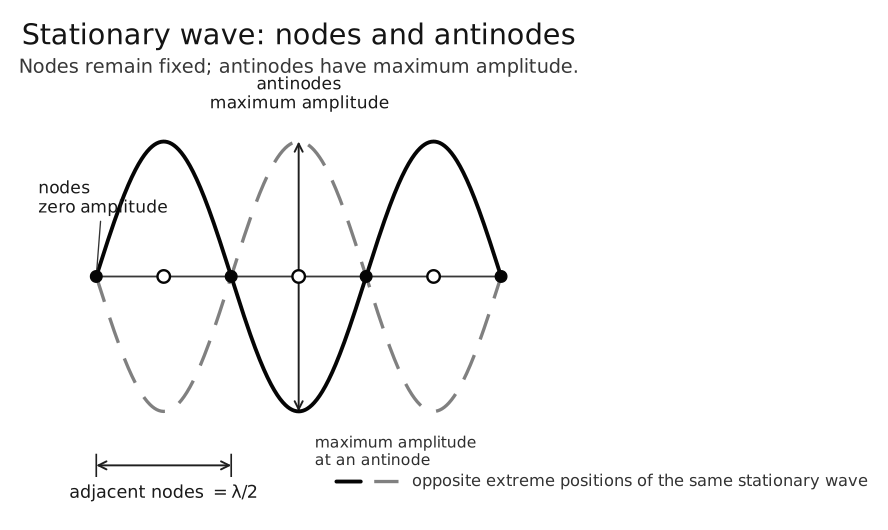
Figure: The two extreme positions show fixed nodes and antinodes. The amplitude at an antinode is measured from equilibrium to one extreme, not from one extreme to the other.
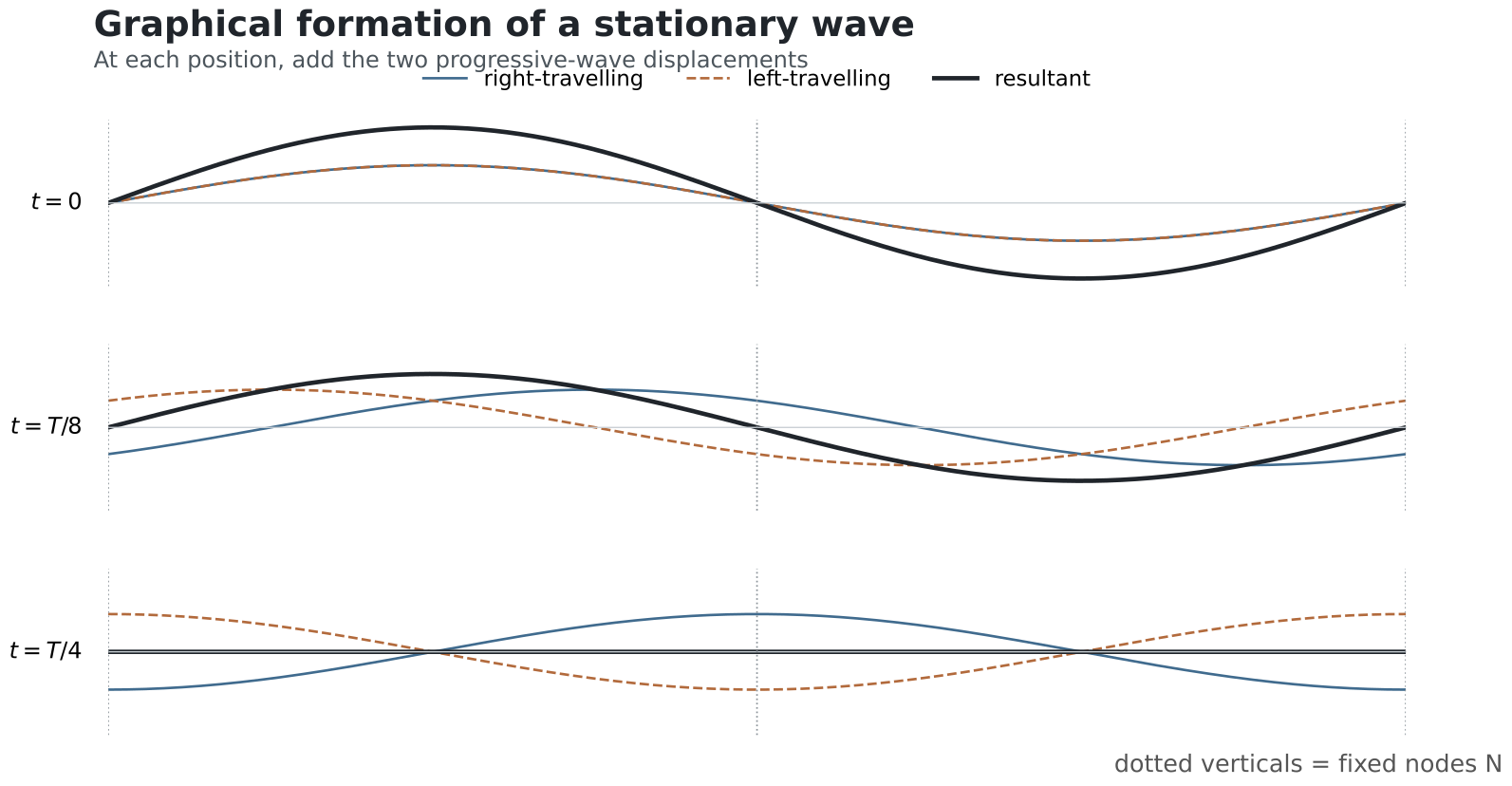
Figure: At each selected instant, add the displacement of the right-travelling wave to that of the left-travelling wave point by point. Repeating this at different times reveals fixed nodes and alternating extreme shapes.
Nodes and Antinodes
Nodes
A node is a point of zero amplitude.
At a node:
- the displacement is always zero
- the two waves always cancel
- the point does not oscillate
Do not say merely that a node is a point of zero displacement at one instant. Many points can have zero displacement at one instant. A node has zero displacement at all times.
Antinodes
An antinode is a point of maximum amplitude.
At an antinode:
- the oscillation amplitude is maximum
- the two waves reinforce most strongly
- displacement varies between the two extreme positions
Spacing Rules
For a stationary wave:
These spacing rules are often the fastest way to find from a stationary-wave diagram or experiment.
Phase Relationships
All non-node particles between two adjacent nodes oscillate in phase.
Particles in neighbouring loops oscillate in antiphase.
So the phase difference between adjacent loops is:
This is different from a progressive wave, where phase changes continuously along the wave.
Phase is undefined at a node because its amplitude is zero; a point that never oscillates has no oscillation phase to compare.
Energy Transfer
A progressive wave transfers energy along the direction of travel.
A stationary wave has no net average energy transfer from one end of the pattern to the other.
Energy remains stored in the local vibration of the pattern, being exchanged between kinetic and potential forms. This is why stationary waves are associated with resonance and stable modes.
Mathematical Form
One possible expression for a stationary wave is:
This is useful because it separates two ideas:
- controls how amplitude depends on position
- controls the oscillation in time
Where , the amplitude is zero and a node occurs.
Where , the amplitude is maximum and an antinode occurs.
The formula is useful supporting mathematics rather than an expression to memorise. It explains why different positions have different amplitudes.
Stationary Waves on a Stretched String
For a string held at fixed boundaries, each fixed end is a displacement node because that point cannot move. At resonance, an integer number of loops fits into the vibrating length, and each loop has length . This is enough to obtain from the observed pattern before using .
The full catalogue of ideal string and pipe harmonics is useful supporting material but is not an explicit 2026 syllabus outcome. It is kept separately in Stationary-Wave Modes and End Correction — Enrichment.
Demonstrating stationary waves on a string
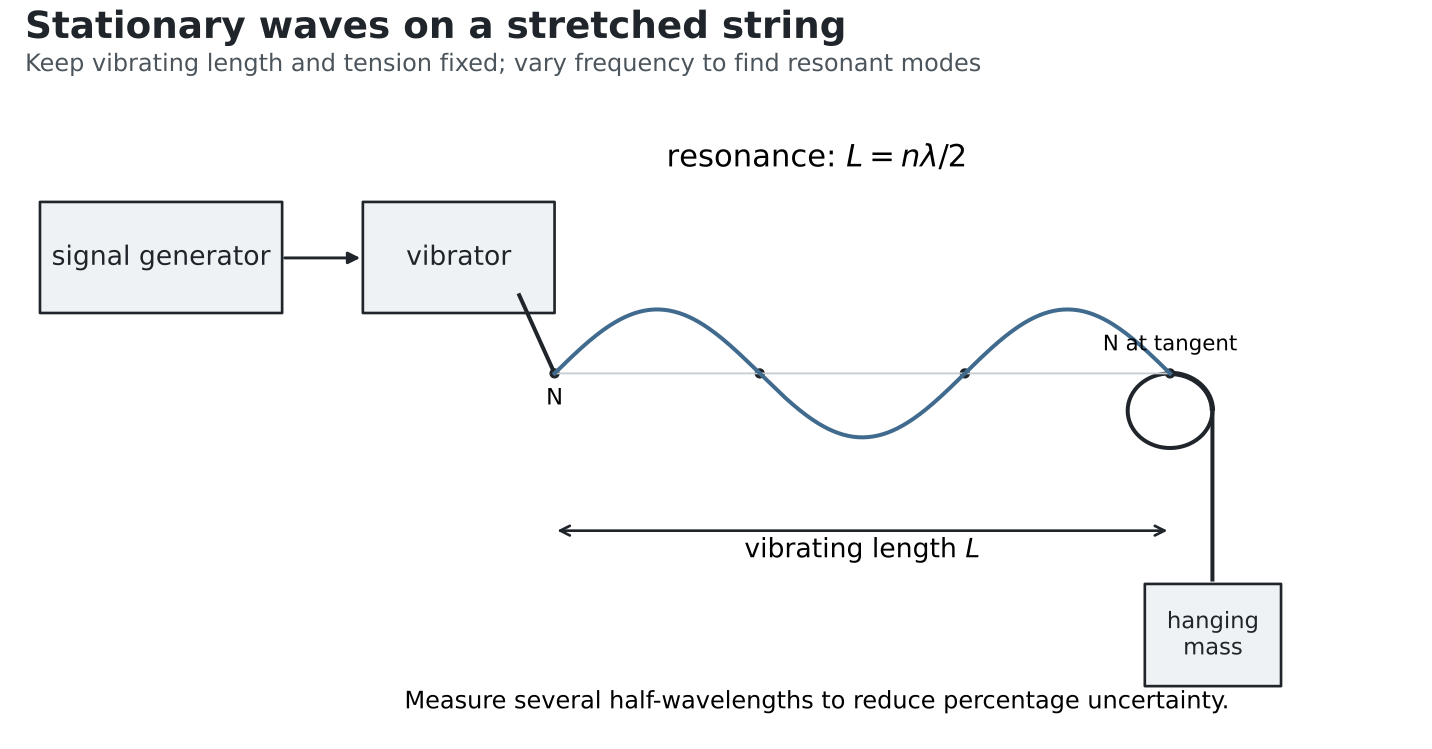
Figure: A vibrator drives a taut string while a pulley and hanging mass keep the tension approximately constant. At resonant frequencies, clear loops with fixed nodes form; changing frequency changes the number of loops.
- Pass a light string from a vibrator over a smooth pulley to a hanging mass.
- Keep the vibrating length and tension fixed.
- Vary the signal-generator frequency slowly.
- Identify resonance when a large, steady pattern with fixed nodes appears.
- Measure the vibrating length across several half-wavelengths, calculate , then use .
Measuring several loops reduces percentage uncertainty compared with measuring one node spacing.
Stationary Waves in Air Columns
Sound waves in air columns are longitudinal waves, but diagrams often show displacement sideways for convenience. This sideways drawing is only a representation; the actual air-particle displacement is along the pipe.
Boundary Conditions
Closed end:
- air cannot move through the wall
- air-particle displacement is zero
- displacement node
Open end:
- air can move freely in and out of the opening
- air-particle displacement is maximum
- displacement antinode
At a closed end, the wall prevents longitudinal motion of the air particles, so the displacement must be zero. This gives a displacement node.
At an open end, the air is not trapped by a wall and can move more freely. The pressure there stays close to atmospheric pressure, while the displacement of air particles is large. This gives a displacement antinode. In real pipes, the antinode is slightly outside the pipe, which is why an end correction may be needed.
Demonstrating resonance in an air column
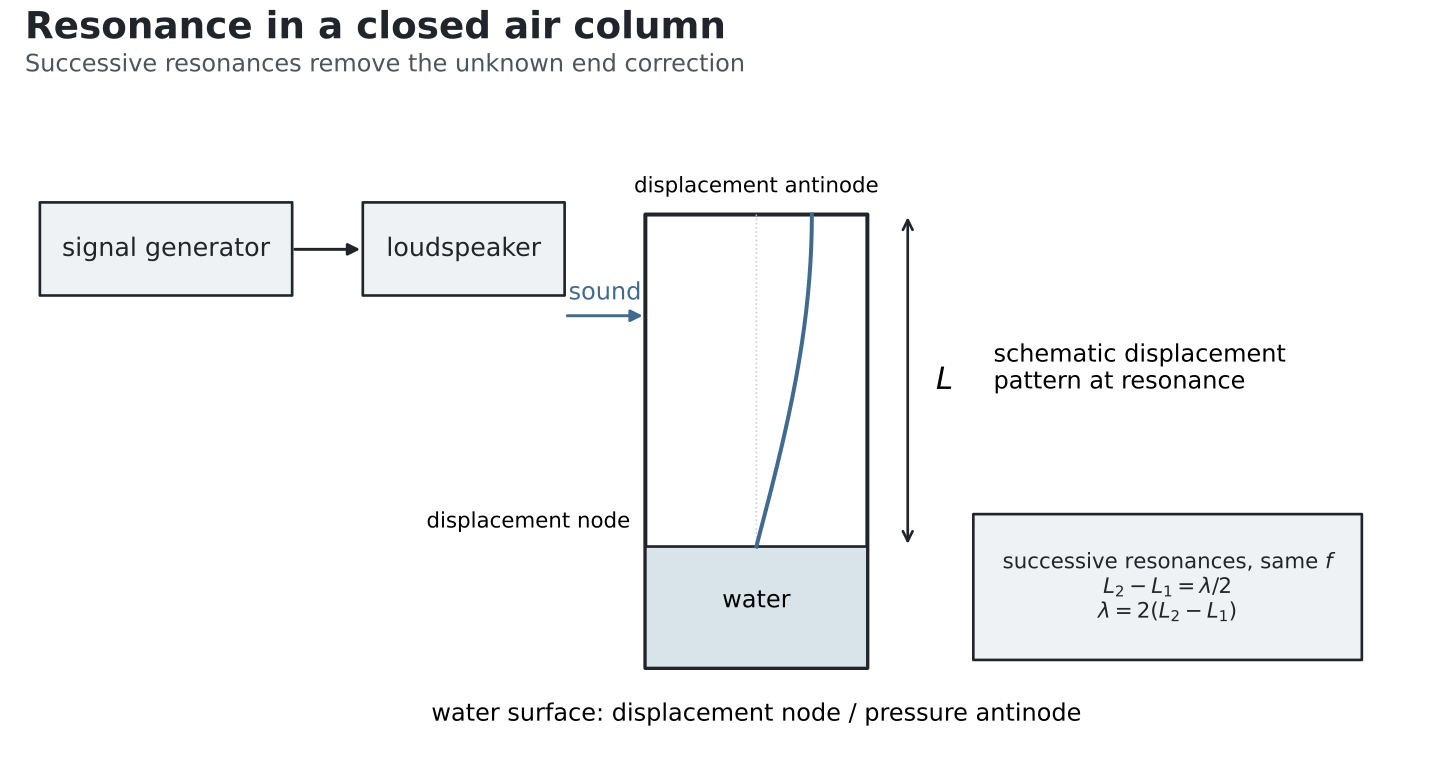
Figure: A loudspeaker drives an adjustable air column. Resonance is detected by a large sound amplitude. Successive resonant lengths differ by , so their difference gives the wavelength without needing the end correction.
In a closed-column experiment, vary the air-column length while keeping the driving frequency fixed. Record successive lengths and at which the sound is loudest. Then
because the same end correction is present at both resonances. Hence and .
The usual pipe curves represent air-particle displacement. At a closed end there is a displacement node and pressure antinode; at an open end there is a displacement antinode and pressure node.
The detailed end-correction model is retained in the enrichment branch linked above. For the core experiment, the important point is that subtracting successive resonant lengths cancels the same end correction.
Microwave Stationary-Wave Experiment
Stationary waves can also be demonstrated using microwaves.
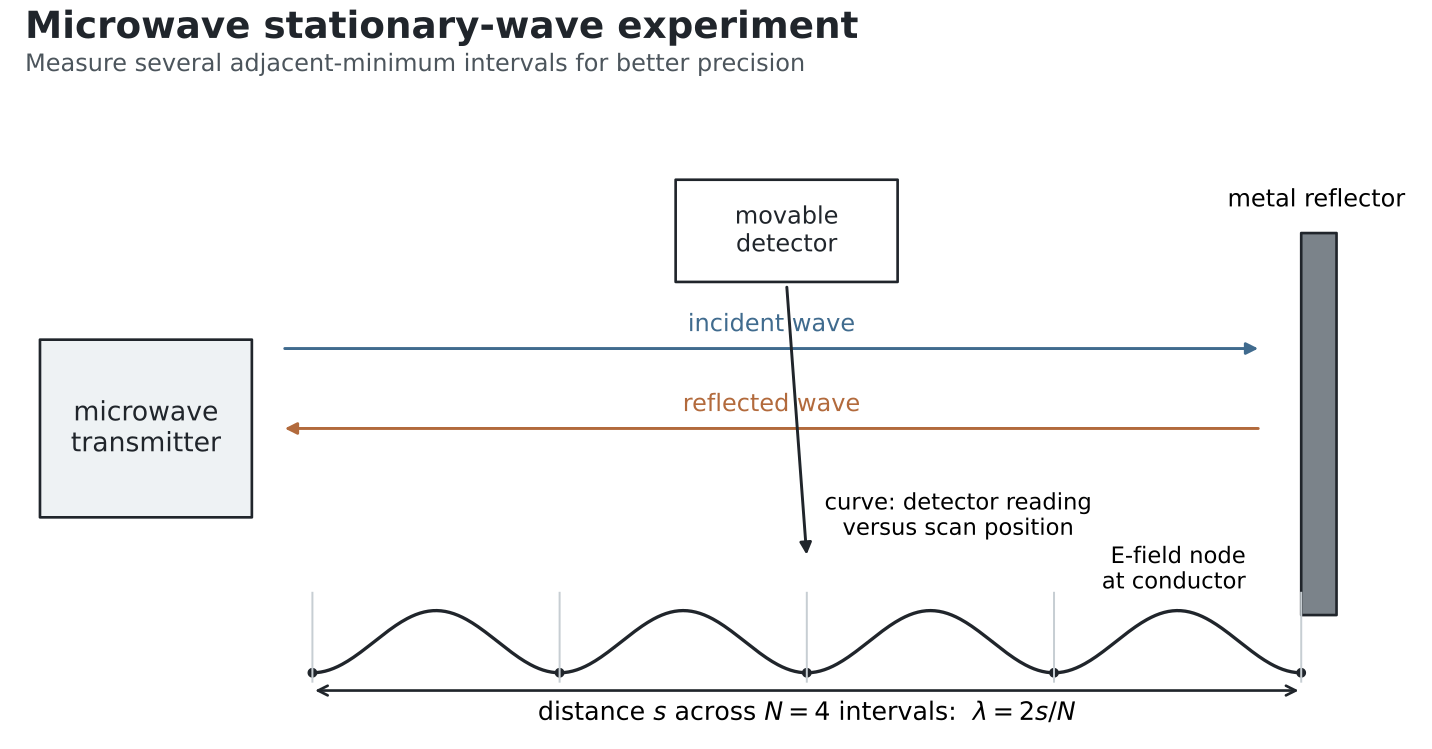
Figure: A metal reflector returns the microwave so that incident and reflected electric fields overlap. A movable detector records alternating minima and maxima in the scan region. The reflector fixes an electric-field node; the transmitter is not itself a required node.
A microwave transmitter sends waves toward a metal reflector. The reflector produces a reflected wave of the same frequency, wavelength, and speed travelling in the opposite direction. The incident and reflected waves overlap and superpose to form a stationary wave.
The condition for a clear pattern is the same as before: the opposite-travelling waves must be coherent and must overlap with comparable amplitudes. The metal reflector supplies the reflected wave, while the line between the transmitter and reflector is the region where the two waves superpose.
A detector moved along the line between transmitter and reflector finds alternating maxima and minima.
- maximum detector readings correspond approximately to electric-field antinodes
- minimum detector readings correspond approximately to electric-field nodes
- distance between adjacent nodes or adjacent antinodes is
For better precision, measure the distance across adjacent-minimum intervals rather than just one. Since each interval is ,
Worked Example 1: String Fundamental
A string of length supports waves of speed .
For the fundamental mode:
so:
Then:
Worked Example 2: Node Spacing
Adjacent nodes are separated by .
Since adjacent node spacing is:
then:
Worked Example 3: Closed Pipe Resonances
A closed pipe gives successive resonance lengths of and for a sound frequency of .
For a closed pipe, successive resonances differ by:
Thus:
So:
The speed of sound is:
If end correction is needed:
Progressive vs Stationary Waves
| Feature | Progressive wave | Stationary wave |
|---|---|---|
| Pattern | travels through space | fixed in space |
| Energy transfer | transfers energy along the wave | no net average energy transfer along pattern |
| Amplitude | same for all points in ideal wave | depends on position |
| Nodes | not fixed permanent nodes | fixed nodes present |
| Phase | changes continuously with position | same phase within a loop; adjacent loops antiphase |
| Wavelength meaning | distance between adjacent in-phase points | twice the node-node spacing |
Exam Strategy
When solving stationary-wave questions:
- Identify the system: string, open pipe, closed pipe, or microwave setup.
- Mark the boundary conditions: node or antinode.
- Count loops or node spacings.
- Convert the diagram into a wavelength relation.
- Use only after identifying correctly.
Common Exam Pitfalls
- Calling any zero-displacement point a node, instead of a point that is always zero.
- Forgetting that adjacent nodes are separated by .
- Forgetting that node-to-antinode spacing is .
- Treating a stationary wave as if the whole pattern travels along the medium.
- Using open-pipe harmonics for a closed pipe.
- Forgetting that a closed pipe supports only odd harmonics.
- Drawing only one extreme position of a stationary wave, making it look like a progressive wave.
- Saying any reflected wave automatically gives a clear stationary wave, without checking the opposite-travelling wave condition and allowed boundary modes.
Quick Revision Checklist
You should be able to answer:
- What two waves form a stationary wave?
- What conditions must be satisfied for a clear stationary wave to appear?
- Where are the nodes and antinodes?
- Are adjacent loops in phase or antiphase?
- What boundary condition applies at each end?
- Is the spacing or ?
- Does the stationary wave transfer energy along the medium?
Links
- Main hub: Superposition of Waves
- Related branch: Diffraction and Gratings
- Common traps: Superposition Common Exam Traps
- Prerequisite topic: Waves
Summary
A stationary wave is formed by superposition of two identical progressive waves travelling in opposite directions. It has fixed nodes and antinodes, no net average energy transfer along the pattern, and allowed modes set by boundary conditions.