Two-Source Interference
Branch note: This page deepens one part of Superposition of Waves.
Overview
Two-source interference occurs when waves from two coherent sources overlap and superpose.
At some points, the waves reinforce each other and produce large resultant amplitude. At other points, the waves cancel partially or completely and produce small or zero resultant amplitude.
The resulting pattern of maxima and minima is called a two-source interference pattern.
In H2 physics, the most important visual example is the ripple-tank experiment with two coherent water-wave sources. The same ideas also apply to sound, microwaves, and light.
Core Ideas
- Interference is caused by superposition of overlapping waves.
- Stable interference patterns require coherent sources.
- Coherent sources have the same frequency and a constant phase difference.
- For two in-phase sources, constructive interference occurs when the path difference is .
- For two in-phase sources, destructive interference occurs when the path difference is .
- In water-wave diagrams, antinodal lines are lines of large disturbance.
- Nodal lines are lines of zero or minimum disturbance.
- If the two sources start in antiphase, the constructive and destructive path-difference conditions are swapped.
Exam Relevance
Two-source interference is often tested because it combines diagrams, physical explanation, and path-difference reasoning.
You should be able to:
- describe the ripple-tank experiment using two dippers
- explain why the two dippers are coherent
- identify nodal and antinodal lines
- use path difference to decide whether a point has constructive or destructive interference
- state the conditions needed for a stable interference pattern
- avoid saying that constructive interference only means “crest meets crest”
Definition
Two-source interference is the pattern of reinforcement and cancellation produced when waves from two coherent sources overlap and superpose.
For a point , the displacement is found from:
where is the displacement due to the wave from and is the displacement due to the wave from .
Why It Matters
Two-source interference is the bridge between the principle of superposition and many experimental wave patterns.
It explains:
- nodal and antinodal lines in water waves
- loud and soft regions in sound
- high and low detector readings for microwaves
- bright and dark fringes in light interference
The same path-difference logic appears later in Young double-slit interference.
Key Representations
The main representations are ripple-tank source diagrams, nodal and antinodal line patterns, and path-difference geometry.
What Is Two-Source Interference?
Suppose two wave sources and produce waves that overlap at a point .
If the waves arrive in phase, the resultant amplitude is larger.
If the waves arrive in antiphase, the waves cancel partially or completely.
The key quantity is the path difference:
The path difference contributes to the phase difference between the waves when they arrive at . The standard magnitude conditions below assume that the sources start in phase. If the sources start with a different phase relation, that initial relation must also be included in the reasoning.
Conditions for Observable Interference
For a clear and stable two-source interference pattern to be observed, the waves should satisfy these conditions:
- the waves must overlap
- the sources must be coherent
- the sources must have the same frequency
- the phase difference between the sources must be constant
- the waves should have equal or approximately equal amplitudes
- for transverse waves, the interfering field components must not be mutually perpendicular; maximum visibility occurs when their polarisation directions are the same
- the source separation should be suitable compared with the wavelength, so that the maxima and minima are observable
Coherence is the most important condition.
Coherent sources do not have to be exactly in phase. They only need a constant phase difference. However, many school-level examples use sources that start in phase because the path-difference conditions are then simpler.
Ripple-Tank Demonstration with Water Waves
In a ripple tank, two small ball-ended dippers are attached to the same vibrator.
The vibrator makes the two dippers oscillate with the same frequency and a fixed phase relationship. Therefore, the two dippers act as coherent sources.
Each dipper produces circular water waves. These waves spread out, overlap, and pass through one another.
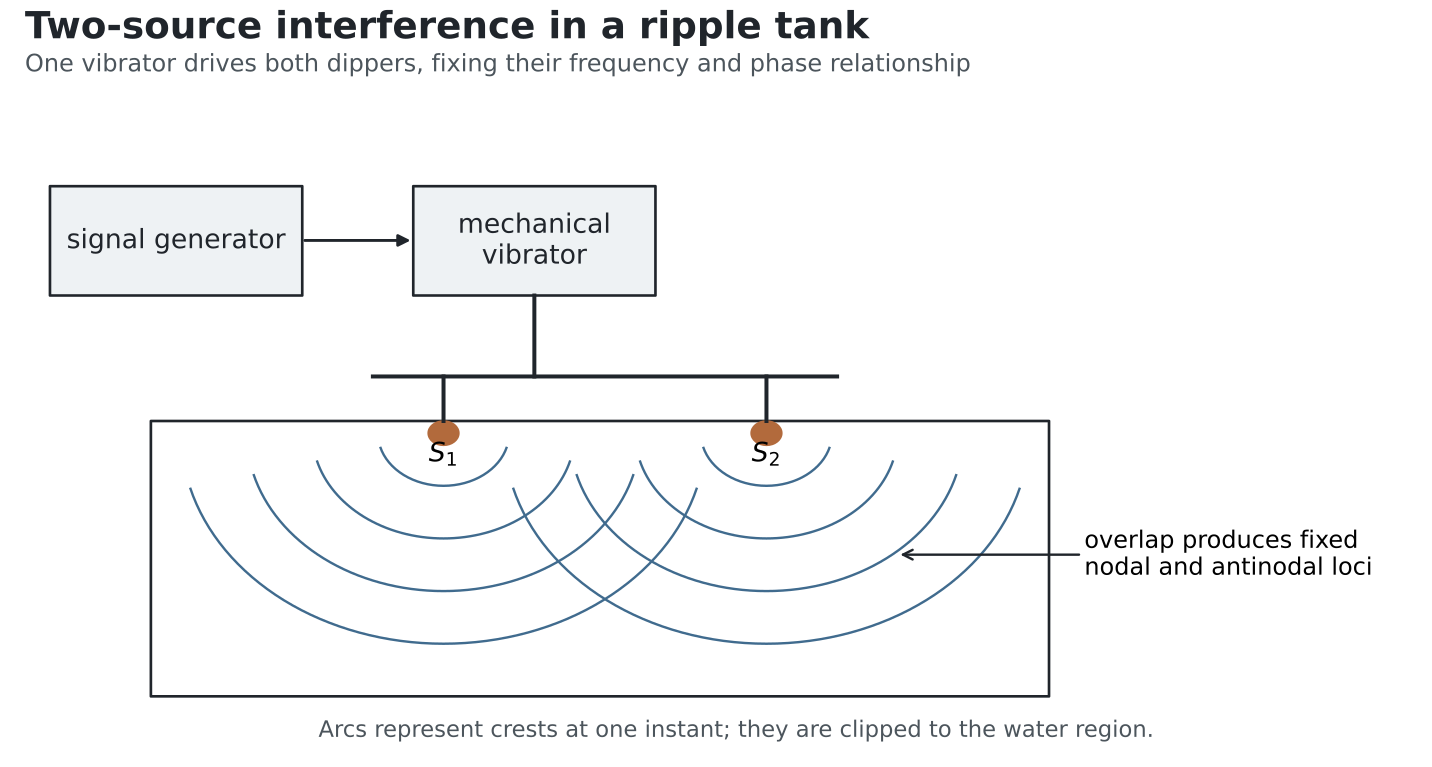
Figure: In a ripple tank, two ball-ended dippers attached to the same vibrator act as coherent sources and produce overlapping circular wavefronts.
Where the two water waves meet in phase, constructive interference occurs and the water surface has a large disturbance.
Where the two water waves meet in antiphase, destructive interference occurs and the water surface has little or no disturbance if the amplitudes are equal.
Antinodal and Nodal Lines
The interference pattern is not just isolated points. The points of constructive interference join together to form antinodal lines. The points of destructive interference join together to form nodal lines.
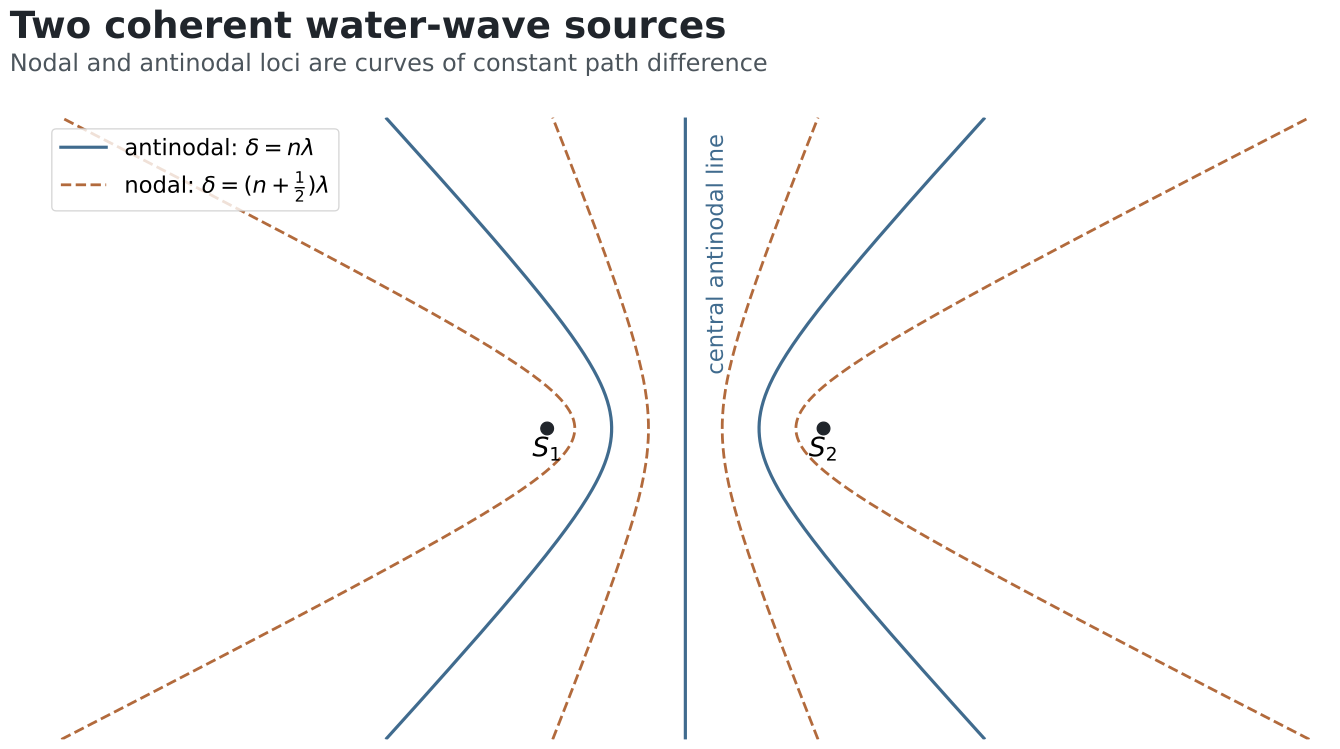
Figure: In a two-source water-wave interference pattern, antinodal lines occur where waves arrive in phase and nodal lines occur where waves arrive in antiphase.
Antinodal Lines
An antinodal line is a line of maximum disturbance.
Along an antinodal line:
- the waves arrive in phase
- constructive interference occurs
- the resultant amplitude is large
- crests may meet crests, or troughs may meet troughs
For two in-phase sources:
where:
The central antinodal line occurs where the path difference is zero:
This is because points on the perpendicular bisector of the two sources are equally far from and .
Nodal Lines
A nodal line is a line of minimum disturbance.
Along a nodal line:
- the waves arrive in antiphase
- destructive interference occurs
- the resultant amplitude is small
- if the amplitudes are equal, the resultant amplitude is zero
For two in-phase sources:
where:
Path Difference Conditions
For two coherent sources that start in phase:
| Arrival condition | Interference | Path difference | Result |
|---|---|---|---|
| in phase | constructive | maximum amplitude | |
| antiphase | destructive | minimum amplitude |
The path difference is:
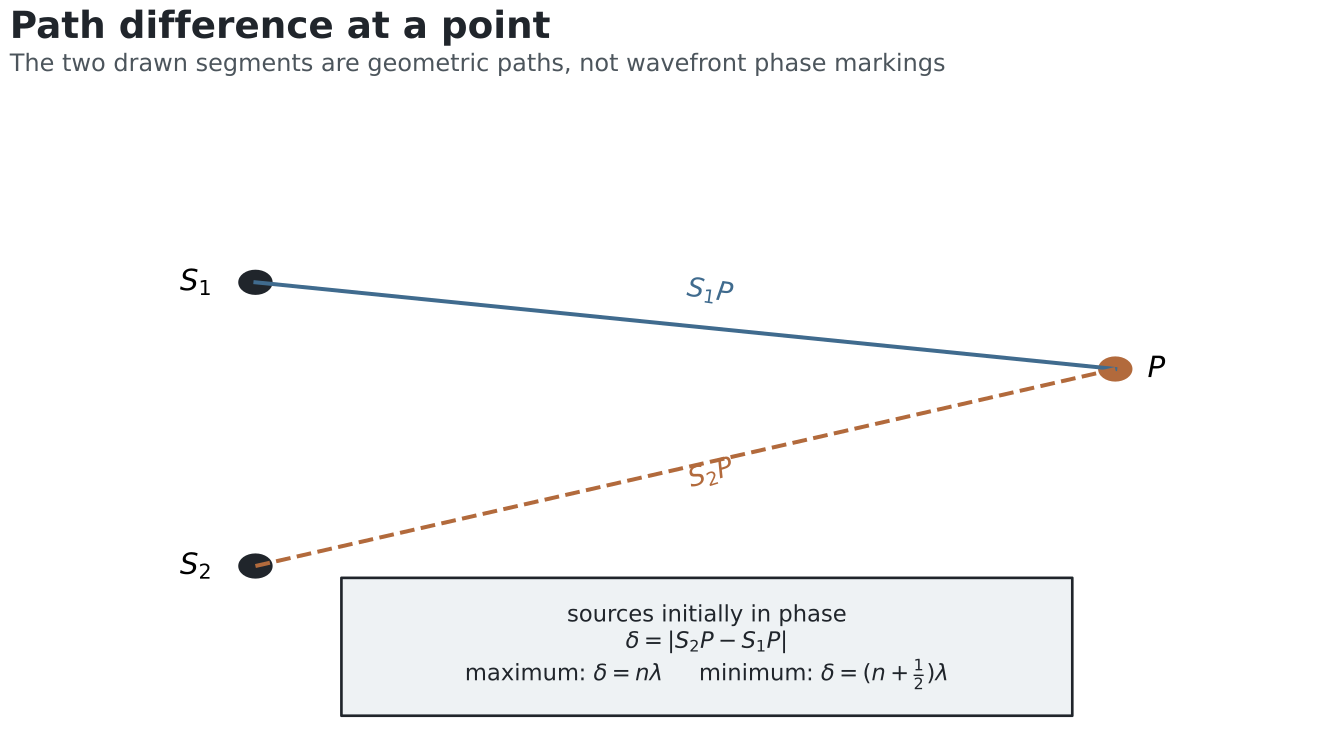
Figure: Path difference at is . For in-phase sources, integer multiples of give constructive interference, while half-integer multiples give destructive interference. The drawn segments are geometric paths, not crest or trough markers.
Crest-Trough Language
It is common to explain interference using crests and troughs:
- crest meets crest: constructive interference
- trough meets trough: constructive interference
- crest meets trough: destructive interference
This is useful, but it is not the most general wording.
The better wording is:
- constructive interference occurs when waves meet in phase
- destructive interference occurs when waves meet in antiphase
This matters because waves are continuously oscillating. A point of constructive interference does not mean that a crest is always present there. It means the two waves always arrive with the same phase relationship, so their oscillations reinforce.
Water Waves, Sound, Microwaves, and Light
The same two-source interference idea applies to different waves.
| Wave type | Coherent sources | Observable pattern |
|---|---|---|
| water waves | two dippers attached to the same vibrator | nodal and antinodal lines on water surface |
| sound waves | two loudspeakers connected to the same signal generator | alternating loud and soft regions |
| microwaves | two slits or two coherent microwave sources | alternating high and low detector readings |
| light | two slits illuminated by one source | bright and dark fringes |
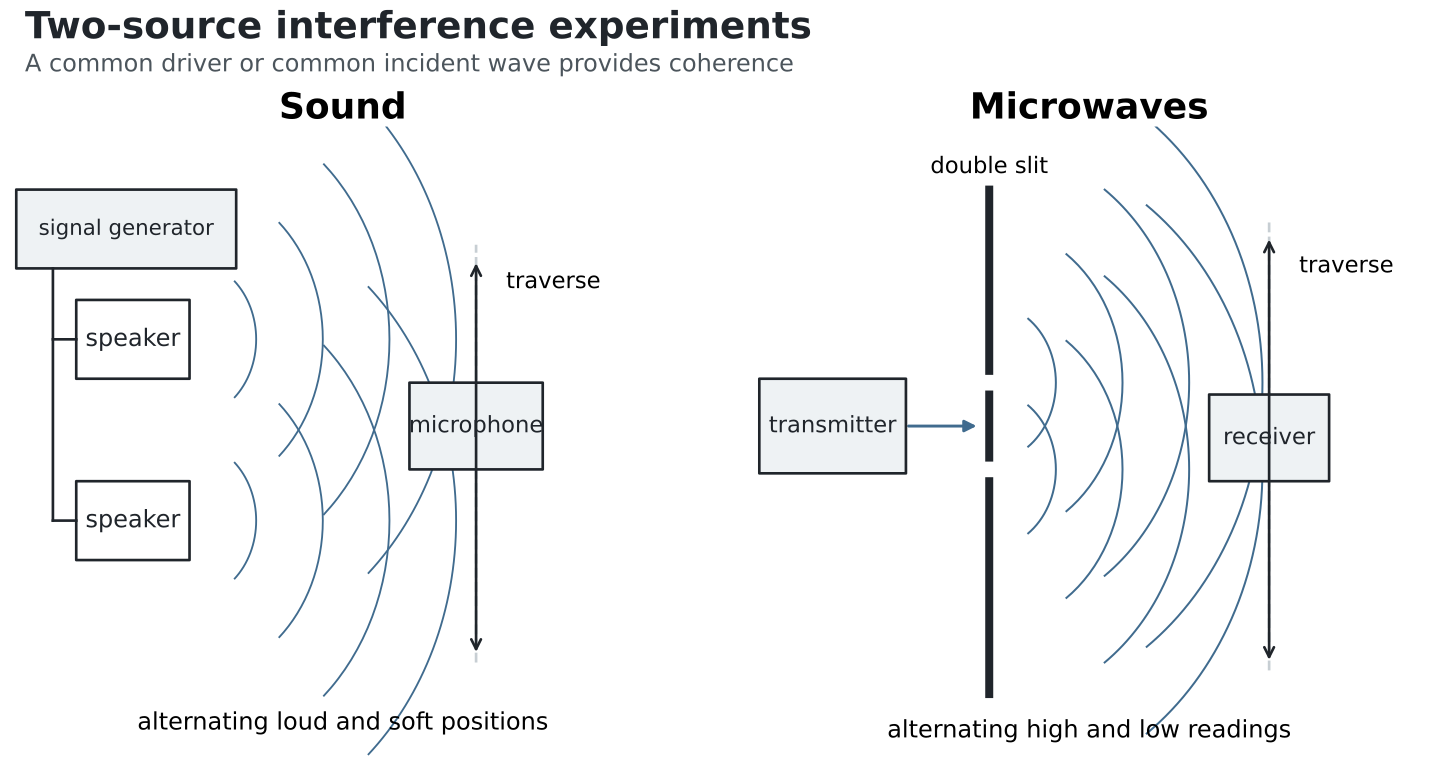
Figure: Two coherent loudspeakers connected to one signal generator produce alternating loud and soft positions as a microphone traverses the overlap region. In the microwave version, radiation diffracts through two slits and a receiver records alternating high and low readings.
For sound, connect both loudspeakers to the same signal generator so their frequency and phase relation are fixed. Move a microphone along a line crossing the overlap region and record alternating maxima and minima. The measured quantity is sound intensity or microphone signal, not air-particle displacement directly.
For microwaves, illuminate two narrow slits with one transmitter and move a receiver across the diffracted beams. The common transmitter supplies coherence; the detector records high and low intensity. This is a two-source interference experiment and must not be confused with the single-reflector microwave stationary-wave experiment.
For light, illuminate a single source slit with monochromatic light and use it to illuminate the two narrow slits and . Splitting one wavefront makes and coherent. A distant screen then shows bright and dark fringes.
The language should match the wave type.
For light, use bright and dark fringes.
For sound, use loud and soft regions.
For microwaves, use high intensity and low intensity, or high and low detector readings.
For water waves, use large disturbance and minimum disturbance, or antinodal and nodal lines.
Why Coherence Is Needed
If the two sources are not coherent, the phase difference between the arriving waves changes randomly.
Then the positions of constructive and destructive interference keep shifting.
As a result, no stable pattern of nodal and antinodal lines is observed.
In a ripple tank, coherence is achieved by attaching both dippers to the same vibrator. This forces the dippers to oscillate with the same frequency and a fixed phase relationship.
Equal Amplitudes and Complete Cancellation
Destructive interference does not always mean the resultant displacement is exactly zero.
If the two waves arrive in antiphase but have unequal amplitudes, they only cancel partially.
Complete cancellation requires:
- antiphase arrival
- equal amplitudes
For water waves, the amplitude from each source may become smaller as the waves spread out. Therefore, nodal lines are often described as lines of minimum disturbance rather than perfect zero disturbance.
If the Sources Start in Antiphase
The standard conditions above assume that the two sources start in phase.
If the two coherent sources start in antiphase, the conditions are swapped.
For antiphase sources:
gives destructive interference.
gives constructive interference.
Always check whether the question says the sources are in phase or antiphase.
Worked Example 1: Identifying a Maximum
Two coherent water-wave sources start in phase. At point :
The wavelength is:
The path difference is:
Since:
the waves arrive in phase.
Therefore, constructive interference occurs at and the disturbance is maximum.
Worked Example 2: Identifying a Nodal Line
Two coherent water-wave sources start in phase. At point :
The wavelength is:
The path difference is:
So:
This is a half-integer multiple of the wavelength.
Therefore, destructive interference occurs at , so lies on a nodal line.
Common Exam Phrases
Useful answer phrases:
- “The two sources are coherent because they are driven by the same vibrator.”
- “The waves overlap and superpose.”
- “At points where the waves arrive in phase, constructive interference occurs.”
- “At points where the waves arrive in antiphase, destructive interference occurs.”
- “Antinodal lines are lines of maximum disturbance.”
- “Nodal lines are lines of minimum or zero disturbance.”
- “For in-phase sources, maxima occur when the path difference is .”
- “For in-phase sources, minima occur when the path difference is .”
Common Pitfalls
- Saying coherent means “in phase”. Coherent means same frequency with constant phase difference.
- Forgetting that the standard path-difference conditions assume sources start in phase.
- Saying destructive interference always gives zero amplitude. It gives zero only for equal amplitudes.
- Confusing nodal lines in two-source interference with nodes in stationary waves.
- Saying constructive interference only occurs when crests meet crests. It occurs whenever the waves meet in phase.
- Forgetting to use the absolute value of path difference.
- Using “bright” and “dark” for water waves or microwaves. Use wave-appropriate language.
Quick Revision Checklist
You should be able to answer:
- Why are two ripple-tank dippers attached to the same vibrator coherent?
- What is the difference between an antinodal line and a nodal line?
- What path-difference condition gives constructive interference for in-phase sources?
- What path-difference condition gives destructive interference for in-phase sources?
- What changes if the two sources start in antiphase?
- Why is equal amplitude needed for complete cancellation?
- How is two-source water-wave interference related to sound, microwaves, and light?
Links
- Main hub: Superposition of Waves
- Related branch: Stationary Waves
- Related branch: Diffraction and Gratings
- Related concept: Interference
- Related concept: Interference and Diffraction
- Common traps: Superposition Common Exam Traps
Summary
Two-source interference occurs when waves from two coherent sources overlap and superpose. In a ripple tank, two dippers attached to the same vibrator act as coherent water-wave sources. Lines of constructive interference form antinodal lines, while lines of destructive interference form nodal lines; except for the central line, these constant-path-difference loci are generally hyperbolae. For in-phase sources, the conditions are for maxima and for minima.