Resistivity and Materials
Branch note: This page deepens one part of Current Electricity Fundamentals.
Overview
This note explains why conductors made from different materials or with different dimensions can have different resistance.
The core idea is that resistance belongs to a specific object, while resistivity belongs to the material.
Related topics:
Core Ideas
- Resistance belongs to a specific object; resistivity belongs to the material.
- For a uniform conductor, .
- Longer conductors have larger resistance, while conductors with larger cross-sectional area have smaller resistance.
- Resistivity depends on material and temperature.
Exam Relevance
Resistivity questions often combine measurements of length, diameter, voltage, and current. The common risk is forgetting that cross-sectional area depends on diameter squared.
Definition
Resistance
Resistance is the opposition a specific object offers to current flow.
It depends on:
- material
- length
- cross-sectional area
- temperature
Unit:
Resistivity
Resistivity is a material property at a given temperature.
It allows fair comparison between materials independent of size and shape.
Unit:
Why It Matters
Resistivity links microscopic material structure to macroscopic circuit resistance.
It explains why different materials are used for:
- wires
- resistors
- heating elements
- sensors
Key Representations
For a uniform conductor made of one material, with uniform cross-section and fixed temperature,
Where:
- = resistance
- = resistivity
- = length
- = cross-sectional area
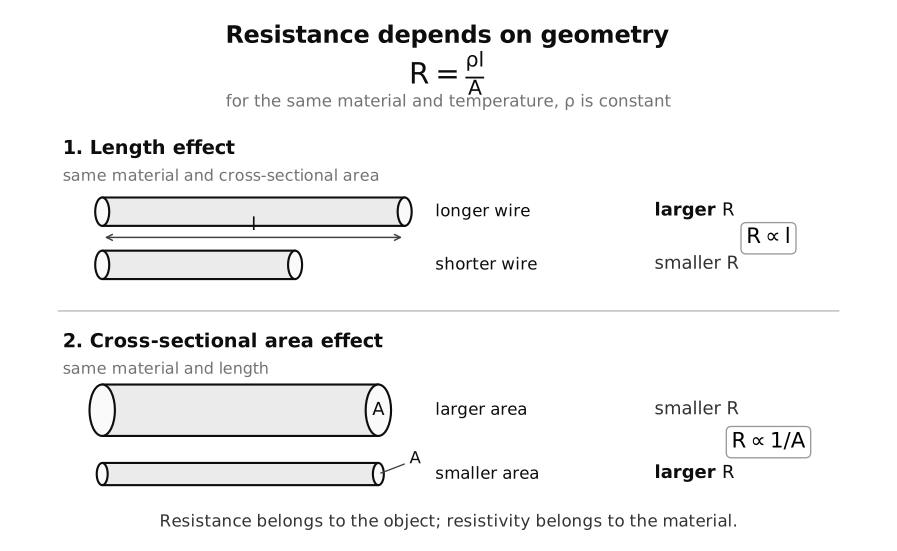
Figure: For the same material and temperature, compare length while holding constant, and compare area while holding constant. A longer uniform conductor has greater resistance; a larger cross-sectional area provides more parallel conducting paths and gives smaller resistance.
Geometry Effects
If the conductor is longer,
because adding length adds more scattering region in series, so a larger p.d. is required to maintain the same current.
If the conductor is thicker,
because there are more parallel paths for current flow.
For a circular wire,
The square matters: doubling diameter makes four times larger and, with and unchanged, makes four times smaller.
If a wire is stretched without changing its volume, is constant. Hence and, if remains unchanged,
Quick Comparison
| Wire type | Resistance |
|---|---|
| Long thin wire | High |
| Short thick wire | Low |
| Same size, higher- material | Higher |
Material Dependence
Different materials have different resistivities because of their atomic structure and available charge carriers.
Low Resistivity Materials
Good conductors:
- copper
- silver
- aluminium
These are used for wiring.
Moderate Resistivity Materials
Useful for resistors and heating elements:
- nichrome
- manganin
High Resistivity Materials
Insulators:
- rubber
- glass
- plastic
Temperature Effects
Metals
For metallic conductors,
The lattice vibrations become stronger, so electrons experience more collisions.
Semiconductors
For semiconductors,
More charge carriers become available as temperature rises.
This is the material link behind thermistors in I-V Characteristics.
Measuring Resistivity
Practical enrichment
The measurement method below supports practical reasoning but goes beyond the minimum conceptual statement of .
To measure a wire’s resistivity:
- measure length
- measure diameter and calculate cross-sectional area
- measure voltage and current
- calculate resistance using
- then use to find
Good Practice
- take diameter measurements carefully; the area depends on the square of the diameter
- use a short current pulse if heating would noticeably change the resistance
- keep the wire temperature as steady as possible
A useful graph method is to measure for several lengths at constant temperature. A graph of against has gradient , so .
Worked Example
A wire has length , diameter , and resistance .
Quick Checks
- Resistance is for the object.
- Resistivity is for the material.
- Longer wire means larger resistance.
- Thicker wire means smaller resistance.
- Hot metal usually has larger resistance; hot semiconductor usually has smaller resistance.