Transformer Losses and Efficiency — Enrichment
Enrichment — beyond the explicitly named H2 Physics 9749 transformer outcome. The syllabus requires the simple iron-core principle and ideal ratio. This branch preserves useful practical-transformer material from the teacher anchor; treat it as extension unless your teacher specifies otherwise.
Main topic: Transformers
Overview
Real transformers depart from the ideal model because their windings and cores dissipate energy and their magnetic coupling is imperfect. Efficiency compares useful real output power with real input power.
Core Ideas
- Winding resistance, eddy currents and hysteresis dissipate real power as heat.
- Flux leakage is an imperfect-coupling and voltage-regulation effect, not a direct heat-loss term.
- Each non-ideal effect has a distinct physical cause and reduction method.
- Efficiency is a power ratio, not a voltage ratio.
1. Why a real transformer is not ideal
An ideal transformer transfers all input power to the secondary:
A real transformer has
because some input energy becomes thermal energy in the windings or core. A real transformer also has imperfect magnetic coupling: some primary flux does not link the secondary. Flux leakage affects the secondary voltage and voltage regulation, but it is not by itself a direct thermal-energy dissipation mechanism.
2. Four main departures from the ideal model
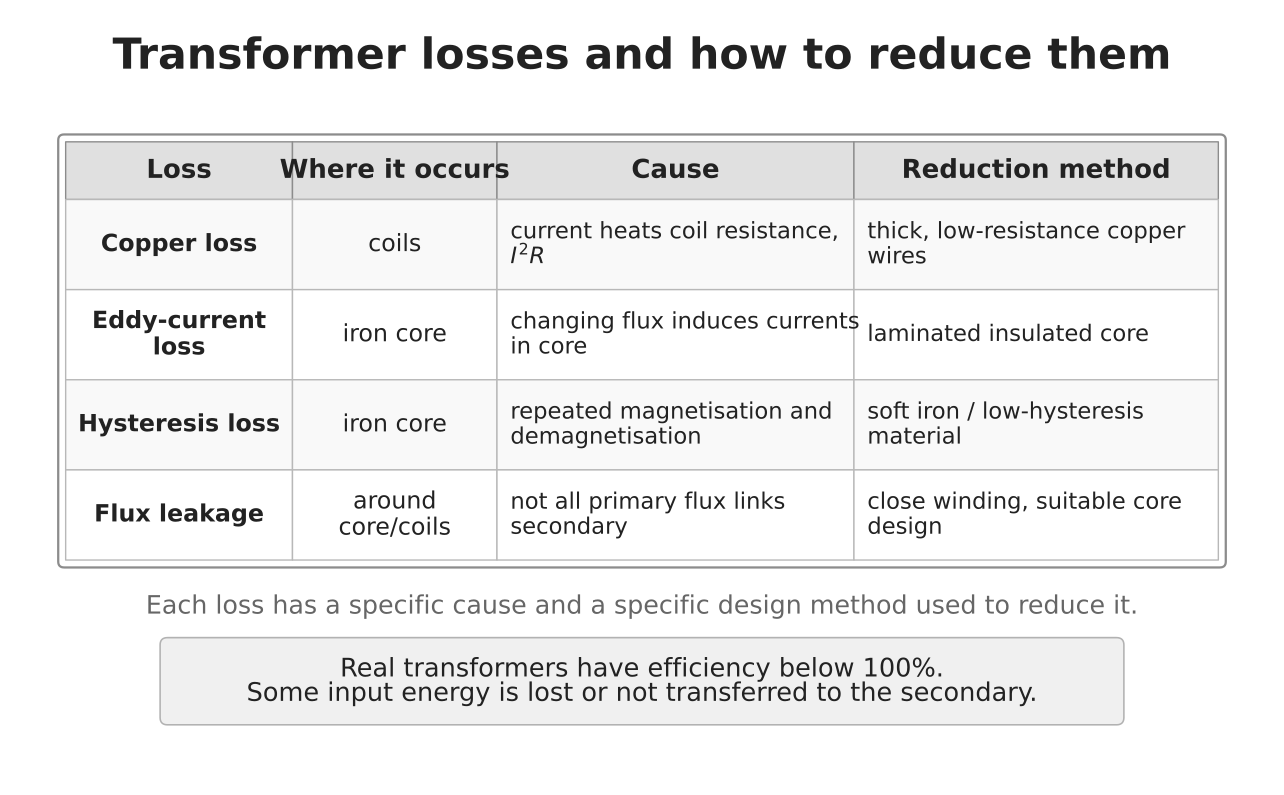
Figure: Read each card as a causal chain. Copper, eddy-current and hysteresis effects dissipate real power as heat. Flux leakage is shown separately as imperfect coupling, not as a fourth heat-loss mechanism. Lamination primarily addresses eddy currents; it is not a general cure for every non-ideal effect.
Copper loss in the windings
Real wire has resistance. The rms winding current produces heating at a rate
Thicker, low-resistivity copper wire reduces and therefore reduces this heating for a given current.
Eddy-current loss in the core
The changing core flux induces currents within the conducting core itself. These eddy currents dissipate energy as heat.
Thin laminations are electrically insulated from one another. They interrupt large circulating current paths, increasing their resistance and reducing eddy-current heating.
Hysteresis loss in the core
The core is magnetised first in one direction and then the other during each AC cycle. Some energy supplied during magnetisation is not recovered during demagnetisation and becomes thermal energy.
A soft magnetic material with a narrow hysteresis loop reduces the energy lost per cycle.
Flux leakage: imperfect coupling
In a real transformer, not all flux produced by the primary links every secondary turn. Leakage flux therefore does not contribute fully to the desired secondary emf. It is best treated as a coupling and voltage-regulation effect rather than as energy that is directly converted to heat.
Suitable core geometry and closely coupled windings reduce leakage.
3. Efficiency
Transformer efficiency is
As a percentage,
If both input and output are treated as unity-power-factor quantities in a simplified calculation, then
The missing power is
Efficiency below does not mean charge is lost. It means some input energy per unit time is not delivered as useful output power.
For a general AC circuit, apparent power need not equal real power; a power-factor term may be required. A wattmeter directly measures real power.
4. Worked example
A wattmeter measures the real input power of a transformer as . Its secondary supplies and to a resistive load.
Input power is the wattmeter reading:
Output power:
Efficiency:
Total power loss:
This calculation finds the total real-power loss. It does not by itself tell us how the is divided among copper, eddy-current and hysteresis heating. Flux leakage may affect the operating currents and voltage regulation, but it is not itself a direct heat term to add to this power balance.
5. Misconception checks
- “Laminating the core reduces hysteresis.” No. Lamination primarily reduces eddy currents; low-hysteresis material reduces hysteresis loss.
- “Thicker wire removes all transformer loss.” No. It reduces winding resistance but does not remove core loss or leakage.
- “Flux leakage is heating in the core.” No. It is imperfect magnetic coupling; not all primary flux links the secondary.
- “Efficiency is the voltage ratio.” No. Efficiency is an output-power to input-power ratio.
Exam Relevance
This material is enrichment under the explicit 9749 transformer wording. If it appears in a school question or supplied context, state the physical mechanism precisely, match each reduction method to the correct effect, and use real power—not apparent power without justification—in efficiency calculations.
Summary table
| Departure from ideal model | Main effect | Reduction |
|---|---|---|
| winding resistance | heating in coils | thick, low-resistance copper |
| eddy currents | heating in core | insulated laminations |
| hysteresis | heating from repeated magnetisation | low-hysteresis soft magnetic material |
| flux leakage | imperfect coupling and voltage regulation | suitable core and close winding arrangement |