RMS and AC Power
Overview
The root mean square value measures the effective heating action of a periodic current or voltage. It is needed because a symmetric alternating current has zero mean over a complete cycle, even though it heats a resistor.
This note develops the idea in the order named by root mean square: square the instantaneous values, find their mean, then take the square root.
Core Ideas
- Squaring removes the sign and matches the dependence of resistive heating.
- RMS is defined for any periodic waveform; the factor is specific to a sinusoid.
- For sinusoidal current in a pure resistor, mean power is half the maximum instantaneous power.
- Resistive AC power formulae use rms values, not a mixture of peak and rms values.
General rms definition
For a periodic current of period ,
Equivalently, is the steady direct current that produces the same mean heating power in the same resistor.
For voltage,
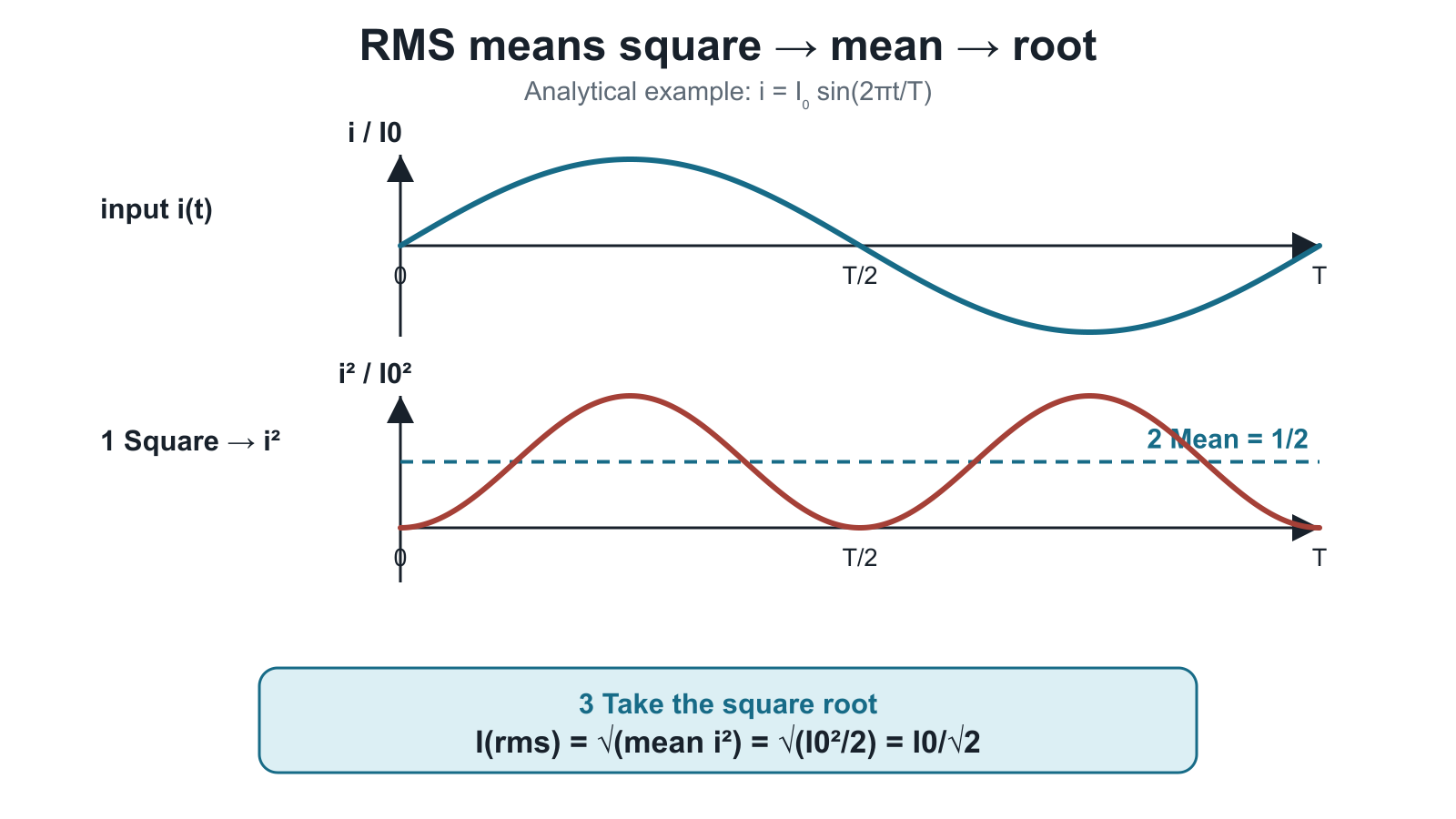
Figure: The rms operation. First square the current so both half-cycles become positive; then average over one complete period; finally take the square root. For , the mean square is , so the rms current is .
Sinusoidal rms derivation
Let
Then
Over one complete period,
Therefore,
Similarly, for sinusoidal voltage,
The peak-to-peak value is or ; it is not twice the rms value.
Mean power in a pure resistor
In a pure resistor, voltage and current are in phase. Using
the instantaneous power is
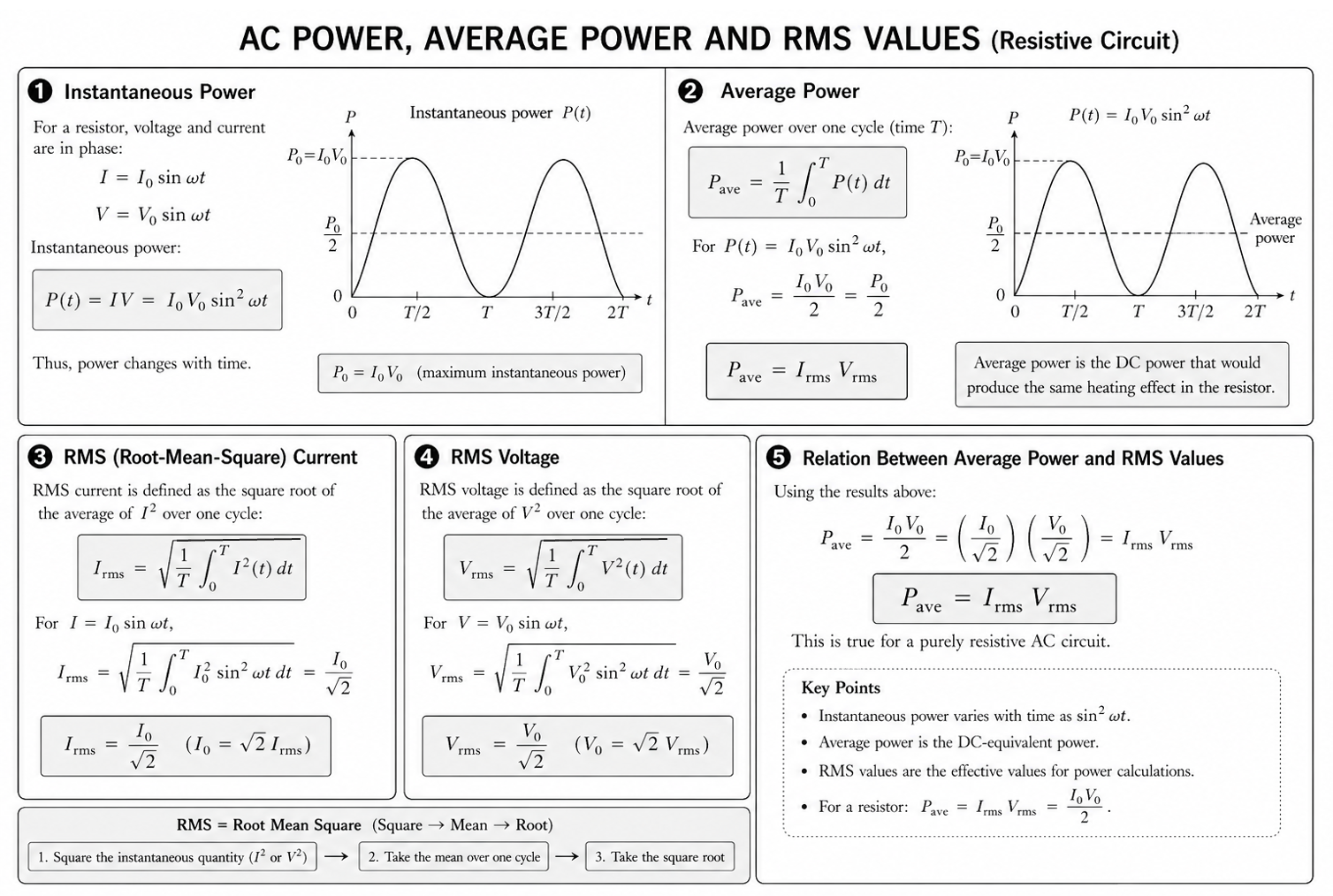
Figure: The current waveform has period , but squaring produces a non-negative power waveform of period . The dashed mean-power line is at half the maximum instantaneous power.
The maximum instantaneous power is
Since the mean of is ,
Using ,
For the same pure resistor,
The simple product is being used here for in-phase voltage and current. It is not a universal real-power formula for arbitrary AC components.
Worked Example 1: sinusoidal supply
A heater is connected to a rms supply.
No conversion by is needed because the stated voltage is already rms.
Worked Example 2: peak voltage given
A sinusoidal source with is connected across a resistor.
so
The maximum instantaneous power is , confirming .
Worked Example 3: a non-sinusoidal waveform
A current is for one quarter of every period and zero for the remaining three quarters. Its rms value is
This is not , because the waveform is not sinusoidal. More generally, for piecewise-constant intervals,
Common Mistakes
Averaging before squaring
For a symmetric sinusoid, , but . Follow the order: square, mean, root.
Applying to every waveform
The factor follows from the mean of ; use the general definition for another shape.
Writing instantaneous power as
Use for the changing instantaneous power and for its cycle mean. This prevents confusion between and .
Mixing peak and rms quantities
Do not use . Convert first or derive directly from the instantaneous functions.
Exam Relevance
Questions commonly ask you to derive , convert peak and rms values, or determine rms from a graph. State the waveform and load assumptions before selecting a formula.
Links
Summary
For any periodic current,
For a sinusoid only,
For sinusoidal current in a pure resistor,