Transformers
Overview
A transformer uses a changing magnetic flux in an iron core to transfer electrical energy between two electrically isolated windings and change an alternating voltage. The core syllabus model is ideal: voltage follows turn number and loaded current changes inversely so power is conserved.
Scope guide
The explicit H2 Physics 9749 requirement is to understand the operation of a simple iron-core transformer and use the ideal-transformer ratio
This hub teaches that assessable core first. The teacher anchor also contains useful material on real-transformer losses, efficiency and electrical transmission. Those extensions have been preserved in clearly labelled enrichment branches near the end of this page.
Core Ideas
- Primary AC produces changing magnetic flux in the iron core.
- The changing flux links the secondary and induces an emf by mutual induction.
- In an ideal transformer, .
- For an ideal loaded transformer, , so the current ratio is inverse to the voltage ratio.
- The two windings are electrically isolated; magnetic flux, not charge, links them.
1. What a transformer does
A transformer transfers electrical energy between two circuits by mutual induction. It can change an alternating voltage without requiring a direct electrical connection between the input and output coils.
- A step-up transformer produces a larger secondary voltage than primary voltage.
- A step-down transformer produces a smaller secondary voltage than primary voltage.
- An ideal transformer changes the voltage-current combination; it does not create energy or step up power.
The input winding is called the primary coil. The output winding is called the secondary coil.
2. Construction and component roles
A simple iron-core transformer contains:
- a primary coil of turns connected to an AC source;
- a secondary coil of turns connected to an output circuit or load;
- a soft iron core that provides a continuous path linking most of the changing magnetic flux through both windings.
The two coils are insulated from one another. Charge carriers do not travel from the primary wire, through the core, into the secondary wire.
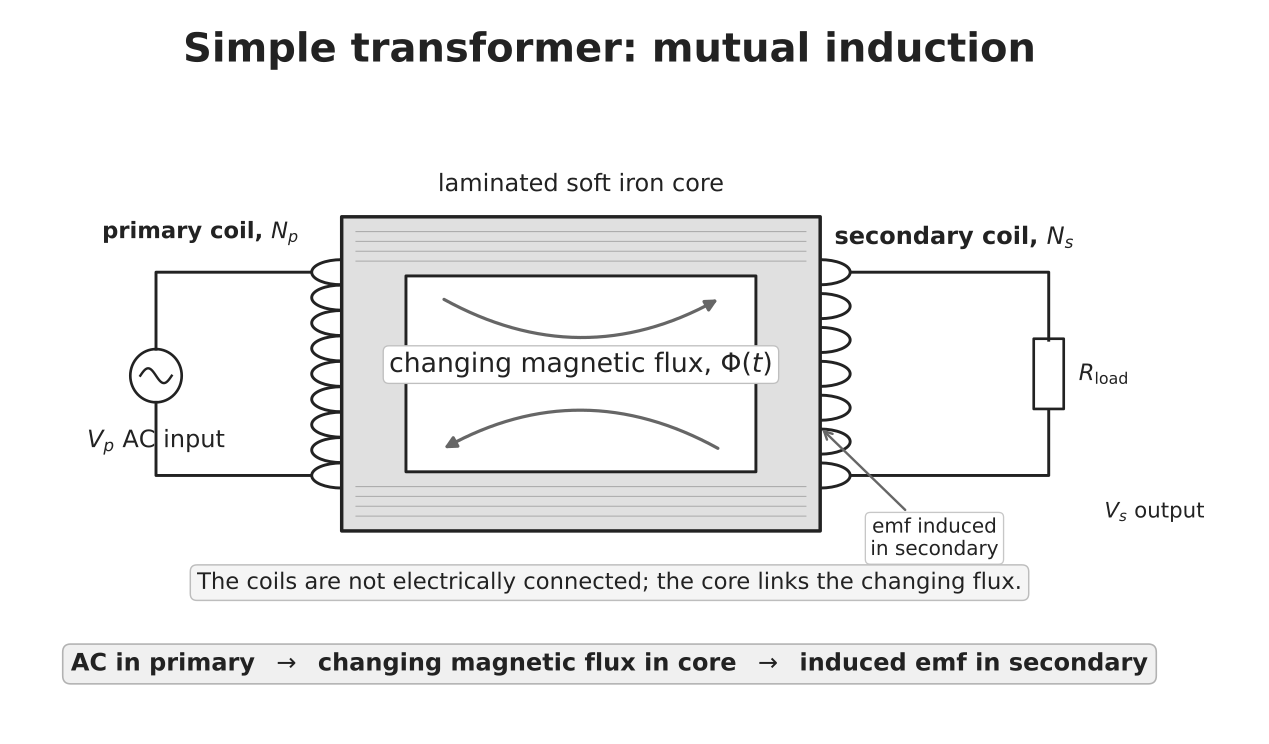
Figure: Read the diagram from left to right. The primary AC creates changing magnetic flux in the core; the same changing core flux links the electrically isolated secondary; Faraday’s law then gives a secondary emf. The core transfers the magnetic effect, not electric charge.
Why soft iron?
Soft iron magnetises and demagnetises readily. It helps guide the magnetic flux around the core so that a large fraction of the primary flux also links the secondary turns.
Why a laminated core?
Lamination reduces eddy currents in a real core. This construction detail is useful background; practical losses are developed in the enrichment branch.
3. The causal sequence: mutual induction
Do not compress transformer operation into “AC goes through the transformer”. Use the complete causal chain:
- An alternating p.d. is applied across the primary coil.
- An alternating current flows in the primary coil.
- This current produces changing magnetic flux in the iron core.
- The changing core flux links the turns of the secondary coil.
- The changing secondary flux linkage induces an emf across the secondary coil.
- If the secondary circuit is closed, this emf drives a secondary current and transfers power to the load.
This is mutual induction: a changing current in one circuit causes an induced emf in a nearby, magnetically linked circuit.
4. Why the input must change
Faraday’s law requires changing magnetic flux linkage:
| Primary supply | Core flux after transients | Secondary emf |
|---|---|---|
| AC | changes continuously | induced continuously |
| steady DC | becomes constant | zero after the switching transient |
| DC switched on or off | changes briefly | brief transient emf |
Therefore, a transformer does not provide a continuous secondary emf from steady DC.
Practical warning: connecting a transformer winding to steady DC can produce a dangerously large primary current because there is no continuous transformer action to provide the usual inductive opposition. This warning supports understanding; detailed transient and inductive-reactance analysis is beyond this topic.
5. Ideal-transformer model
The standard ratio describes an ideal transformer. The model assumes:
- no resistance in either winding;
- no energy loss in the core;
- no magnetic flux leakage, so the same flux passes through every turn of both coils;
- therefore, input power equals output power when a load is connected.
These assumptions are not claims that a real transformer is perfect. They define the simplified model used in the syllabus equation.
6. Deriving the voltage ratio
Let:
- , be the primary and secondary turn numbers;
- , be the magnitudes of the primary and secondary rms p.d.;
- be the common magnetic flux through one turn in the ideal core.
Faraday’s law gives the induced-emf magnitudes
For an ideal transformer, winding resistance is negligible, so the terminal p.d. magnitudes equal the corresponding induced-emf magnitudes. Both windings share the same . Dividing therefore gives
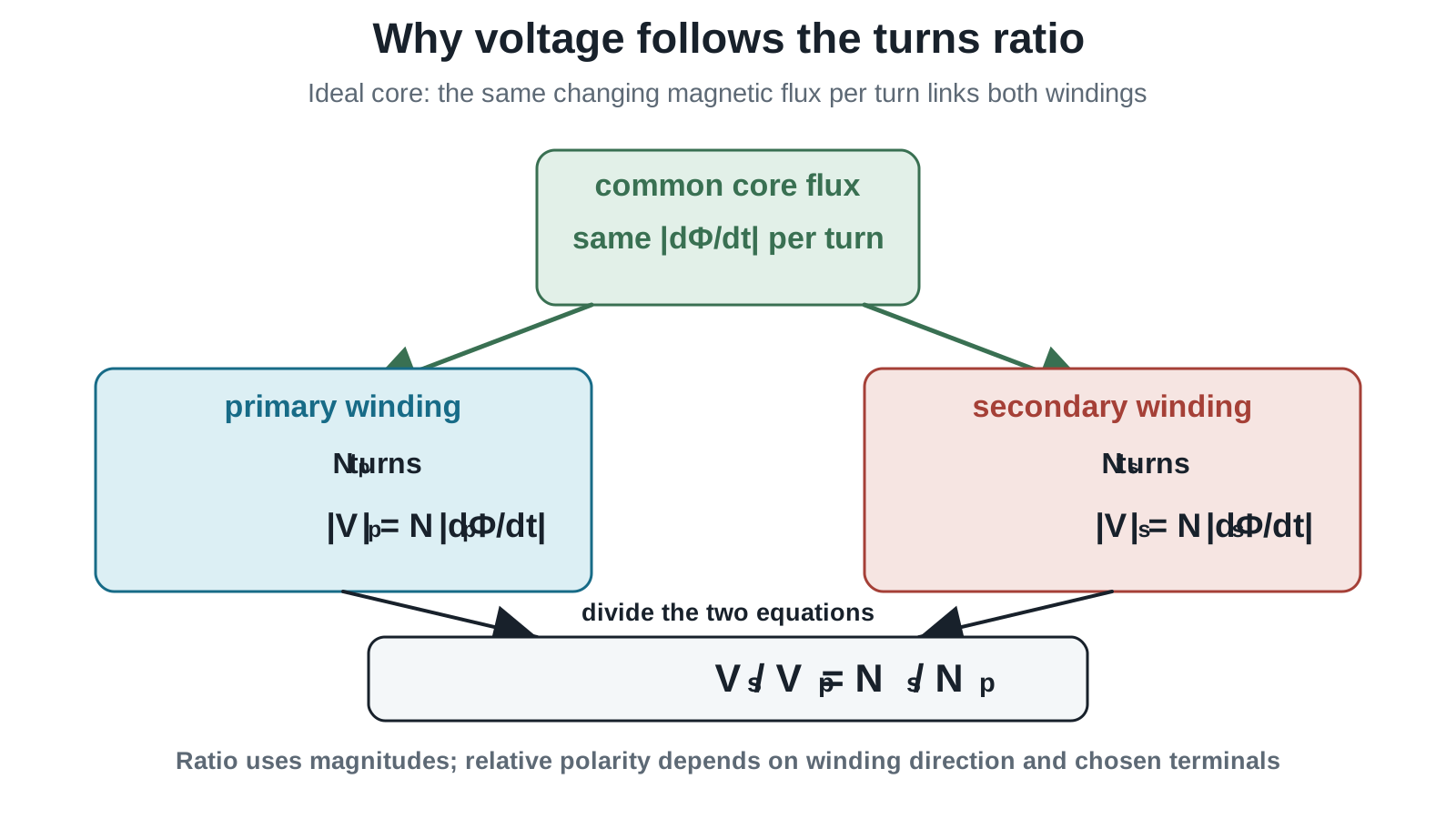
Figure: The turn ratio follows because both windings share the same changing flux per turn. More turns give a larger total flux linkage and hence a larger induced-emf magnitude. The figure uses magnitudes because relative polarity depends on which coil ends are chosen as positive.
A subtle point about phase
The statement “the secondary voltage is always out of phase with the primary voltage” is not convention-independent. Reversing either winding direction or swapping the labelled secondary terminals reverses the plotted secondary voltage. Unless terminal markings or winding sense are given, use the required magnitude ratio, not an assumed phase relation.
7. Step-up and step-down action
Step-up transformer
If
then
Step-down transformer
If
then
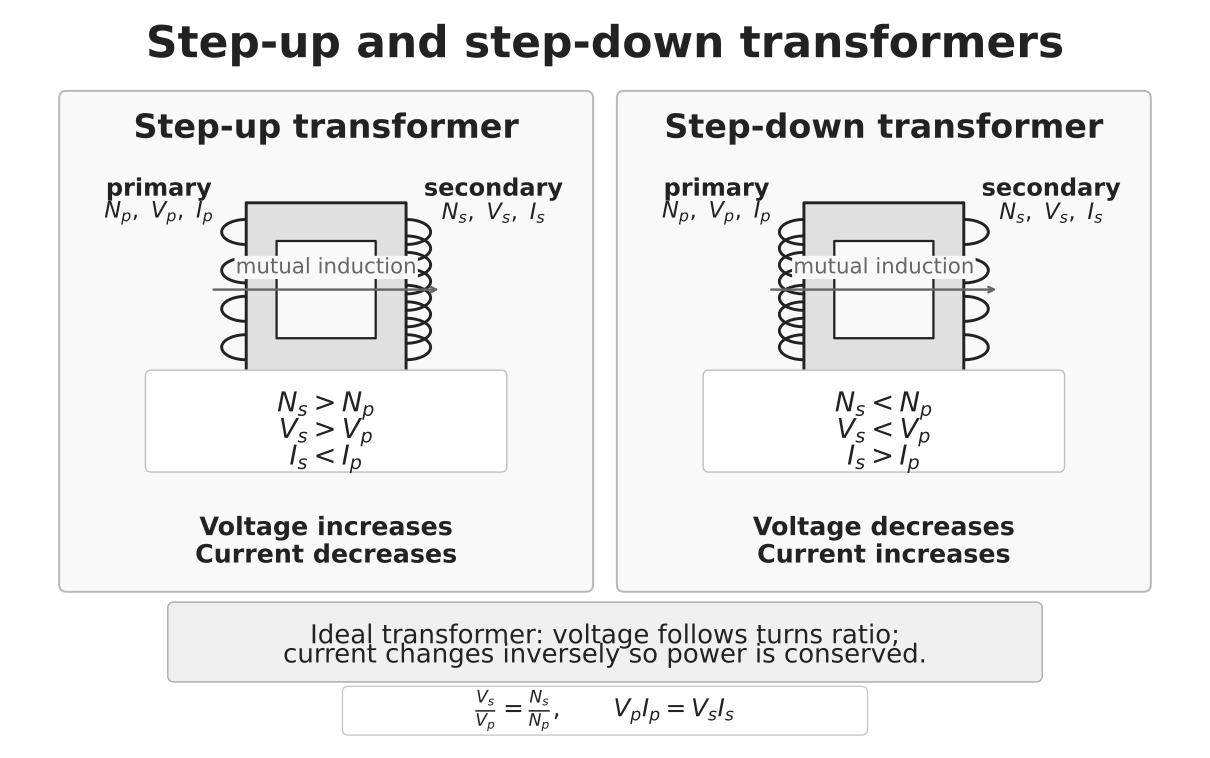
Figure: Compare the number of turns first, then infer the voltage. The inverse current comparison belongs to an ideal transformer transferring power to a load; it does not mean that an open secondary somehow carries current.
8. Why the current ratio is inverse
For an ideal transformer transferring power to a load,
Using rms quantities,
Hence
Therefore,
The current ratio is inverse because ideal power is conserved. If the voltage becomes five times larger, the current becomes five times smaller for the same transferred power.
Open-circuit distinction: if no load is connected, . A real primary may still draw a small magnetising current. The inverse current ratio is used for the ideal loaded-transformer model, not as a reason to invent a secondary current in an open circuit.
9. Worked examples
Example 1: turns and voltage only
A transformer has , and .
so
Since , this is a step-down transformer.
Example 2: voltage and load current
An ideal transformer changes to . A load draws from the secondary.
Output power:
For an ideal transformer, :
The voltage is multiplied by , while the current is divided by from primary to secondary.
Example 3: use one combined ratio carefully
If , then
but
The most common ratio error is to write simply because the secondary has more turns.
10. Core exam traps
| Mistake | Correction |
|---|---|
| “Current flows through the iron core.” | The windings are electrically isolated; the core links magnetic flux. |
| “Any DC input is transformed.” | Only changing flux gives continuous induced emf; steady DC gives none after the switching transient. |
| Reversing and | Match secondary with secondary and primary with primary. |
| Increasing both voltage and current | In an ideal loaded transformer, increasing voltage decreases current because power is conserved. |
| Treating and as peak values without checking | Transformer power and stated mains-type values normally use rms quantities unless specified otherwise. |
| Assuming a fixed phase difference without terminal markings | Relative polarity depends on winding direction and chosen terminals; use magnitudes unless the convention is specified. |
| Applying the inverse current ratio to an open secondary | An open secondary has ; the ideal current ratio describes loaded power transfer. |
11. Figure-led recap
Use each figure for one question:
- mutual-induction figure: How does primary AC cause secondary emf without electrical contact?
- Faraday-ratio figure: Why does voltage scale with turn number?
- step-up/step-down figure: Which side has the larger voltage and smaller loaded current?
12. Enrichment — beyond the explicitly named 9749 transformer outcome
The teacher anchor develops two useful applications beyond the minimum wording of outcome 18(e):
These branches are helpful for physical understanding and broader question contexts, but they should not obscure the core ideal-transformer outcome above.
Exam Relevance
For the explicit 9749 outcome, be able to describe the simple iron-core operating principle and apply the combined ideal-transformer ratio. In explanations, name the changing flux and electrical isolation; in calculations, keep primary quantities paired with primary and secondary with secondary, and use the inverse current ratio only for loaded ideal power transfer.
Formula summary
For an ideal transformer:
and, for loaded power transfer,