Thermistors and LDRs
Branch note: This page develops the sensor applications of Semiconductors and Diodes.
Overview
Thermistors and LDRs convert a physical condition into a resistance change. A potential divider then converts that resistance change into a measurable output p.d.
What you must know
For H2 Physics 9749, you should be able to:
- sketch and explain the current–voltage characteristic of an NTC thermistor;
- sketch the resistance–temperature characteristic of an NTC thermistor;
- state how an LDR’s resistance changes with illumination;
- explain how either sensor in a potential divider produces an output p.d. that depends on temperature or illumination.
The main skill is not memorising a list of circuit outcomes. It is determining the output trend from the circuit connections.
Core Ideas
- An NTC thermistor has lower resistance at higher temperature.
- An LDR has lower resistance at higher illumination.
- A potential divider output depends on which component is across the output terminals.
- The unloaded divider formula assumes the measuring device or following circuit draws negligible current.
1. Sensors convert a physical change into an electrical change
A resistive sensor is a component whose resistance changes when a physical condition changes. The two sensors here are:
| Sensor | Input condition | Required resistance trend |
|---|---|---|
| NTC thermistor | temperature | |
| LDR | illumination | illumination |
The resistance change can then be converted into a measurable voltage change by a potential divider.
2. NTC thermistor
A thermistor is a resistor whose resistance changes appreciably with temperature. In this syllabus, the usual device is an NTC thermistor, where NTC means negative temperature coefficient.
The word negative refers to the gradient of its resistance–temperature characteristic:
It does not mean that the resistance is negative. At every ordinary operating point,
Current–voltage characteristic
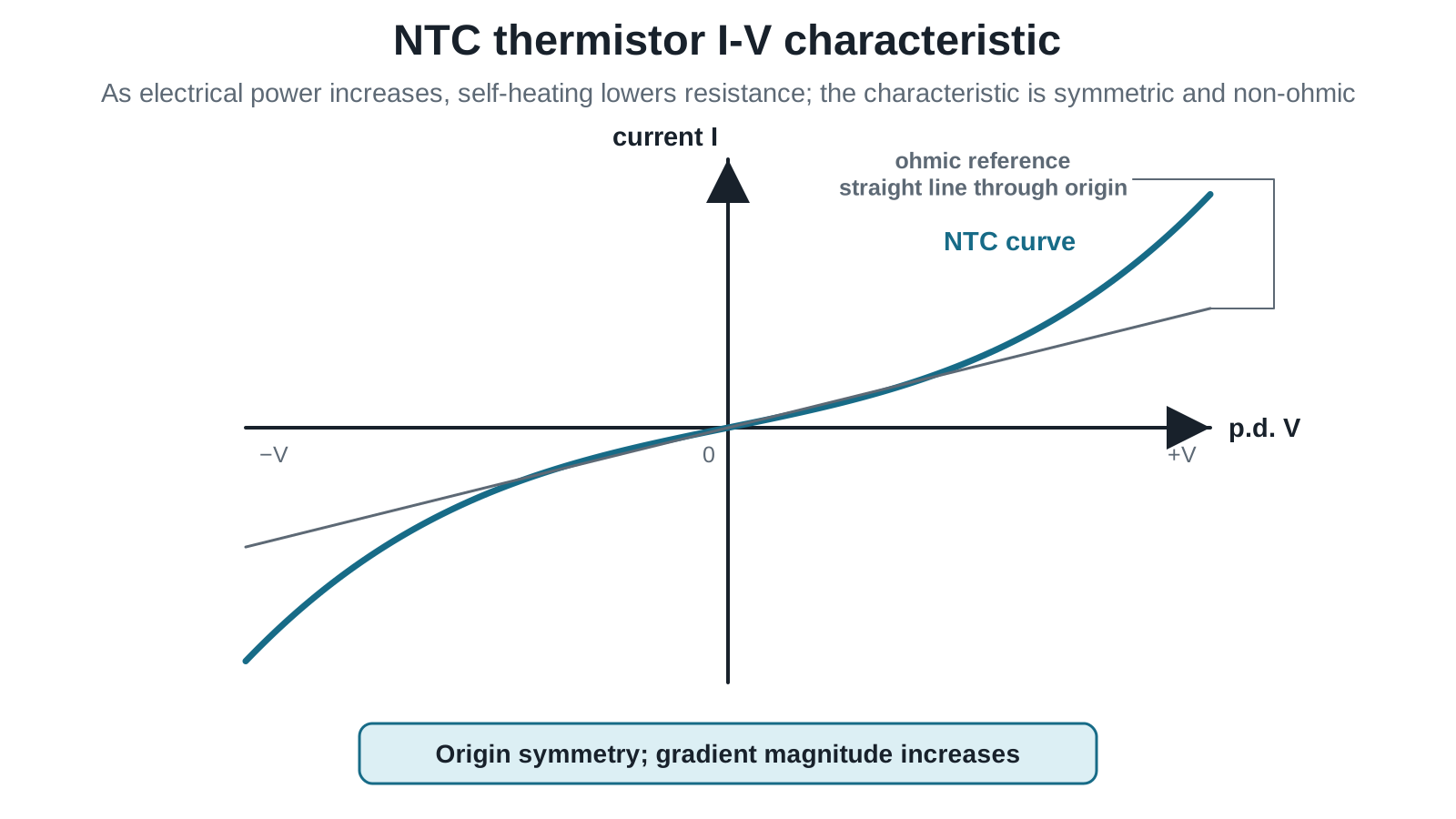
Figure: An NTC thermistor’s I–V characteristic is non-linear but symmetric about the origin. At larger , electrical self-heating raises its temperature and lowers its resistance, so grows more rapidly and the graph becomes steeper.
The curve passes through the origin and has the same shape for the two polarities because an ordinary thermistor has no preferred current direction. This differs fundamentally from the polarity-asymmetric diode characteristic.
At a fixed controlled temperature and over a sufficiently small range, a thermistor may be approximately ohmic. The familiar curved I–V characteristic arises because its temperature changes as the electrical power increases.
Resistance–temperature characteristic
This characteristic plots resistance on the vertical axis and temperature on the horizontal axis.
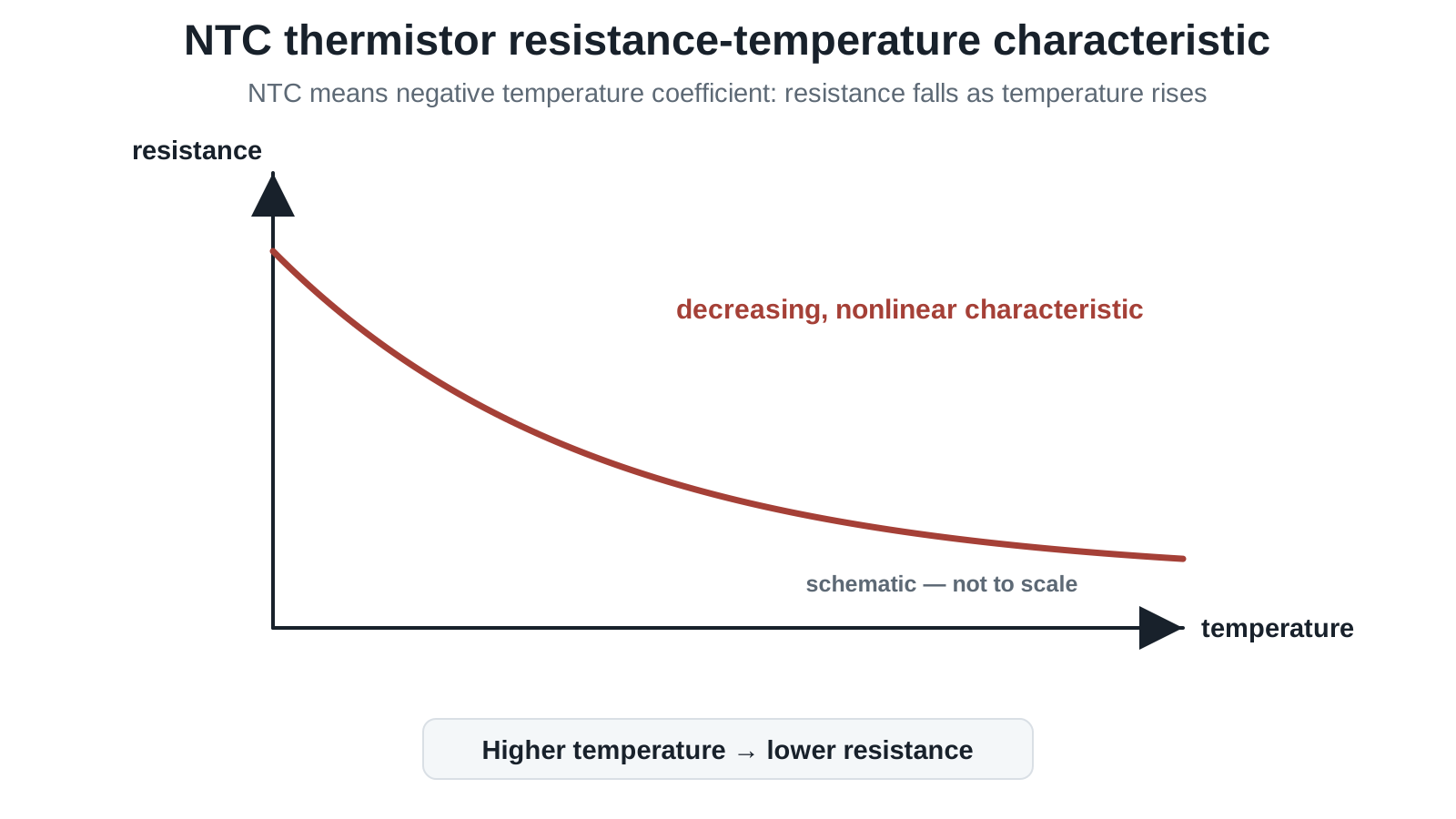
Figure: The resistance of an NTC thermistor decreases non-linearly as temperature increases. The exact numerical curve depends on the device, so the graph communicates the qualitative trend rather than a universal formula.
At low temperature, the resistance is relatively high. As temperature rises, more mobile charge carriers become available in the semiconductor, so its resistance falls. This carrier explanation is qualitative; a detailed microscopic band-theory treatment is not required.
Do not confuse these graphs
- An NTC current–voltage graph shows how self-heating makes vary non-linearly but symmetrically with .
- An NTC resistance–temperature graph shows how varies with temperature .
- A diode current–voltage graph is strongly polarity-asymmetric.
Both devices are non-ohmic, but their graphs answer different questions.
Comparison with a metallic conductor
For a metallic conductor over its usual operating range, increasing temperature normally increases resistance. An NTC thermistor shows the opposite trend because semiconductor carrier effects dominate.
3. Light-dependent resistor
An LDR is a resistor whose resistance depends on illumination.
In darkness its resistance is relatively high; in brighter conditions its resistance is lower. Incident light makes more mobile charge carriers available.
The syllabus requires the qualitative trend. Do not assume a particular straight-line or inverse mathematical law unless the question supplies one.
4. Potential-divider principle
Two resistors and are connected in series across a supply . If the output is measured across , then, assuming the voltmeter or following circuit draws negligible current,
This equation follows because the same current flows through series components:
The words across which component? are essential. A falling sensor resistance can make the output fall or rise, depending on where the output terminals are placed.
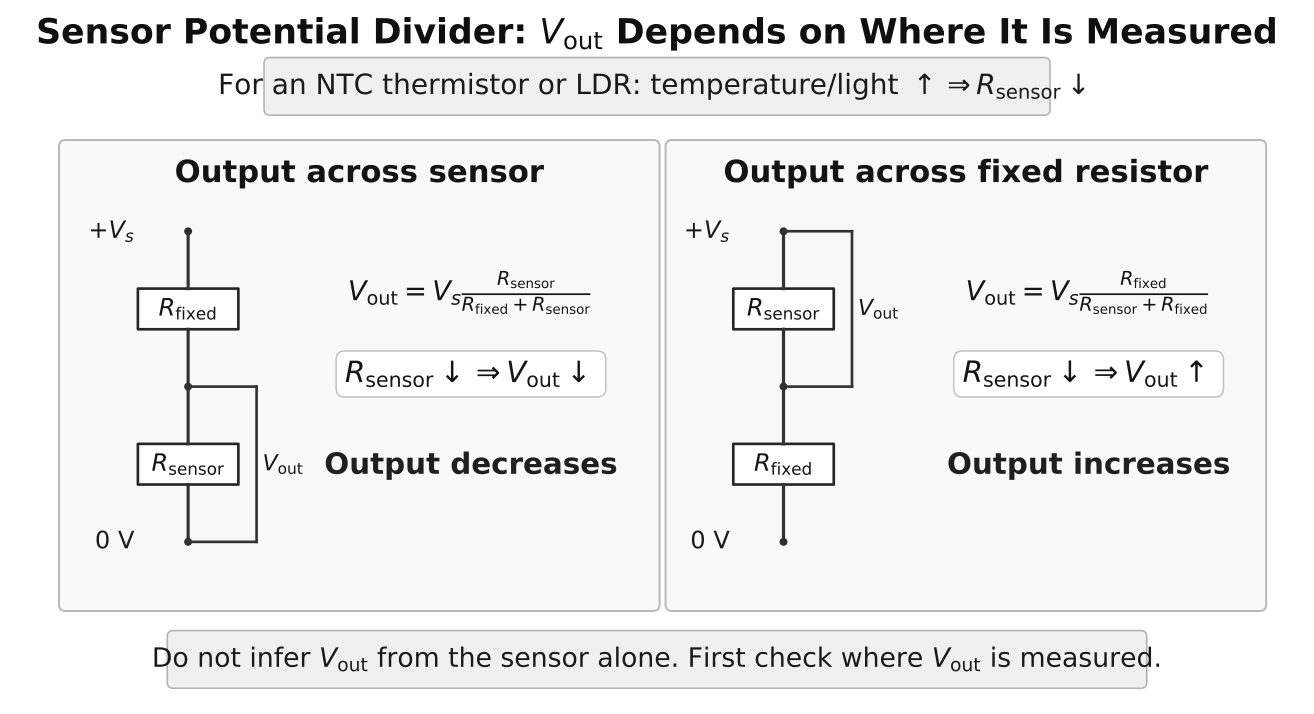
Figure: In the left arrangement, the output is measured across the sensor, so decreasing sensor resistance decreases its share of the supply p.d. In the right arrangement, the output is measured across the fixed resistor, so the same decrease in sensor resistance increases the fixed resistor’s share.
5. A reliable decision method
For every sensor-divider question:
-
Identify the physical change: temperature or illumination increases or decreases.
-
Convert it into a sensor-resistance change.
-
Mark the two output terminals and identify the resistance directly across them.
-
Write
-
Decide how the numerator and denominator change; calculate if values are provided.
This method is safer than memorising phrases such as “more light gives more voltage”, which are not true for every connection.
6. Worked example: output across the sensor
A fixed resistor and a sensor are connected in series across a supply. The output is measured across the sensor.
Initially :
After the sensor resistance falls to :
Therefore, when the resistance of the component across the output falls, its voltage share falls in this circuit.
7. Worked example: output across the fixed resistor
Use the same values, but measure the output across the fixed resistor.
Initially:
After the sensor resistance falls to :
Now the output rises. The physical sensor change is identical; only the chosen output changes.
8. Applying the reasoning
Temperature alarm using an NTC thermistor
Suppose the output is across the fixed resistor. When temperature rises,
The rising output could be compared with a switching threshold in a control circuit.
Automatic night light using an LDR
Suppose the output is across the fixed resistor. When the surroundings become darker,
If the required control voltage must instead rise in darkness, place the output across the LDR or use an appropriate later control stage. Always follow the actual circuit shown.
9. Loading and measurement assumption
The simple potential-divider expression assumes the measuring device or following circuit has a resistance much larger than the resistance across which it is connected. It then draws negligible current and does not significantly change the divider ratio.
If a load draws appreciable current, the load and the component across it form a parallel combination. The simple unloaded formula must then be modified. Detailed loaded-divider analysis is useful circuit enrichment, but is not normally the central sensor outcome here.
Common mistakes
- writing when temperature rises;
- assuming an LDR has low resistance in darkness;
- drawing a straight line for an NTC characteristic without justification;
- drawing the NTC I–V curve as one-way conduction like a diode;
- using the divider formula without identifying the component across the output;
- saying that the supply voltage is divided equally when the resistances are unequal;
- assuming the sensor alone determines the output trend;
- forgetting that a real connected load may alter the ideal divider result.
Exam method
A complete explanation usually follows this chain:
State each link explicitly. This makes the direction of change clear and earns more credit than giving only the final trend.
Exam Relevance
Most sensor questions test reasoning through a chain, not memorised outcomes. Identify the physical change, convert it to a resistance change, locate the output terminals, and then apply the divider ratio.
Links
Summary
An NTC thermistor has lower resistance at higher temperature, and an LDR has lower resistance at greater illumination. A potential divider converts that resistance change into a voltage change. The output trend is determined by the component across which the output is measured, so derive it from the circuit rather than memorising it.