1D Infinite Potential Well
Branch note: This page deepens one part of Quantum Physics.
Enrichment beyond 9749 Topic 19(a–o)
The infinite potential well, wavefunction normalisation and probability-density calculations are useful quantum-mechanics extensions, but they are not explicit syllabus outcomes. Study this note after mastering the core photon, duality, spectra, X-ray and uncertainty content.
Overview
The one-dimensional infinite potential well is a simple model of a quantum particle confined to a region of length .
It is often called the particle in a box model.
The model is artificial, but it is educationally important because it shows how confinement naturally leads to:
- wavefunctions
- probability density
- standing-wave boundary conditions
- quantised energy levels
- a non-zero lowest energy
It links directly to Quantum Physics, Wave-Particle Duality, and Uncertainty Principle.
Core Ideas
- A confined quantum particle is described by a wavefunction .
- The probability density is .
- The wavefunction must fit the boundary conditions at the walls.
- Only certain standing-wave patterns fit inside the box.
- Therefore only certain wavelengths, momenta, and energies are allowed.
- The wavefunction must be normalised so that the total probability of finding the particle somewhere in the well is 1.
- Stronger confinement gives more widely spaced energy levels.
Exam Relevance
This is an enrichment branch rather than explicit 9749 Topic 19 core. It is useful for deepening the ideas of quantisation, boundary conditions and probability density, but exam-facing revision should prioritise the core photon, photoelectric, de Broglie, line-spectrum, X-ray and uncertainty outcomes in Quantum Physics.
Enrichment learning goals
This extension is useful for conceptual explanation and graph interpretation. After studying it, you should be able to:
- explain why the energy levels are discrete
- sketch or interpret and for low-lying states
- state and apply the boundary conditions at and
- interpret as probability density
- use the normalised wavefunction where it is given or expected
- use to compare levels and calculate transition energies
Definition
In a one-dimensional infinite potential well:
- the particle is confined between and
- the potential energy is zero inside the well
- the potential energy is treated as infinitely large outside the well
This means the particle cannot be found outside the well.
Why It Matters
The infinite well is the cleanest example showing that quantisation can arise from wave behaviour plus boundary conditions.
The logic is similar to stationary waves on a string:
- fixed ends force nodes at the ends
- only certain wavelengths fit
- only certain modes are allowed
For a quantum particle:
- the wavefunction must satisfy the wall boundary conditions
- only certain standing-wave wavefunctions are allowed
- these give discrete energy levels
The important shift is that is not a physical displacement of the particle. It is a probability amplitude. Its square, , gives probability density.
Key Representations
Boundary Conditions
For an infinite well from to :
The wavefunction is zero at the walls because the particle cannot exist inside the infinitely high barriers.
For the same reason:
Inside the well, can be non-zero.
Allowed Standing Waves
Only standing waves with nodes at both walls are allowed.
The allowed wavelengths are:
where:
- is the quantum number
- is the length of the well
The first few modes correspond to:
| Quantum number | Pattern inside the well | Wavelength |
|---|---|---|
| half a wavelength fits | ||
| one wavelength fits | ||
| one and a half wavelengths fit |
Wavefunctions
For the standard infinite well, the allowed wavefunctions have the form:
where is a normalisation constant.
Each value of gives a different standing-wave shape. Higher states have more nodes inside the well and shorter wavelengths.
For the first three states:
- : no internal node; largest probability density near the centre
- : one internal node at
- : two internal nodes at and
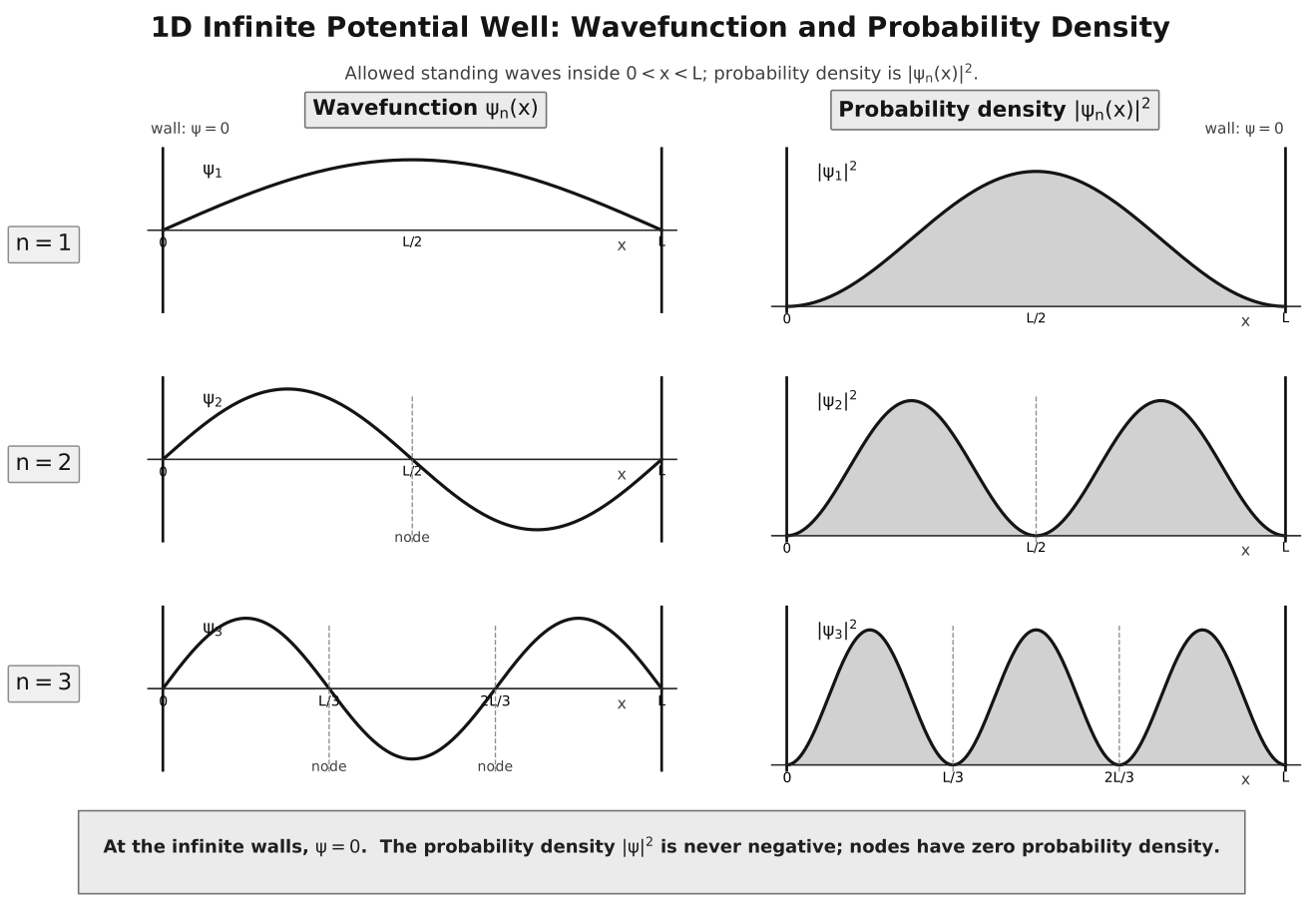
Figure: The first three infinite-well states show allowed standing-wave wavefunctions and their probability densities . Nodes of are positions where the particle is never detected.
Normalised Wavefunctions
The wavefunction must be normalised so that the particle is found somewhere in the well with total probability 1:
For the standard infinite well, the normalised wavefunctions are:
for:
and:
outside the well.
The factor ensures that the total area under the graph from to is 1.
Probability Density
The probability density is:
This tells where the particle is more likely to be detected.
Important:
- itself is not a probability.
- may be positive or negative.
- is always non-negative.
- Nodes of are positions where , so the particle is never detected there.
- The total area under the graph over the allowed region is 1.
For the normalised infinite-well states:
for .
Quantised Energies
Using de Broglie’s relation:
and the allowed wavelengths:
the allowed momenta have magnitudes:
For a non-relativistic particle:
so the allowed energies are:
where:
- is the mass of the particle
- is the well width
Meaning of the Energy Levels
The energy levels are not equally spaced because:
So:
The separation between higher levels becomes larger:
This is different from a system with equally spaced energy levels.
Ground State Is Not Zero Energy
The lowest allowed state is , not .
If , then:
everywhere. That would mean there is no particle in the well.
Therefore the minimum energy is:
This is called the ground-state energy.
The particle cannot have zero kinetic energy while confined in the well. This non-zero ground-state energy is consistent with the uncertainty principle: confinement in position requires uncertainty in momentum.
Transitions Between Energy Levels
If the particle changes between two allowed states, the energy change is:
Using:
gives:
If a photon is absorbed or emitted during the transition:
For absorption:
- the final state has higher energy
- the photon supplies the energy difference
For emission:
- the final state has lower energy
- the photon carries away the energy difference
Example: Transition from to
The energy difference is:
A photon absorbed in this transition must have:
Link to Uncertainty Principle
Confinement to a small length means the particle’s position is restricted.
Qualitatively:
- smaller means smaller position uncertainty
- smaller position uncertainty implies larger momentum uncertainty
- larger momentum uncertainty corresponds to larger kinetic energy scale
This agrees with:
When decreases, the allowed energies increase.
Common Exam Traps
1. Thinking the Particle Moves Like a Classical Ball
The model does not describe a ball bouncing between walls with a known position at every instant. It describes a quantum state using a wavefunction and probability density.
2. Treating as Probability
is the wavefunction or probability amplitude. The probability density is .
3. Ignoring Normalisation
The probability density must be normalised so that:
A graph of is not just a shape; its total area represents total probability.
4. Allowing
The quantum number starts from:
There is no energy state for a particle in the box.
5. Forgetting the Dependence
Energy levels scale as , not .
6. Forgetting the Well Width Dependence
Energy levels scale as:
Narrower wells give higher energy levels and larger spacing.
7. Confusing Nodes with Peaks
Where , the probability density is also zero.
However, positive and negative parts of both give positive probability density after squaring.
Short Worked Examples
Example 1: Allowed Wavelengths
A particle is confined in a well of width .
For :
For :
The second state has half the wavelength of the first state.
Example 2: Energy Ratio
Since:
then:
The third energy level is nine times the ground-state energy.
Example 3: Effect of Narrowing the Well
If the well width is halved:
Since:
the energy becomes four times larger for the same .
Example 4: Photon for a Transition
A particle moves from to .
The emitted photon energy is:
The photon frequency is:
Formula Summary
| Quantity | Formula | Meaning |
|---|---|---|
| Boundary conditions | , | The wavefunction is zero at the infinite walls. |
| Allowed wavelengths | Only standing waves fitting the box are allowed. | |
| Normalised wavefunction | Standard state inside the well for . | |
| Probability density | $ | \psi_n(x) |
| Normalisation | $\int_0^L | \psi_n(x) |
| Momentum magnitude | Follows from de Broglie relation. | |
| Energy levels | Energies are discrete and scale as . | |
| Transition energy | $\Delta E= | E_{n_f}-E_{n_i} |
| Photon relation | Links transition energy to photon frequency or wavelength. |
Summary
The one-dimensional infinite potential well shows how quantum confinement creates discrete states.
Core ideas:
- the particle is confined between two impenetrable walls
- the wavefunction must be zero at the walls
- only standing waves that fit the well are allowed
- the normalised wavefunction gives a probability density through
- allowed wavelengths lead to allowed momenta
- allowed momenta lead to quantised energies
- the ground-state energy is non-zero
- transitions between energy levels involve photons with