Uncertainty Principle
Branch note: This page deepens one part of Quantum Physics.
Core outcome 19(o)
For 9749 calculations and explanations, use the assessed order-of-magnitude form . Here and describe characteristic spreads or uncertainties, not ordinary measurement mistakes.
Overview
In classical physics, it is often assumed that a particle can have both:
- an exact position
- an exact momentum
at the same time.
Quantum physics shows that this is not generally possible for microscopic particles such as electrons.
This limitation is described by the uncertainty principle.
It is a fundamental idea in Wave-Particle Duality and Quantum Physics.
Core Ideas
- microscopic particles cannot generally be assigned exact position and exact momentum simultaneously
- reducing position uncertainty increases the minimum possible momentum uncertainty
- the limitation is fundamental, not merely due to poor instruments
- the idea is closely linked to the wave nature of matter
- uncertainty matters most when length scales are microscopic
Exam Relevance
Most H2 questions test qualitative interpretation rather than long calculations. Students should be able to explain the meaning of:
and avoid describing uncertainty as only an experimental disturbance effect.
Definition
The uncertainty principle states that there is a fundamental limit to the simultaneous precision with which certain pairs of quantities can be known.
For position and momentum:
where:
- = uncertainty in position
- = uncertainty in momentum
- = Planck constant
The symbol means “greater than or of the order of”. This syllabus relation is an order-of-magnitude estimate, not an exact equality.
Worked estimate
Suppose an electron is localised to a region of width
Then
For an electron of mass , the associated velocity spread is of order
The point is the scale: atomic localisation produces a substantial momentum spread.
Why It Matters
This principle explains why microscopic systems cannot always be described using classical trajectories and exact particle positions.
It helps explain:
- why matter waves are important
- why confinement affects particle momentum
- why atomic-scale behaviour differs from everyday mechanics
Key Representations
Qualitative Meaning
If the position of a particle is known more precisely:
- becomes smaller
then the uncertainty in momentum must increase:
- becomes larger
Likewise, if momentum is known very precisely, position becomes less certain.
This is not a calculation trick. It reflects the wave-like nature of matter.
Why This Is Not Due to Poor Apparatus Only
A common misconception is that uncertainty happens only because instruments are imperfect.
This is incorrect.
Even with ideal measuring devices:
- quantum particles are described by wavefunctions
- localisation of a wave packet naturally introduces spread in momentum
Hence uncertainty is a fundamental property of nature, not merely bad equipment.
Relation Between Position and Momentum
To confine a particle to a small region:
- the wavefunction must be narrow in space
A narrow spatial wave packet requires many wavelengths, hence many momenta, mixed together.
So momentum uncertainty increases.
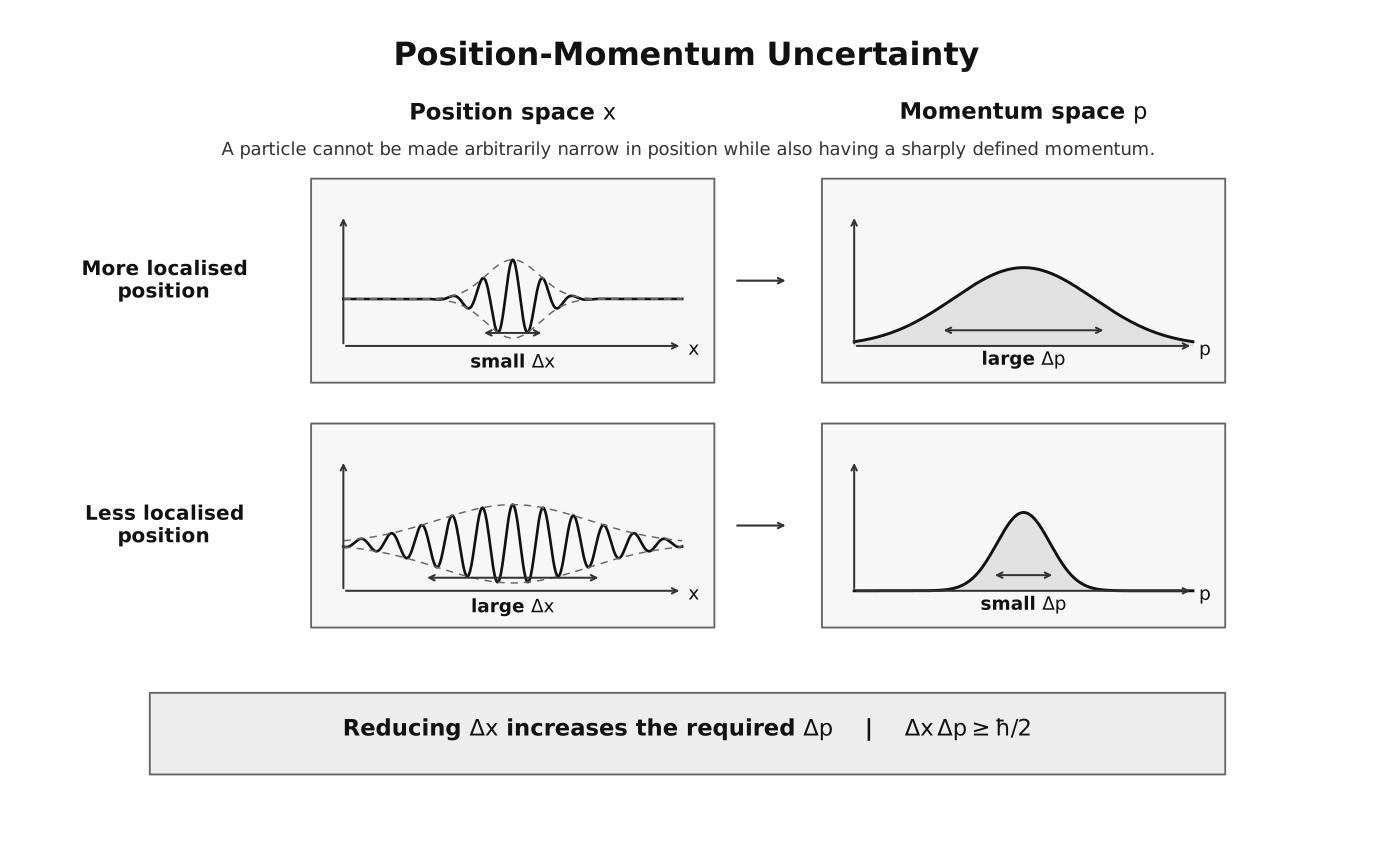
Figure: Both columns show non-negative probability-density distributions, so their widths represent comparable characteristic spreads. A more localised position distribution has smaller and is paired with a broader momentum distribution with larger . The lower row shows the converse. Probability-density language is visual enrichment; for 9749, the assessed conclusion is the order-of-magnitude relation .
If a particle has nearly one wavelength:
- momentum is well defined
but the wave extends over a large region, so position is uncertain.
Microscopic vs Macroscopic Significance
For electrons, atoms, and other tiny particles:
- is significant compared with their momentum scale
- uncertainty effects are important
For a ball or car:
- momentum is very large
- uncertainties are negligible in practice
So classical physics works well for macroscopic objects.
Confinement Increases Momentum Uncertainty
If an electron is trapped inside a very small region such as an atom:
- is small
Therefore:
- must be relatively large
This helps explain why electrons in atoms cannot simply remain motionless at the nucleus.
See Atomic Structure.
Common Misconceptions
1. “Anything Can Happen Because of Uncertainty”
Incorrect.
The principle sets a specific limit on simultaneous precision. It does not mean physics becomes random without rules.
2. “It Is Caused Only by Disturbing the Particle”
Measurement disturbance may matter, but uncertainty remains even in ideal quantum descriptions.
3. “Large Objects Are Highly Uncertain”
For macroscopic objects, uncertainty exists but is usually negligible.
4. “Exact Position Means Zero Momentum”
Exact position would imply very large momentum uncertainty, not zero momentum.
Summary
The uncertainty principle states:
Key ideas:
- precise position leads to uncertain momentum
- precise momentum leads to uncertain position
- this is fundamental, not just poor measurement
- it is very important for microscopic particles
- it is negligible for most everyday objects
It is a central concept in quantum mechanics.
Enrichment: more formal and time–energy forms
For standard deviations in a formal quantum treatment, one often writes
This convention is related to, but numerically different from, the syllabus’s order-of-magnitude relation. Do not substitute it for in a 9749 calculation.
The anchor material also introduces a time–energy uncertainty relation. Its meaning and interpretation require additional care and it is not an explicit Topic 19(a–o) outcome, so it is retained only as enrichment rather than a core calculation tool.