Atomic Structure
Repo topic versus official syllabus
Topic 25 is an internal wiki organisation, not a separate official 9749 syllabus topic. This note joins two assessed strands:
- Topic 19(k–m): discrete electronic energy levels, emission and absorption line spectra, and ;
- Topic 20(a): Rutherford -particle scattering evidence for the existence and small size of the nucleus.
Ionisation limits, the hydrogen value, classical-orbit stability, hydrogen series and lasers are retained later as Enrichment unless a question supplies the relevant model or data.
Overview
Atomic structure in this wiki connects two assessed ideas: Rutherford scattering evidence for a small dense nucleus, and discrete electronic energy levels that explain atomic line spectra.
Core Ideas
- Rutherford -particle scattering shows that positive charge and nearly all atomic mass are concentrated in a very small nucleus.
- Isolated atoms have discrete electronic energy levels.
- Upward photon absorption requires photon energy to match an allowed energy gap.
- Downward transitions emit photons with energies equal to the positive level differences.
- Emission and absorption line spectra are evidence for discrete atomic energy gaps.
- Ionisation limits, hydrogen formulae, named spectral series and lasers are enrichment unless supplied by the question.
First-Learner Checklist
By the end of the assessed sections, you should be able to:
- state the main observations from Rutherford scattering and infer the nuclear model from them;
- explain why rare large deflections require positive charge concentrated in a very small region;
- define isolated atom, discrete energy level, ground state, excited state, excitation and de-excitation;
- explain why a photon is absorbed only when its energy matches an allowed upward gap;
- explain how downward transitions produce photons and emission lines;
- distinguish how emission and absorption line spectra are produced;
- calculate photon frequency or wavelength using .
1. Essential Definitions
Atom
An atom is an electrically neutral system consisting of a positively charged nucleus with electrons outside it.
Nucleus
The nucleus is the very small central region of an atom in which its positive charge and nearly all its mass are concentrated.
Isolated Atom
An isolated atom is an atom whose interaction with neighbouring atoms is negligible. A low-density gas is a useful approximation because its atoms are far apart. The electronic energy levels are then well defined and give distinct spectral lines.
Discrete or Quantised Energy Level
A discrete electronic energy level is one of the specific allowed energies of an electron in an isolated atom. The electron cannot remain in a stationary state with an arbitrary energy between two allowed levels.
Ground and Excited States
- The ground state is the lowest allowed electronic energy state.
- An excited state is any allowed state above the ground state.
Excitation and De-Excitation
- Excitation: an electron gains energy and moves from a lower allowed level to a higher allowed level.
- De-excitation: an electron moves from a higher allowed level to a lower allowed level and loses energy.
2. Rutherford Scattering and the Nuclear Model
The Experiment
In the Rutherford–Geiger–Marsden experiment:
- a collimated beam of positively charged particles was directed at a very thin metal foil;
- a movable scintillation detector recorded the directions in which the particles emerged;
- the chamber was evacuated so that scattering by air molecules was minimised;
- the foil was thin so that most detected particles underwent at most one significant scattering event.
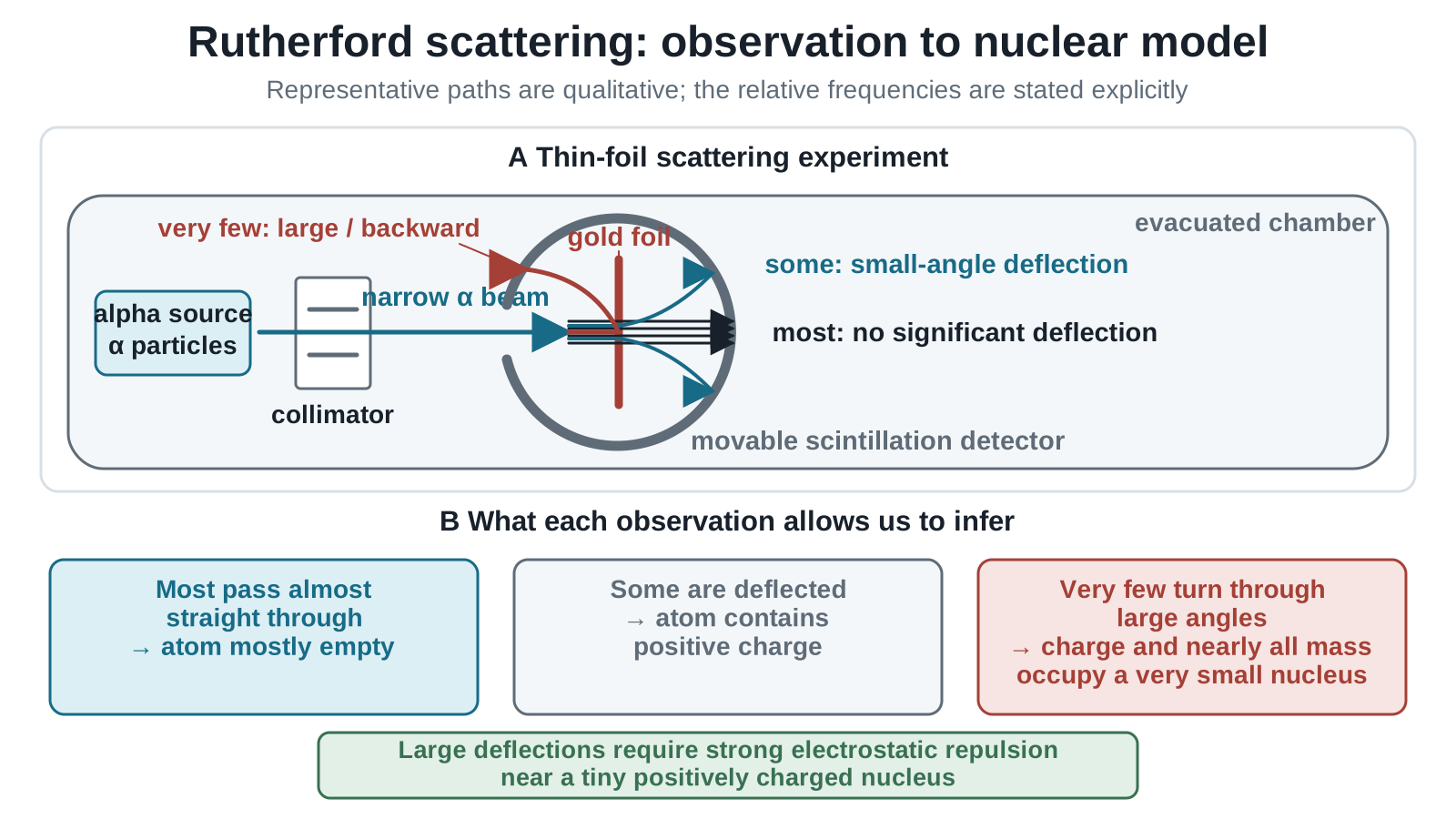
Figure: Rutherford evidence must be read as observation followed by inference. Most particles pass through with little or no deflection, so the region capable of producing a strong force occupies a very small fraction of the atom. Rare large-angle deflections and backscattering require intense Coulomb repulsion from positive charge concentrated in a compact nucleus.
Observation-to-Inference Reasoning
| Experimental observation | Physical reasoning | Inference about the atom |
|---|---|---|
| Most particles passed straight through or were deflected only slightly. | Most trajectories did not pass close enough to a concentrated charge to experience a large transverse force. | The nucleus occupies a very small fraction of the atomic volume; most of the atom does not contain matter dense enough to cause strong scattering. |
| A small proportion were deflected through large angles. | A large change in momentum requires a large impulse. Because the particle and nuclear charge are both positive, close approaches produce strong Coulomb repulsion. | Positive charge is concentrated in a compact nucleus rather than spread throughout the atom. |
| A very small number were deflected backwards. | Reversing the forward momentum of a fast, relatively massive particle requires an exceptionally strong repulsive encounter with a compact, massive region. | The nucleus is extremely small compared with the atom and contains nearly all the atomic mass. |
Why Electrons Cannot Explain the Large Deflections
Atomic electrons are negatively charged and far less massive than an particle. They cannot provide the strong repulsive force or large momentum reversal needed to explain backscattering. The rare large-angle events therefore point to a concentrated positive nuclear charge.
Why a Diffuse Positive-Charge Model Fails
If positive charge were spread throughout the atom, an particle would experience many weak forces rather than the occasional very large repulsive force observed. Such a model cannot account for rare backscattering.
Exam-answer structure
Write observation → force or momentum reasoning → inference. Do not write only “the atom is mostly empty space” without tying it to the scattering evidence.
3. Discrete Electronic Energy Levels
Official Topic 19(k) states that isolated atoms have discrete electronic energy levels. Draw an energy-level diagram with energy increasing vertically.
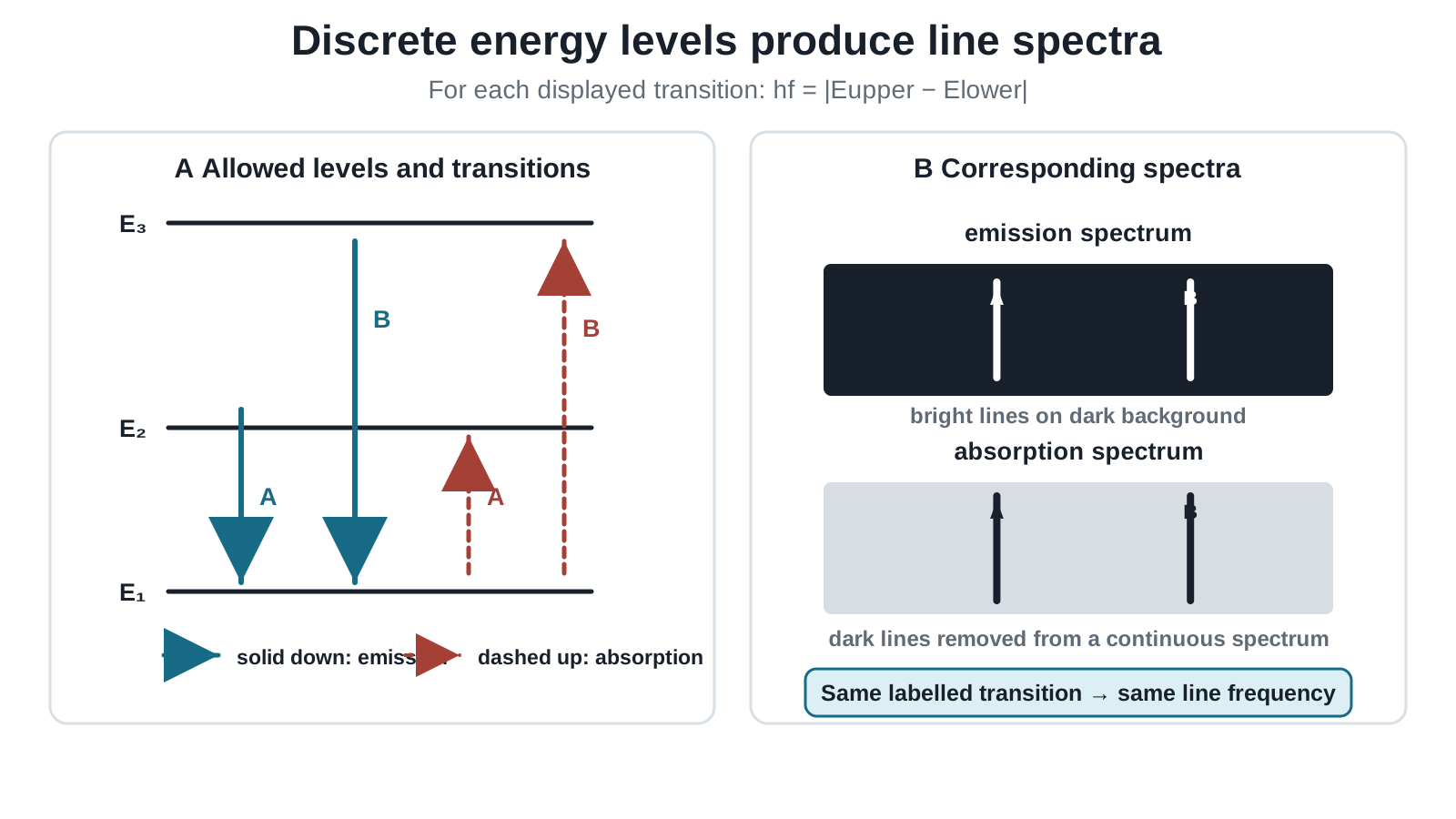
Figure: Horizontal lines represent allowed electronic energies . An upward arrow represents excitation by absorption; a downward arrow represents de-excitation and photon emission. Each displayed gap gives one photon frequency through , and corresponding upward and downward transitions have the same line position.
How to Read an Energy-Level Diagram
- The vertical position represents energy, not the electron’s physical distance from the nucleus.
- A horizontal line represents an allowed energy, not a physical orbit or path.
- A larger vertical separation represents a larger energy gap.
- An electron in a stationary state occupies an allowed level; it does not remain between levels.
Upward Transitions: Excitation
For a transition from lower level to higher level ,
Excitation by photon absorption
A single photon is absorbed only if its energy matches the allowed gap exactly:
A photon with a non-matching energy is not partly absorbed to leave the electron between levels.
Excitation by collision
A fast incident particle may transfer some of its kinetic energy to the atom. Its initial kinetic energy must be sufficient for the transition, but its complete kinetic energy does not have to equal the gap exactly because the incident particle can retain kinetic energy after the collision.
Downward Transitions: De-Excitation
For a transition from higher level to lower level , the atom loses energy and emits one photon:
Equivalently, for any transition direction, the photon-energy magnitude is
Photon energy is always positive.
Frequency and Wavelength
Using ,
Therefore:
- larger energy gap higher frequency;
- larger energy gap shorter wavelength.
4. How Emission and Absorption Line Spectra Are Produced
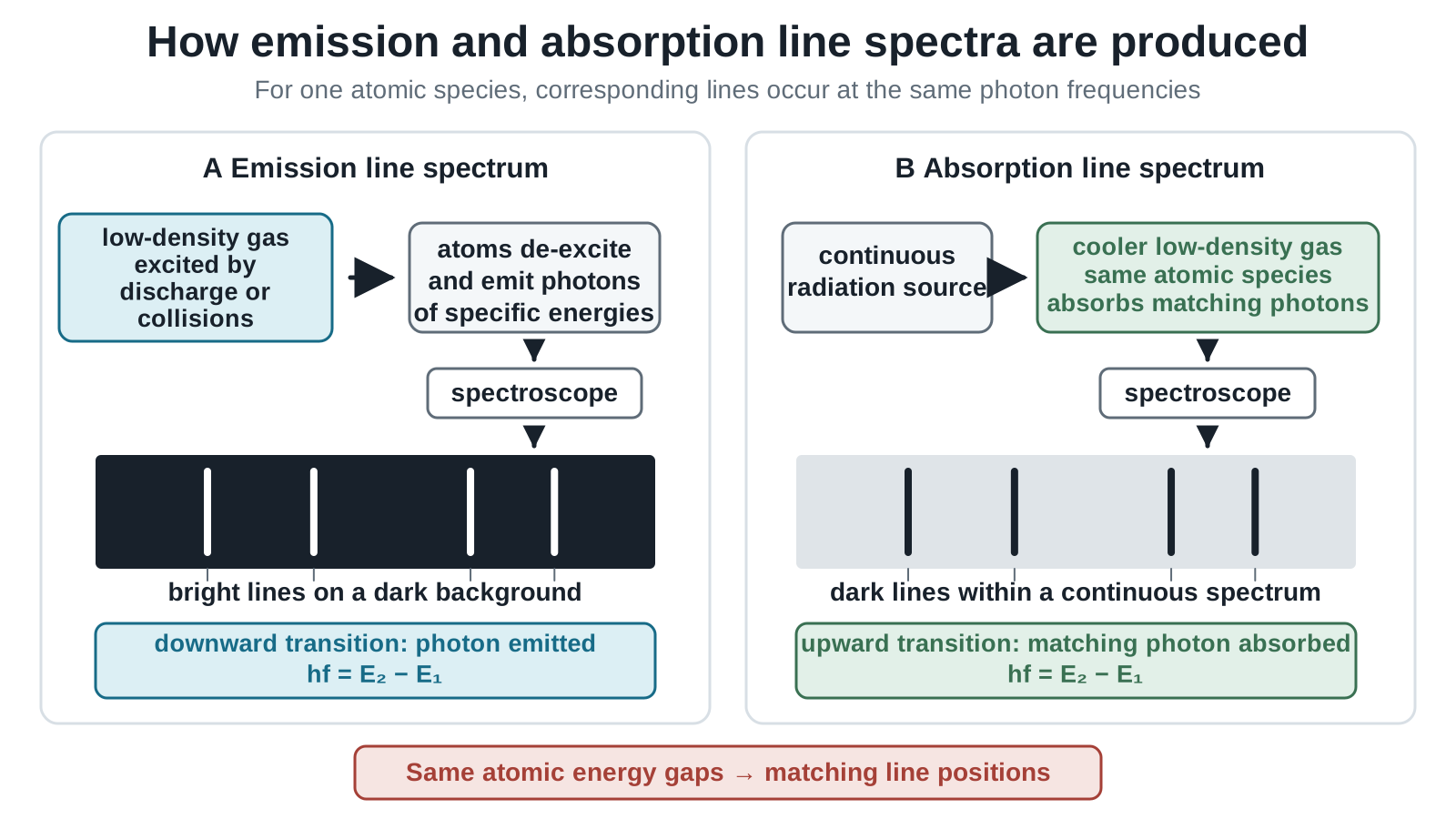
Figure: An excited low-density gas emits selected photon wavelengths, producing bright emission lines on a dark background. When continuous radiation passes through a cooler low-density gas, photons matching allowed upward gaps are absorbed and later re-emitted in many directions, leaving dark absorption lines in the forward continuous spectrum.
Emission Line Spectrum
Production condition: atoms in a low-density gas are excited, commonly by an electrical discharge or collisions.
Sequence:
- collisions transfer energy to the atoms;
- electrons move to higher allowed levels;
- the excited states are unstable;
- electrons de-excite through allowed downward transitions;
- each transition emits a photon with .
Appearance: discrete bright lines on a dark background.
Absorption Line Spectrum
Production condition: radiation with a continuous range of wavelengths passes through a cooler, low-density gas.
Sequence:
- the incident beam contains a continuous range of photon energies;
- atoms absorb photons whose energies match allowed upward gaps from occupied lower levels;
- the excited atoms later re-emit photons in many directions;
- fewer photons of those frequencies continue in the original forward direction.
Appearance: dark lines within a continuous spectrum.
Direct Comparison
| Feature | Emission spectrum | Absorption spectrum |
|---|---|---|
| Source arrangement | excited low-density gas acts as the source | continuous radiation passes through cooler low-density gas |
| Transition responsible | downward | upward absorption, followed by later re-emission |
| Appearance | bright lines on dark background | dark lines in a continuous background |
| Line energy |
For the same atomic species, corresponding upward and downward transitions have the same energy gap. Their absorption and emission lines therefore occur at the same frequency or wavelength. The complete observed line sets need not be identical if the initially populated states differ.
Why Lines Are Evidence for Discrete Levels
Each line corresponds to one photon frequency and hence one photon energy . If electron energies were continuous, arbitrary energy changes and a continuous range of photon energies would be possible. Discrete spectral lines therefore provide evidence that only particular electronic energy differences are allowed.
5. Worked Examples
Use
Example 1: Emitted Photon Frequency and Wavelength
An isolated atom has two allowed levels
Find the frequency and wavelength of the photon emitted when an electron moves from to .
Step 1: Find the positive energy gap
Step 2: Use
Step 3: Use
The emitted wavelength is approximately .
Example 2: Which Photon Can Be Absorbed?
An atom initially in its ground state has levels
Two photons have energies and . Which photon can excite the ground-state atom?
Allowed upward gaps from are
and
Therefore, the photon can be absorbed for the transition. The photon matches neither allowed gap, so it is not absorbed in this bound-level model.
Example 3: Rutherford Explanation in Exam Form
Observation: most particles pass through the thin foil with little or no deflection.
Inference: the region causing strong scattering occupies a very small fraction of each atom, so the nucleus is very small compared with the atom.
Observation: a very small proportion are deflected through large angles or backwards.
Reasoning: such a large momentum change requires a large impulse; close approach to concentrated positive charge gives strong Coulomb repulsion.
Inference: the atom’s positive charge, and nearly all its mass, are concentrated in a compact nucleus.
6. Common Assessed Mistakes
Mistake 1: Treating an Energy-Level Line as an Orbit
An energy-level diagram represents allowed energies, not the electron’s path or physical height.
Mistake 2: Using the Final Level as Photon Energy
Photon energy is the difference between levels:
Mistake 3: Allowing Partial Photon Absorption
One photon is absorbed as a whole only when matches an allowed upward gap.
Mistake 4: Swapping Spectrum Conditions
- excited low-density gas emission lines;
- continuous radiation through cooler low-density gas absorption lines.
Mistake 5: Giving Rutherford Conclusions Without Evidence
Always connect the observed scattering frequency and angle to force, impulse or momentum change before stating the inference.
Check scope before following the concept link
The linked diagnostic concept note includes substantial enrichment beyond official 9749 Topic 19(k–m), including hydrogen-specific formulae, named spectral series and line-count shortcuts. Treat those parts as extension material unless the required model, levels or data are supplied in a question.
In particular, counting all possible downward transitions assumes that the relevant upper levels have been populated and that every counted transition is allowed and observable. Actual spectral lines also depend on initial-state populations and experimental conditions.
See Atomic Structure Common Exam Traps for further diagnostic practice.
7. Enrichment Beyond the Explicit Outcomes
Enrichment: Why the Classical Orbit Picture Fails
A classical planetary model imagines electrons continuously orbiting the nucleus. An orbiting charge accelerates and, classically, should radiate energy, lose orbital energy and spiral inward. Stable atoms and discrete spectra therefore cannot be explained by the Rutherford nuclear model plus ordinary classical orbits alone.
At 9749 level, the assessed replacement is the existence of discrete allowed electronic energy levels. A full quantum-mechanical account of atomic stability is beyond Topic 19(k–m).
Enrichment: Bound-State Energy and Ionisation Limit
A common energy convention chooses
for a free electron at rest very far from the nucleus. Bound states then have negative energy. The minimum energy needed to remove a bound electron is the increase from its initial negative energy to the ionisation limit at zero.
Negative energy does not mean “impossible energy”; it means energy must be supplied to free the electron under this chosen reference.
Enrichment: Hydrogen Values
For the simple hydrogen model,
The ground-state energy is , so the ground-state ionisation energy is :
The levels approach as . This formula, the Lyman/Balmer/Paschen series and line-count shortcuts are useful enrichment unless they are supplied or explicitly required by the active course context.
Enrichment: Lasers and Spectroscopy Applications
- Element identification: each atomic species has characteristic energy gaps and hence a characteristic line pattern.
- Astronomy: absorption and emission lines help identify elements in stars and gases.
- Lasers: stimulated emission, together with population inversion and optical feedback, can produce coherent radiation. Detailed laser operation is beyond the explicit Topic 19(k–m) outcomes.
- Fluorescence and discharge lamps: excitation followed by de-excitation produces characteristic radiation.
Exam Relevance
Assessed Core from Topic 19(k–m)
- explain that isolated atoms have discrete electronic energy levels;
- deduce that discrete gaps produce spectral lines;
- distinguish emission from absorption line spectra;
- solve transition problems using .
Assessed Core from Topic 20(a)
- infer the existence and small size of the nucleus from Rutherford -particle scattering results.
Enrichment on This Page
- classical-orbit stability discussion;
- ionisation-limit and negative-energy convention;
- hydrogen and ;
- named hydrogen series, lasers and wider applications.
For the remainder of official Topic 20, continue to Nuclear Physics.
Summary
Assessed Core
- Most particles undergo little deflection, while rare large deflections reveal a very small, positively charged nucleus.
- Isolated atoms have discrete electronic energy levels.
- Upward photon absorption requires .
- A downward transition emits one photon with energy equal to the positive level difference.
- Excited low-density gas produces emission lines.
- Continuous radiation passing through cooler low-density gas produces absorption lines.
- Spectral lines provide evidence for discrete electronic energy gaps.
Enrichment
- Classical orbit models do not explain stable atoms.
- Negative bound-state energies are measured relative to the ionisation limit.
- Hydrogen’s ground-state ionisation energy is in the simple hydrogen model.
- Lasers and spectroscopy extend the energy-level framework into applications.
Links
Scope of the linked concept notes
The two linked atomic-structure concept notes contain substantial enrichment beyond official 9749 Topic 19(k–m), including hydrogen-specific energy formulae, named spectral series and line-count methods. Treat those sections as extension material unless the required model, levels or data are supplied in a question.
A shortcut such as counting all possible downward transitions assumes that the stated upper levels have actually been populated and that every relevant transition is allowed and observable. A real spectrum also depends on initial-state populations, permitted transitions and experimental conditions; do not infer a line count from the number of drawn levels without stating these assumptions.